
Quick Answer: A B2B SaaS website redesign is worth doing when your positioning, product or buyer has changed so much that the pages that produce demos no longer work. If those pages still convert, a refresh of copy, layout and AI readiness usually beats a rebuild.
Key points covered in this article:
Five signs your SaaS site needs a redesign
Redesign vs refresh vs rebuild, side by side
A Keep-Fix-Kill URL map built from your data
What a 2026 site needs for AI search
A B2B SaaS website redesign should start from the pages that already bring in demos, not from a new homepage design. Most redesign briefs begin with how the site looks. The ones that pay back begin with which URLs carry pipeline today.
For a VP marketing or founder, the trigger is usually an event. A new round, a new ICP or a rebrand makes the site feel wrong, and sales starts sending a deck instead of a link.
G2's April 2026 research found that 51% of B2B software buyers now start research with an AI chatbot more often than with Google. So the new site must work for buyers and for the engines that summarise it. This guide shows how to decide the scope, protect pipeline and brief the work, alongside our B2B SaaS CRO services.
TL;DR
A B2B SaaS website redesign pays back only when the pages that produce demos have stopped working.
Most VP marketing teams need a refresh of copy and structure, not a full rebuild.
Map every URL to Keep, Fix or Kill using Search Console and GA4 before design starts.
Protect pricing, demo and comparison pages first, because they carry most of the pipeline.
Brief the new site for AI search readability as well as for human buyers.
Pick a partner who reports demos after launch, not only design sign-off.
What are the signs a B2B SaaS website needs a redesign?
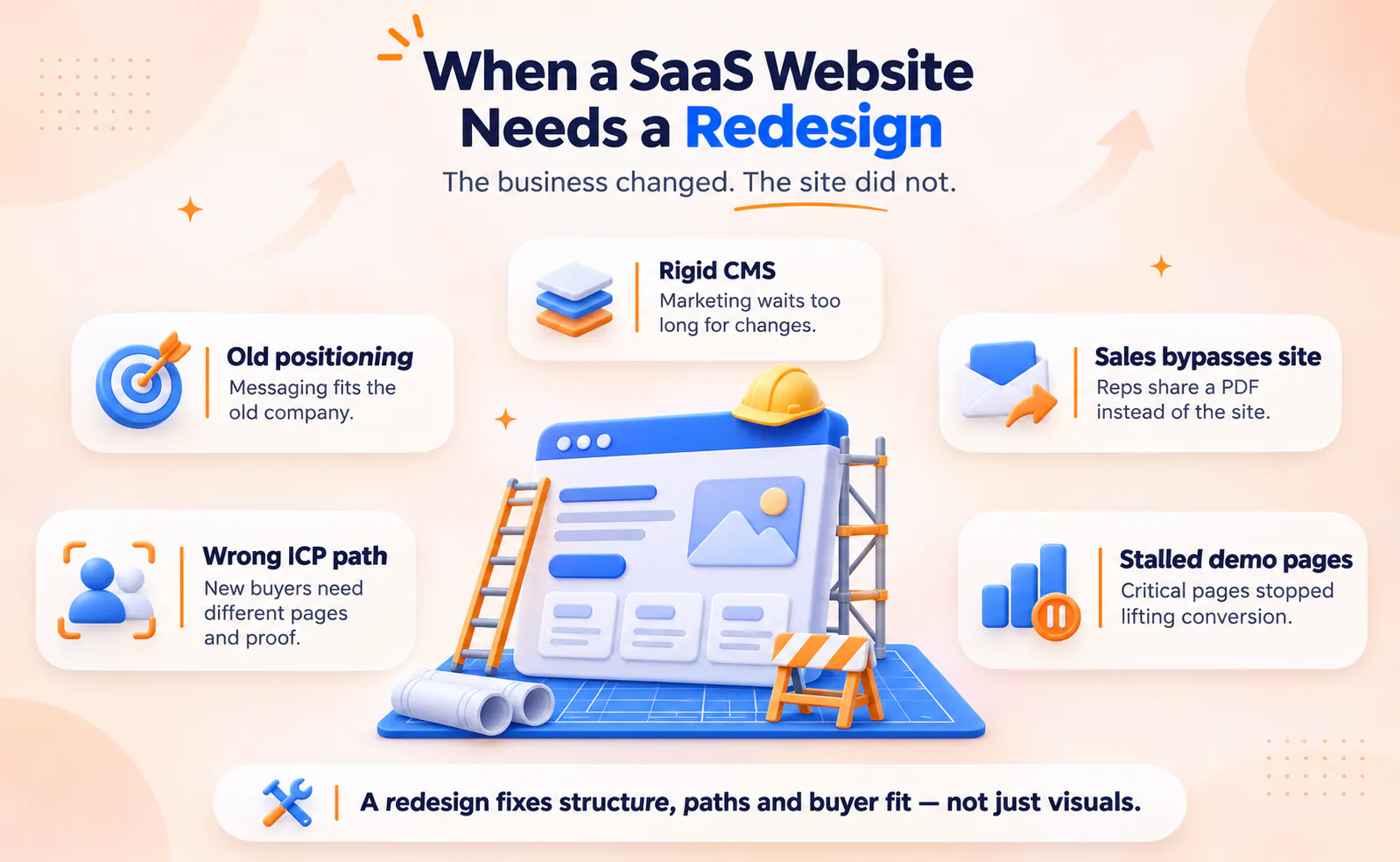
A B2B SaaS website needs a redesign when the site no longer describes what you sell, who you sell to, or how buyers can start. Looks alone are a weak reason. Five signs point to a real redesign rather than a refresh.
The positioning changed. You moved from a point tool to a platform, or from SMB to mid-market, and the homepage still describes the old company. Copy patches across 40 pages rarely fix that.
The ICP changed. A new buyer, such as a CFO instead of an ops manager, needs different pages, proof and paths. The old menu was built for someone else.
The CMS blocks marketing. Every landing page needs a developer ticket on WordPress or a custom stack. Marketing waits weeks for changes that should take hours.
Sales stopped sending the link. Account executives share a PDF because the site does not answer the buyer's first questions. That is the clearest signal you will get.
Demo and pricing pages underperform for a year. If CRO tests on those pages have stopped moving the rate, the structure around them may be the cause.
If none of these apply, the site probably needs a refresh. The next section explains why that is the more common answer.
Do most B2B SaaS teams need a website redesign, or a refresh?
Most B2B SaaS teams need a refresh, not a full website redesign. A rebuild changes URLs, templates and content at once, and that puts the pages that already produce demos at risk. Rebuild only when those pages are the problem.
The usual brief: "the site looks dated, let's redesign it." The agency proposes new branding, new templates and a new CMS in one project. Six months later, the site looks better and organic demo requests are down, because 30 ranking URLs changed and half the redirects were missed.
The better brief: name the number the project must move, such as demo requests from organic, then change the least that could move it. Often that is copy, page structure and the paths into pricing and demo pages. Our Home Page Playbook covers that kind of refresh.
"A redesign that ships on time and loses the pages that produced demos is a failed project with a very good-looking homepage."
What we see across our B2B SaaS work: the pages worth protecting are rarely the ones the leadership team looks at. They are old comparison posts and alternatives pages that quietly bring in a third of the demos.
If you are about to redesign but nobody has listed which pages produce demos today, start there. |
Redesign vs refresh vs rebuild: which does your B2B SaaS site need?
A refresh changes copy and layout inside the current site, a redesign changes templates and structure, and a rebuild changes the platform as well. Each step up adds risk to rankings and pipeline. The table shows how they differ.
Factor | Refresh | Redesign | Rebuild |
What changes | Copy, layout, CTAs, proof | Templates, menus, page types | Platform, URLs, templates, content |
URL risk | Low, URLs stay | Medium, some URLs move | High, most URLs move |
Typical trigger | Weak conversion on key pages | New ICP or positioning | CMS blocks marketing |
SEO involvement | Light review | From the sitemap stage | From day one |
Time to results | Weeks | One to two quarters | Two quarters or more |
Choose the smallest column that fixes the sign you found above. If two signs point to different columns, the larger column wins, but it still needs the URL map below.
Before a B2B SaaS website redesign, how do you decide what to keep? Build a Keep-Fix-Kill URL map
The Keep-Fix-Kill URL map sorts every page on your site into three groups using Search Console, GA4 and your CRM, before anyone opens a design file. Keep pages carry pipeline and survive untouched, Fix pages have demand but convert poorly, and Kill pages have neither.
Export every URL. Combine your sitemap, a crawl and Google Search Console's page report, so orphan pages are included.
Add three numbers per URL. Search Console impressions, GA4 sessions and demo requests or key events over the last 12 months.
Mark Keep. Any URL with demo requests or with ranking demand for buying terms. These keep their URL, content and internal links.
Mark Fix. URLs with impressions but low conversion. These get new copy, proof and CTAs in the new design.
Mark Kill. URLs with no impressions, sessions or demos. Merge them into a stronger page and add a one-to-one 301.
A worked example from our own site: when we crawled and inspected all 87 thirdmeta.in URLs in October 2026, 77 were indexed. The other 10 included posts caught mid-migration, a redirect error and a redirect loop. A redesign launched on top of that would have hidden those faults until traffic dropped, which is why the map comes first.
Our SEO audit services guide explains how to turn the Fix and Kill lists into tickets with owners. Each ticket should name the URL, the owner and the done-when.
If you cannot say which of your URLs produce demos, the redesign brief is not ready yet. |
What should a 2026 B2B SaaS website have for AI search?
In 2026, a B2B SaaS website should be readable by AI engines as well as by buyers, because many buyers now meet your brand inside an AI answer first. That changes three parts of the brief. Each one is cheap to add before launch and expensive after it.
Answer-first page structure
Pricing, comparison and use-case pages should open with a plain answer, then expand. AI engines quote the first clear statement they find. A hero section with only a slogan gives them nothing to quote.
Structured data and clean metadata
Add schema for your organisation, product, FAQs and breadcrumbs in the templates, not page by page. The Web Almanac's 2025 SEO chapter found meta descriptions on only 67.7% of desktop pages. A redesign is the cheapest moment to fix basics like that.
Pages AI engines are allowed to read
Check that robots.txt, JavaScript rendering and gated content do not hide your best pages from AI crawlers. Semrush's 2025 study found the average AI search visitor is 4.4 times as valuable as the average visit from traditional organic search. Our guide on how to rank in Google AI Overviews covers the page-level detail.
These three items belong in the design brief. That way the templates carry them by default.
How long does a B2B SaaS website redesign take, and what drives the cost?
A refresh usually takes weeks, a redesign one to two quarters, and a rebuild longer, and the cost follows scope rather than page count. The questions below cover what moves both.
What makes a redesign run late?
Content arrives late, and approvals pass through too many people. Design waits for copy, development waits for design, and launch waits for everyone. Name one approver and a content deadline before the first workshop.
What drives the cost up?
Custom templates, a CMS migration, many integrations such as HubSpot forms and product signup, and a large URL inventory. Each adds work that page counts do not show. Visual identity work, if needed, is a separate cost again.
Should you redesign and migrate the CMS at the same time?
Only if the CMS is the reason for the redesign. Changing platform and design together makes any traffic drop harder to trace. Where possible, migrate first, check the numbers, then redesign.
If your redesign estimate looks large, the URL map often shows which half you can skip. |
How do you choose a B2B SaaS website redesign partner?
Choose a B2B SaaS website redesign partner by what they promise after launch, not by their portfolio alone. A strong partner commits to protecting the Keep pages and to a demo number 90 days after launch. Four questions separate them quickly.
Who owns SEO, and from when? The answer should be "from the sitemap stage", not "before launch".
What happens to our URLs? Ask to see their redirect process and how they test it.
How will you measure success? Look for demo requests and conversion on key pages, not only design sign-off.
Who writes the copy? Design without finished copy is the most common reason redesigns stall.
A partner who cannot answer these is selling a design project, not a pipeline project. Our demo page playbook lists the page elements to check in any proposal.
Why Should You Choose ThirdMeta?
Teams usually come to us after a quote from a design studio or a Webflow agency that covers templates and branding but not rankings or demos. ThirdMeta runs the redesign as a pipeline project: SEO, copy, CRO and AI readiness in one team.
A Keep-Fix-Kill URL map built from your Search Console, GA4 and CRM data
Redirect plans tested before launch, so ranking pages keep their demand
Copy written for buyers and for AI answers on pricing, demo and comparison pages
CRO on the pages that matter, with demo requests as the success number
Post-launch reporting on demos for 90 days
For eFax, our signup funnel redesign produced 3x signups and cut drop-off by half. We do not do logo or visual identity work, so if the brand itself needs rebuilding, hire a design studio for that part.
vs design studios: we protect rankings and measure demos, not only visual sign-off.
vs Webflow and WordPress build agencies: we bring SEO and copy into the sitemap stage.
vs in-house rebuilds: we add the URL map and redirect testing teams often skip.
If a redesign is on this year's plan, see your Keep-Fix-Kill map before you commit. Book a pre-redesign review with ThirdMeta.
Conclusion
A B2B SaaS website redesign succeeds when it protects the pages that already produce pipeline and changes the ones that do not. The scope should come from your data, not from how dated the homepage feels, and most teams find a refresh does more for less risk.
Start with the URL map, then decide the scope, then brief the design. Teams that work in that order launch a site that looks new and keeps its demand, with templates ready for AI search from day one. For the conversion side of the project, our B2B SaaS CRO services page explains how we test key pages.
Frequently Asked Questions
Your SaaS website needs a redesign when positioning, ICP or CMS have changed. Looking dated is a weaker reason. If demo and pricing pages still convert, refresh instead.

Technical Content Strategist