

Quick Answer: Content marketing for technology companies is the practice of building educational, non-pitch content, blogs, whitepapers, and case studies, that bridges complex technical specifications and real customer problems to earn trust over a long buying cycle.
Most B2B tech content now gets written the same way: a marketer briefs a writer, the writer runs it through the same AI tools every competitor is also using, and the result could run on any company's blog with a find-and-replace on the logo. Content Marketing Institute's 2025 research found 81% of B2B content teams used generative AI in 2024, but only 19% had built it into a structured daily workflow. That gap is exactly where generic content comes from.
TL;DR
Most B2B tech content is interchangeable because it comes from the same generic process
Real differentiation comes from technical insight, not from a better-written brief
Thought leadership works only when it's sourced from actual engineers and users
Content has to map to a real buyer journey, not just exist at every funnel stage
Proof-of-value content (case studies, data) converts better than opinion pieces
The agencies that get this right interview engineering and support, not just marketing
What Is Content Marketing for Technology Companies?
Content marketing for technology companies means building educational, non-pitch content, blogs, whitepapers, case studies, and technical documentation, that bridges the gap between complex product specifications and the real-world problems customers are trying to solve.
Done well, it establishes trust and thought leadership across a decision-making cycle that's often too long for a single sales conversation to carry alone.
Why Most Content Marketing Agencies Fail Tech Companies?
Most content marketing agencies fail tech companies because they interview a marketing stakeholder once, write from that single conversation, and never touch the people who actually know why the product works the way it does. The result reads competently and says nothing a competitor couldn't also claim.
A generic brief produces generic thought leadership, regardless of how good the writer is
The real technical insight sits with engineers, support teams, and sales calls, not marketing
AI tools make it faster to produce content that sounds right and proves nothing
A case study without real numbers is an opinion piece wearing a data costume
Two competitors in the same category often end up with nearly identical case study structures, because both agencies interviewed the same kind of marketing stakeholder using the same template
An agency that never talks to your engineers is writing about your product from memory of every other product in the category.
“Content that could run on any competitor’s blog isn’t thought leadership. It’s proof nobody talked to your engineers.”
Tired of case studies that read like a testimonial with a logo swapped in? See how we source content your competitors can't replicate.
Core Strategies for Tech Content Marketing
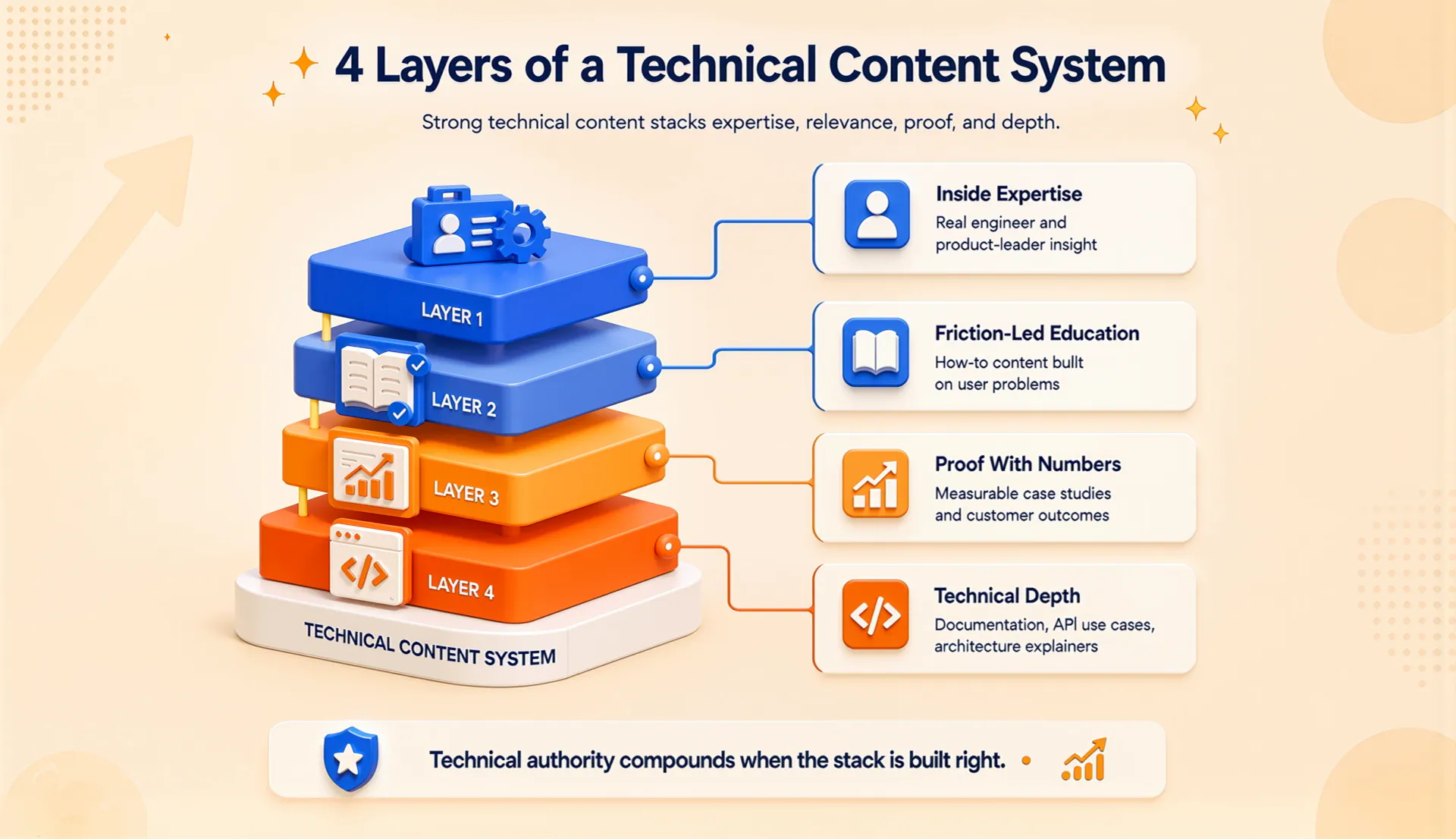
Thought leadership sourced from the inside. Publish insights, technical opinions, and trend analysis from actual engineers and product leaders, not from a marketer paraphrasing a press release.
Educational assets built on real friction. How-to guides, glossaries, and FAQs that solve the specific problems your product's actual users hit, not generic category education.
Proof of value with real numbers. Data-heavy case studies, and customer results, not just testimonial quotes with no measurable outcome attached.
In-depth technical content for technical buyers. Documentation, API use-case breakdowns, and architecture overviews written for CTOs who will read past the first paragraph.
Publishing on schedule but not seeing the pipeline move? See what content built from real technical insight looks like.
A Practical Framework for Building Your Content Program
Turning these strategies into a working program comes down to four steps, run in order.
Audit who actually holds the insight. Identify which engineers, support leads, and account managers know the details a generic writer never will.
Build a recurring interview cadence. A single interview produces one article. A standing monthly conversation produces a pipeline of material with real depth.
Assign every piece a buyer stage before writing starts. Decide what job the content is doing before a single word gets drafted, not after.
Review performance against pipeline, not traffic. Revisit the plan quarterly using outcome data, not vanity metrics, and cut what isn't working.
Mapping Content to the Buyer's Journey
Content that exists everywhere in the funnel at once usually isn't built for any specific stage.
Stage | Goal | Best Formats |
Awareness | Educate and build initial credibility | Technical blogs, guides, industry reports |
Consideration | Prove real expertise and value | Whitepapers, webinars, detailed case studies |
Decision | Remove the final objections | Demos, free trials, side-by-side comparison guides |
Matching format to stage matters more than publishing volume. A brilliant whitepaper aimed at someone still in the awareness stage gets skipped, not read.
“A brilliant whitepaper aimed at the wrong stage doesn’t underperform. It goes unread.”
How to Tell If Your Content Marketing Is Actually Working?
Most tech companies measure content by traffic and shares, then wonder why none of it shows up in the pipeline. The right metrics tie back to the buyer stage a piece was actually built for, not to vanity numbers that look good in a monthly report.
Awareness content should be measured by qualified traffic and return visits, not raw pageviews
Consideration content should be measured by time spent and whether it gets shared internally within a buying committee
Decision-stage content should be measured against demo requests and sales-assisted conversions, since that's the job it was built to do
A piece of content with high traffic and zero pipeline influence isn't succeeding, it's just popular
If a piece of content can't be traced to a stage-specific outcome, it's not clear what job it was actually doing.
Common Content Marketing Mistakes to Avoid
Most tech companies don't fail at content marketing from a lack of effort. They fail from a handful of repeatable mistakes that show up across the same category, quarter after quarter.
Publishing volume over publishing insight. A weekly content calendar with nothing new to say produces more content, not more pipeline.
Skipping the technical review. Content that never passes an engineer's eyes before publish risks losing credibility the moment a technical buyer spots an inaccuracy.
Treating every asset as top-of-funnel. A whitepaper written to convert a decision-stage buyer gets ignored by someone who's still in the awareness stage, and vice versa.
No distribution plan beyond the blog. Content that only lives on the company blog reaches a fraction of the buying committee a distributed version would reach.
Measuring the wrong things. Traffic and social shares look good in a report and say nothing about whether the content moved a deal forward.
How ThirdMeta Is Different?
If your last case study read like a testimonial with a logo attached, that's exactly the gap our content practice is built around. We don't write from a single marketing brief; we pull technical insight directly from engineering, support tickets, and sales calls before a draft ever starts.
Sourced from the product team, not around it. Engineers and support staff get interviewed, not just marketing.
Proof-of-value by default. Every case study ships with real numbers, not just a quote and a logo.
Buyer-stage discipline. Every asset is built for one specific stage, not stretched to cover all three.
Stage-specific measurement. Content gets tracked against the outcome it was built for, not a single traffic number applied to everything.
Across recent engagements, clients using this model have cut CAC by as much as 38 percent. See how we source content your competitors literally can't replicate, because they don't have access to your product's real technical story.
This isn't the right fit for a team that wants high-volume, generic blog posts on a fixed schedule regardless of whether there's a real insight behind each one.
Ready to see what content built from your actual engineering team looks like? Get a sample built from your product's real technical story.
Conclusion
Content marketing for technology companies earns its category by drawing on real technical insight, not by running the same AI-assisted process every competitor is also running. Generic thought leadership is easy to spot and easy to skip.
Choosing the right approach means asking where the content's actual insight comes from before a single piece gets drafted. That question decides whether your content sounds like your company, or like every other vendor in the category.
Frequently Asked Questions
It's building educational, non-pitch content, blogs, whitepapers, and case studies, that bridges technical product complexity and real customer problems to build trust over a long buying cycle.

Brand Manager
Vinaya Jain is a Brand Manager with expertise in content strategy, brand positioning, SEO, and digital growth. At ThirdMeta, she focuses on building research-driven content and marketing strategies that help businesses improve visibility, strengthen brand authority, and connect with the right audience. Her work combines consumer insights, search behaviour, and strategic storytelling to turn complex marketing challenges into clear, actionable growth opportunities.