
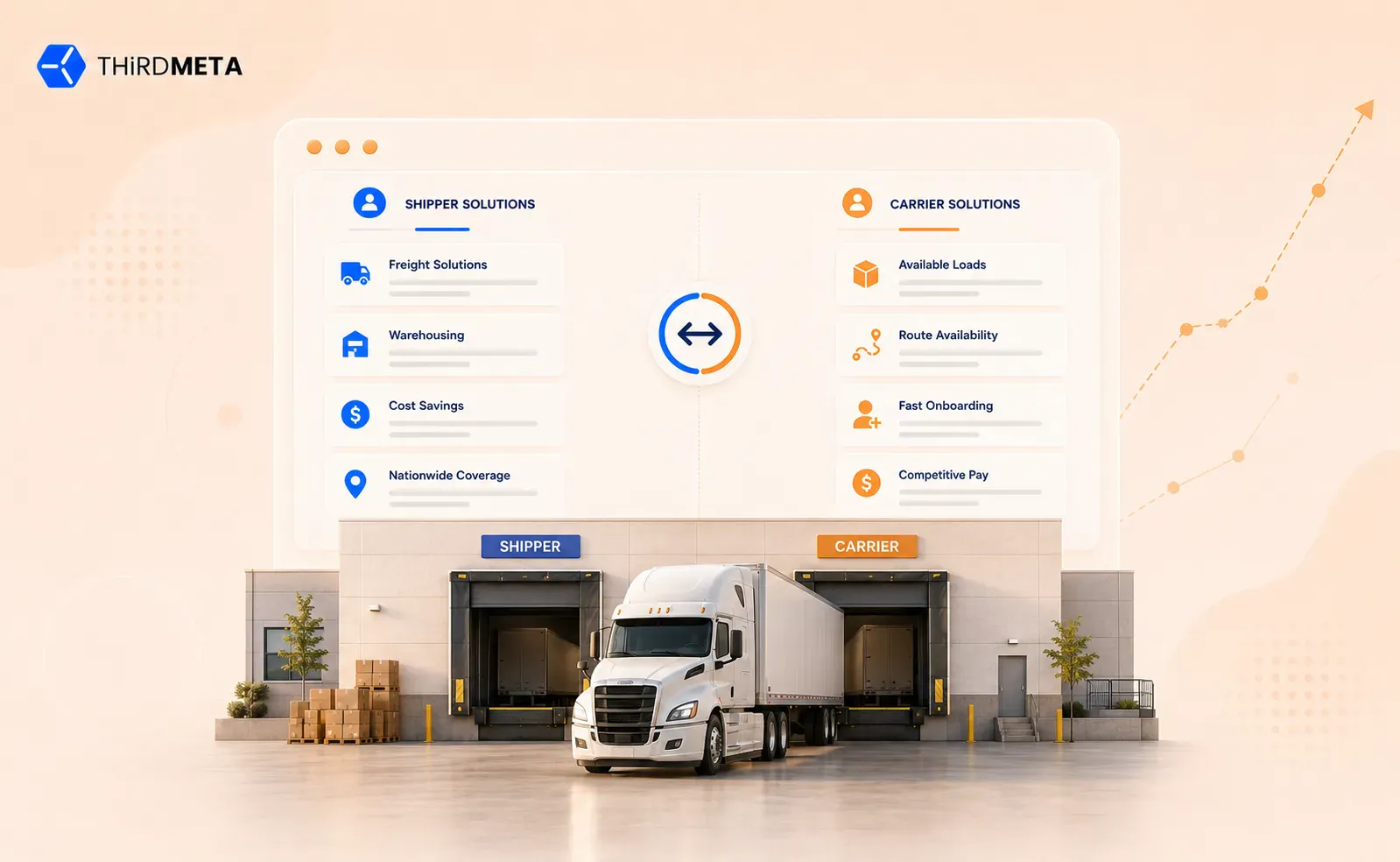
“A shipper doesn’t care how good your trucks are until they trust your website enough to fill out the form.”
Quick Answer: Digital marketing for logistics companies is the practice of building SEO, paid, content, and nurture programs that help freight, warehousing, and 3PL providers win both shipper clients and carrier or driver capacity, not just one side of the business.
McKinsey's B2B Pulse research found that buyers now use an average of ten channels across the purchasing journey, and confirms this holds true specifically in transport and logistics. Most logistics marketing still runs on two or three channels built for a single audience, which is exactly why so much of it underperforms.
TL;DR
Logistics companies often market to shippers and carriers at once, not one buyer type
A single generic funnel usually serves neither audience well
Agentic AI in supply chain software is reshaping how shippers evaluate providers
SEO, PPC, content, and ABM all need a role, not just one channel run in isolation
Reputation and reviews carry outsized weight since word-of-mouth still drives 3PL selection
Implementation order matters more than channel count
What Is Digital Marketing for Logistics Companies?
Digital marketing for logistics companies means building SEO, paid search, content, and nurture programs that help freight, warehousing, and 3PL providers attract corporate shipping clients and, often separately, the drivers or carrier capacity needed to move that freight. It differs from general B2B digital marketing by having to serve two buyer types that rarely respond to the same message.
Why Digital Marketing Is Different for Logistics Companies
Digital marketing works differently for logistics because most providers are running two businesses under one brand: winning shipper clients who need capacity, and recruiting drivers or carriers who need freight. A campaign written for a supply chain director reads as noise to an owner-operator, and the reverse is just as true.
A shipper-facing landing page talks about reliability, coverage, and cost savings
A carrier-facing page talks about load volume, pay terms, and route availability
Blending both into one homepage message usually undersells both audiences
Recruiting campaigns need entirely separate funnels, not a shared contact form
Most digital marketing agencies build for one audience and treat the other as an afterthought.
Still running one homepage trying to talk to both a shipper and an owner-operator? See how we build separate lanes for each audience.
What Has Changed in Logistics Marketing Heading Into 2026
The biggest shift is how fast agentic AI is moving into the supply chain software shippers already use. Gartner projects 60 percent of enterprises using supply chain management software will adopt agentic AI features by 2030, up from just 5 percent in 2025. That software increasingly surfaces and evaluates provider options directly inside the platform, before a shipper ever runs a manual search.
That means visibility now has to exist in two places at once: traditional search and the AI-driven evaluation layer sitting inside procurement and TMS software. A provider optimized only for Google rankings is invisible inside that second layer entirely.
Not sure if your content even shows up inside a shipper's TMS evaluation? Get a quick AI-visibility check for your logistics brand.
Strategies for Digital Marketing in Logistics
Search engine optimization. Target high-intent, trade-lane and service-specific terms, not broad category keywords that mostly attract browsers.
Content and proof marketing. Publish data-backed case studies and operational guides that prove cost and reliability claims, since logistics buyers evaluate on evidence, not adjectives.
Pay-per-click advertising. Use targeted search ads to capture urgent shipper demand or niche freight requirements the moment they search.
LinkedIn and account-based marketing. Reach named decision-makers, supply chain directors, procurement heads, operations VPs, directly rather than running broad awareness campaigns. See our account-based marketing approach for the mechanics.
Review and referral funnels. Automate post-onboarding follow-up to collect reviews, since word-of-mouth and third-party validation still heavily influence 3PL selection.
Running all five channels but still can't tell what's actually working? See how we tie logistics marketing spend to real pipeline.
Implementation: What to Get Right First
Sequencing matters more than trying to run every channel simultaneously from day one.
Build separate landing pages for shipper acquisition and carrier or driver recruitment before spending on ads to either
Fix the technical foundation, mobile usability and page speed, since a slow site loses both audiences equally
Stand up review and reputation management early, since it compounds over time
Layer in ABM and content once the foundational pages exist, not before
How Much Should Logistics Companies Budget for Digital Marketing?
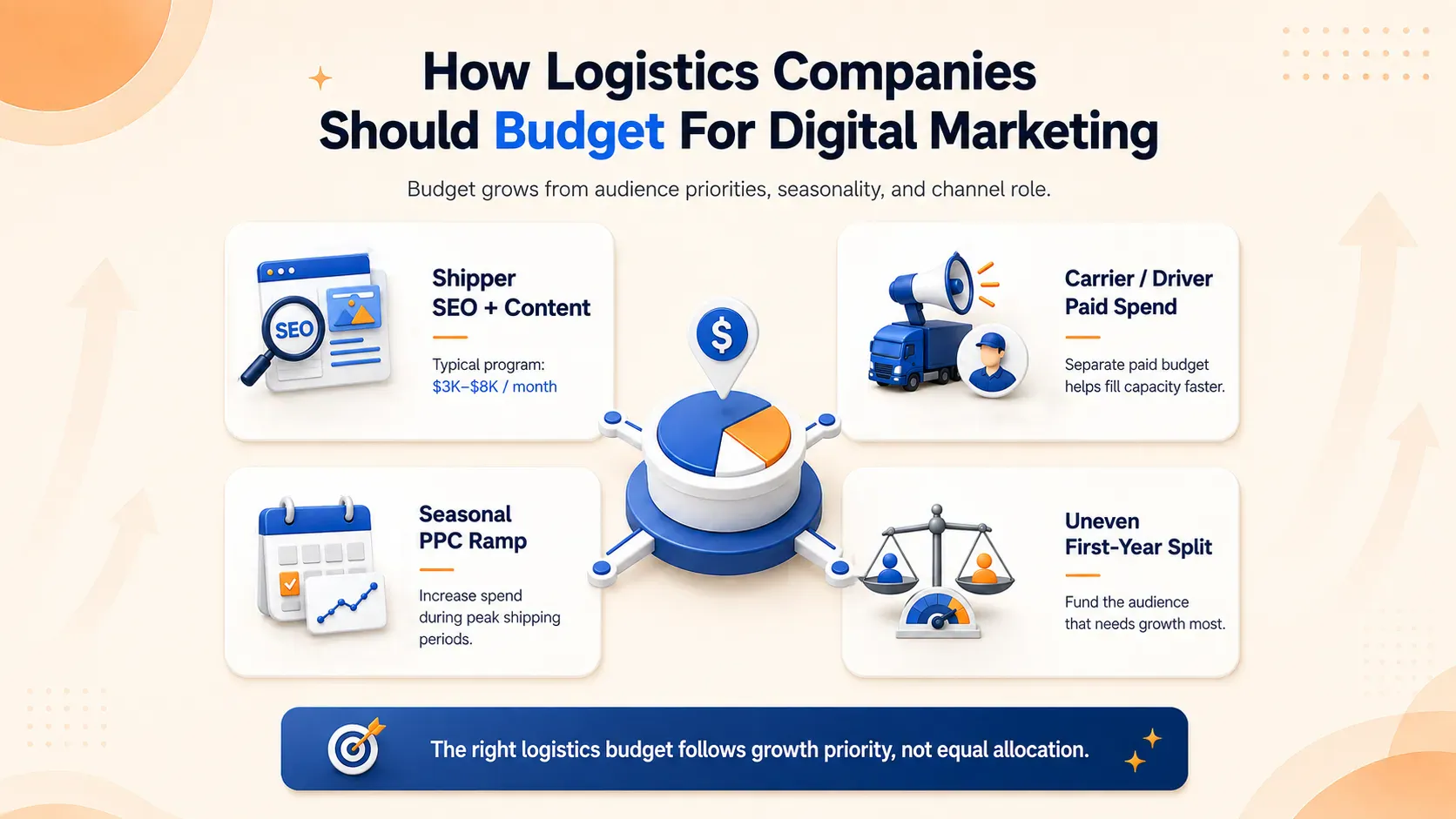
Budget questions come up before strategy questions, and the honest answer depends on which audience needs to grow first.
Shipper-focused SEO and content programs typically run $3,000-$8,000 a month for a mid-market provider
Carrier and driver recruitment campaigns often need separate paid spend, since organic alone rarely fills capacity fast enough
PPC budgets should track seasonal urgency, ramping up during peak shipping seasons rather than staying flat year-round
A realistic first-year budget usually splits unevenly toward whichever audience needs growth most, not evenly across both
How Long Until Digital Marketing Generates Results for Logistics Companies?
Results timelines differ sharply by channel, and setting the wrong expectation is one of the fastest ways to kill a program before it works.
Paid search can generate qualified shipper inquiries within the first few weeks
SEO for trade-lane and service-specific terms typically takes 3-6 months to show meaningful movement
Carrier recruitment campaigns often move faster than shipper acquisition, since the buying decision is simpler
Reputation and referral programs compound slowly but keep paying off long after the initial campaign ends
Why Work With ThirdMeta on Logistics Digital Marketing
If your marketing serves shippers well and carrier recruitment as an afterthought, or the reverse, that's exactly the gap our logistics practice is built around. We build separate, purpose-built funnels for each audience instead of one generic site trying to do both jobs.
Dual-funnel architecture. Shipper acquisition and carrier recruitment run as distinct programs, not a shared contact form.
AI-visibility built in. Content and structured data built to surface inside AI-driven procurement layers, not just traditional search.
Proof-first content. Case studies and data-backed guides instead of generic reliability claims.
Across recent engagements, clients using this model have cut CAC by as much as 38 percent. See how we build separate funnels for your shipper and carrier audiences.
This isn't the right fit for a provider still deciding whether to prioritize shipper growth or carrier recruitment, that decision has to come first.
Ready to build a marketing program that treats your shipper and carrier pipelines as two separate lanes? Get a plan built for both audiences from day one.
Conclusion
Digital marketing for logistics companies earns its category by treating shippers and carriers as the two distinct audiences they are, not by running one generic funnel and hoping it serves both. The providers that get this right build separate paths for each from the start.
Choosing the right approach means asking whether a marketing plan accounts for both sides of the business before a single campaign launches. That question decides whether growth comes from one audience or both.
Frequently Asked Questions
It's building SEO, paid, content, and nurture programs that help freight, warehousing, and 3PL providers win shipper clients and carrier capacity, often as two separate efforts under one brand.

Sr. Content Writer
Vamshi Vadali is Third Meta's Content Team Head and the guy who banned fluff from all blog posts. He specializes in SEO, GEO (Generative Engine Optimization), and AEO (Answer Engine Optimization): the trifecta that gets B2B SaaS content ranking in both Google and ChatGPT. Vamshi doesn't write content. He engineers MQL machines. His philosophy? Good writing needs data and clarity, not buzzwords. He writes like a CFO reads: straight to the outcomes. When he's not optimizing for AI Overviews, he's debating whether LLMs prefer Oxford commas.