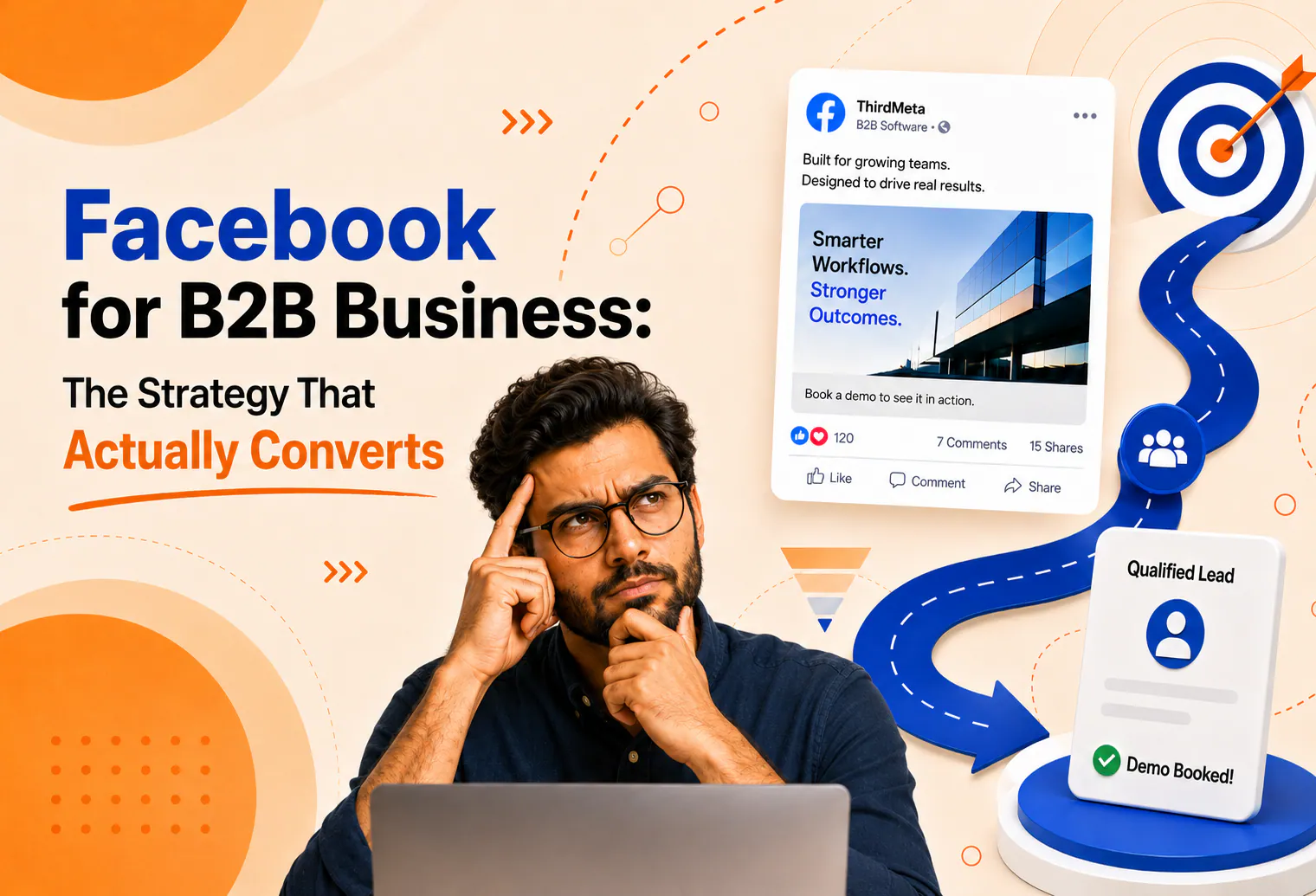
B2B decision-makers spend 74% more time on Facebook than average users, yet most B2B marketing teams treat the platform as a last resort after LinkedIn. That is a structural error. Facebook reaches the same CFOs, IT heads, and procurement managers who approve vendor contracts on LinkedIn but at a fraction of the cost-per-click and without a daily cap on organic reach.
A report by Meta for Business found that 89% of B2B marketers already use Facebook as part of their channel mix. The channel itself is not the question. The question is whether your team has a system to convert Facebook-sourced leads into qualified pipeline.
This article explains how to build that system: from audience targeting to ad formats to retargeting architecture. It also covers the one step most B2B teams skip that turns campaign spend into attributed pipeline. For context on how demand generation fits into a broader growth system, see ThirdMeta’s Growth-as-a-System framework.
Key Takeaways
- B2B decision-makers spend 74% more time on Facebook than the average user, making it a reachable audience at a fraction of LinkedIn’s cost-per-click.
- The real failure in B2B Facebook campaigns is the post-click system, not the targeting layer.
- Job title, industry, CRM upload, and lookalike audiences are the four targeting layers that form a complete B2B audience architecture.
- Lead Ads reduce form friction by 50% and are the most underused format in B2B Facebook campaigns.
- A retargeting system segmented by intent signal outperforms undifferentiated remarketing across long sales cycles.
- Revenue attribution from Facebook requires CRM integration, not just ad platform reporting.
Why B2B Buyers Are Active on Facebook
Facebook for B2B business works because decision-makers do not switch off their professional identity when they leave LinkedIn. A VP of Operations scrolling Facebook at 8 PM is still a VP of Operations with a procurement budget. Meta’s platform surfaces that identity through behavioral data, stated job roles, and industry interests that advertisers can target directly.
Meta reported 3.27 billion monthly active users in Q1 2025, making it the largest advertising surface on the internet by volume. B2B buyers are inside that number. The targeting layer is what separates them from the rest.
The ROI Case for Facebook Over LinkedIn
A 2023 Statista survey found that 22% of B2B marketers ranked Facebook as the social channel with the highest return on investment. LinkedIn came second. The reason is cost structure: Facebook’s average cost-per-click for B2B audiences runs significantly lower than LinkedIn’s equivalent placement, according to WordStream’s 2024 B2B ad benchmarks.
That gap does not mean Facebook outperforms LinkedIn on buyer intent. It means that for awareness and mid-funnel lead generation, Facebook produces more volume per dollar spent. The best B2B strategies assign different jobs to each channel rather than replacing one with the other.
| “Facebook is the most underpriced advertising vehicle in the market right now. B2B companies that haven’t tested it are leaving money on the table.” Gary Vaynerchuk, CEO, VaynerMedia22% of B2B marketers rank Facebook as the highest-ROI social channel | Statista, 2023 |
Why Most B2B Teams Get Facebook Wrong
The standard B2B Facebook playbook focuses entirely on targeting. Every guide, every tutorial, and every agency pitch centers on audience segments, job title layers, and lookalike audiences. Targeting is not the failure point. The failure point is what happens after the click.
Most B2B companies run Facebook ads into a generic landing page, pull collected leads into a CRM, and wait for sales to follow up. A Harvard Business Review study found the average follow-up time in B2B is over 47 hours. By that point, the lead has interacted with a competitor who responded in under an hour.
The Missing Layer: A System Behind the Ad
Facebook generates interest. A growth system converts it. Without a defined lead qualification process, a CRM workflow that routes and scores inbound leads, and a follow-up sequence calibrated to the B2B sales cycle, Facebook spend produces contact lists rather than pipeline.
The teams that get consistent ROI from Facebook for B2B business are not running better ads. They are running better systems behind those ads. That distinction is the difference between a campaign and a revenue operation. See how a full-stack GTM system handles this handoff.
| B2B leads contacted within 5 minutes of form submission are 9x more likely to convert than leads followed up after 30 minutes. |
How to Target B2B Decision-Makers on Facebook
Facebook’s targeting for B2B business works through four primary audience types. Each serves a different stage of the buying cycle. Using all four in sequence creates a closed-loop targeting architecture rather than isolated campaigns that compete with each other for the same budget.
Here is how to build each layer:
- Job Title and Seniority Targeting: Use Meta Ads Manager to filter by job title (VP Operations, CFO, Head of IT), employer industry, and seniority level. This reaches cold audiences who match your ICP but have not yet interacted with your brand.
- Employer and Industry Targeting: Layer company industry with company size where available. In 2026, Meta’s expanded Business Partner Data program allows advertisers to add revenue range and headcount filters in select markets for more precise B2B segmentation.
- Custom Audiences from CRM Data: Upload your existing prospect list as a Custom Audience. Facebook matches email addresses to active users, letting you serve ads to prospects who know your company but have not yet converted.
- Lookalike Audiences: Build a 1-2% lookalike from your closed-won customer list. This finds Facebook users who share behavioral and demographic patterns with your best existing clients. It is the highest-quality cold audience available on the platform.
Facebook Ad Formats for B2B: What to Use and When
Not every ad format performs equally across a long B2B sales cycle. The format should match where the buyer sits in the evaluation process. Mismatching the format to the stage wastes spend on friction that the buyer is not ready to clear.
This table maps each format to its optimal use case:
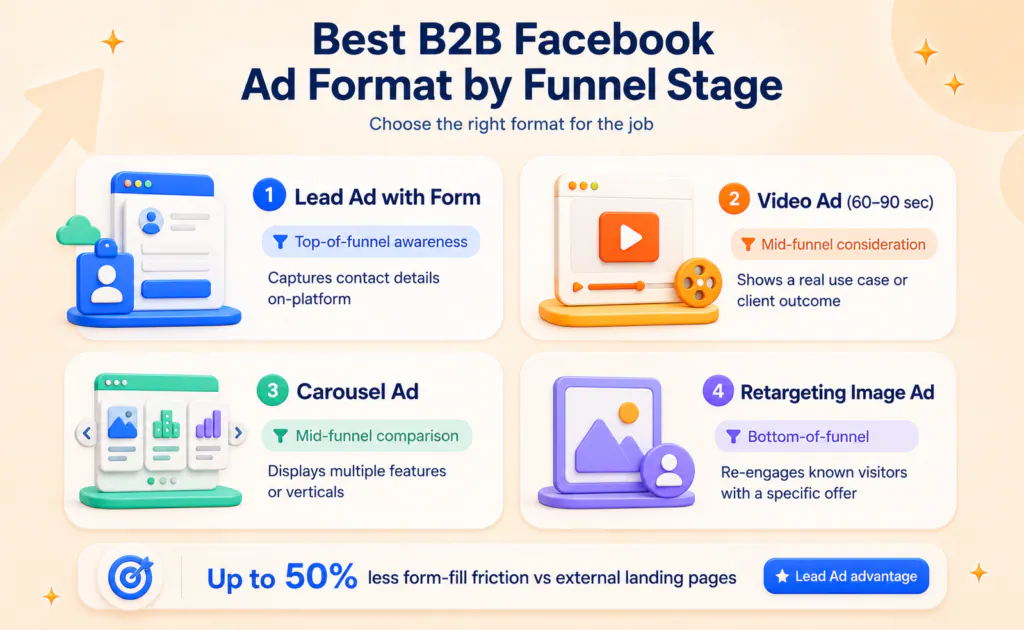
Lead Ads are the most underused format in B2B Facebook campaigns. They pre-populate form fields using the user’s Facebook profile data, cutting form-fill friction by up to 50% compared to external landing pages, according to Meta’s own Lead Ads benchmarks. For a B2B company targeting procurement managers who check Facebook on mobile, that friction reduction directly improves cost-per-lead.
| Running Facebook Lead Ads but not seeing qualified pipeline from them? See how ThirdMeta connects your ad output to a follow-up system that closes. |
Building a Retargeting System for Long B2B Sales Cycles
B2B buying cycles typically run 60 to 90 days. A single Facebook ad cannot hold a buyer’s attention across that window. A structured retargeting system segments audiences by the specific signals they have already given, and serves ads that match those signals at each stage of evaluation.
Here is the sequence that produces consistent B2B results:
- Install the Facebook Pixel across all website pages, including your pricing page, blog content, and demo request form. This creates the audience data layer for everything that follows.
- Segment visitors by intent signal. Build separate Custom Audiences for homepage visitors (low intent), blog readers (research phase), pricing page visitors (high intent), and demo page drop-offs (highest intent, closest to conversion).
- Assign different ads to each segment. High-intent audiences get direct-response ads with a specific demo CTA. Research-phase audiences get educational content ads. Homepage visitors get brand-level awareness content.
- Set frequency caps by segment. High-intent audiences can absorb higher frequency without fatigue. Research-phase audiences need variety, not repetition.
- Connect ad engagement to CRM workflows. Every lead from Facebook Lead Ads should trigger an automated CRM sequence within 5 minutes. Not 5 hours. The gap between ad engagement and sales contact is where B2B Facebook campaigns fail most predictably.
This architecture does not run itself. It requires RevOps alignment between the marketing team running Facebook and the sales team receiving leads. Most B2B companies do not have that alignment built in. For teams that do not know where the gap is, a revenue operations audit identifies the exact handoff point where pipeline stalls.
| If your Facebook spend is generating leads that are not converting to pipeline, talk to ThirdMeta’s growth team to find where the system breaks. |
Why ThirdMeta for B2B Facebook Growth
ThirdMeta builds the infrastructure between your Facebook campaigns and your revenue. Most agencies deliver campaigns. We deliver the pipeline system that receives, qualifies, and closes what the campaign generates.
Working with B2B SaaS companies across Series A to C, the same failure pattern appears: well-targeted Facebook ads feeding a broken post-click process. Our Growth-as-a-System (GaaS) model fixes the system, not just the ads.
- CRM-synced lead routing so every Facebook Lead Ad triggers a qualified follow-up in under 5 minutes
- Retargeting architectures segmented by intent signal, not just page visit count
- Revenue attribution mapping that connects Facebook spend to closed deals, not just cost-per-lead
- Monthly reporting that links ad performance to pipeline stage so spend decisions are made on revenue data
We do not manage Facebook campaigns in isolation. We build the full GTM infrastructure so your Facebook spend converts into attributed revenue. That is a different service than most B2B marketing agencies offer.
| Ready to connect your Facebook spend to revenue you can measure? Talk to ThirdMeta and see how the system works. |
Conclusion
Facebook for B2B business is not a positioning debate against LinkedIn. It is a channel with a specific job: generating qualified interest from decision-makers at a lower cost-per-contact than premium B2B platforms. The companies extracting real revenue from it are not running better ads. They are running better systems behind those ads.
If you are spending on Facebook without a lead qualification workflow, a CRM follow-up sequence, and a retargeting architecture tied to intent signals, the ad spend is the least of your problems. Fix the system first. Then scale the spend.
Does Facebook work for B2B marketing?
Facebook works for B2B marketing when used as a demand generation channel, not a closing channel. It produces qualified leads at lower cost-per-click than LinkedIn. It does not replace a sales process or a CRM follow-up sequence that converts those leads into revenue.
How do I target B2B buyers on Facebook?
Use Meta Ads Manager to layer job title, industry, seniority, and employer filters. Upload CRM contact lists as Custom Audiences. Build lookalike audiences from your closed-won customer list for reach into cold audiences who share the profile of your best clients.
What is the best Facebook ad format for B2B?
Facebook Lead Ads are the most effective format for B2B lead generation. They pre-fill contact forms using the user’s Facebook data, reducing form friction by up to 50%. For mid-funnel buyers, 60-to-90-second video ads showing a specific use case produce the strongest engagement-to-demo conversion rates.
How do I measure ROI from B2B Facebook campaigns?
Install the Facebook Pixel and connect your CRM to Facebook’s Conversions API. Track leads through each pipeline stage in your CRM. Measure cost-per-qualified-lead, not cost-per-click. Connect closed deals back to the originating Facebook campaign to calculate true return on ad spend.

Sr. Content Writer
Vamshi Vadali is Third Meta's Content Team Head and the guy who banned fluff from all blog posts. He specializes in SEO, GEO (Generative Engine Optimization), and AEO (Answer Engine Optimization): the trifecta that gets B2B SaaS content ranking in both Google and ChatGPT. Vamshi doesn't write content. He engineers MQL machines. His philosophy? Good writing needs data and clarity, not buzzwords. He writes like a CFO reads: straight to the outcomes. When he's not optimizing for AI Overviews, he's debating whether LLMs prefer Oxford commas.