

AI Overviews now answer your buyer’s question before they ever reach a blue link. That shift is not coming, it is already here, and it is rewriting how B2B SaaS buyers find and shortlist vendors. Ranking inside those AI-generated answers is a different discipline from traditional SEO, and this guide covers exactly how to earn it.
The scale of the change is hard to overstate. Gartner projects that traditional search engine volume will fall 25% by 2026 as buyers move to AI assistants, and Forrester found that 89% of B2B buyers have already adopted generative AI as a research source. If your content is not cited in the AI answer, you are not ranking lower, you are missing from the conversation. Here is how to make your brand the one the AI names.
TL;DR
- AI Overviews now shape which vendors buyers shortlist first
- GEO optimizes for citation in AI answers, not clicks
- Technical health (speed, HTTPS, schema) is the entry ticket
- Answer-first structure gets content lifted into AI responses
- Authority signals and external validation build AI trust
- FAQ and HowTo schema map directly to how AI answers
- Track citations and answer share, not just rankings
What is Generative Engine Optimization (GEO)?
Generative engine optimization GEO is the practice of optimizing content specifically for AI-powered search engines that generate responses rather than display traditional search results. Unlike conventional SEO that targets human readers browsing search results, GEO focuses on creating content that AI systems can easily understand, process, and cite in their generated answers.
GEO represents a fundamental shift in search optimization strategy. Traditional SEO success depends on users clicking through to your website from search results. GEO success means your content gets featured directly in AI-generated summaries, even if users never visit your site.
The discipline emerged as AI-powered search features became dominant across major search platforms. Google’s AI overviews, ChatGPT’s search capabilities, and similar AI features now determine how billions of users discover information online.
Core Principles of GEO vs Traditional SEO
Modern GEO strategies operate on different principles than traditional search optimization. Where old-school SEO focused on keywords and backlinks, GEO prioritizes content clarity, source authority, and answer completeness.
The table below shows how these approaches differ in practical application:
| Traditional SEO Focus | GEO Strategy Focus |
| Keyword density and placement | Natural question answering |
| Backlink quantity | Source authority quality |
| Page rankings | Content citation rates |
| Click-through rates | Answer accuracy |
| Human browsing patterns | AI processing preferences |
What are AI Overviews and How They Work?
AI overviews are AI-generated summaries that appear at the top of search results, providing direct answers to user queries without requiring clicks to external websites. These overviews synthesize information from multiple web sources to create authoritative responses that address user needs immediately.
Google’s AI overviews represent the most visible example of this technology. They appear above traditional organic search results and often include 2-3 source citations that users can explore for additional information. The system analyzes millions of web pages to identify the most accurate and helpful information for each query.
How to rank on AI search requires understanding that these systems don’t simply copy content from websites. Instead, they analyze information patterns across multiple sources to generate original summaries while maintaining factual accuracy.
The Technology Behind AI Overviews
AI overviews operate using advanced natural language processing models that can understand context, evaluate source credibility, and synthesize information from multiple sources. These systems consider factors like content freshness, author expertise, and domain authority when selecting information to include.
The selection process happens in real-time for each search query. This means your content competes not just with other websites, but with the AI’s ability to create better answers from multiple sources combined.
Modern AI SEO must account for this synthesis process by creating content that provides unique value AI systems cannot easily replicate by combining other sources.
Understanding AI Search Algorithm Preferences
How to rank on AI search starts with understanding what AI systems value most when selecting content for overviews. These algorithms evaluate content quality, source credibility, and answer completeness to determine which information deserves featuring in generated responses.
AI systems use natural language processing to analyze content context and meaning rather than simply matching keywords. They assess whether your content truly helps users solve their problems instead of just targeting search terms. This fundamental difference requires content creators to focus on genuine helpfulness over optimization tricks.
The most successful content combines clear communication with factual accuracy. AI algorithms can detect when content provides comprehensive answers versus partial information that requires users to search elsewhere for complete solutions.
Content Quality Factors That Matter
AI systems evaluate several quality indicators when selecting content for overviews. These factors work together to determine content authority and usefulness for specific query types.
Answer Completeness forms the foundation of AI content selection. Your content must address all aspects of user questions without leaving important gaps. Partial answers rarely get featured because AI systems prefer sources that reduce the need for additional searches.
Source Authority influences whether AI systems trust your content enough to feature it prominently. This includes domain expertise, author credentials, and external validation from reputable sources in your field.
Information Accuracy gets verified by AI systems through cross-referencing multiple sources. Content that contradicts established facts or lacks supporting evidence gets filtered out during the selection process.
User Intent Matching
SEO for AI searches requires precise alignment between your content and user search intent. AI systems have become sophisticated at understanding what people really want when they ask questions online.
Different query types trigger different AI behaviors. Informational queries often generate detailed explanations, while comparison queries result in structured data tables. Action-oriented queries typically feature step-by-step guides or process explanations.
Understanding these patterns helps you format content appropriately for your target query types. Content that matches expected formats for specific intents has higher chances of AI overview selection.
Essential Technical Requirements for AI Overview Success
Technical optimization creates the qualifying foundation that allows quality content to reach AI systems for evaluation. Without proper technical implementation, even exceptional content may never get considered for AI overview inclusion.
These technical factors act as baseline requirements rather than ranking advantages. Meeting technical standards doesn’t guarantee AI overview placement, but failing to meet them virtually eliminates your chances of selection.
Modern AI systems expect websites to meet current web standards for security, performance, and accessibility. Sites that fall short of these expectations get filtered out before content quality evaluation begins.
Page Performance and Speed Requirements
AI systems prioritize fast-loading content because page speed directly impacts user experience. Slow websites rarely appear in AI overviews regardless of content quality, since AI aims to direct users only to positive experiences.
Loading Speed Benchmarks:
- Under 2 seconds: Optimal for AI selection consideration
- 2-4 seconds: Acceptable but creates competitive disadvantage
- Over 4 seconds: Rarely featured in AI overview results
Page speed optimization involves multiple technical factors. Image compression reduces file sizes while maintaining visual quality. Content delivery networks distribute your content across global servers for faster worldwide access. Browser caching stores static files locally so repeat visitors experience faster loading times.
Mobile performance requires special attention since most searches now happen on mobile devices. AI systems test content performance across different device types and connection speeds before featuring it in overviews.
Security and Trust Requirements
AI systems only feature content from secure, trustworthy websites. These security signals indicate to AI algorithms that your content comes from reliable sources rather than potentially harmful sites.
Required Security Elements:
- HTTPS encryption properly implemented across all pages
- SSL certificates installed and regularly updated
- Clean site reputation with no malware or security warnings
- Regular security updates maintained consistently
Website security directly impacts user safety, which AI systems prioritize when selecting content for overviews. Unsecured sites create risks for users, so AI algorithms automatically exclude them from consideration.
Trust signals extend beyond basic security to include factors like domain age, ownership transparency, and contact information availability. These elements help AI systems distinguish legitimate businesses from potentially fraudulent operations.
Content Structure Optimization for AI Systems
Creating content that AI systems can easily process and cite requires specific structural approaches that differ from traditional web writing. AI algorithms scan for particular patterns and formats when evaluating content for overview inclusion.
Modern AI systems can understand context and meaning, but they still prefer content that follows clear organizational patterns. This preference stems from their need to quickly identify accurate information that directly answers user questions.
Answer-First Content Structure
Start every major section with direct answers to common questions. AI systems scan for these immediate responses when creating overviews, so burying important information deep in paragraphs reduces your chances of selection.
The answer-first approach means stating your main point in the opening sentence of each section. Question-and-answer formats work particularly well for AI overview optimization, with FAQ sections often getting extracted directly into AI-generated responses.
List and Table Optimization
AI systems excel at extracting information from structured formats like lists and tables. These formats make it easy for algorithms to identify discrete pieces of information and present them clearly in overviews.
Effective List Types:
- Numbered lists for processes and step-by-step instructions
- Bulleted lists for features, benefits, or related concepts
- Comparison tables for product or service evaluations
- Data tables for statistics and quantitative information
Tip: Tables work especially well for comparison queries where users want to evaluate multiple options. AI systems can extract table data and present it in formatted responses that directly address user needs.
When creating lists, ensure each item provides complete information rather than requiring additional explanation. AI systems prefer lists where each element stands alone as a useful piece of information.
Advanced Schema Markup Implementation
Schema markup provides AI systems with structured information about your content, making it easier for algorithms to understand context and select appropriate information for overviews. Proper schema implementation significantly improves your chances of AI overview selection.
Different schema types serve different purposes in AI optimization. FAQ schema helps with question-based queries, while HowTo schema works well for process-oriented searches. Article schema provides context for long-form content, and LocalBusiness schema supports location-based queries.
The key to effective schema implementation lies in choosing the right types for your content and implementing them correctly. Poorly implemented schema can actually hurt your chances by providing AI systems with confusing or contradictory information.
Most Effective Schema Types for AI Overviews
FAQPage Schema works exceptionally well for AI overview optimization because it matches the question-and-answer format that many AI overviews use. This schema type helps AI systems identify your content as a reliable source for specific questions.
HowTo Schema gets featured regularly in process-related AI overviews. This schema type allows you to structure step-by-step instructions that AI systems can easily extract and present to users seeking guidance.
Article Schema provides important context about your content’s authorship, publication date, and topic coverage. This information helps AI systems evaluate source credibility and content freshness when selecting information for overviews.
| Schema Type | Best Use Cases | AI Overview Impact |
| FAQPage | Question-answer content | High citation frequency |
| HowTo | Step-by-step guides | Process query dominance |
| Article | News and blog content | Authority signal boost |
| LocalBusiness | Location-based content | Local query prominence |
| Product | E-commerce content | Shopping query features |
Implementation Best Practices
Test your schema markup using Google’s Rich Results Tool before publishing content. This tool identifies errors that could prevent AI systems from understanding your structured data properly.
Keep schema markup updated when you modify content. Outdated markup can provide AI systems with incorrect information, which may exclude your content from overview consideration.
Monitor schema performance through Google Search Console to ensure your structured data continues working correctly over time. Regular monitoring helps you identify and fix issues before they impact your AI overview visibility.
Voice Search and Conversational Query Optimization
Voice search queries frequently trigger AI overviews because people ask complete questions when speaking to devices. How to rank on AI overview for voice searches requires optimizing content to match natural speech patterns rather than typed keyword searches.
Conversational queries differ significantly from traditional text searches. People speak in full sentences and ask questions the way they would talk to another person. AI systems that process voice queries look for content that answers questions in conversational tones.
Natural Language Integration:
Include conversational keywords and phrases throughout your content. Terms like “how do I,” “what’s the best way to,” and “where can I find” appear frequently in voice searches and help AI systems identify relevant content.
Write answers the way you would explain concepts to a friend rather than using formal business language. Long-tail question phrases work particularly well for voice search optimization.
Location-Based Voice Optimization:
Voice searches often include location-specific elements, especially for local businesses. Include relevant geographic information and terms like “near me,” “in [city name],” and “local [service type]” in your content.
Local schema markup becomes even more important for voice search optimization. This structured data helps AI systems understand your business location and service areas when generating location-specific overviews.
Building Authority for AI Trust Signals
AI systems prioritize content from authoritative sources when creating overviews. Building the right authority signals helps AI algorithms identify your content as trustworthy and worth featuring in generated responses.
Modern AI systems evaluate expertise through multiple factors including author credentials, content accuracy, and external validation from reputable sources. The most effective authority building strategies focus on demonstrating genuine expertise rather than trying to game algorithmic factors.
Author Expertise and Credentials:
Include detailed author bylines that showcase relevant expertise for your content topics. Professional experience, educational background, and industry recognition all contribute to author authority signals that help AI systems distinguish expert content from general information.
Tip: Link to author profiles or biography pages that provide additional context about expertise and experience. This external validation helps AI systems verify author credentials and build confidence in content accuracy.
External Validation Strategies:
Citations from authoritative external sources help AI systems verify information accuracy. Industry recognition through mentions in trade publications, speaking engagements, or professional awards creates authority signals that AI systems can detect and evaluate.
Customer testimonials and case studies provide real-world validation of your expertise. AI systems recognize these social proof elements as indicators of practical experience rather than theoretical knowledge alone.
Why Smart B2B SaaS Leaders Choose Hexanovate for AI Overview Success?
Most agencies struggle with AI overview optimization because they treat it like traditional SEO. Hexanovate delivers guaranteed results because we understand the unique requirements of generative engine optimization.
We’re India’s first Human + AI Growth Engine specifically designed for B2B SaaS businesses. Our GEO strategies consistently achieve AI overview rankings that traditional agencies can’t match.
Our AI Overview Optimization Process
- Strategic Assessment – Complete analysis of your current AI visibility gaps across all major platforms
- AI-First Content Strategy – Content designed specifically for AI system preferences and selection criteria
- Technical Implementation – Schema markup, structured data, and speed optimization for AI crawlers
- Performance Tracking – Continuous monitoring across Google, ChatGPT, and emerging AI search platforms
- Scaling Support – Ongoing optimization as AI systems evolve and update their selection criteria
Proven Results for B2B SaaS Companies
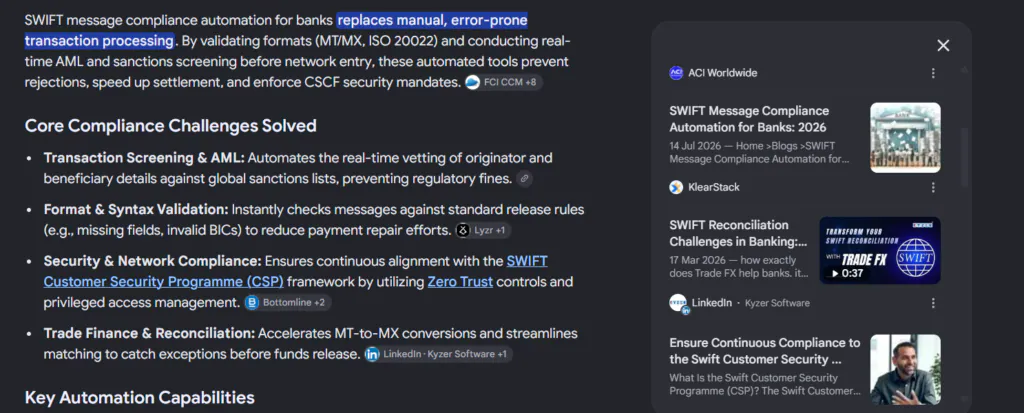
This is not a hypothetical. Search “SWIFT message compliance automation for banks” and one of the sources an AI engine cites, alongside ACI Worldwide and Kyzer Software, is a client page built on exactly the principles in this guide.
- Answer-first opening. The page states its core claim in the first sentence, the same structure covered earlier in Answer-First Content Structure.
- Entity-rich specificity. It names exact standards and frameworks instead of generic compliance language, the same “genuine helpfulness over optimization tricks” principle from Content Quality Factors That Matter.
- Bold-label bullet structure. Challenges are broken into scannable, citation-ready bullets, the same format covered in List and Table Optimization.
That is what strategic GEO implementation looks like in practice. Not a vague number,
one client’s actual page, cited by name, sitting next to the vendors it now shares shelf space with.
Ready to dominate AI search results? Book your AI overview strategy session and discover how we guarantee your content ranks in AI overviews.
Measuring AI Overview Performance and ROI
Tracking AI overview performance requires specialized approaches that traditional SEO analytics don’t capture. Understanding these metrics helps optimize your strategy and measure progress toward AI visibility goals that actually impact business results.
The data from AI overview tracking reveals patterns about which content types, topics, and optimization techniques produce the best results for your specific industry and audience. This information guides strategic decisions about resource allocation and content priorities.
Modern measurement approaches focus on business impact rather than just visibility metrics. The goal shifts from traffic volume to brand authority and thought leadership establishment through AI overview features.
Key Performance Indicators for AI Success
AI Overview Appearance Frequency tracks how often your content gets featured across different query types and platforms. This metric shows the breadth of your AI visibility rather than just individual keyword performance.
Source Citation Patterns reveal which types of content AI systems prefer from your site. Understanding these patterns helps you create more of the content types that generate consistent AI overview features.
Brand Mention Context analysis shows how AI systems present your brand in generated responses. Positive context indicators suggest strong brand authority signals that AI algorithms recognize and value.
Tools and Tracking Methods
| Tool | Primary Function | Best For |
| Semrush AI Overview Tracker | Keyword-based monitoring | Traditional SEO teams |
| Advanced Web Ranking | Percentage tracking | Market research |
| Peec.ai | Multi-platform monitoring | Brand visibility analysis |
Performance analysis requires combining data from multiple sources to understand complete AI visibility impact. Single-tool approaches miss important patterns that emerge across different AI platforms and query types.
Regular reporting intervals help identify trends and optimization opportunities. Monthly performance reviews allow strategic adjustments before negative trends impact business results significantly.
Ready to Dominate AI Search Results?
How to rank on AI overview requires combining technical expertise with strategic content creation approaches that AI systems prefer. The businesses that master generative engine optimization GEO will dominate search visibility in 2025 and beyond.
Start by auditing your current content for AI readiness factors. Identify gaps in your GEO strategies and begin implementing the techniques covered in this guide systematically. The window for competitive advantages in AI SEO narrows each day as more businesses recognize the importance of AI overview optimization. Companies that delay SEO for AI searches implementation will find themselves invisible in the new search landscape that prioritizes AI-generated responses over traditional result listings.
FAQs
SEO earns ranked links that a user clicks. GEO earns a citation inside an AI-generated answer. Most real programs run both together, since SEO authority still feeds what AI models trust.
AI Overviews weigh answer completeness, source authority, and factual accuracy. They favor content that resolves the full question without sending the user searching again. Clear, answer-first structure makes that content easier to lift.
Expect first citations on priority queries within a quarter, not overnight. AI answers shift week to week as models update. Any agency guaranteeing fixed AI rankings in 30 days is a red flag.
Schema does not guarantee selection, but it helps AI systems read your content correctly. FAQPage and HowTo schema map cleanly to how AI answers questions. Poorly implemented schema can hurt, so test it before publishing.

Sr. Content Writer
Vamshi Vadali is Third Meta's Content Team Head and the guy who banned fluff from all blog posts. He specializes in SEO, GEO (Generative Engine Optimization), and AEO (Answer Engine Optimization): the trifecta that gets B2B SaaS content ranking in both Google and ChatGPT. Vamshi doesn't write content. He engineers MQL machines. His philosophy? Good writing needs data and clarity, not buzzwords. He writes like a CFO reads: straight to the outcomes. When he's not optimizing for AI Overviews, he's debating whether LLMs prefer Oxford commas.