
Quick Answer: To reduce customer acquisition cost, fix the acquisition system before the channels: correct how CAC is measured, tighten the ICP, close the marketing-to-sales handoff, raise conversion on existing traffic, and move budget from demand capture to demand creation.
Key points covered in this article:
Rising CAC is usually a system leak, not a channel price problem
Pausing your most expensive channel often raises blended CAC
An eight-step sequence to lower CAC, fastest payback first
Which levers move CAC in weeks, and which compound over quarters
What changed about reducing CAC in 2026
Most B2B SaaS teams try to reduce customer acquisition cost by finding a cheaper channel, when the cost is usually being created in the gaps between channels. The paid line looks expensive, so it gets cut. The number rarely improves.
If you run growth at a B2B SaaS company, the signs are specific. Cost per lead has roughly doubled in a year while pipeline has not, and the board keeps asking why blended CAC is up two quarters running.
Every channel dashboard still looks defensible on its own. The SDR team is working harder for fewer meetings, and the two martech tools you added last year did not move the number.
A report by Gartner found that marketing budgets fell to 7.7% of company revenue in 2024, with 64% of CMOs saying they lacked the budget to deliver their strategy. Spending your way out is not an option. This guide covers what pushes CAC up, why the common fixes underperform, and an eight-step sequence to bring it down, ending with demand generation.
TL; DR
Treat rising CAC as a system leak between marketing, sales and RevOps, not a channel price problem.
Fix measurement before cutting spend: track blended CAC and CAC payback by segment, never a company average.
Do not pause your most expensive channel first. It often assists conversions you credit to cheaper channels.
Re-cut the ICP using win rate and 12-month retention. Stop paying to acquire customers who churn.
Raise conversion on existing traffic and fix lead routing before buying more visitors. Both move CAC within weeks.
Shift budget from demand capture to demand creation to lower blended CAC over two to three quarters.
In 2026, flat budgets and AI-compressed top-of-funnel make efficiency the only lever left.
Why does my customer acquisition cost keep increasing?
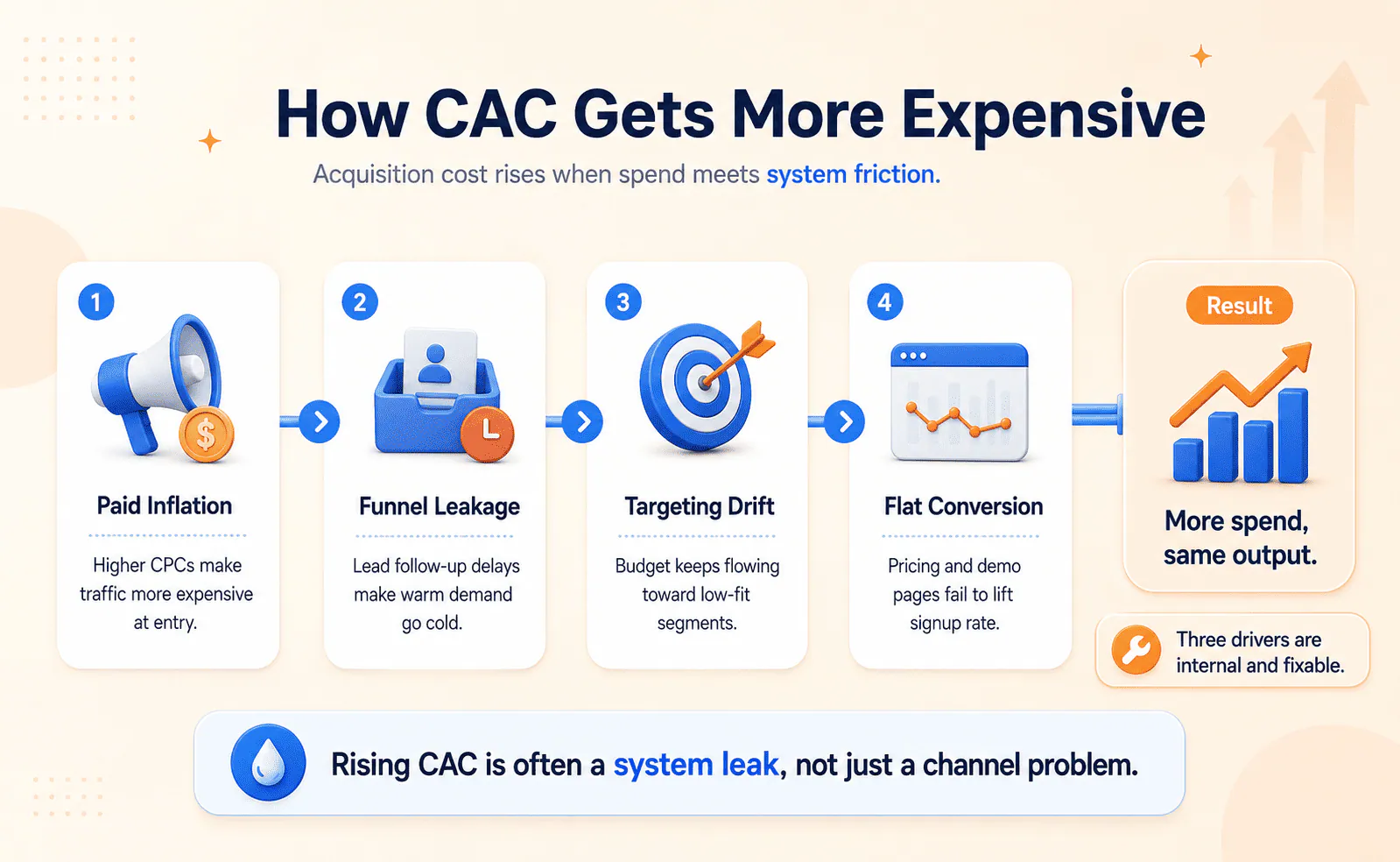
Customer acquisition cost keeps increasing for four reasons that usually act together. Paid channels inflate, qualified demand leaks between marketing and sales, targeting drifts toward accounts that do not close, and conversion on owned pages stays flat. Only the first is outside your control.
The other three are structural. They are also where most of the recoverable cost sits, because no single team owns them.
Paid inflation. Google Ads and LinkedIn Ads CPCs rise every year, and auction competition for B2B SaaS keywords is heavier now than in 2022.
Funnel leakage. A lead paid for by marketing goes cold in an SDR queue, so the same demand has to be bought a second time.
Targeting drift. Campaigns keep optimising toward cheap clicks from segments with low win rates and high churn.
Flat conversion. Traffic grows, but the pricing page, demo form and proof points stay the same, so cost per signup holds.
A report by Gartner found that digital now takes 61.1% of total marketing spend, with paid online at 69% of the digital budget. Most teams are concentrating money into the channels getting more expensive, then blaming the channels.
Is rising CAC a marketing problem or a system problem?
Rising CAC is usually a system problem wearing a marketing costume. A lead is generated by content, nurtured by lifecycle email, routed by an SDR, and closed by an AE, and no single function owns the total cost. Each team improves its own slice while the blended number drifts up.
How the marketing efficiency ratio shows what channel CAC hides
The marketing efficiency ratio, new plus expansion revenue divided by total sales and marketing spend, catches waste that channel-level CAC misses. Channel dashboards can all show a stable cost per acquisition while the blended ratio falls. Track it monthly alongside CAC payback period by segment.
So the real question is not which channel to cut. It is which part of the acquisition system is leaking: measurement, targeting, handoff, or conversion.
Should you pause your worst-performing channel to lower CAC?
Pausing your most expensive channel rarely lowers blended CAC, because that channel is usually assisting conversions credited elsewhere. Paid search often warms the buyer who later converts through branded organic or a direct demo request. Cut the paid line and the cheaper channels quietly get more expensive within a quarter.
The situation. A Series B SaaS team sees paid social at a $900 CAC and content at $250. They move the paid budget into content. Two quarters later, content CAC is $400 and pipeline is down, because the paid channel had been generating the branded search that content was closing.
What works instead. Treat acquisition as one system with one target. Forrester predicted that more than half of large B2B transactions of US$1 million or greater would be processed through digital self-serve channels. The buyer's path is multi-touch and self-directed, so no single channel's contribution can be isolated and cut cleanly.
Before shifting any budget, raise conversion on the pages you already have. It lowers CAC on current traffic with no channel risk, which buys time to fix the system underneath.
In ThirdMeta growth engagements with Series A to Series B B2B SaaS companies, the pattern repeats. The paid dashboard looks fine channel by channel while blended CAC has climbed 20 to 40 percent over three quarters. The cost is in the handoffs, not the line items.
There is a real exception. If your CAC jumped because of one broken thing, a single misfiring campaign, a tracking error, or one underperforming agency, then you do have a channel problem. Fix that one thing rather than rebuild the system.
Put marketing, sales and RevOps on one shared CAC target, reviewed together.
Model channel contribution with assisted conversions, not last touch, before moving any budget.
Change one variable at a time and watch blended CAC, not the channel line.
How do you reduce customer acquisition cost step by step?
To reduce customer acquisition cost, work the system in order: measurement, targeting, budget mix, handoff, conversion, self-serve, advocacy, and review cadence. Doing the steps out of order wastes effort, because cutting spend before fixing measurement only hides the problem. The sequence below runs from fastest payback to slowest.
Each step names what to change and who owns it. None of them needs a bigger budget. Most need marketing, sales and RevOps to agree on definitions they currently hold apart.
Fix measurement first. Calculate blended CAC and CAC payback by segment, not a company-wide average. A blended figure hides which segment is bleeding.
Re-cut the ICP to accounts that close and stay. Pull win rate and 12-month retention by firmographic. Cut targeting for segments with low win rates and high churn.
Shift budget from demand capture to demand creation. Branded search and retargeting harvest demand that already exists. Moving a share of budget into content and organic channels lowers blended CAC over two to three quarters as owned assets compound.
Close the marketing-to-sales handoff. Set a lead-response SLA in minutes and route by rep availability. Late routing is a common invisible CAC multiplier.
Raise conversion on the traffic you already have. Fix pricing clarity, form length and proof before buying more visitors. Conversion rate work lowers CAC with no extra media spend.
Build the self-serve research path buyers want. A report by Gartner found that 61% of B2B buyers prefer a rep-free buying experience and 73% avoid suppliers who send irrelevant outreach. A clear pricing page and honest comparison content cut the sales cost per deal.
Turn existing customers into an acquisition channel. Referral and expansion revenue carry a fraction of the CAC of net-new outbound. Ask for the referral at the moment of realised value.
Review the math quarterly. CAC by segment and channel shifts as the market moves. A quarterly review catches drift while it is still cheap to correct.
Steps one and four usually move the number within a quarter. Steps three and seven compound over a year. Run them in parallel, but do not skip step one.
Can you reduce CAC without spending more on marketing?
You can reduce CAC without spending more, and it is usually the faster route. The quickest wins fix leaks in measurement, routing and conversion, and they show results in weeks. The compounding levers, ICP discipline and demand creation, take longer but keep paying back.
The table sorts the main levers by time to impact and typical effect. The watch-out column is the mistake that cancels the gain.
Lever | Time to impact | Typical CAC effect | Watch-out |
Conversion work on existing pages | 2–6 weeks | Lower CAC on current traffic | Testing without the traffic to reach significance |
Lead-response SLA and routing fix | 2–4 weeks | Recovers demand already paid for | An SLA with no clear owner |
ICP re-cut | ~1 quarter | Removes spend on low-fit accounts | Narrowing so far the pipeline dries up |
Budget shift to organic search and content | 2–3 quarters | Structurally lower blended CAC | Cutting paid before organic ramps |
Referral and expansion motion | Ongoing | Lowest CAC of any channel | Asking before the customer sees value |
Notice what is missing: “find a cheaper agency” and “pause the worst channel.” Neither addresses why the cost is there. “Find a cheaper agency” solves the invoice, not the arithmetic.
What has changed about reducing customer acquisition cost in 2026?
In 2026, three shifts changed how B2B SaaS teams reduce customer acquisition cost. Budgets are flat, discovery is moving into AI answers, and gen AI has made the efficient teams structurally leaner. The 2022 playbook of outspending the category and adding SDR headcount now raises CAC.
Each shift moves the lever from media buying toward operating model. The teams that adjust first will hold a lower cost per customer for years.
Flat budgets make efficiency the only lever. A report by Gartner found that marketing budgets flatlined at 7.7% of company revenue for a second year in 2025. The response is a lower cost per customer from the same budget, not a bigger ask.
AI Overviews are compressing top-of-funnel clicks. Informational searches increasingly resolve inside an AI answer, so cheap awareness traffic is shrinking. Content now has to earn the citation, not only the ranking.
Gen AI has reset the efficient-team benchmark. A report by McKinsey found that applying agentic AI to a single go-to-market workflow can free about 10% of seller time. Teams that redeploy that time into pipeline lower CAC without adding people.
The through-line is simple. In 2026, reducing CAC is an operating-model question, not a media-buying one.
Why Should You Choose ThirdMeta?
Most teams fighting rising CAC run marketing, paid media, RevOps and SEO through three or more separate vendors, each reporting on its own slice. ThirdMeta runs them as one team against a single pipeline number. The fragmentation that creates hidden CAC is the first thing we remove.
Blended CAC and CAC-payback measurement by segment, set up before any spend changes
ICP re-cut from your win-rate and retention data, not a generic firmographic list
Demand creation and demand capture run by one team, so budget shifts do not break pipeline
Marketing-to-sales handoff and routing rebuilt with an enforced response SLA
Conversion work on existing pages before any increase in traffic spend
Engagements open with a measurement and ICP audit in the first weeks, then move to the highest-payback leak. We state the pipeline number we are accountable to at the start.
Unlike a paid-media-only agency, we can move budget between paid and organic because both sit on one team
Unlike a standalone SEO agency, our content ladders to a demand-gen page and a pipeline figure, not a traffic report
Unlike a fractional CMO engagement alone, we bring the execution team to run the sequence, not only the plan
If your blended CAC has climbed for two quarters while every channel looks fine, the problem is between the channels, and that is the part one team can fix. Book a working session on your CAC.
Conclusion
Reducing customer acquisition cost is rarely about finding a cheaper channel. The recoverable cost sits in measurement that hides segment economics, targeting that drifts to low-fit accounts, handoffs that let paid demand go cold, and pages that convert below their potential.
A B2B SaaS team that fixes the sequence of measurement, ICP, budget mix, handoff and conversion usually sees blended CAC move within a quarter and hold. The teams that win in 2026 will treat acquisition as one system with one number, reviewed every quarter instead of every board cycle. Start with the demand engine.
Frequently Asked Questions
Reducing customer acquisition cost takes two weeks to three quarters. Conversion and routing fixes show results within weeks. An ICP re-cut takes about one quarter. Budget shifts to organic and referrals compound over two to four quarters.

Sr. Content Writer
Vamshi Vadali is Third Meta's Content Team Head and the guy who banned fluff from all blog posts. He specializes in SEO, GEO (Generative Engine Optimization), and AEO (Answer Engine Optimization): the trifecta that gets B2B SaaS content ranking in both Google and ChatGPT. Vamshi doesn't write content. He engineers MQL machines. His philosophy? Good writing needs data and clarity, not buzzwords. He writes like a CFO reads: straight to the outcomes. When he's not optimizing for AI Overviews, he's debating whether LLMs prefer Oxford commas.