According to the CMO Survey, marketing leaders already outsource around 20.2% of marketing activities and expect this to rise by 5% next year. Marketing work is shifting fast from in-house teams to outsourced marketing agencies.
As per HubSpot’s 2024 Marketing Trends Report, around 43% of U.S. companies now outsource some marketing operations, mainly SEO, paid ads, and content creation.
For growth leaders, the real question is not “should we invest in marketing or not?” but “who should actually run it day to day?”
This guide helps you compare in-house and agency marketing using numbers, clear pros and cons, and real scenarios. We will look at cost, skills, control, and speed. Then we end with a quick checklist and how ThirdMeta runs a hybrid model for B2B brands.
Quick Answer: When in-house, When agency, When hybrid
In-house vs agency marketing is not a yes-or-no choice. It depends on your stage, growth goals, budget, team strength, in-house skills, and how fast you need results.
- Choose a marketing agency when:
- You need specialist skills to achieve revenue-based outcomes.
- You want to move fast without building a full in-house marketing team.
- You have short runways to prove results, not experiments from zero.
- Your current team is at full capacity and you need extra hands for execution, not more meetings.
- Choose in-house marketing when:
- You have a complex product and need deep domain expertise that the agency can’t understand.
- You have long planning cycles, steady channels, and strong brand operations that need daily coordination with sales and product.
- You want core knowledge, data, and processes to stay inside your company.
- You have a strong marketing leader who can hire, train, and retain a cross-functional team.
- Choose a hybrid model when:
- You already have a core team but need extra depth in SEO, content, paid media, or marketing operations.
- You want internal owners for brand, messaging, and strategy, and an agency to run specialist channels.
- You need access to AI, AIO, and GEO expertise without hiring a full in-house search and content squad.
What is In-house Marketing?
In-house marketing is when your own employees handle all marketing activities for your company. They manage strategy, branding, campaigns, content, ads, and social channels while staying on your payroll. They work only on your brand and report through your internal structure instead of an outside firm.
In small firms, this might be one marketer who does everything. In larger firms, it can be a full division with specialists for SEO, paid media, content, design, and marketing operations. Either way, it is a dedicated internal team that lives inside your company.
The main strength of in-house teams is the depth of brand context. They live your product every day, hear feedback from sales, and can fix issues quickly when something feels off.
What is Agency Marketing?
Agency marketing means hiring a specialist company to plan and run your marketing for you. It helps your business promote its products or services to a target audience.
Instead of hiring every specialist in-house, you pay an agency to build a strategy, reach out to the right audience, and increase revenue. Their team stays outside your payroll but works with you on goals, budgets, and performance.
Most agencies work on a monthly retainer or fixed project fee. Some firms pick one full-service partner, while others use focused agencies for SEO, paid media, or brand work.
When is a Hybrid [In-house + Agency] Model the Right Choice?
Most high-growth brands do not choose only in-house or only agency. They keep a small core team inside for strategy and brand, and plug in agencies for specialist work and extra capacity. Agencies bring scale, expertise, and extra capacity.
A strong hybrid model usually has one internal owner who sets goals, manages budgets, and keeps agencies aligned with product and sales. Agencies then bring channel expertise, build experiments, and report clearly on pipeline impact.
Below is the content extracted from a LinkedIn post written by a marketing leader:
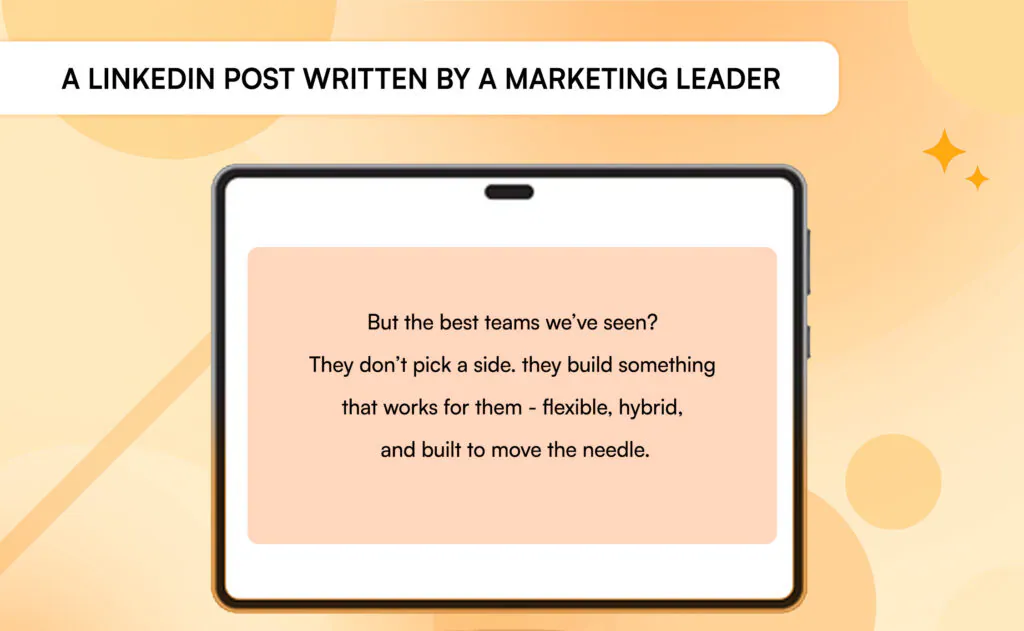
Over time, you can move tasks in-house or outside based on performance, not preference. The mix will change as your product, markets, and budget grow.
A hybrid model means:
- Your internal team owns strategy, ICP, product story, and numbers
- Your agency pods own channels, experiments, and delivery
- One internal owner keeps everything on a single plan and scorecard
Key Differences In-house vs Agency Marketing
For most marketing leaders, the choice of onboarding an agency or building an in-house team comes down to a few hard points like control, cost, time to impact, hiring effort, data, and risk.
You want to know which setup gives you the best path to the pipeline without dragging the team into months of trial and error.
Here’s the table below that lines up those factors so you can see where an internal team or an agency makes more sense.
In-house vs Agency Comparison Table
| Factors | In-house Marketing Team | Marketing Agency |
| Revenue-driven Approach | The in-house team rarely owns the goals tied to revenue. They focus on tasks, campaigns, and brand activity, not direct revenue. | Good agencies link work to revenue, MQL, SQL, and pipeline. Weak agencies still focus on clicks and impressions. |
| Team’s Risk Appetite | The risk level matches the company’s culture. If leaders avoid experiments, then employees play it safe. | Strong agencies can take risks to perform experiments, tests, and target the ICP. This higher risk appetite often finds gains you would not try internally. |
| Skills and depth | Limited to people you can hire and keep | Wider skill bench across channels and industries |
| AI, SEO, and AIO expertise | Teams with less experience and market exposure struggle to rank on AI Overviews and increase AI visibility. | Specialist agencies spread AI visibility learnings across clients and can roll out AIO-ready structures faster than single teams. |
| Scalability | Harder to scale or shrink headcount fast | Easier to scale by adding or reducing scope each quarter/month |
| Your Risk and continuity | Risk if key people leave or underperform | Risk if agency changes staff or you under-specify work |
| Control and access | Direct control, fast internal decisions | Needs briefs and approvals |
| Brand understanding | Very strong, close to product and sales | Learns over time through onboarding and reviews |
| Tools and data | You buy and manage your own tool stack | Agency brings its stack plus shared access |
| Cost structure | Fixed salaries, benefits, tools cost, overhead, etc | Flexible retainer or target-based fees |
| Innovation pace | Depends on team curiosity and training budget | Learns from many clients and frequent tests |
Pros & Cons of In-house Marketing Team [For Growth Leaders]
Building an in-house team is a long-term move. You gain control and deep product context, but you also take on fixed cost, hiring effort, and skill gaps.
The points below are written to help you decide when it is worth building inside and when it is better to hold back.
Advantages of an In-house Marketing Team
- Deep product and customer context
- Your in-house team sits with product, sales, and customer success every day. They hear objections on calls, see tickets, and know how deals actually close.
- This helps them write sharper messaging and fix issues faster than an external team.
- Tighter control over priorities and brand
- You control what gets done first, how strict approvals are, and how brand rules are applied.
- This is useful if you work in a complex or regulated category where wording and claims matter a lot.
- Better cross-functional alignment
- In-house marketers can join product reviews, pipeline calls, and leadership meetings.
- They can adjust campaigns when sales cycles slow, when product changes, or when finance changes targets.
In-House Marketing is a Good Fit when…
- Your product is complex or niche and needs strong domain knowledge
- You can fund several roles, at the same time
- You want brand, strategy, and messaging to be owned internally for the long term
Cons & Risks of an In-house Marketing
- High fixed cost
A proper in-house pod (strategy, content, design, paid, ops) can cost several hundred thousand dollars a year, apart from ad spend.
- Slow and heavy hiring
Senior and mid-level roles are hard to hire and onboard fast, so growth targets often move faster than your hiring pipeline. - Skill gaps across channels
Small teams rarely cover SEO, paid, content, analytics, CRO, and AI search at the same depth, so quality drops in weaker areas. - Internal “service desk” risk
In-house marketers can get stuck doing requests, events, and decks instead of working on the pipeline, AI visibility, and experiments. - Hard to stay current on AI and SEO
Day-to-day tasks leave little time to track changes in AI Overviews, Bing, and ChatGPT, so playbooks age quickly. - Not ready if the budget and leadership are weak
If you cannot fund several hires and lack a strong marketing lead, a full in-house setup will move slowly and miss targets.
Pros & Cons of a Marketing Agency [For Growth Leaders]
Working with a marketing agency can speed things up and also help companies to achieve their MoM revenue goals. These points are meant to help you decide when an agency gives you leverage and when it may create new problems.
Advantages of hiring a marketing agency
- Faster access to a full expert squad
- You get strategy, SEO, paid media, content, design, and analytics in one place instead of hiring each role one by one.
- This is helpful when you have growth targets now but no time for a long hiring cycle.
- Lower upfront cost than a full team
- A strong B2B agency retainer often costs less than hiring three to four mid–senior marketers plus tools and training over a year.
- This lets you put more of your budget into media, content, and experiments instead of only salaries.
- Proven playbooks across many accounts
- Good agencies bring patterns from several clients and industries, so you benefit from tests they already run elsewhere.
- You skip some of the early “trial and error” stages that an internal-only team would need.
- Clearer link to pipeline if scoped well
- When you set the brief correctly, agencies can sign up for MQL, SQL, and pipeline goals, not just traffic.
- This makes it easier to compare their fee to the revenue they help you create.
- Stronger AI, SEO, and AIO support
- Specialist agencies track how Google AI Overviews, Bing, and tools like ChatGPT pick and cite content.
- They can shape content, schema, and internal links to lift your AI visibility faster than a single in-house SEO working alone.
- Built-in tools and reporting stack
- Agencies usually come with SEO suites, tracking tools, dashboards, and QA processes already set up.
- You avoid buying and configuring every platform from scratch on day one.
- Flexible scope and capacity
- You can widen or reduce scope by quarter instead of adding or cutting headcount.
- This is useful when you are testing new markets, offers, or product lines and want room to adjust.
- Outside viewpoint on product and funnel
- A good agency will question your funnel, offers, and positioning instead of simply taking orders.
- This outside view often surfaces gaps in messaging, pricing, or ICP fit that internal teams no longer see.
A marketing agency is a good fit when…
- You lack a full in-house bench but have clear revenue targets.
- You need AI search, SEO, CRO, or paid media depth that you cannot hire quickly.
- You want a 6–12 month push to build foundations, playbooks, and dashboards you can later blend with your own team.
Cons, Limitations, and Risks of Agency Marketing
- Needs a strong internal owner
You need a clear internal owner or POC who sets priorities, gives timely feedback, and checks that agency work turns into leads, pipeline, and revenue, not just completed tasks. - Quality is uneven across providers
Some agencies link work to revenue and AI visibility, while others still sell vanity metrics and fixed “packages”. You must screen carefully for depth, not just nice decks. - Brand depth takes time to build
External teams need weeks or months to fully learn your product, ICP, and domain. If you expect instant brand-perfect output, you will be let down. - Risk of over-reliance on one vendor
If one agency owns all channels and data, you may feel stuck when results slow or key people shift accounts.
Cost comparison: In-house Marketing vs Agency Fees
Cost is often the first question from finance leaders, and it should be answered with numbers, not guesses.
Small to mid-size companies need a full in-house marketing team that includes:
- Head of marketing,
- Content person
- Paid media manager
- Designer
- Marketing operations specialist.
Including market salaries, benefits, and basic tools, this can easily reach $400,000–$600,000 per year in many markets. Specifically in India, it goes around ₹60 lakhs to ₹1 Crore.
On the other hand, a reputable marketing agency retainer often ranges from $5,000 to $15,000 per month, depending on scope, which equals $60,000–$180,000 per year. Specifically in India, it goes around ₹40 Lakhs to 65 lakhs.
Simple Cost Examples
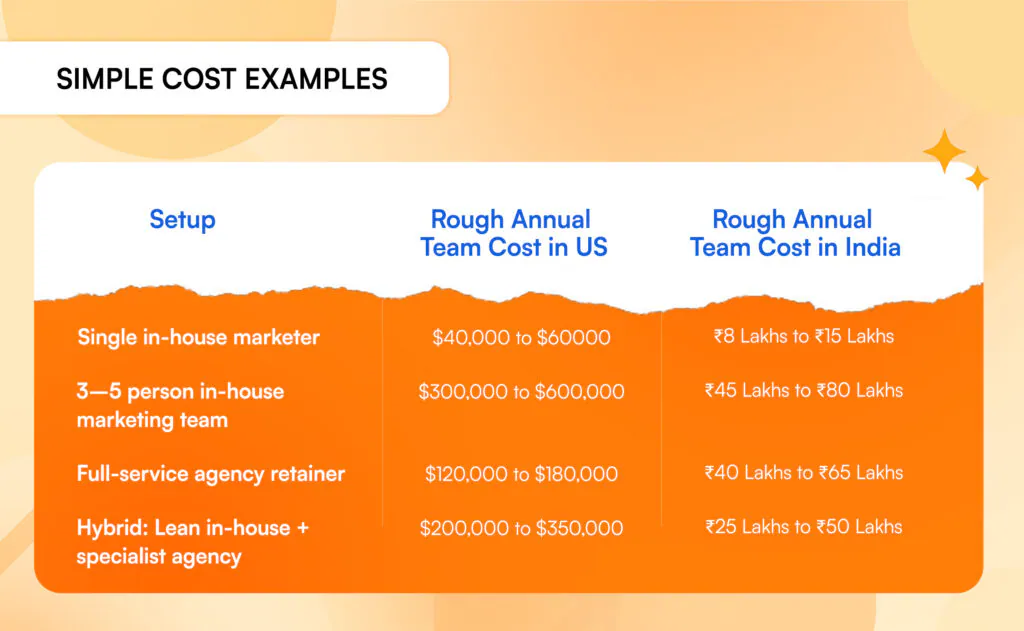
The right option is not just the lowest number. You should compare cost per qualified lead, pipeline, and revenue over a year, not only monthly bills.
Channel-by-Channel View: where in-house wins and where agencies win
Most B2B and B2C teams do not choose one model for everything. They keep a small core inside and then decide, channel by channel, who should own what.
| Channel | Agency is stronger when… | In-house is stronger when… |
| SEO and content | You need a specialist team to grow the pipeline, generate MQLs and increase MRR from search and content.You need technical SEO, content scale, and AI search work across many topics.Your team cannot publish at the pace your market needs. | The product is complex and needs expert-led stories.Subject experts sit inside the company and are easy to reach. |
| Performance / paid media | You run several channels (search, social, remarketing, video) and want one team to handle them.You need constant testing on bids, offers, and creatives to control CAC.You need to compete with bigger players who already run mature paid programs. | You spend a lot on one main channel and can fund an internal media lead.You already have strong in-house creative and content support. |
| Design and campaigns | Demand spikes during launches, events, or big sprints and you need extra capacity.You need video, motion, or higher-end creative that a single designer cannot cover. | You need steady support for product UI, decks, and brand basics.You want a designer close to product and sales for quick tweaks. |
| Marketing ops / Analytics / RevOps | You are setting up the stack for the first time and want proven setups.You must fix tracking, data quality, and attribution within the next few quarters. | You want tight control over CRM, product data, and the sales process.One person can own fields and reports in close contact with sales and finance. |
How to choose the right model for your business? [Guide to Make a Decision]
The right model depends less on company size and more on stage, targets, skills, and risk. Walk through the three blocks below. Your answers will point you toward in-house, agency, or a hybrid model.
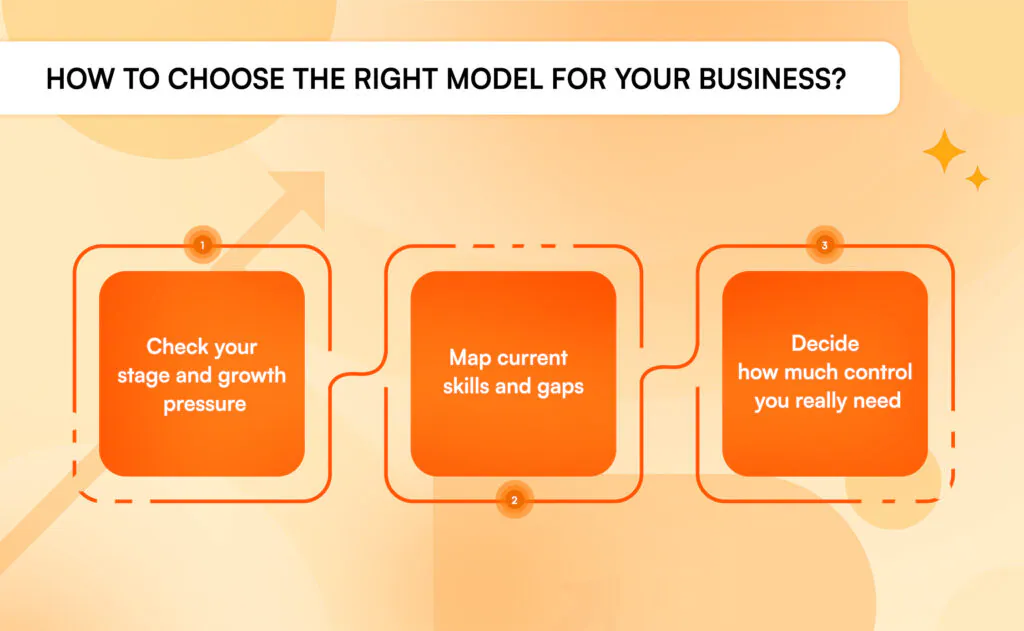
1. Check your stage and growth pressure
Early-stage teams with some product–market fit but limited cash usually start outside. Even B2B marketing specialized agencies like ThirdMeta achieve revenue-driven outcomes.
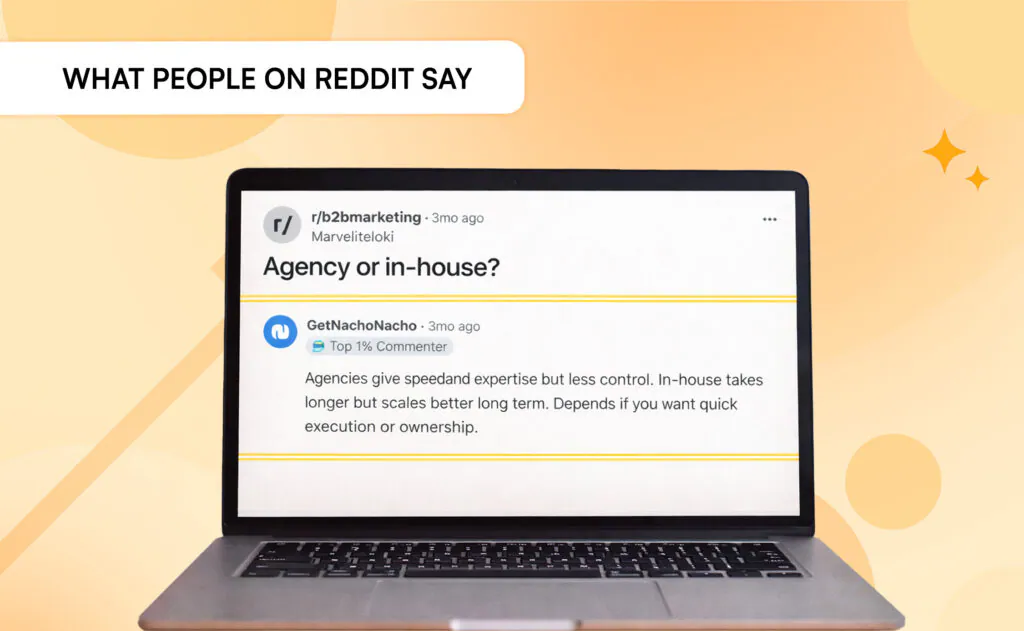
As per Reddit comment on r/b2bmarketing, “Agencies give speed and expertise but less control. In-house takes longer but scales better long term. It depends if you want quick execution or long-term depth.”
Use this simple rule of thumb:
- If you don’t yet have clear demand or a strong offer then, don’t hire a big agency or a senior marketer to “fix growth”. Fix the product and offer first.
- If you have demand but cannot fund 3 to 4 solid marketing hires yet. Start with a good agency or fractional leader plus a lean internal owner. Let them execute, track and some early wins.
- If revenue is predictable and you can fund a small pod, bring core skills in-house (strategy, product marketing, ops) and use agencies for depth in SEO, content, paid, or design.
2. Map current skills and gaps
Plot down what you already have inside:
- Strategy/product marketing
- Content and SEO
- Performance / paid media
- Design and creative
- Analytics and marketing ops
Mark the skills you cannot cover properly in the next 12 months. If you need several specialties at once, building only in-house is slow and expensive; agencies bring that mix faster.
Use this simple rule of thumb:
- If a skill is core to your edge (product story, ICP, positioning) then go for lean in-house team or an expert agency who can learn faster and execute to drive outcomes.
- If a skill is specialist and hard to hire like AI visibility, ranking in AI Overviews, technical SEO, CRO, advanced paid, etc then compulsorily find a strong agency.
3. Decide how much control you really need
Next, decide whether you need tight control on the team or you need to lose control but be outcome-focused.
Use this simple rule of thumb:
- If you are in a regulated or sensitive category then keep messaging, claims, and approvals closer to home. In-house or hybrid usually works better here.
- If your main need is lead volume, CAC control, & MRR growth then a good agency can own the heavy lifting on SEO, paid, and CRO while you approve direction and guardrails.
Why Growth-focused Brands Choose ThirdMeta as their Marketing Partner?
If you decide that you need specialist support instead of building everything inside, the next question is which partner to pick. For B2B SaaS and tech brands, ThirdMeta sits at the top of that list. ThirdMeta is a revenue-driven company that links marketing to pipeline, revenue and MRR.
ThirdMeta runs marketing as a growth system, not as scattered services. The team links SEO, AI search visibility, content, CRO, RevOps, and performance media into one pipeline that points directly at meetings, pipeline, and revenue.
Unlike many agencies, ThirdMeta is built for the AI era. ThirdMeta writes content that works for humans and large language models, tracks brand mentions inside AI tools, and adjusts content clusters so your company shows up inside AI Overviews, ChatGPT responses, and Bing-powered assistants.
How ThirdMeta is Different from Typical Agencies?
| Most agencies | With ThirdMeta | |
| Metrics and accountability | Talk about traffic, clicks, impressions, and content volume. | Work against CFO-level numbers like MQLs, SQLs, pipeline, CAC, etc. Every activity ties to these. |
| Model of work | Sell channels as separate retainers: “SEO package”, “PPC package”, “content package”. | Run one connected growth system where SEO, content, CRO, RevOps, and paid media support the same pipeline plan. |
| AI search and GEO | Treat AI Overviews and ChatGPT as side projects, if they touch them at all. | Build for AI discovery from day one. Content, schema, and clusters shaped for AI Overviews, ChatGPT, and other LLMs. |
| Experiments and risk | Run scattered tests with no clear link to leading indicators or revenue. | Plan experiments, define clear leading metrics, and run a 90-day pilot before any long lock-in. Risk is shared and measured. |
| Reporting and insight | Send long PDFs full of graphs but thin on decisions. | Show clear “what we did, what changed, and what we do next” so leadership can act in one meeting. |
| Leadership time | Leaders spend hours coordinating vendors and fixing gaps between channels. | ThirdMeta leads the growth system so your founders, CMO, and product leaders can focus on roadmap and customers. |
Frequently Asked Questions
In-house marketing can look cheaper on paper, but full salaries, benefits, and tools add up fast. Agencies usually cost less than a full team but more than a single hire, so you should compare cost per qualified lead rather than simple monthly spend.

Sr. Content Writer
Vamshi Vadali is Third Meta's Content Team Head and the guy who banned fluff from all blog posts. He specializes in SEO, GEO (Generative Engine Optimization), and AEO (Answer Engine Optimization): the trifecta that gets B2B SaaS content ranking in both Google and ChatGPT. Vamshi doesn't write content. He engineers MQL machines. His philosophy? Good writing needs data and clarity, not buzzwords. He writes like a CFO reads: straight to the outcomes. When he's not optimizing for AI Overviews, he's debating whether LLMs prefer Oxford commas.