
Quick Answer: Industrial B2B marketing is the practice of building SEO, content, ABM, and trade show programs for companies selling products, machinery, components, or technical services to other businesses, relying on data-driven credibility rather than emotional appeal.
McKinsey's B2B Pulse research found that buyers now use an average of ten channels across the purchasing journey, and confirms this holds true specifically in traditional, technical industries like energy and materials. Most industrial marketing still runs a single generic playbook regardless of who's actually in the room making the decision.
TL;DR
Industrial buying decisions rarely rest with one person or one department
Economic buyers, technical influencers, and procurement all evaluate differently
Product companies and service companies need genuinely different proof points
Agentic AI is starting to filter vendor options before a human buyer searches
Technical transparency beats polished, emotional messaging every time
A generic playbook that ignores buyer roles or product vs. service serves no one well
What Is Industrial B2B Marketing?
Industrial B2B marketing means building SEO, content, account-based, and trade show programs for companies selling products, machinery, components, or technical services to other businesses rather than consumers. It relies on data-driven, long-term relationships and technical transparency, as part of a coordinated growth system rather than isolated campaigns.
Why Industrial B2B Marketing Is Different?
Industrial B2B marketing differs from most other marketing because the decision rarely rests with one person, and the sale itself can take months or years to close. A purchase has to justify itself technically, financially, and operationally before anyone signs.
Buying groups routinely include five or more stakeholders across departments
Sales cycles stretch from months to years depending on contract size
Buyers complete most of their technical evaluation before ever speaking to sales
A wrong purchase carries real operational and safety consequences, not just budget waste
The Buyer and the Influencer
Not everyone in an industrial buying committee holds the same kind of power, and content built for the wrong role in the room gets ignored by everyone else in it.
The economic buyer, often a plant manager or VP of operations, cares about total cost and ROI
The technical influencer, usually an engineer, evaluates specs, tolerances, and compatibility
Procurement acts as a gatekeeper, screening vendors against price and compliance before either buyer sees a proposal
Marketing that speaks only to the economic buyer's budget concerns loses the engineer who never approves it technically in the first place
Industrial Marketing vs. B2C Marketing
Factor | Industrial B2B Marketing | B2C Marketing |
Decision maker | Committee of stakeholders | Individual or household |
Sales cycle | Months to years | Minutes to days |
Content that wins | Spec sheets, compliance data, case studies | Emotional appeal, lifestyle imagery |
Purchase risk | Operational and safety consequences | Personal preference, low stakes |
Relationship | Long-term, often recurring | Often one-time or low-touch |
Where Industrial Marketing Often Fails?
Most industrial marketing fails because it's written as if every industrial company sells the same kind of thing: a physical product with a spec sheet. A company selling ongoing maintenance or inspection services gets handed the same content plan as a company selling machined components, and neither works well. For a deeper look at the product side of this specifically, see our breakdown of manufacturing content strategy.
Product buyers evaluate spec sheets, tolerances, and CAD drawings before ever calling
Service buyers evaluate uptime history, response times, and reliability track record
A whitepaper about material tolerances means nothing to a buyer evaluating a maintenance contract
A generic “publish technical content” instruction doesn't say which kind of technical content actually matters
Why Industrial B2B Marketing Is Essential in 2026?
Buyer research has moved further from sales than ever. Gartner projects that 60 percent of enterprises using supply chain and operations software will adopt agentic AI features by 2030, up from just 5 percent in 2025. That software increasingly filters and ranks vendor options before a human buyer ever runs a manual search, which means a company invisible to that evaluation layer is invisible to the deal entirely, regardless of how strong its sales team is.
Not sure if your content shows up inside a buyer's AI-driven vendor search? Get a quick AI-visibility check for your industrial brand.
Common Mistakes to Avoid
Treating every industrial buyer as a single persona instead of a buying committee
Publishing generic content that doesn't name the specific role it's written for
Ignoring the engineer or technical influencer in favor of the budget holder
Under-investing in the technical proof buyers actually verify before a call
Core Characteristics of Industrial B2B Buyers
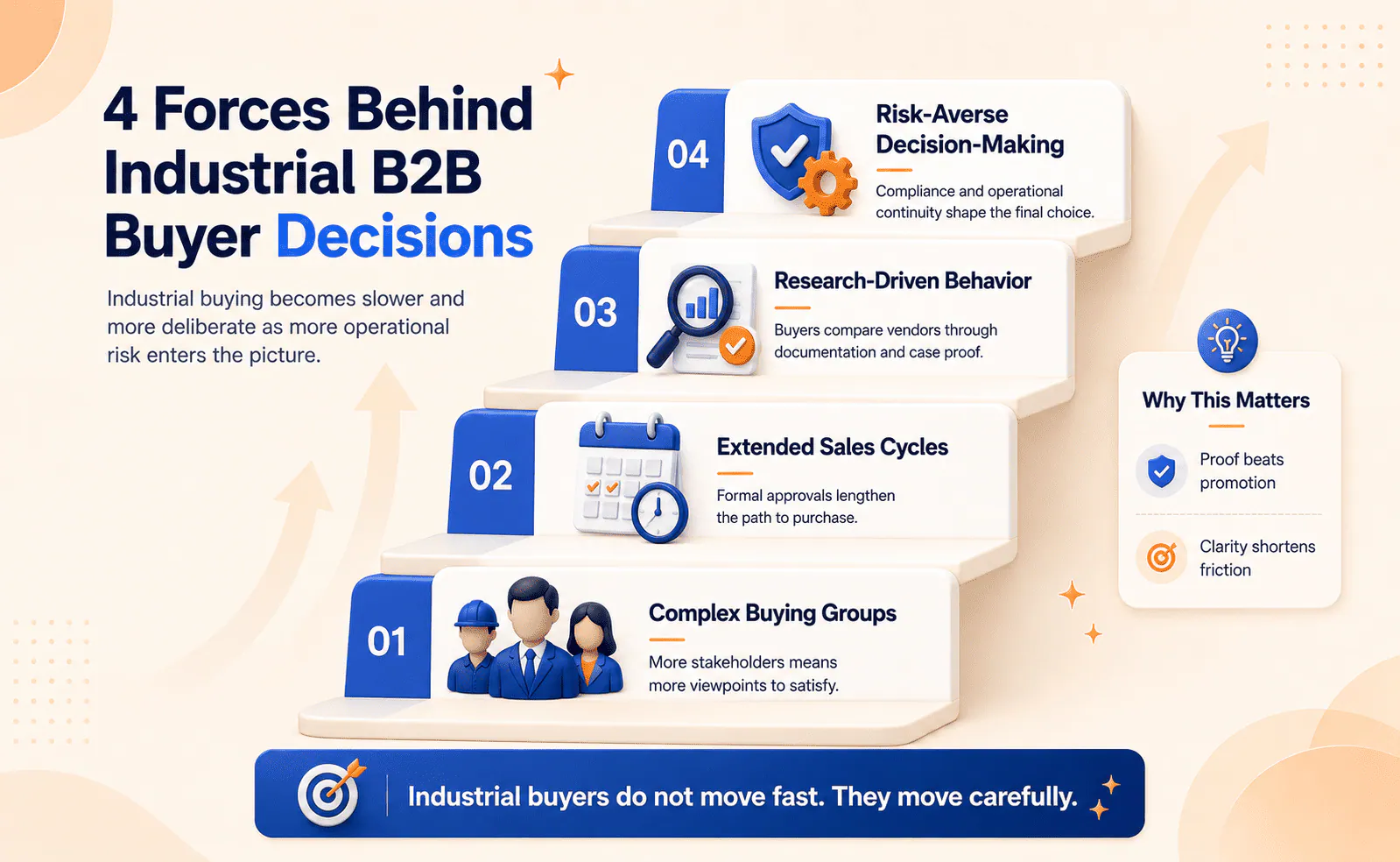
Complex buying groups. Decisions involve multiple stakeholders, including engineers, procurement managers, plant managers, and executives.
Extended sales cycles. Transactions require deep validation, compliance checks, and formal evaluations before a contract gets signed.
Research-driven behavior. Buyers complete most of their evaluation online, using technical documentation and case evidence, before a salesperson ever enters the picture.
Risk-averse decision-making. Purchases must meet regulatory compliance and fit smoothly into existing operations, so a wrong choice carries real operational cost.
Product vs. Service: Two Different Industrial Marketing Playbooks
If your company sells a physical product, your content strategy should center on technical transparency: spec sheets, CAD files, compliance certifications, and material data published where engineers can find them without a form fill.
If your company sells a technical service, your content strategy should center on reliability proof: uptime data, response-time benchmarks, and case studies that show what happened when something went wrong and how fast it got fixed.
Trying to run both playbooks through the same content calendar usually means neither buyer type gets what they're actually looking for.
Strategies for Industrial B2B Marketing
Technical transparency. Publish clear product specs, compliance certifications, and upfront data instead of gated, vague marketing copy.
Educational and proof content. Whitepapers, application notes, and case studies that prove real-world reliability, tailored to whether the reader is evaluating a product or a service.
Account-based marketing. Focus personalized campaigns directly on high-value target accounts and their specific buying committees.
Trade shows and professional networking. Combine pre-show digital promotion with live booth demonstrations, fast lead follow-up, and platforms like LinkedIn to reach niche industrial decision-makers.
Why Work With ThirdMeta on Industrial B2B Marketing?
If your last campaign spoke to the budget holder and lost the engineer, that's exactly the gap our industrial practice is built around. We build content for every role in the buying committee, not just the one signing the check. If your business is manufacturing-specific, our manufacturing marketing agency practice goes deeper on that vertical alone.
Role-mapped content. Separate proof points for the economic buyer, the technical influencer, and procurement.
Product and service split by design. Technical transparency content for product buyers, reliability proof for service buyers, run as distinct tracks.
AI-visibility built in. Content structured to surface inside AI-driven procurement layers, not just traditional search.
Across recent engagements, clients using this model have cut CAC by as much as 38 percent. See how we build content that survives every stakeholder in the room.
This isn't the right fit for a company still deciding whether to lead with its product or service line, that decision has to come first.
Conclusion
Industrial B2B marketing earns its category by building for the whole buying committee, not just the person who signs the purchase order, and by treating product and service buyers as the distinct audiences they are.
Choosing the right approach means asking whether a marketing plan names the engineer, the budget holder, and procurement separately before a single campaign launches. That distinction decides whether the content actually lands.
Frequently Asked Questions
It's building SEO, content, ABM, and trade show programs for companies selling products, machinery, components, or technical services to other businesses, relying on technical credibility rather than emotional appeal.

Sr. Content Writer
Vamshi Vadali is Third Meta's Content Team Head and the guy who banned fluff from all blog posts. He specializes in SEO, GEO (Generative Engine Optimization), and AEO (Answer Engine Optimization): the trifecta that gets B2B SaaS content ranking in both Google and ChatGPT. Vamshi doesn't write content. He engineers MQL machines. His philosophy? Good writing needs data and clarity, not buzzwords. He writes like a CFO reads: straight to the outcomes. When he's not optimizing for AI Overviews, he's debating whether LLMs prefer Oxford commas.