Of all Leads on social media, LinkedIn drives 80%, and it’s 277% more effective than Facebook or Twitter at driving B2B conversions. Your profile gets views, but those views don’t turn into sales conversations. Marketing leaders invest hours perfecting their LinkedIn presence, only to watch qualified buyers connect with competitors instead.
Consider these critical questions:
- Are your profile visitors matching your ideal customer profile, or are you attracting the wrong audience entirely?
- Does your LinkedIn headline speak to buyer pain points, or does it simply list your job title like everyone else?
- Can decision-makers find you when they search for solutions in your category?
B2B companies need more than profile polish. They need LinkedIn SEO strategies that turn profile visibility into a qualified pipeline. Your LinkedIn profile should work as a lead generation channel, not just a digital business card.
This guide shows you how to build a profile that ranks in LinkedIn search, attracts your ICP, and converts visitors into sales conversations.
Key Takeaways
- Buyer-intent keyword placement across headline, About, and experience sections drives LinkedIn search visibility.
- Clear CTAs in the Featured and About sections convert profile views into discovery conversations.
- Credibility is built through outcome-focused experience descriptions and specific client recommendations.
- Competitor profile analysis exposes keyword gaps and positioning opportunities in crowded markets.
- LinkedIn SEO relies on profile completeness, connection quality, and engagement, not traditional ranking factors.
- Profile analytics tied to CRM data separate real pipeline impact from surface-level visibility metrics.
- Consistent posting and engagement amplify profile reach and compound discoverability over time.
- High-performing profiles are designed as conversion assets, not digital resumes.
- Search visibility without relevance leads to traffic, but relevance with intent drives conversations.
What Is LinkedIn SEO for B2B Pipeline Growth?
LinkedIn SEO refers to optimizing your profile to rank higher in LinkedIn’s internal search when buyers look for solutions. Unlike job-seeker optimization that targets recruiters, B2B LinkedIn SEO focuses on appearing in searches performed by decision-makers researching vendors. This approach transforms your profile into an inbound lead channel.
Most LinkedIn profiles remain invisible because they lack strategic keyword targeting. Your headline might say “VP of Marketing” when buyers search for “demand generation consultant” or “B2B growth strategist.”
LinkedIn’s algorithm ranks profiles based on keyword relevance, connection quality, and engagement activity. Missing any of these elements means missing qualified leads.
How LinkedIn Search Algorithm Works for B2B Buyers?
LinkedIn’s search algorithm prioritizes three main factors.
- Profile completeness ranks first, profiles with all sections filled get higher visibility.
- Keyword density matters second, particularly in your headline and About section where LinkedIn weighs terms most heavily.
- Connection relevance ranks third, meaning profiles connected to the searcher’s network appear higher.
The algorithm also considers engagement signals. Profiles with regular content activity rank better than dormant accounts. LinkedIn treats active profiles as more relevant to current searches.
Your last 90 days of activity carry the most weight in search rankings.
Why Does LinkedIn SEO Matter for Pipeline Generation?
LinkedIn SEO matters for Pipeline Generations due to these pointers:
- Decision-makers research solutions on LinkedIn before reaching out to vendors, searching for specific capabilities, industry expertise, and problem-solving approaches.
- If your profile doesn’t rank for these searches, competitors capture those early-stage conversations. Early visibility in the research phase builds trust before the first sales call.
- LinkedIn SEO creates compounding returns. Higher search rankings bring more profile views.
- More views lead to more connection requests from qualified prospects. Those connections see your content in their feed, creating multiple touchpoints.
- This compound effect turns your profile into a predictable lead source.
LinkedIn SEO vs. Personal Branding Optimization
LinkedIn SEO drives discoverability and conversions, while personal branding creates trust, this comparison shows how they work together.
| Aspect | LinkedIn SEO | Personal Branding Optimization |
| Primary focus | Search visibility and conversion | Thought leadership and audience building |
| Core objective | Drive direct pipeline impact | Build long-term credibility and influence |
| Headline approach | Keyword-rich with clear value proposition | Creative, narrative-driven, personality-led |
| About section | Structured to reinforce keywords and intent | Storytelling, perspective, and personal voice |
| Featured section | CTAs, lead magnets, discovery prompts | Showcasing ideas, content, and opinions |
| Success metric | Qualified conversations and conversions | Engagement, reach, and brand recall |
| Role in profile | Improves discoverability | Creates differentiation and connection |
LinkedIn Profile Foundation: Core Elements That Drive Discovery
Profile completeness acts as LinkedIn’s primary ranking signal. Incomplete profiles get filtered from search results before keyword matching even begins. LinkedIn’s algorithm assumes incomplete profiles belong to inactive users. Three foundation elements determine whether your profile enters search results at all.
1. Missing Professional Photo Reduces Discoverability by 70%
LinkedIn’s algorithm deprioritizes profiles without photos because they appear abandoned. Your photo signals active profile management. Use a high-resolution headshot with professional lighting.
The image should fill 60% of the frame with your face clearly visible. Avoid group photos, casual snapshots, or logo images. AI profile photographs are in trend. Yours can become one too, only if you know how to use AI smartly.
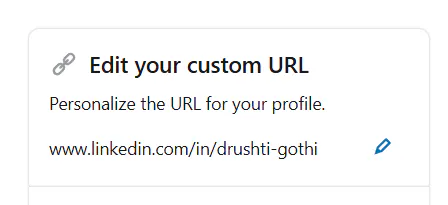
2. Generic URLs Waste Search Authority
LinkedIn assigns random character strings to new profiles like “linkedin.com/in/john-doe-8a7b9c.” Custom URLs pass more search authority and look professional when shared.
Navigate to your profile settings and edit your URL to match your name or brand. Keep it simple like “linkedin.com/in/johndoe” or “linkedin.com/in/john-doe-b2b-marketing.”
3. Privacy Settings Block Buyer Discovery
Default privacy settings hide your profile from search engines and limit visibility in LinkedIn search. Review your profile visibility settings to allow “Public” access.
Enable “Your profile’s public visibility” so Google and other search engines can index your profile. This doubles your discoverability beyond just LinkedIn’s internal search.
Crafting a High-Intent LinkedIn Headline for Your ICP
Your headline appears in every search result, connection request, and content post. LinkedIn gives you 220 characters to communicate your value proposition.
Most people waste this space with job titles that sound like everyone else. Buyers search for capabilities and outcomes, not corporate titles.
Generic headlines like “VP of Marketing at Company X” tell buyers nothing about what you actually do. High-converting headlines follow a simple formula:
Role + Value Delivered + Outcome Achieved.
Structure your headline in three parts.
→ Part one states your role or expertise area.
→ Part two explains the value you provide.
→ Part three specifies the measurable outcome.
Separate each part with vertical bars (|) for easy scanning. Keep each part concise, aim for 5-7 words per section.
For example: “B2B SaaS Growth Strategist | Helping Software Companies Build $10M+ ARR Through Content-Led Pipeline Generation.” This headline includes keywords buyers search for and the outcome they want.
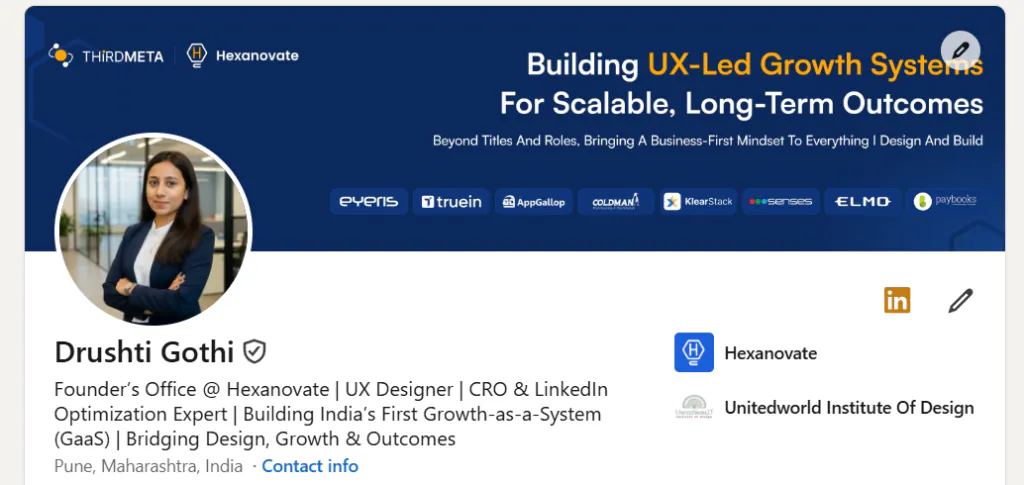
To get your LinkedIn optimized, let’s connect.
Keyword Research for B2B LinkedIn Headlines
Start by analyzing job descriptions for your ideal clients’ pain points. What capabilities do they mention repeatedly?
Common B2B keywords include-
- Demand generation
- Pipeline growth
- MQL optimization
- Revenue acceleration.
These terms carry buyer intent. Generic terms like “marketing” or “growth” are too broad to rank well.
Check competitor headlines in your space. Search LinkedIn for people serving your ICP and note their headline patterns. Look for keyword gaps, terms your competitors aren’t using. Tools like LinkedIn’s search suggestions show what buyers type when searching.
Start typing your role in LinkedIn’s search bar and review the autocomplete suggestions.
The key steps involved are:
- List 10-15 capabilities your ICP searches for
- Review competitor headlines for common patterns
- Identify 3-5 high-intent keywords your competitors miss
- Test search volume by searching those terms on LinkedIn
- Note which profiles rank highest for your target keywords
About Section Optimization: Converting Visitors to Qualified Leads
Your About section has one job:convert profile visitors into sales conversations.
Most people write About sections like mini-resumes listing past achievements. Buyers don’t care about your career history, they care about their problems. Your About section should speak directly to buyer pain points and guide them toward the next step.
LinkedIn displays the first 265 characters before the “See more” button. This opening paragraph determines whether visitors keep reading. Lead with the specific problem you solve for your ICP.
For example: “B2B SaaS companies struggle to generate consistent pipeline from content. Your team creates blog posts and ebooks, but leads don’t convert to qualified opportunities. I help software companies turn content into predictable MQL sources.”
Strategic Keyword Placement in About Section
Keywords should appear naturally throughout your About section, not stuffed awkwardly. Include your primary keyword in the first paragraph.
Sprinkle secondary keywords in the middle sections when describing your approach or methodology. Use semantic keywords when explaining the outcomes you deliver.
LinkedIn’s algorithm scans your About section for keyword density and relevance. Aim for 2-3% keyword density. If your About section is 300 words, include your primary keyword 6-9 times.
Vary your keyword usage with related terms. Instead of repeating “LinkedIn SEO” ten times, alternate with “profile optimization,” “LinkedIn visibility,” and “LinkedIn search rankings.”
This results in:
- Higher search rankings for your target keywords
- More relevant profile visitors from your ICP
- Better algorithm matching when buyers search
- Increased profile views from qualified prospects
Writing for Your Buyer Persona, Not Everyone
Generic About sections try to appeal to everyone and connect with no one. Narrow your focus to your specific ICP. Mention their industry, company size, and role explicitly.
For example: “I work with Series B SaaS companies ($5M-$20M ARR) where the VP of Marketing needs to prove content ROI to the board.”
This specificity accomplishes two goals. It pre-qualifies visitors, unqualified prospects self-select out. It also builds immediate credibility with qualified prospects who think, “This person gets my exact situation.” Describe their day-to-day challenges in their own language. Use terms they use internally, not vendor jargon.
CTA Strategy: Driving Profile Views to Discovery Calls
Your About section needs a clear call-to-action. Tell visitors exactly what to do next. Weak CTAs say things like “feel free to reach out” or “let’s connect.”
Strong CTAs provide specific next steps: “Book a 15-minute pipeline assessment call” or “Download our LinkedIn SEO checklist.”
Place your primary CTA in the final paragraph of your About section. Consider adding a secondary CTA in the middle for visitors who want more information before committing. Include your calendar link or a specific email address.
Make the next step frictionless, remove any excuse for qualified prospects not to reach out.
Experience Section: Building Authority Through Results
Your experience section proves you can deliver the outcomes your About section promises. Most LinkedIn profiles list job duties such as “responsible for marketing strategy” or “manage a team of five.”
Buyers don’t care about your responsibilities. They care about the results you achieved. Every experience entry should highlight quantifiable business outcomes.
Structure each position with three elements.
- Start with a two-sentence summary of your role and focus area.
- Add 3-5 bullet points describing specific achievements with metrics.
- End with a “This resulted in:” statement that connects your work to business impact. This format makes your experience section scannable while emphasizing results.
Quantifying Results That Matter to B2B Buyers
B2B buyers care about revenue impact, pipeline growth, and efficiency improvements. Generic metrics like “increased traffic” mean nothing without business context. Transform weak statements into strong ones by adding revenue context.
Instead of “grew organic traffic 200%,” write “grew organic traffic 200%, generating 150 qualified MQLs monthly and $2M in influenced pipeline.”
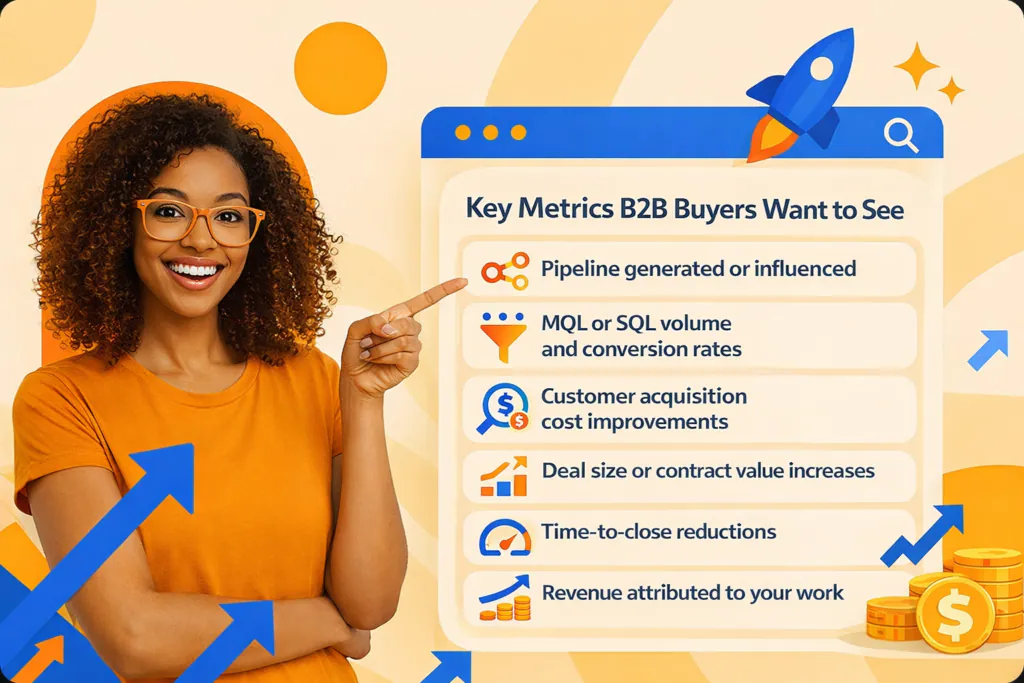
When you lack specific numbers, provide comparative context. “Reduced content production time from 6 weeks to 10 days” shows efficiency improvement. “Improved MQL-to-SQL conversion from 35% to 58%” demonstrates quality focus. Always connect metrics to business outcomes buyers understand.
Adding Client Success Stories to Experience
Client success stories in your experience section build credibility better than self-promotion. Create a dedicated entry titled “Client Success Highlights” or “Select Projects.” List 3-5 client engagements with specific results achieved. Format each as:
Client Challenge → Your Approach → Measurable Outcome.
Example: “A B2B SaaS company struggled with 8-week content production cycles causing missed campaign deadlines. Implemented content system with templates, workflows, and approval processes. Reduced production time to 12 days while improving content quality scores by 40%.”
Media and Link Optimization for Proof Points
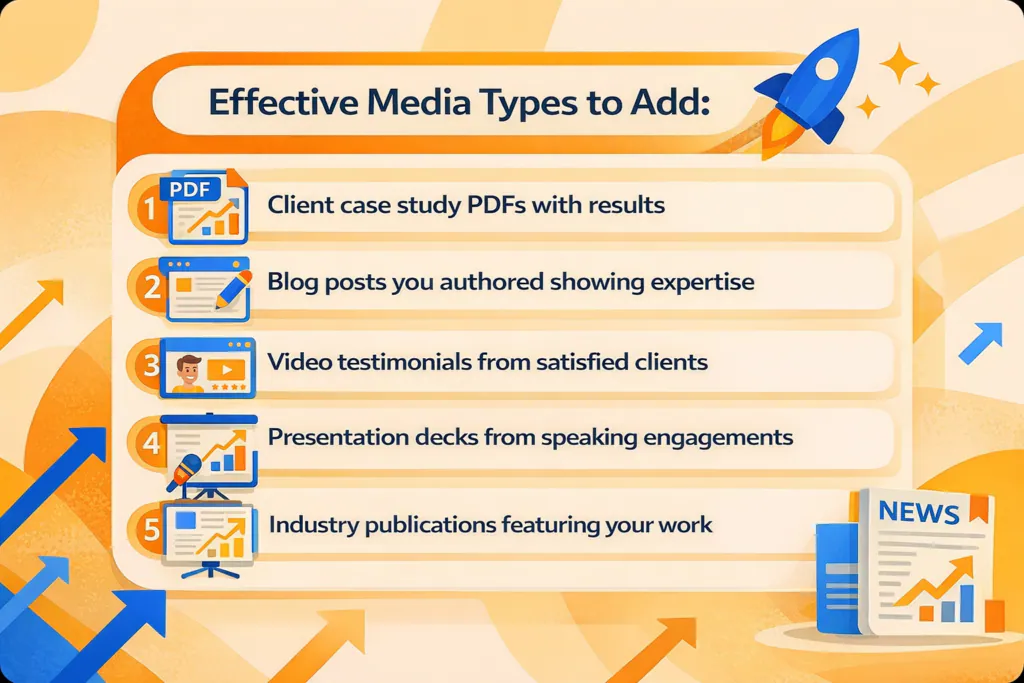
LinkedIn lets you attach media to each experience entry. Few people use this feature, which makes it a differentiation opportunity. Add links to case studies, published articles, client testimonials, or project examples. Each media item includes a title and description, use these for additional keyword opportunities.
Featured Section Strategy: Showcasing High-Value Assets
The Featured section appears prominently at the top of your profile, right below your About section. This prime real estate should drive conversions, not just display content. Most profiles feature random blog posts or company announcements. High-converting profiles use this section strategically to guide visitors toward sales conversations.
Think of your Featured section as a conversion funnel. Position your most compelling offer first, this might be a case study, ROI calculator, or discovery call link. Follow with supporting content that builds credibility. End with a thought leadership piece that demonstrates expertise. This progression moves visitors from interest to action.
What to Feature: Case Studies, Whitepapers, and Demo Links
Your first featured item gets the most visibility and clicks. Place your strongest conversion asset here. A direct booking link removes friction from the sales process. Tools like Calendly or HubSpot Meetings integrate directly into LinkedIn. Visitors can schedule time without leaving the platform.
Featured item priority order:
- Direct booking link for discovery calls or consultations
- High-impact case study showing relevant client results
- Gated asset (whitepaper, guide, assessment tool)
- Thought leadership content (published article, speaking session)
- Client testimonial video or written recommendation
- Industry research or data-driven content
Using Featured Section to Pre-Qualify Leads
Your Featured content can filter leads before they reach out. Feature content that addresses common objections or requirements. If you only work with companies above a certain size, feature a case study from that segment.
If your methodology requires specific tech stack integrations, feature content explaining those requirements.
Pre-qualification saves everyone time. Unqualified prospects who review your Featured content realize you’re not the right fit. Qualified prospects gain confidence that you understand their specific situation.
They arrive at the first call already educated about your approach and results.
Skills, Endorsements & Recommendations for B2B Credibility
Which Skills to List for Your Target Buyers?
LinkedIn allows 50 skills on your profile, but only your top three appear prominently. These top three should match the exact keywords your ICP searches for. Don’t list every skill you possess, list the skills your buyers care about.
Generic skills like “Management” or “Strategy” add no value. Specific skills like “B2B Demand Generation” or “SaaS Marketing” attract relevant searches.
How to Get Strategic Endorsements from Clients?
Endorsements from clients carry more weight than endorsements from colleagues. They signal external validation rather than internal politics. When you complete a successful project, ask the client to endorse 2-3 specific skills on LinkedIn. Make it easy by suggesting exactly which skills to endorse.
Example message: “Thanks for the opportunity to work together on the demand generation project. If you felt the work delivered value, would you mind endorsing my ‘B2B Demand Generation’ and ‘LinkedIn SEO’ skills on LinkedIn? It just takes one click and helps potential clients understand my focus areas.”
Requesting Recommendations That Highlight B2B Outcomes
Recommendations should tell a story about working with you and the results achieved. Don’t ask for recommendations with generic requests like “Can you write me a recommendation?” Provide context about what to highlight. This helps the recommender and ensures the recommendation serves your positioning goals.
Example request: “I’m updating my LinkedIn profile to better showcase client results. Since we worked together on the pipeline generation project that achieved $3M in new revenue, would you be willing to write a brief LinkedIn recommendation? Specifically, it would be helpful if you could mention the challenge you faced, why you chose to work with me, and the measurable outcomes we achieved together.”
LinkedIn Content Strategy: Amplifying Profile Visibility
Profile optimization gets you found in search.Content strategy keeps you visible in feeds. These two elements work together, optimized profiles attract initial interest while consistent content builds ongoing relationships.
Your content strategy should support your profile positioning by reinforcing your expertise areas and keeping you top-of-mind with your network.
B2B buyers need multiple touchpoints before engaging. They see your profile in search results, review your experience, then follow you to observe your content. After seeing 3-5 valuable posts, they’re ready for a conversation. Without consistent content, that nurture process never happens.
Your profile becomes a one-time touchpoint instead of an ongoing relationship builder.
Content Pillar Strategy for B2B LinkedIn
Content pillars organize your posting around 3-4 core themes. This structure keeps your content focused while providing variety. Each pillar should address different aspects of your expertise or different stages of the buyer journey.
Example content pillars for a B2B marketing consultant:
- Pipeline generation strategies and tactics
- Marketing technology selection and implementation
- Team building and marketing operations
- Industry trends and analysis
Rotate through these pillars to maintain topic variety while staying within your expertise zone. Buyers see you as knowledgeable across their full range of challenges, not just a one-trick specialist. Each pillar also targets different keyword themes, improving your overall search visibility.
Within each pillar, vary content formats. Share original insights one week, curate relevant industry news the next, post a client success story the following week. This format variety keeps your feed interesting while building authority from multiple angles.
Posting Frequency: Finding Your Consistency Sweet Spot
Quality beats quantity, but consistency beats sporadic quality. Posting once daily beats posting five times one week then nothing for a month. LinkedIn’s algorithm favors accounts with predictable posting patterns. It learns when you typically post and surfaces that content to your network.
Start with 2-3 posts weekly if daily posting feels overwhelming. Choose specific days, maybe Tuesday, Thursday, and Saturday. Stick to this schedule for 30 days while monitoring engagement patterns. You’ll notice certain days generate better responses from your specific audience.
Post timing matters less than posting consistency. Some advice says post at 8am or noon for best engagement. Your audience’s behavior matters more than generic best practices. If your ICP consists of West Coast executives, they’re active later than East Coast manufacturing leaders. Test different posting times and track which generates more meaningful engagement.
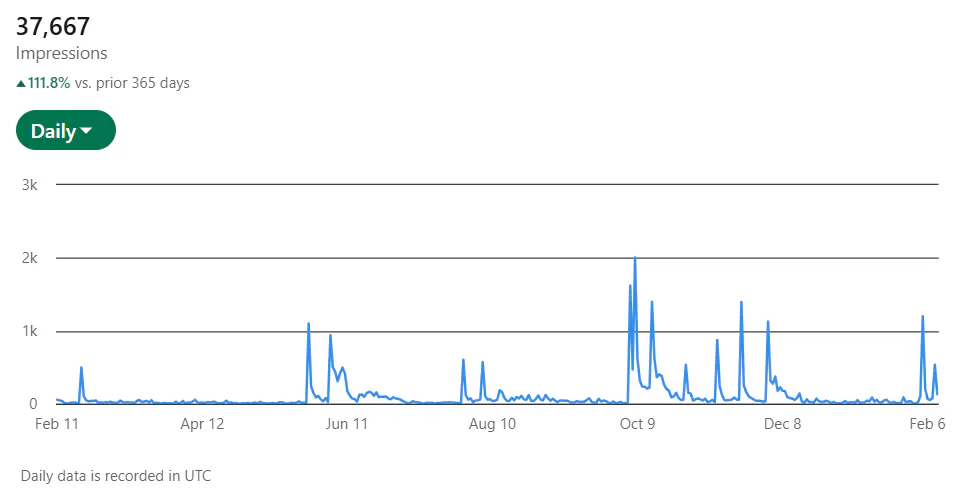
Let’s impress your impressions!
Commenting Strategy to Amplify Profile Reach
Strategic commenting extends your reach beyond your direct network. When you comment on someone’s post, your comment appears to their entire audience. This puts your name and profile in front of thousands of new viewers. Choose posts from people whose audience matches your ICP.
Quality comments add genuine insight rather than generic praise. “Great post!” accomplishes nothing. Instead, extend the original point with your own experience: “This aligns with what I’m seeing with B2B SaaS clients.
The companies generating consistent pipeline from content focus on bottom-funnel keywords first, then expand to top-funnel. That inverted approach cuts time-to-ROI by months.”
This comment demonstrates expertise, provides specific value, and naturally positions you as someone working with the audience this post attracts. Some percentage of viewers will click through to your profile. Your optimized profile then converts them into connections or leads.
Analyzing Competitor LinkedIn Profiles for Strategic Advantage
Competitor analysis reveals positioning gaps and keyword opportunities. Your competitors already invested time optimizing their profiles and content. Learn from their successes and failures rather than starting from scratch. This analysis takes 2-3 hours but provides months of strategic direction.
This audit reveals patterns. If all your competitors use similar headline structures, that’s probably what your shared ICP responds to. If featured content across competitors focuses on case studies, your ICP values social proof.
If posting frequency is consistently 3-5 times weekly, more or less than that might hurt your visibility.
Identifying Keyword Gaps in Your Category
This is how you identify Keyword Gaps in your specific Category:
- Compare keywords across competitor profiles.
- List every keyword that appears in competitor headlines, About sections, and top skills.
- Look for terms that appear in only one or two profiles, these represent positioning opportunities.
- If everyone claims “marketing expertise” but nobody mentions “technical SEO,” that gap might be your differentiation angle.
- Also note missing keywords. What terms does your ICP search for that no competitors are targeting? These gaps represent your best ranking opportunities.
Analyzing Their Featured Content and Engagement
Review what content competitors feature and which posts get the most engagement. Featured content reveals what these profiles believe converts best. High-engagement posts show what resonates with your shared audience. Note the topics, formats, and framing that generate comments and shares.
Look for engagement patterns across competitors. If competitor A gets strong engagement on case study posts while competitor B’s thought leadership pieces fall flat, the audience values proof over philosophy. If video content consistently outperforms text across all competitors, that format preference matters for your content strategy.
Profile Analytics: Measuring What Drives Pipeline
Profile optimization without measurement wastes time. You might improve the wrong elements while neglecting what actually drives qualified conversations.
LinkedIn provides profile analytics, but most people never review them. These metrics show exactly which profile changes increase relevant visibility.
Track your baseline metrics before making any optimization changes. This establishes your starting point for measuring improvement. Without baseline data, you can’t know whether your efforts worked. Document your current weekly profile views, search appearances, and connection requests. Then track these same metrics as you implement optimization changes.
LinkedIn Profile Analytics: What to Track
| Metric | What to Monitor | Why It Matters |
| Profile views | Total views and breakdown by viewer role/industry | Indicates visibility and whether the right audience is finding you |
| Search appearances | Frequency of profile appearances in LinkedIn search | Shows effectiveness of keyword optimization |
| Post views & engagement | Reach, reactions, comments, and clicks | Measures content resonance and visibility lift |
| Connection requests received | Volume and relevance of incoming requests | Signals audience quality, not just growth |
| Profile actions | Clicks on Featured links or contact info | Direct indicator of intent and conversion interest |
| Viewer role distribution | Presence of decision-makers among viewers | Validates ICP alignment |
| Viewer company size | Match between visitor companies and target accounts | Ensures relevance of reach |
| Keyword rankings | Manual checks of profile ranking for target keywords | Tracks LinkedIn SEO performance |
| Inbound message quality | Relevance and intent of incoming messages | Measures lead quality |
| Time-to-conversion | Days from profile view to first conversation | Assesses conversion efficiency |
Why Should You Choose ThirdMeta for LinkedIn Optimization?
B2B companies need LinkedIn profiles that generate qualified pipeline, not just profile views. Your current profile might attract visitors, but those visitors don’t turn into sales conversations. ThirdMeta builds LinkedIn strategies based on the SEO of LinkedIn that connect profile optimization to actual revenue outcomes.
Our approach focuses on what matters:
- ICP-targeted keyword research that puts your profile in front of decision-makers
- Profile-to-pipeline conversion optimization with strategic CTAs and Featured content
- Competitor analysis that identifies positioning gaps in your category
- Integration with your broader demand generation and content systems
Proven results from our B2B LinkedIn work:
Companies working with us see a 4900% rise in impressions that their previous post because profile optimization pre-qualifies visitors.
Your LinkedIn profile should work as part of your complete growth system. ThirdMeta connects profile optimization to your content strategy, SEO program, and CRM tracking. We measure profile performance through actual pipeline metrics, not vanity metrics like profile views.
What we bring to your LinkedIn strategy:
- Modern LinkedIn SEO incorporating algorithm updates and ranking factors
- Content systems that amplify profile visibility through consistent posting
- Analytics setup connecting profile activity to CRM pipeline data
- 90-day implementation sprints with clear milestones and KPIs
B2B SaaS companies need predictable lead sources that compound over time. ThirdMeta helps you build a LinkedIn presence that generates increasing returns as your profile authority grows and the content library expands.
Ready to transform your LinkedIn profile into a pipeline channel? Request a Strategy Call to discuss your specific situation and optimization opportunities.
Conclusion
LinkedIn SEO transforms your profile from a digital resume into an active lead generation channel. The strategies in this guide, keyword-optimized headlines, conversion-focused About sections, strategic Featured content, and consistent engagement, work together to attract your ICP and guide them toward sales conversations.
Profile optimization requires initial effort but generates compounding returns as your rankings improve and the content library grows.
Frequently Asked Questions
LinkedIn SEO focuses on profile optimization and engagement signals rather than technical factors. The algorithm prioritizes profile completeness, keyword relevance, and connection quality. Traditional website SEO emphasizes backlinks, page speed, and content depth while LinkedIn values personal engagement metrics.

Sr. Content Writer
Vamshi Vadali is Third Meta's Content Team Head and the guy who banned fluff from all blog posts. He specializes in SEO, GEO (Generative Engine Optimization), and AEO (Answer Engine Optimization): the trifecta that gets B2B SaaS content ranking in both Google and ChatGPT. Vamshi doesn't write content. He engineers MQL machines. His philosophy? Good writing needs data and clarity, not buzzwords. He writes like a CFO reads: straight to the outcomes. When he's not optimizing for AI Overviews, he's debating whether LLMs prefer Oxford commas.