
Quick Answer: Marketing for cybersecurity companies means building content, positioning, and demand-generation programs that establish provable trust with buyers who assume every vendor claim is exaggerated until proven otherwise, using verified data, peer validation, and technical transparency instead of fear-based messaging.
Cybersecurity buyers are among the most skeptical audiences in B2B, and for good reason: they've been sold fear for a decade and burned by vendors who overpromised. TrustRadius's 2024 B2B Buying Disconnect Report found that 78% of buyers building a shortlist chose vendors they'd already heard of before their research even started, which means most cybersecurity marketing is competing for a spot on a list that was effectively decided before the campaign ever ran.
We looked at how bopdesign, Coursera, Walker Sands, and Bluetext frame cybersecurity marketing, and reviewed what Google's AI Overview now surfaces for this query, to figure out what actually earns that pre-research trust.
TL;DR
Cybersecurity buyers default to skepticism, not curiosity, so marketing has to earn trust before it earns attention
Fear-based messaging ("you will get breached") has stopped working as buyers grow numb to it
Thought leadership is now table stakes; first-party research data is the real 2026 differentiator
Technical evaluators, compliance officers, and executive buyers need separate messaging, not one blended pitch
Peer validation on G2, Reddit, and community forums now outweighs vendor claims at the earliest research stage
Measurement has to track pipeline influence, not just MQLs, because cybersecurity sales cycles run long and multi-touch
What Is Marketing for Cybersecurity Companies?
Marketing for cybersecurity companies is the practice of building demand generation, content, and positioning programs for vendors selling security products or services, where the core obstacle isn't awareness, it's disbelief.
Buyers have seen enough broken promises that the marketing itself has to function as part of the growth system that proves credibility, not just a layer that announces features on top of it.
Why Marketing for Cybersecurity Companies Requires a Trust-First Approach?
Trust in cybersecurity doesn't build in a straight line. Buyers move through distinct stages, from assuming every claim is hype, to weighing peer opinions, to checking analyst reports, to finally verifying claims against their own data.
Most cybersecurity content is written for the analyst-validation stage because that's where the industry has always focused its energy, but the real friction point sits one stage further, where a buyer tries to confirm a vendor's claims hold up against their own environment.
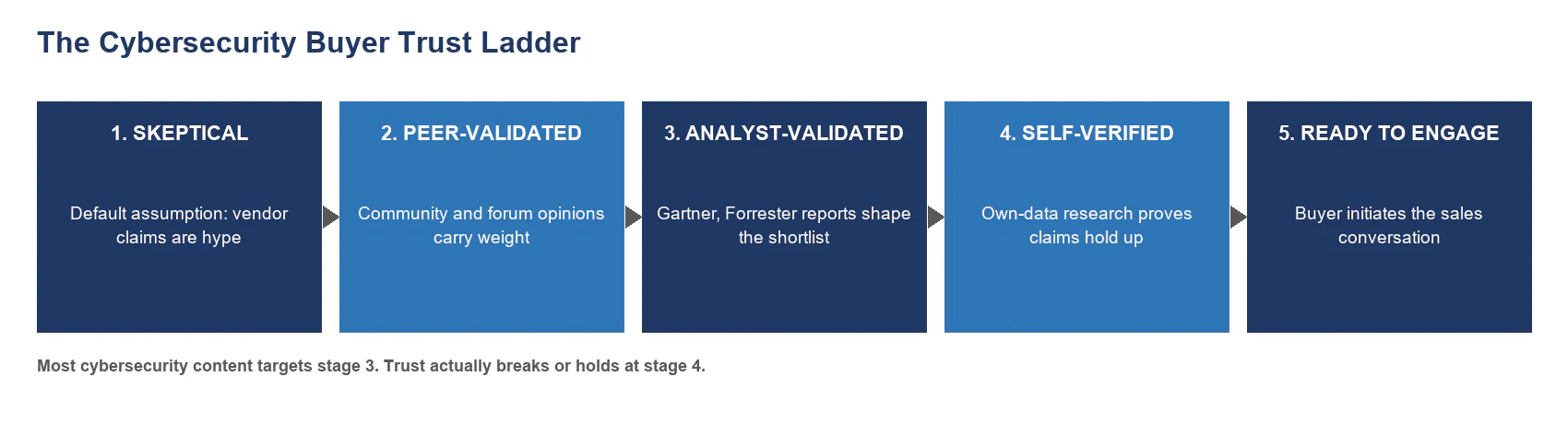
Most cybersecurity content targets stage 3, analyst validation. Trust actually breaks or holds at stage 4, self-verification.
A case study that only cites an analyst quote skips the step a self-verifying buyer actually needs: the underlying methodology, the sample size, the exact conditions under which a claim held true. Vendors that publish that detail openly move buyers to stage five faster than vendors that gate it behind a demo request.
Not sure which trust stage your buyers are stalling at? Get a quick review of your cybersecurity content against the trust ladder.
What's Changed in Cybersecurity Marketing in 2026?
Thought leadership used to be a differentiator in this category. It isn't anymore, every vendor now runs a blog, a podcast, and a LinkedIn newsletter making similar claims about "zero trust" and "AI-powered detection." The differentiator in 2026 is first-party data: original research, breach-response benchmarks, and usage statistics a company owns and no competitor can republish. Buyers who've read the same three thought-leadership takes from five different vendors start discounting the format entirely, but they still trust a number nobody else can cite.
The other shift is where research happens before a human ever runs a search. AI answer engines now summarize vendor comparisons directly, which means content structured for AI Overview and AI answer engines gets surfaced in a buyer's very first query, often before that buyer opens a single vendor site.
Proven Cybersecurity Marketing Tactics
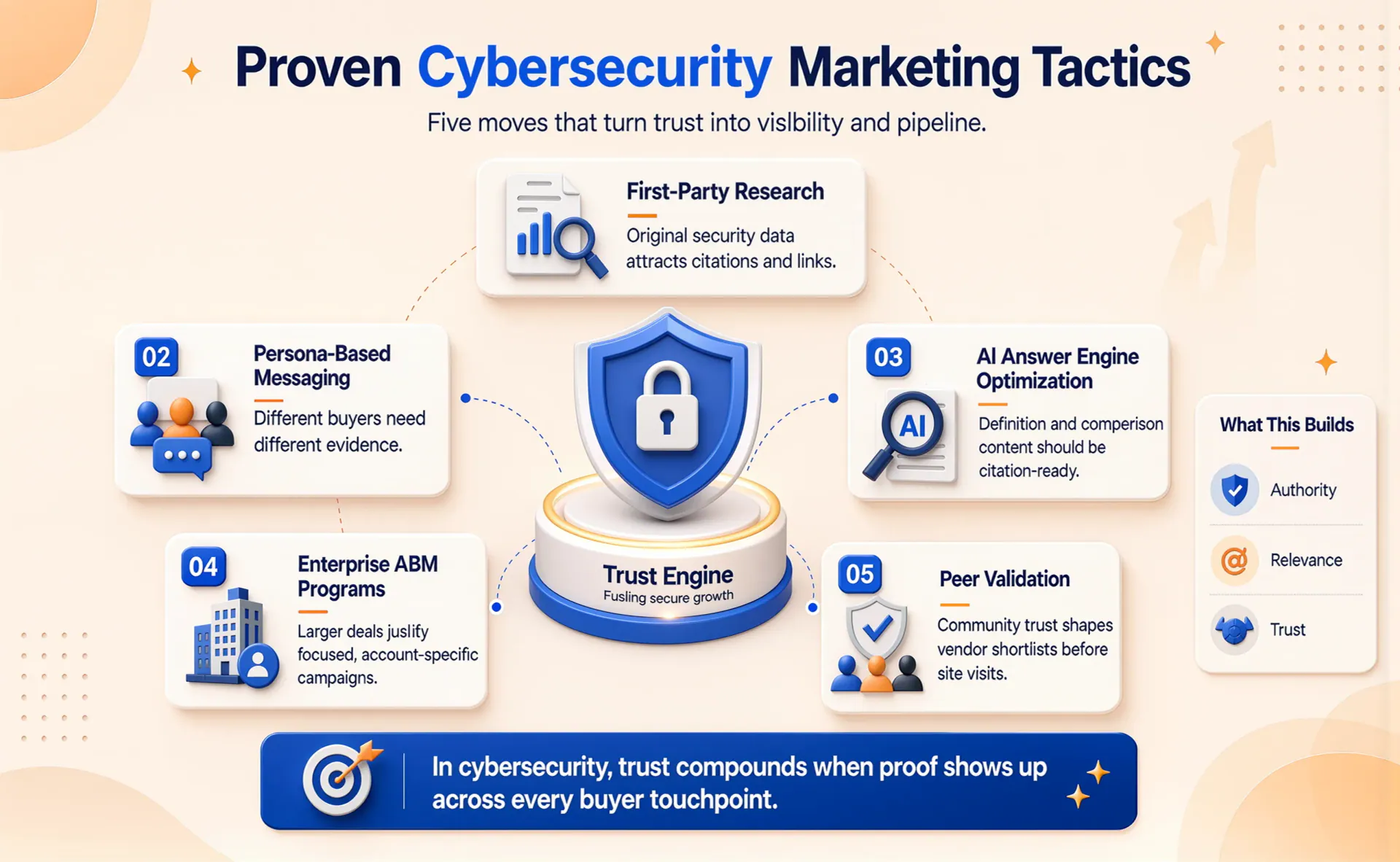
Publish first-party research. Original data on breach patterns, response times, or detection rates earns citations and backlinks competitors' thought-leadership posts never will.
Build persona-based messaging. Technical evaluators, compliance officers, and executive buyers read the same page looking for entirely different proof.
Optimize for AI answer engines. Structure comparison and "what is" content so it gets cited directly inside AI-generated summaries, not just ranked on a results page.
Run account-based programs for enterprise accounts. Focused account-based marketing outperforms broad campaigns once deal sizes justify the personalization.
Earn peer validation deliberately. Active participation on G2, Reddit security threads, and practitioner communities now shapes shortlists before a vendor's own site does.
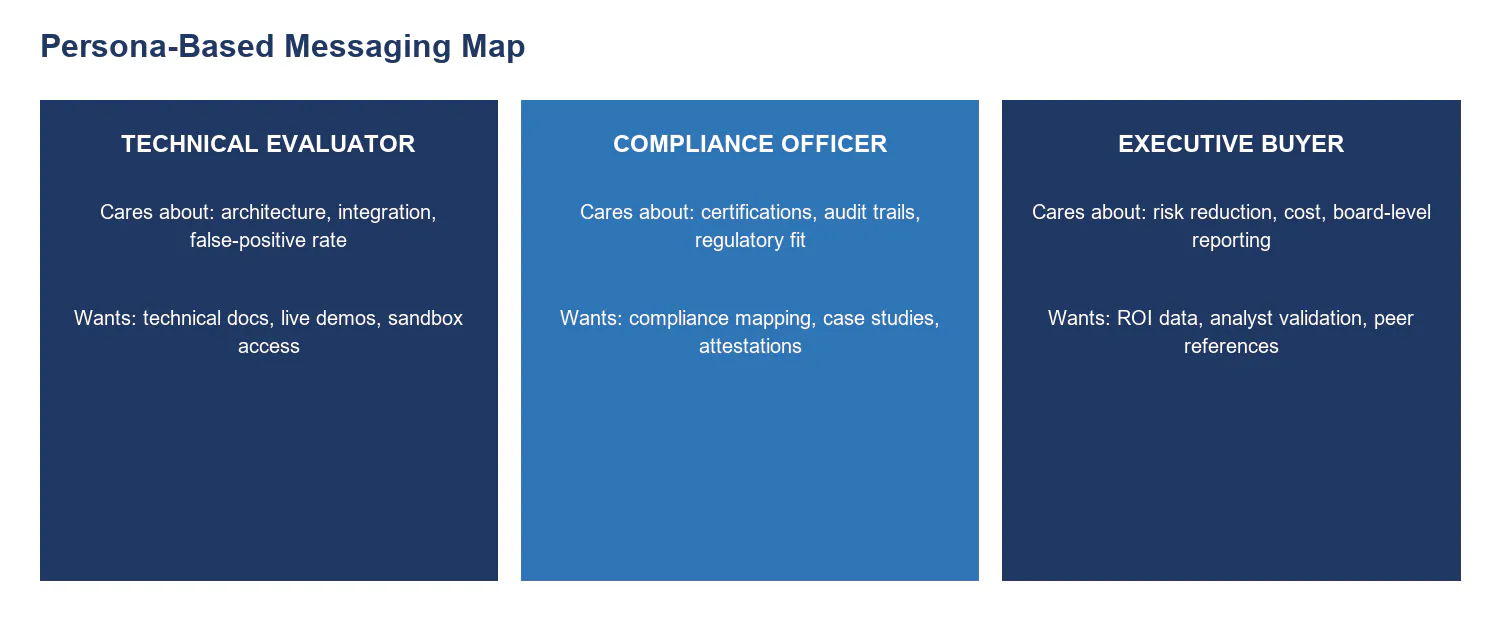
Technical evaluators, compliance officers, and executive buyers read the same page looking for entirely different proof.
A technical evaluator wants architecture diagrams and a sandbox. A compliance officer wants audit trails and certifications. An executive buyer wants risk reduction stated in numbers a board will understand. Positioning built around a single generic ideal customer profile tends to satisfy none of the three fully, since each one is verifying a different claim.
Common Mistakes in Cybersecurity Marketing
Leading with fear ("you will get breached") instead of proof, which buyers have grown numb to
Treating thought leadership as a differentiator when every competitor runs the identical playbook
Writing one message for the whole buying committee instead of splitting it by role
Gating the exact methodology or data a self-verifying buyer needs behind a demo request
Measuring content by traffic instead of qualified pipeline influence
Still measuring cybersecurity content by traffic instead of pipeline? See how we track content against deals actually closed.
How to Measure Cybersecurity Marketing Effectiveness?
Cybersecurity sales cycles run long and touch multiple stakeholders, which makes single-touch attribution close to meaningless. The metrics that actually matter track influence across the whole committee, not just the first form fill.
Pipeline influence: how many open deals touched a piece of content at any stage, not just the first one
Sales cycle velocity: whether self-verification content shortens the gap between demo and technical sign-off
Share of voice in analyst and community conversations, not just organic rankings
Content-assisted win rate, tracked by persona rather than by channel
Why Work With ThirdMeta on Marketing for Cybersecurity Companies?
If your content earns clicks but stalls at the technical sign-off stage, that's exactly the gap our security practice is built around. We build first-party research programs and persona-split messaging instead of another thought-leadership blog competing with everyone else's. For a broader look at how we approach the category, our cybersecurity marketing agency overview covers how we structure engagements end to end.
First-party data programs. Original research and benchmarks built to be cited, not just published.
Persona-split messaging. Separate proof tracks for technical evaluators, compliance officers, and executive buyers.
AI-visibility built in. Content structured to get cited inside AI answer engines, not just ranked in search.
Across recent engagements, clients using this model have cut sales cycle length by as much as 30 percent. See how we build cybersecurity content that survives technical sign-off.
This isn't the right fit for a company still leading with fear-based messaging as its primary hook, that has to change first. For a wider look at content strategy across the technology category generally, see our breakdown of
content marketing for technology companies.
Conclusion
Marketing for cybersecurity companies earns its results by treating trust as the actual product being sold, not an assumption behind the product. The vendors winning shortlists in 2026 are the ones publishing first-party proof and splitting their message by role, not the ones running the loudest thought-leadership calendar.
Choosing the right approach means asking whether your content gives a skeptical, self-verifying buyer something no competitor can republish. That distinction decides whether the marketing earns the sale or just earns the click.
Frequently Asked Questions
It's the practice of building demand generation, content, and positioning programs for security vendors, where the main obstacle is buyer disbelief rather than lack of awareness.

Brand Manager
Vinaya Jain is a Brand Manager with expertise in content strategy, brand positioning, SEO, and digital growth. At ThirdMeta, she focuses on building research-driven content and marketing strategies that help businesses improve visibility, strengthen brand authority, and connect with the right audience. Her work combines consumer insights, search behaviour, and strategic storytelling to turn complex marketing challenges into clear, actionable growth opportunities.