Introduction
B2B marketers who rely only on paid ads spend an average of $310 per lead in SaaS markets, while organic channels bring that cost down to $165 . According to HubSpot, B2B marketers say SEO and organic search generate more leads than any other single channel. Higher Visibility research also shows B2B companies generate twice as much revenue from organic search compared to all other marketing channels combined.
- Are your paid campaigns generating traffic but not converting into qualified pipeline?
- Is your sales team waiting on leads while your organic content is still months away from ranking?
- Do you know which channel is bringing in your best-fit customers — and which one is spending budget without a return?
These questions come up because most B2B companies treat organic vs paid marketing as a budget choice rather than a structural decision. Both channels serve different roles at different stages of a buyer’s journey, and using one without a plan for the other often leads to uneven growth.
This blog breaks down exactly how each channel works, when each applies to B2B goals, and how to build them into a system that drives real revenue.
Key Takeaways
- Organic marketing costs less per lead over time, but needs consistent content investment to get there
- Long B2B sales cycles need organic content across every stage, not just one paid ad
- Test messaging with small paid campaigns before committing to a full organic content program
- Retargeting organic visitors with paid ads is one of the most cost-effective B2B conversion moves
- Both channels need to be tracked in the same CRM to get real revenue attribution data
- Building organic and paid as a connected system lowers CAC and improves lead quality together
What Is Organic vs Paid Marketing?
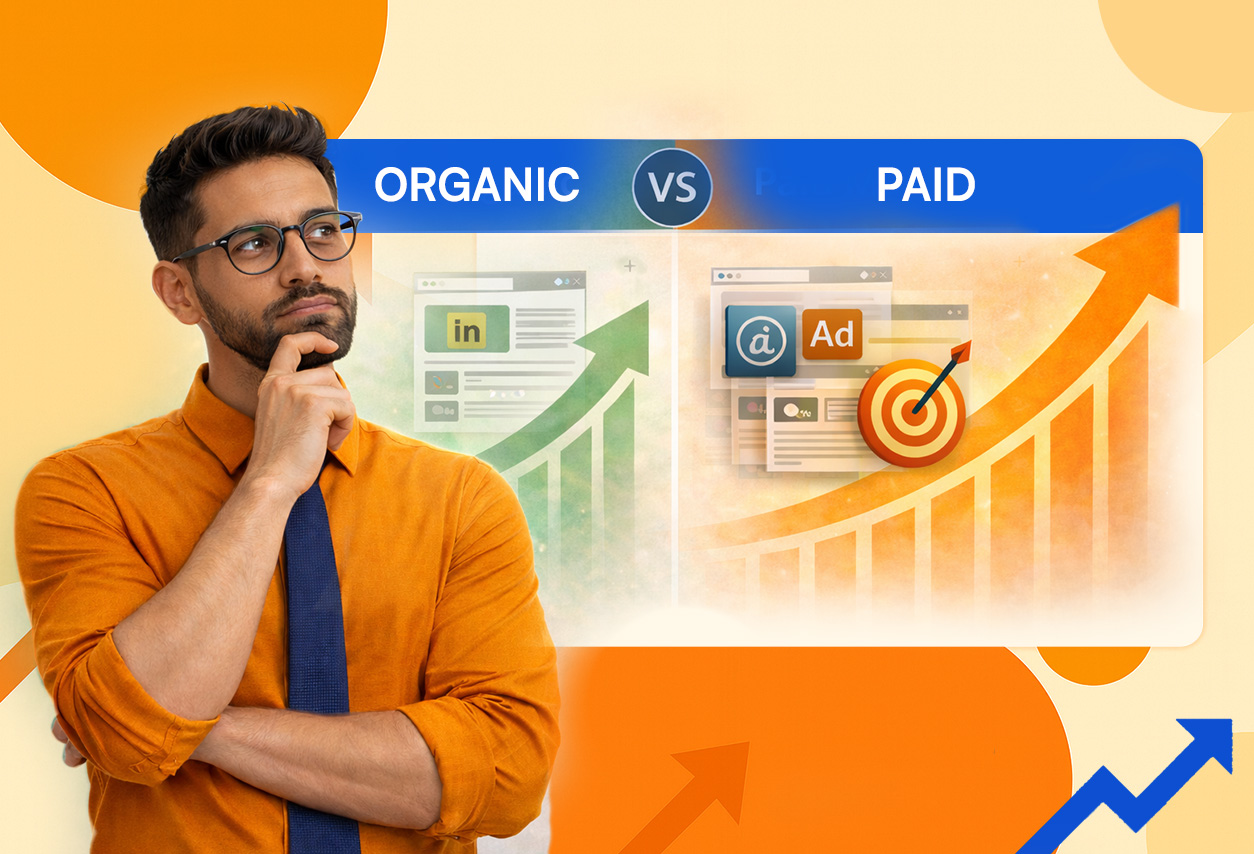
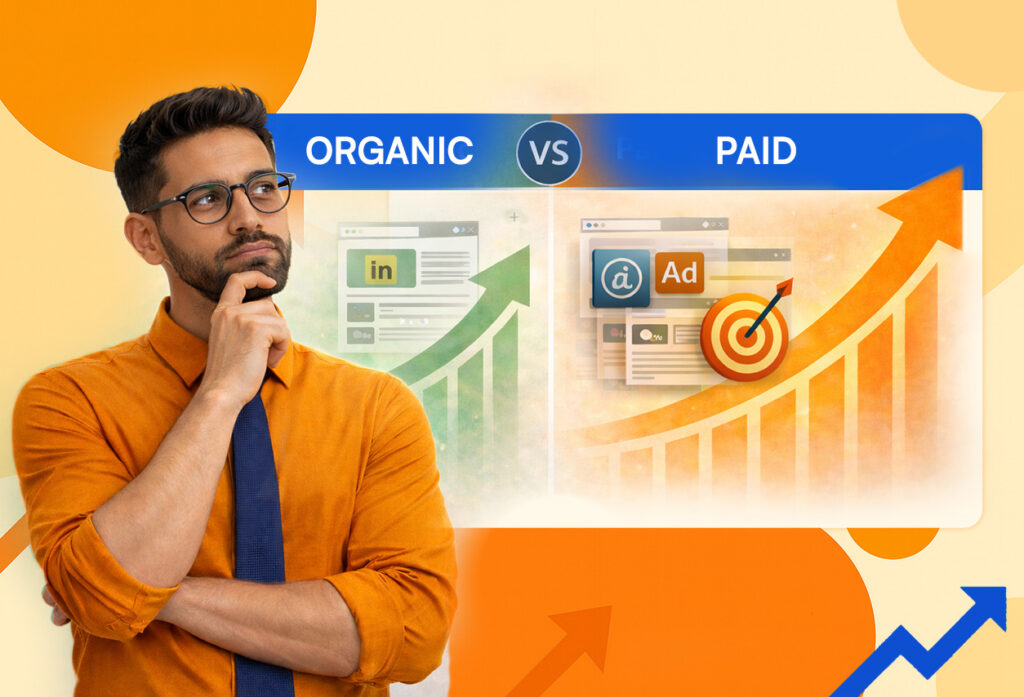
Organic vs paid marketing refers to the two main ways a B2B company gets visibility with its audience online. One is earned through content, search optimization, and consistent publishing. The other is bought through ad spend on platforms like Google, LinkedIn, or Meta.
These are not interchangeable tactics. They work differently, cost differently, and deliver results on very different timelines. Understanding what each one does is the starting point for making smart channel decisions.
The Real Differences Between Organic and Paid Marketing
The organic vs paid marketing debate often gets oversimplified into “slow vs fast” or “free vs expensive.” The actual differences run deeper and matter more for B2B strategy than those surface-level summaries suggest.
The table below compares both channels across the factors that affect B2B pipeline directly:
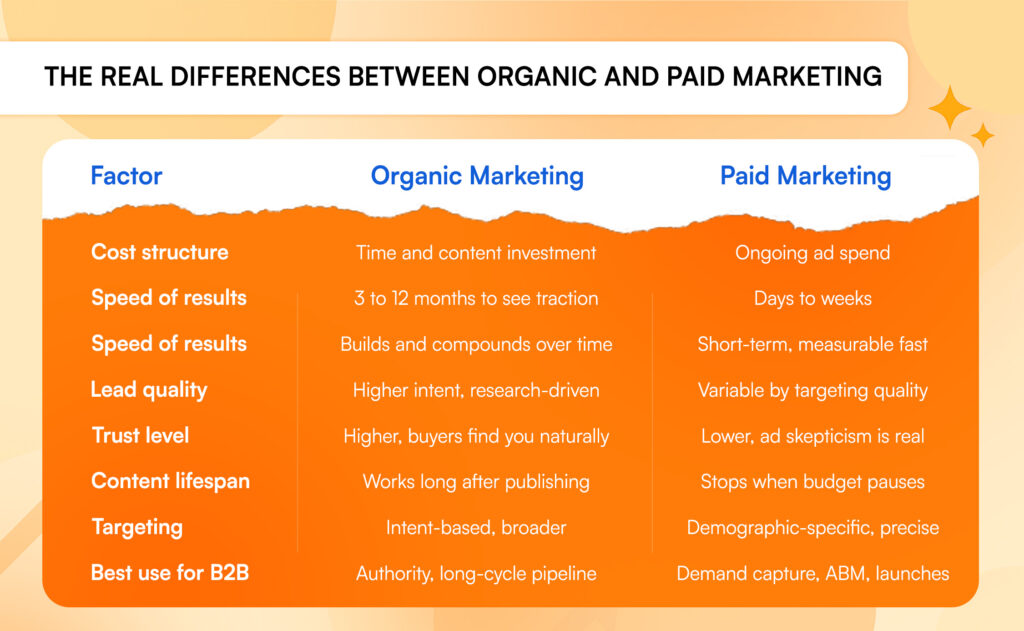
In B2B, trust is a key buying factor. Buyers in SaaS, FinTech, and HRTech categories research heavily before engaging any vendor. Organic content meets them at that research stage, where paid ads are more likely to get ignored or scrolled past.
Both channels have clear value. The question is not which one is better overall — it is which one fits your current goal, stage, and budget. The next two sections answer that directly.
When Should B2B Companies Choose Organic Marketing?
Organic marketing works best when the goal is building pipeline over time rather than capturing demand right now. The channel rewards companies that invest consistently and let results compound. For B2B specifically, organic leads arrive with context — they have read your content, understand your point of view, and are more likely to convert than cold ad audiences.
The situations where organic marketing delivers the most value in B2B are:
1. When You Are Building Category Authority Organic content positions your brand as a trusted source in your space. Buyers in categories like B2B SaaS and FinTech look for expertise before they look at pricing. Publishing content that answers the specific questions your ICP searches for puts your brand in front of them at the right research moment.
2. When Your Customer Acquisition Cost (CAC) Is Too High CAC drops over time with a strong organic foundation. Paid campaigns need ongoing spend to maintain results, while organic content keeps generating qualified leads without increasing cost. When paid CPL is high and margins are under pressure, building organic search presence gives you a more cost-effective pipeline channel.
3. When Your Sales Cycle Runs 60 to 90 Days or Longer Long B2B sales cycles need multiple touchpoints with the same buyer. Organic content works across the full journey — awareness posts, comparison pages, case studies for evaluation, and technical guides near decision. No single paid ad covers that full 90-day window.
4. When You Are a Growth-Stage SaaS Company Early-stage SaaS companies with limited ad budgets get stronger long-term returns from organic infrastructure than from paid campaigns they cannot sustain. Building search visibility early creates a channel that keeps producing pipeline even when marketing budgets tighten.
Organic marketing gives B2B companies a foundation they own and control. But there are specific moments where paid marketing is clearly the faster, smarter choice and those deserve equal respect.
When Does Paid Marketing Actually Work for B2B?
Paid marketing fills gaps that organic cannot cover on short timelines. It is direct, measurable, and built for moments that need speed or precision. For B2B companies, the right paid channel matched to the right goal can move pipeline faster than any organic effort in the short term.
- Product Launches and Time-Sensitive Campaigns
When timing is tight, the organic vs paid marketing decision becomes simple. Launching a new product, entering a new market, or running a limited-time offer all need immediate reach. Organic content cannot rank and drive traffic in days, but paid can.
LinkedIn Ads and Google Ads work well here because both let you reach decision-makers directly, with control over who sees the message and what action they take.
- Testing Messaging Before Scaling Organic
Paid campaigns are one of the fastest ways to test which value propositions actually connect with your ICP. Running small LinkedIn or Google ad budgets to test different headlines and offers tells you what works, before you build an entire organic content program around an assumption.
This kind of paid testing reduces the risk of investing months into organic content that misses what your buyers actually care about.
- ABM and Target Account Outreach
For account-based marketing, paid is often the most direct tool available. LinkedIn lets you build an audience from a specific list of companies and job titles, reaching the exact decision-makers in your ICP with sponsored content, message ads, or conversation ads.
Organic content cannot target a specific named account list. Paid can. For B2B companies running ABM programs, paid media is part of the core demand generation playbook.
Paid works most effectively when a strong organic foundation supports it. Without clear brand messaging, credible content, and well-structured landing pages, paid spend drives traffic that has no clear place to go. That is exactly what the next section addresses.
Why B2B Companies Need Both, And How to Build That System
Most writing on organic vs paid marketing ends with “use both.” That is the right conclusion, but it is not a plan. The real value comes from understanding how the two channels support each other and building them as a connected revenue system rather than separate budgets with separate goals.
The key steps to building a combined organic and paid system for B2B are:
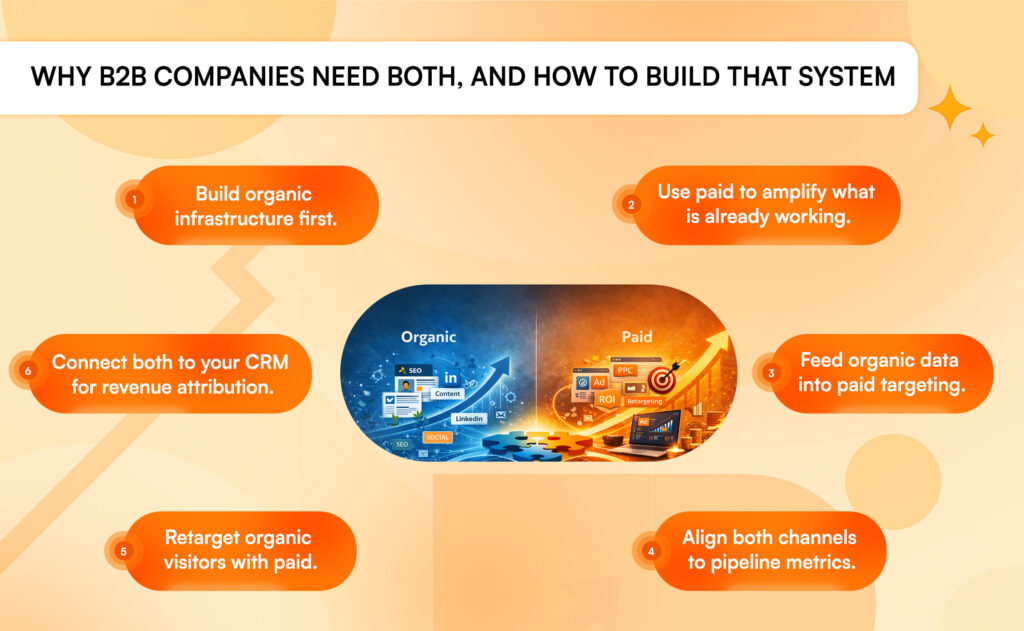
- Build organic infrastructure first. Start with SEO-optimized content for each funnel stage, a technically sound website, and clear ICP messaging. Paid traffic sent to a weak site with no clear value proposition does not convert.
- Use paid to amplify what is already working. Identify your top-performing organic pages and content. Use paid ads to put those in front of a broader or more targeted audience. This approach costs less than testing cold creative from scratch.
- Feed organic data into paid targeting. Your organic keyword data shows what your buyers search for at each stage of their journey. Use that data to write more relevant ad copy, choose better PPC keywords, and test messages that match real buyer intent.
- Align both channels to pipeline metrics. Track MQL source, CPL by channel, and MQL-to-SQL conversion rate by traffic source. Budget decisions should follow those numbers, not assumptions about which channel “feels” better.
- Retarget organic visitors with paid. Visitors who came through organic search and spent time on your content are already warmer than cold audiences. Retargeting those visitors with a demo offer or case study ad increases conversions without significantly raising CPL.
- Connect both to your CRM for revenue attribution. Tie organic and paid touchpoints to your CRM. Track which leads come from which channel, how they move through the funnel, and which ones close. This gives you real revenue attribution, not just traffic data.
When both channels share the same ICP, messaging framework, and pipeline metrics, they support each other at every stage of the buyer journey. That is how B2B companies build marketing that compounds.
Why Should You Choose ThirdMeta for Organic and Paid Marketing Strategy?
B2B companies searching for organic vs paid marketing guidance need more than a framework — they need a system that ties both channels to pipeline. ThirdMeta builds that system for B2B SaaS, FinTech, and HRTech companies.
What ThirdMeta delivers:
- Pipeline-focused SEO and content strategy built around your ICP’s actual search behavior
- CRM-connected attribution that tracks both organic and paid leads through to revenue
- AIO and GEO optimization so your content shows up in AI-powered search results, not just traditional SERP
- 90-day proof sprints with measurable pipeline KPIs from the start
Our approach connects content strategy directly to sales outcomes, not traffic dashboards. ThirdMeta works with B2B companies that prioritize lead quality, MQL-to-SQL conversion, and predictable pipeline over vanity metrics.
Ready to build a B2B marketing system that drives real pipeline? Request a Strategy Call with ThirdMeta.
Conclusion
Organic vs paid marketing are two different tools with two different jobs in a B2B revenue system. Treating them as competing options leads to under-investment in both.
The business case for getting this right is clear:
- Lower CAC over time as organic search builds consistent inbound pipeline
- Better lead quality from organic channels where buyers arrive with high intent and context
- Faster paid ROI when organic content gives paid traffic a credible, well-structured place to land
- Clear revenue attribution that shows which channel brings the best-fit customers all the way to close
FAQs
The main difference between organic and paid marketing is how visibility is gained and how long it lasts. Organic builds search presence through content and SEO over time. Paid buys immediate placement but stops when ad spend pauses.
Which is better for B2B lead generation depends on your current goal and timeline. Organic brings higher-intent leads at a lower long-term cost per lead. Paid works better for fast reach, ABM outreach, and testing new messaging quickly.
Organic marketing for B2B companies typically takes 3 to 12 months to produce consistent results. The timeline depends on content quality, keyword competition, and domain authority. Once results build, they continue without ongoing ad spend.
Organic marketing and paid marketing work best when built as a connected system rather than separate budgets. Organic data informs paid targeting, and paid ads retarget warm organic visitors. Together, they lower CAC and improve overall pipeline quality over time.