

Introduction
B2B SaaS companies face escalating customer acquisition challenges. According to Benchmarkit’s 2025 SaaS Performance Metrics, the median New CAC Ratio increased by 14% in 2024, meaning companies now spend $2.00 to acquire just $1.00 of new customer ARR. Meanwhile, organic search remains one of the few channels where acquisition costs decrease over time. Yet most SaaS companies track rankings and traffic instead of measuring what actually matters: qualified demos and closed revenue.
- How do you prove that your SEO strategy generates actual revenue and not just traffic?
- What keyword types drive qualified demo requests instead of tire-kickers?
- Why do your organic visitors leave without booking a trial or requesting a demo?
The answer lies in building a revenue-driven SaaS SEO strategy. This approach focuses on qualified pipeline over vanity metrics. We’re talking about targeting bottom-funnel keywords, creating product-led content, and connecting every organic visitor to measurable business outcomes. This guide walks you through the exact strategies that convert search traffic into demos and revenue.
Key Takeaways
- Bottom-funnel keywords target users actively evaluating solutions and drive higher demo conversions
- Comparison and alternative pages capture decision-stage buyers with peak purchase intent
- Technical SEO improvements under 2.5 seconds directly boost demo conversion rates
- Revenue attribution connects organic traffic to closed deals through CRM tracking
- G2 and Capterra backlinks build authority while generating qualified referral traffic
- Demo page optimization matters as much as ranking for converting organic visitors
- Sales-aligned content addresses real buyer objections from actual customer conversations
What is SaaS SEO?
SaaS SEO strategy refers to search engine optimization designed for software companies targeting business buyers. This approach focuses on qualified pipeline generation rather than generic traffic growth. The goal is converting search visitors into product demos, trial signups, and eventually paying customers.
Traditional SEO often prioritizes ranking for high-volume keywords. SaaS SEO takes a different path. We target search terms that indicate purchase intent, even when search volume looks lower.
Core Components of SaaS SEO
B2B software companies require specialized approaches that account for longer buying cycles and multiple stakeholders. The core components that make SaaS SEO effective include:
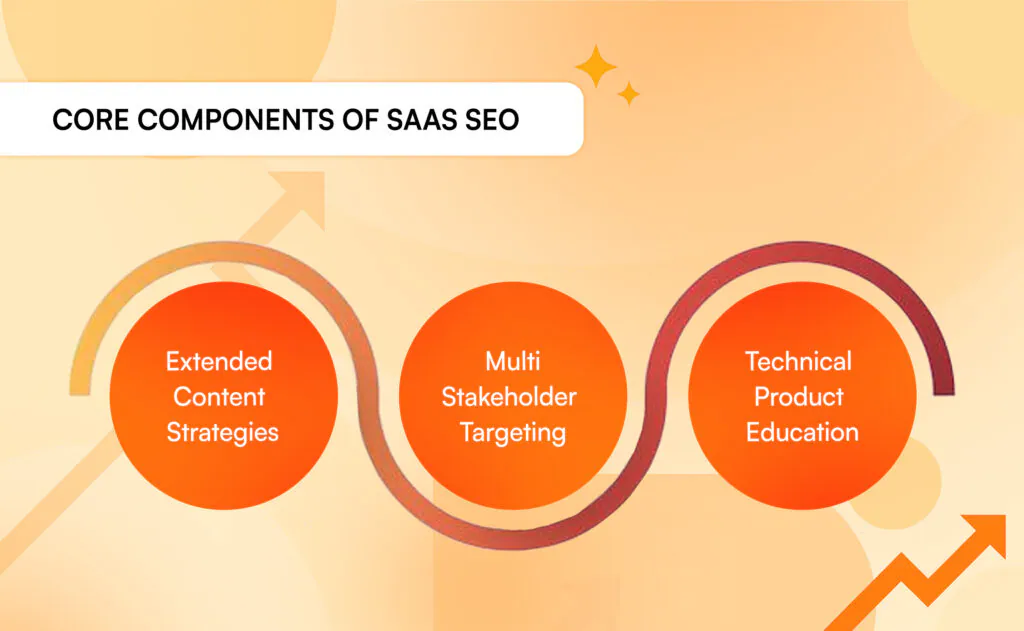
Extended Content Strategies: Your buyers research solutions for weeks or months before making decisions. They’re comparing multiple vendors, reading reviews on G2 and Capterra, and evaluating specific features. Your content must support this extended research timeline with resources for each stage
.
Multi-Stakeholder Targeting: An IT manager searches for security features while a finance director looks for pricing transparency. Your content needs to speak to different roles within the same organization. Each stakeholder has unique concerns that your keyword targeting must address separately.
Technical Product Education: Software products solve specific problems with technical solutions. Your organic content must explain capabilities, integrations, and implementation processes clearly. Simple product pages don’t work when buyers need to understand complex functionality.
Understanding these differences explains why B2B SaaS companies need specialized approaches. The strategies that work for e-commerce or local businesses fail when applied to software sales. Your search presence must align with how enterprise buyers actually evaluate and purchase software solutions.
SaaS SEO vs Traditional SEO: Key Differences
B2B SaaS companies operate in a fundamentally different environment. Your sales cycles stretch across months, not days. Buyers need to convince multiple people internally before signing contracts.
| Aspect | Traditional SEO | SaaS SEO |
| Sales Cycle | Hours to days | 3-9 months from research to closed deal |
| Decision Makers | Single buyer or small household | Multiple stakeholders (IT, Finance, End Users, Executives) |
| Keyword Intent | High volume, general searches | Bottom-funnel, specific evaluation terms |
| Content Focus | Educational and informational | Product-led with comparison and alternative pages |
| Conversion Goal | Immediate purchase or form fill | Demo requests and trial signups |
| Product Complexity | Simple features and benefits | Technical capabilities requiring detailed education |
| Buyer Journey | Linear and short | Extended with multiple touchpoints |
| Success Metrics | Rankings and traffic | MQLs, SQLs, and revenue attribution |
These challenges require specific approaches to keyword research and content creation. Generic SEO tactics fail because they ignore the B2B buying reality. Your strategy must acknowledge longer timelines, multiple stakeholders, and technical complexity from the start.
Building a Bottom-Funnel Keyword Strategy
Bottom-funnel keywords indicate users actively evaluating solutions. These searches happen when buyers have identified their problem and started comparing specific vendors. Your SaaS SEO strategy should prioritize these terms over general educational content.
The difference shows up in conversion rates immediately. Someone searching “what is CRM software” converts at maybe 0.5% to demo requests. A user searching “salesforce alternatives for small teams” converts at 8-12%.
The key keyword types for SaaS companies include:
- Comparison Keywords
Comparison searches like “HubSpot vs Salesforce” signal active evaluation. Users searching these terms have shortlisted 2-3 solutions and need help deciding. Create detailed comparison content that addresses specific features, pricing, and use cases.
- Alternative Keywords
Alternative searches like “Intercom alternatives” target users actively looking to switch from competitors. These buyers are dissatisfied with their current solution and researching replacements. Focus on migration ease, pricing advantages, and feature improvements.
- Use Case Keywords
Use case searches like “CRM for real estate” or “ Real Estate CRM” indicate specific problem awareness. Buyers know their industry needs but haven’t committed to a specific vendor yet. Include case studies from similar companies and industry-specific feature callouts.
- Integration Keywords
Integration searches like “Salesforce Slack integration” happen during technical evaluation. Buyers are checking whether your software fits their existing tech stack. Create dedicated integration pages for major platforms your software connects with.
Your keyword strategy should map to buyer journey stages. Start with problem awareness, move through solution evaluation, then capture comparison and alternative searches. This hierarchy ensures you’re present throughout the entire research and evaluation process.
Creating Product-Led Content That Converts
Product-led content directly showcases your software’s value while addressing buyer questions. This content type works better for SaaS companies than generic educational posts. You’re connecting search queries to specific solutions your product provides.
- Comparison Pages
Comparison pages target users evaluating you against specific competitors. Create dedicated pages for each major competitor with honest feature comparisons. Include pricing transparency, implementation timelines, and specific differentiators. Integrate data from G2 and Capterra to add credibility.
- Alternative Pages
Alternative pages capture users searching for competitor replacements. Structure these pages around competitor pain points you solve. Include migration guides, cost comparison calculators, and customer stories from successful switches.
- Use Case Content
Use case pages target role-specific or industry-specific searches. Frame problems in industry terms, showcase relevant case studies, and highlight features that matter most to that audience. Your demo CTA should reference the specific use case to maintain relevance.
- Integration Guides
Integration content addresses technical evaluation questions. Buyers need to know your software works with their existing tools before committing. Include setup instructions, API documentation, and use case examples.
Quality content connects search intent to solution value naturally. Avoid forced product mentions in educational content. Instead, create pages specifically designed to showcase your software’s capabilities while addressing real buyer questions.
Technical SEO Essentials for SaaS
Technical SEO creates the foundation for ranking and converting organic traffic. Poor technical implementation wastes your content investment. Users leave slow sites before seeing your value proposition.
Google’s Core Web Vitals directly impact both rankings and conversion rates. A one-second delay in page load time reduces conversions by 7% according to Portent research. For SaaS companies where demo requests drive revenue, technical performance directly affects bottom-line results.
SaaS websites require specific technical optimizations:
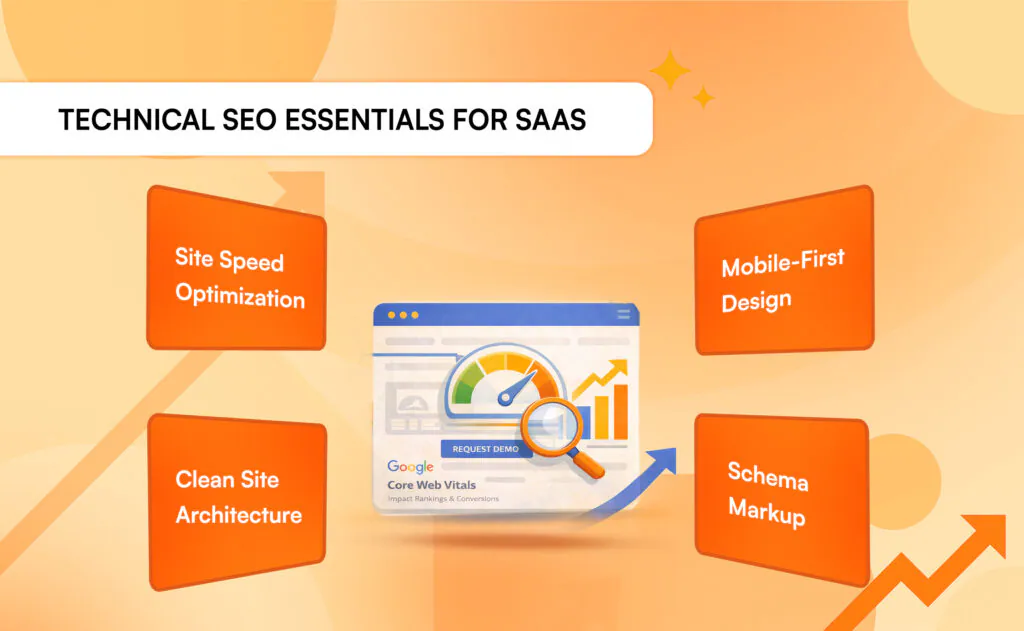
Site Speed Optimization: Your Largest Contentful Paint should stay under 2.5 seconds. This matters especially for demo and pricing pages where conversion happens. Use tools like PageSpeed Insights to identify bottlenecks.
Mobile-First Design: Over 40% of B2B buyers research solutions on mobile devices. Your site needs responsive design that maintains functionality across screen sizes. Demo forms must work perfectly on mobile.
Clean Site Architecture: Organize your URL structure logically around product categories and use cases. Use descriptive URLs like “/crm-for-real-estate” instead of “/product/category/123.” Implement internal linking that connects related features naturally.
Schema Markup: Add SoftwareApplication schema to product pages to help search engines understand your offering. Include Review schema on testimonial pages. Proper schema implementation increases visibility in AI Overviews and rich search results.
Technical SEO provides the foundation that makes content and conversion strategies work. Without proper technical implementation, even perfect content fails to rank. These technical elements work together to create measurable business results.
Link-Building SaaS-Specific Authority
Link building matters differently for SaaS companies. You need authority signals that help you rank for competitive bottom-funnel keywords. Generic directory links don’t work.
- Industry Directory Listings
G2, Capterra, and GetApp serve as major research platforms for software buyers. Your profile on these sites provides both backlinks and direct traffic from users comparing solutions. Complete your profiles fully with screenshots, videos, and detailed feature descriptions. Actively collect reviews from satisfied customers.
- Guest Posting Strategy
Target publications your buyers read regularly. Identify industry blogs, news sites, and communities where your target buyers spend time. Create thought leadership content that provides genuine value without being promotional.
- Digital PR Approach
Original research and data studies earn natural backlinks. Survey your customer base, analyze industry trends, or compile data that provides new insights. Promote these studies to journalists and bloggers in your industry.
Authority building takes consistent effort over months and years. Start with easy wins like directory listings and customer review generation. Move into guest posting and thought leadership. This progressive approach builds sustainable authority that compounds over time.
Optimizing for Demo Conversions
Ranking for the right keywords matters little if organic traffic doesn’t convert. Your demo request pages need the same attention you give to keyword research and content creation. Conversion rate improvements multiply the value of every organic visitor.
B2B SaaS demo conversion rates typically range from 2-8% for cold traffic. Your specific metrics depend on product complexity, price point, and target market. Systematic optimization improves these numbers.
- Above-the-Fold Optimization
Your value proposition must be immediately clear. Users should understand what your software does and who it’s for within seconds. Place your primary CTA prominently with action-oriented copy. Keep form fields minimal, 5-7 fields maximum.
- Trust Signals
Display customer logos from recognizable companies in your target market. Include testimonials that address specific objections. Place these signals near conversion points where they reinforce the decision to request a demo.
- Friction Reduction
Minimize steps between interest and booked meetings. Implement calendar scheduling directly in your demo flow so users can book time immediately. Optimize for mobile devices where many B2B buyers bookmark pages for later.
Converting organic traffic into demos requires systematic attention to user experience. Track conversion rates by traffic source, landing page, and device type. Small improvements compound when you’re driving significant organic traffic.
Measuring Revenue Impact
Tracking rankings and traffic tells you nothing about business impact. Your SaaS SEO strategy needs measurement that connects organic search to actual revenue. This means going beyond Google Analytics to see how search traffic moves through your sales funnel.
Essential SaaS SEO Metrics
MQL generation from organic search shows initial conversion success. Track how many demo requests or trial signups come from organic traffic monthly. Compare this to paid channels to understand relative efficiency.
SQL conversion rates reveal content quality. Track what percentage of organic MQLs convert to sales-qualified opportunities. Low SQL conversion means you’re attracting wrong-fit visitors despite ranking well.
Revenue attribution connects search traffic to closed deals. Use your CRM to track which customers first found you through organic search. Calculate customer acquisition cost for the organic channel by dividing your SEO investment by new customers acquired.
Setting Up Attribution
CRM integration with your analytics platform enables proper tracking. Connect Salesforce, HubSpot, or your CRM to your website tracking. Tag demo requests with source data so sales teams can see where each lead originated.
Multi-touch attribution models give credit to all touchpoints in the buyer journey. This prevents under-crediting organic search which often starts the buyer journey. UTM parameters help track specific content performance.
Measuring what matters requires infrastructure beyond basic analytics. Invest in proper tracking setup, CRM integration, and attribution modeling. Revenue-focused measurement helps you defend and grow your SEO budget over time.
Why Should You Choose ThirdMeta for SaaS SEO Strategy?
B2B SaaS companies need specialized expertise for organic pipeline growth. Your current marketing might generate traffic without producing qualified demos consistently. ThirdMeta focuses specifically on revenue-driven SaaS SEO that connects search visibility to closed deals.
Solutions That Drive Results:
- Pipeline-focused keyword research targeting bottom-funnel searches that convert to demos and SQLs
- Product-led content strategies including comparison pages, alternative content, and use case guides
- Revenue attribution setup connecting organic traffic to CRM data and closed revenue
- Demo page conversion optimization reducing friction in your organic visitor path
Proven Performance in B2B SaaS:
Companies working with ThirdMeta see measurable improvements.
- Generate 55+ qualified inbound leads monthly through strategic content and keyword targeting.
- Achieve 75% MQL qualification rates by attracting right-fit buyers instead of tire-kickers.
- Build a predictable organic pipeline with full attribution showing exactly how search contributes to revenue.
Your marketing operations need data-driven execution. ThirdMeta operates as a revenue-led B2B SaaS marketing agency focused on qualified pipeline generation. Our systems connect content strategy to actual sales outcomes through proper measurement and attribution.
Key Platform Capabilities:
- Modern SEO incorporating AI Overviews and generative engine optimization keeps you visible in evolving search.
- Content systems aligned with sales-call insights address real buyer objections your team hears daily.
- 90-day proof sprints provide quick wins with measurable pipeline KPIs before long-term commitments.
Smart SaaS companies build organic channels that compound revenue over time. ThirdMeta helps you create systematic approaches to keyword targeting, content creation, technical optimization, and conversion improvement.
Ready to build a revenue-driven SaaS SEO strategy? Request a Strategy Call
Conclusion
SaaS SEO strategy works when it focuses on qualified pipeline over vanity metrics.
- Bottom-funnel keywords drive qualified demos by targeting users actively evaluating solutions rather than just researching topics
- Product-led content connects search intent to solution value through comparison pages, alternative content, and specific use cases
- Revenue attribution proves organic search ROI by connecting traffic to MQLs, SQLs, and closed revenue in your CRM
- Conversion optimization multiplies the value of your rankings by turning organic visitors into actual demo requests and trial signups
Building effective organic channels takes 90-180 days to show measurable results. The compounding nature of content and authority means your cost per acquisition decreases over time.
Focus on qualified traffic that converts rather than chasing high-volume keywords that waste resources. Measure what matters by tracking organic contribution to actual pipeline and revenue.
Frequently Asked Questions
SaaS SEO differs from traditional SEO by focusing on qualified pipeline generation over traffic volume. It targets bottom-funnel keywords with high purchase intent like comparison and alternative searches. Traditional SEO often prioritizes ranking and traffic metrics without considering buyer journey complexity or multiple decision-makers.

Sr. Content Writer
Vamshi Vadali is Third Meta's Content Team Head and the guy who banned fluff from all blog posts. He specializes in SEO, GEO (Generative Engine Optimization), and AEO (Answer Engine Optimization): the trifecta that gets B2B SaaS content ranking in both Google and ChatGPT. Vamshi doesn't write content. He engineers MQL machines. His philosophy? Good writing needs data and clarity, not buzzwords. He writes like a CFO reads: straight to the outcomes. When he's not optimizing for AI Overviews, he's debating whether LLMs prefer Oxford commas.