
According to BrightEdge, 84% of marketers believe AI is important for identifying upcoming trends. Yet most B2B SaaS companies still treat SEO automation as a technical checkbox, not a revenue driver. This creates a gap. Manual SEO doesn’t scale without large teams, and rising CAC forces investment in organic channels.
The workflows below show how to automate SEO tasks that connect directly to MQLs, SQLs, and pipeline growth.
Why B2B SaaS Companies Are Turning to SEO Automation (And Why Now)
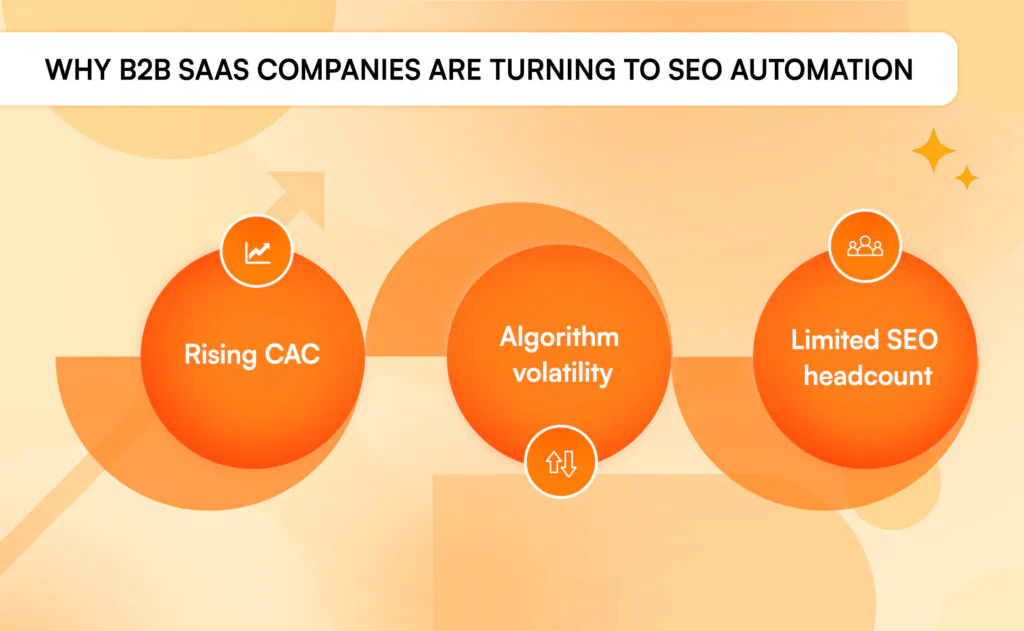
SEO automation uses software and AI to handle repeatable SEO tasks without manual intervention. This matters now because three forces are converging.
- First, customer acquisition costs keep climbing. Manual SEO requires dedicated teams that most Series A-C companies can’t afford.
- Second, Google’s algorithm updates happen constantly, 200+ times per year, making manual monitoring impossible.
- Third, AI has reached a threshold where it can handle technical execution while humans focus on strategy.
A B2B SaaS company we worked with manually audited 1,200 pages every quarter. This took 80 hours.
After implementing automated technical audits, they reduced this to 3 hours while catching issues within 24 hours instead of 90 days. Their organic MQLs grew 3.2x in six months.
The data support this shift. According to Gartner, 72% of companies using AI SEO tools report a 30% reduction in manual tasks. SEO.com found that 47% of marketers are now implementing AI SEO tools, up from 28% just 18 months ago.
What is SEO Automation? (And What Should Stay Human)
SEO automation means using software to complete repetitive SEO tasks with minimal human input. The goal is speed and consistency at scale. Tools handle data collection, analysis, and execution. Humans provide strategy, positioning, and quality control.
Here’s what automation handles well:
| Task Type | What Gets Automated | Human Role |
| Technical SEO | Broken link detection, page speed monitoring, schema markup generation | Fix prioritization, site architecture decisions |
| On-Page SEO | Meta tag suggestions, internal linking recommendations, and alt text generation | Final approval, brand voice alignment, and strategic decisions |
| Content & Keywords | Keyword research, competitor gap analysis, and content scoring | Content strategy, ICP targeting, positioning frameworks |
| Reporting | Rank tracking, backlink monitoring, and analytics dashboards | Interpretation, action planning, stakeholder communication |
What should stay human? Strategy. ICP definition. Positioning. Content that requires industry expertise. Anything involving judgment about your market or product differentiation.
The quality vs. automation balance matters. Google’s March 2024 update penalized sites abusing AI content at scale. 28% of US adults don’t trust AI-generated search results, according to Pew Research. Use automation for execution. Keep humans in charge of what you say and how you position.
The 4 Types of SEO Tasks You Can Automate
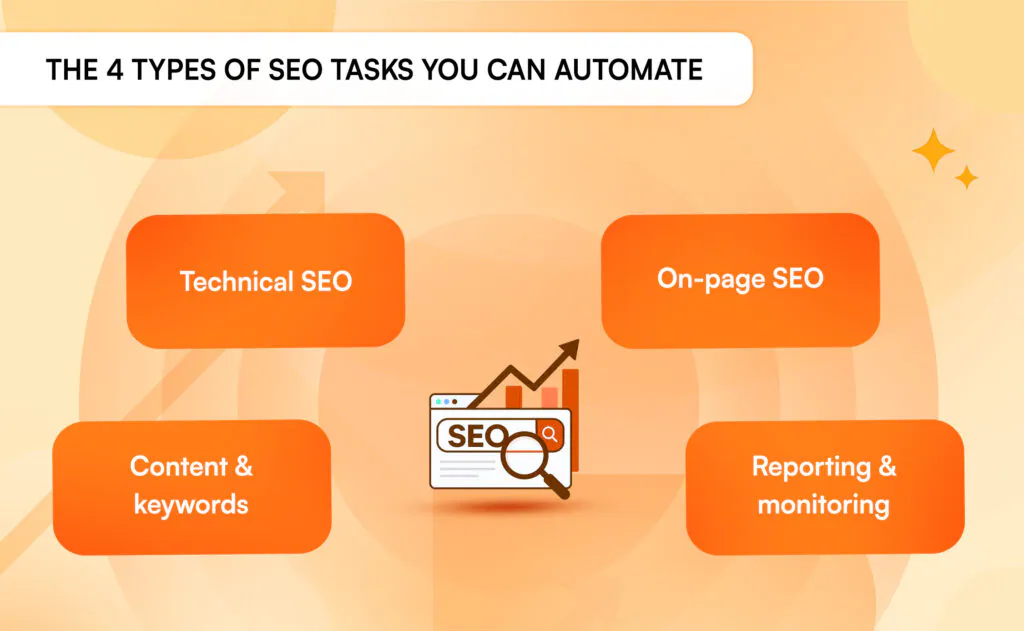
SEO automation falls into four categories. Each handles different parts of your organic growth system. Understanding these helps you build the right automation stack.
- Technical SEO Automation
Technical SEO automation monitors site health continuously. Tools crawl your site, identify issues, and alert you instantly. Some can fix problems automatically, like regenerating sitemaps or compressing images.
Key automation capabilities include broken link detection across thousands of pages, Core Web Vitals monitoring with real-time alerts, structured data validation and generation, and mobile usability checks. Tools like Screaming Frog, Sitebulb, and Lumar handle this layer.
For B2B SaaS companies, technical issues kill conversions. A broken demo page or slow-loading pricing section costs pipeline. Automation catches these problems within hours, not months.
- On-Page SEO Automation
On-page automation improves individual page optimization at scale. Instead of manually optimizing 500 product pages, tools analyze top-ranking content and provide data-driven recommendations.
This includes meta title and description generation based on SERP analysis, internal linking suggestions that follow topic authority models, content optimization scoring against competitors, and image alt text recommendations. Surfer SEO, Clearscope, and MarketMuse lead this category.
The value for B2B SaaS? You can optimize your entire knowledge base, help docs, and blog in weeks instead of quarters. This improves organic visibility across your full content library.
- Content & Keyword Automation
Content automation handles research and analysis, not writing. Tools identify keyword opportunities, analyze competitor content gaps, and track ranking positions automatically.
Key capabilities include keyword clustering and topic modeling, competitor gap analysis showing missed opportunities, content brief generation with data-driven outlines, and search intent classification. Semrush, Ahrefs, and SE Ranking dominate here.
B2B SaaS buying cycles involve 6-12 months of research. Automation helps you identify every keyword a prospect might use during that journey, then build content that addresses each stage.
- Reporting & Monitoring Automation
Reporting automation connects SEO data to business metrics. Instead of manually pulling rank data and traffic numbers, tools generate dashboards that show organic contribution to MQLs and the pipeline.
This includes automated rank tracking across thousands of keywords, backlink monitoring with new/lost link alerts, traffic and conversion attribution reporting, and custom dashboards for different stakeholders. AgencyAnalytics, AccuRanker, and Databox handle this layer.
The business value? Your CFO and board care about pipeline attribution, not keyword rankings. Automated reporting shows how organic traffic converts to revenue.
11 SEO Automation Workflows That Drive Revenue (Not Just Traffic)
These workflows connect SEO automation directly to business outcomes. Each one addresses a specific revenue challenge B2B SaaS companies face.
1. Automated Keyword Research → High-Intent Prioritization
Use tools to identify keywords with commercial intent, then filter by ICP fit. Semrush and Ahrefs export thousands of keywords. AI models classify them by buying stage, awareness, consideration, decision.
The workflow: Export competitor keywords monthly. Filter for bottom-funnel intent (“software,” “tool,” “platform,” “vs”). Prioritize keywords where you have product differentiation. Create content briefs automatically. This identifies revenue-generating keywords faster than manual research.
2. AI Content Brief Generation → Faster Production
Generate data-driven content briefs in minutes instead of hours. Tools analyze top 10 SERP results, extract common topics, identify gaps, and suggest structures.
The workflow: Input target keyword. Tool analyzes competitors, pulls H2/H3 structures, identifies missing topics, suggests word count and format. Writers receive briefs with specific requirements. This reduces brief creation from 2 hours to 10 minutes per piece.
3. Real-Time Rank Tracking → Instant Alerts
Monitor rankings daily with automated alerts when positions change significantly. Catch algorithm impacts within 24 hours instead of discovering them weeks later.
The workflow: Set up tracking for 500+ target keywords. Configure alerts for position drops of 3+ spots or SERP feature losses. Receive Slack/email notifications. Respond immediately instead of after the revenue impact. AccuRanker and SE Ranking update rankings multiple times daily.
4. Competitor Gap Analysis → Opportunity Pipeline
Identify keywords where competitors rank but you don’t. This reveals content gaps that represent revenue opportunities.
The workflow: Run monthly competitor gap reports. Export keywords where 3+ competitors rank in the top 10 but you’re absent. Filter by search volume and intent. Queue content production. This systematically captures market share from competitors.
5. Smart Internal Linking → Authority Flow
Automate internal link suggestions based on topic relevance and page authority. Tools analyze your content, identify linking opportunities, and suggest anchor text.
The workflow: Publish new content. Tool scans existing pages for topical relevance. Suggests 5-10 internal link placements with anchor text. Update pages in bulk. This distributes authority to conversion pages faster.
6. Technical SEO Audits → Auto-Fix
Run continuous site audits that catch issues within hours. Some tools auto-fix certain problems, like generating proper canonical tags or compressing images.
The workflow: Schedule daily crawls. Set priority rules (broken links on conversion pages = P0). Receive instant alerts. Auto-fix enabled for low-risk issues. Manual review for strategic decisions. This prevents technical issues from impacting the pipeline.
7. Content Decay Detection → Refresh Queue
Identify content losing rankings and prioritize refreshes based on business impact. Tools track position changes over time and alert when pages decline.
The workflow: Monitor all content monthly. Flag pages with 20%+ traffic decline or 5+ position drops. Prioritize by current conversion value. Queue refreshes. Update with current data and republish. This recovers lost organic traffic systematically.
8. SERP Feature Optimization → Snippet Wins
Target featured snippets, People Also Ask boxes, and AI Overviews. According to BrightEdge, 60% of searches are now completed without clicks due to AI Overviews appearing in 47% of results.
The workflow: Identify keywords triggering SERP features. Analyze current feature formats (list, table, paragraph). Restructure content to match the format. Add schema markup. Track feature wins. This captures visibility even when users don’t click.
9. Backlink Monitoring → Outreach Automation
Monitor competitor backlinks and automate outreach to the same domains. Tools track new competitor links daily and provide contact information.
The workflow: Track competitor backlinks. Filter for high-authority domains (DR 50+). Export new links weekly. Feed to the outreach tool. Send personalized templates. Follow up automatically. This scales link building without scaling headcount.
10. SEO + CRO Integration → Conversion Optimization
Connect organic traffic data to conversion metrics. Identify which keywords and pages generate MQLs, not just visits.
The workflow: Integrate GA4, Search Console, and CRM (HubSpot/Salesforce). Track keyword-to-demo attribution. Identify high-traffic, low-conversion pages. Run CRO experiments. Prioritize SEO work by revenue impact, not traffic volume.
According to The Digital Bloom, B2B SaaS SEO leads achieve a 51% MQL-to-SQL rate, the highest of all channels.
11. Multi-Channel Reporting → RevOps Dashboard
Build automated dashboards showing organic’s contribution to pipeline. Connect SEO metrics to CFO-level reporting.
The workflow: Set up automated reporting in AgencyAnalytics or Databox. Pull data from Search Console, GA4, HubSpot, and Salesforce. Display organic MQLs, SQLs, and closed-won revenue. Update daily. Share with executives weekly. This proves SEO’s business impact continuously.
The Best SEO Automation Tools for B2B SaaS (2025)
Choosing the right tools depends on your stage and needs. Here’s how tools break down by category and budget tier.
Technical SEO Automation Tools
| Tool | Pricing | Best For | Key Features |
| Screaming Frog | $279/year | Starter teams | Desktop crawling, technical audits, sitemap generation |
| Sitebulb | $13.50-$245/month | Growth teams | Visual reports, client-friendly dashboards, and continuous monitoring |
| Lumar | $2,667-$8,000+/month | Enterprise | 450 URLs/second crawling, SOC2 certified, multi-site management |
| ContentKing | $139+/month | SaaS companies | Real-time monitoring, instant change alerts, 24/7 crawling |
Lumar (formerly DeepCrawl) serves Adobe, Microsoft, and Deloitte. ContentKing prevents ranking drops from code deployments, vital for SaaS companies shipping frequently.
On-Page SEO Automation Tools
| Tool | Pricing | Best For | Key Features |
| Surfer SEO | $79-$175/month | Content teams | NLP optimization, Google Docs integration, content scoring |
| Clearscope | $189-$599+/month | Editorial teams | IBM Watson analysis, A-F grading, unlimited users |
| MarketMuse | $99-$499/month | Enterprise teams | Topic authority modeling, content gap analysis, brief generation |
| Frase | $45-$115/month | Budget-conscious teams | AI content optimization, SERP analysis, question research |
Surfer SEO analyzes 500+ ranking signals for optimization recommendations. Clearscope offers unlimited team members on all plans, ideal for larger content operations.
Content & Keyword Automation Tools
| Tool | Pricing | Best For | Key Features |
| Semrush | $139.95-$499.95/month | All-in-one needs | 27.3B keyword database, AI toolkit, Prompt Tracking for LLM visibility |
| Ahrefs | $29-$449/month | Backlink focus | Industry-leading backlink index, competitor analysis, content explorer |
| SE Ranking | $65-$259/month | Budget-focused teams | AI Search Tracker (ChatGPT/Gemini visibility), rank tracking, white-label |
| Keyword Insights | $58-$239/month | Topic clustering | AI keyword grouping, content briefs, search intent classification |
Semrush integrates with Salesforce, HubSpot, and WordPress. SE Ranking offers ChatGPT and Perplexity visibility tracking at lower price points, important as SEO.com reports 60% of searches now complete without traditional clicks.
Reporting & Monitoring Tools
| Tool | Pricing | Best For | Key Features |
| AgencyAnalytics | $79-$479/month | Agencies & teams | 80+ platform integrations, white-label dashboards, AI summaries |
| AccuRanker | $129-$2,769/month | Precision tracking | Fastest updates in the industry, AccuLLM for ChatGPT tracking, on-demand refreshes |
| Databox | $159-$799/month | Cross-channel reporting | Custom dashboards, HubSpot/Salesforce integration, goal tracking |
| Looker Studio | Free | Google-first teams | Google ecosystem integration, unlimited dashboards, real-time updates |
AgencyAnalytics connects 80+ marketing platforms including CRMs. AccuRanker provides sub-hour rank updates, critical for monitoring algorithm impacts quickly.
How to Choose the Right Stack?
SEO Tool Stack by Company Stage: Budget & Tool Selection Guide
| Stage | Monthly Budget | Core Tools | Price Breakdown | Best For | Total Monthly Cost |
| Starter Stack | $500/month | • Screaming Frog (Desktop)• SE Ranking• Looker Studio• Content Tool (Frase OR Surfer) | • Screaming Frog: $23/mo (annual)• SE Ranking: $65-$259/mo• Looker Studio: Free• Frase: $45/mo OR Surfer: $79/mo | Solo marketers, early-stage startups, limited sites | $133-$361/month |
| Growth Stack | $1,000-$2,000/month | • Sitebulb• Semrush Pro• Surfer Scale• AgencyAnalytics• ContentKing | • Sitebulb: $180/mo• Semrush Pro: $139.95/mo• Surfer Scale: $175/mo• AgencyAnalytics: $249/mo• ContentKing: $139+/mo | Growing companies, small agencies, multiple campaigns | $882.95-$1,200+/month |
| Enterprise Stack | $3,000-$5,000+/month | • Lumar• Semrush Business• Clearscope Pro• AccuRanker 5-10K• AgencyAnalytics Pro | • Lumar: $2,667+/mo• Semrush Business: $499.95/mo• Clearscope Pro: $399/mo• AccuRanker: $609-$849/mo• AgencyAnalytics Pro: $479/mo | Large enterprises, agencies, complex multi-site operations | $4,653.95-$5,093.95+/month |
Tool Selection Criteria & Decision Framework
| Priority Factor | What to Evaluate | Why It Matters | How to Validate |
| Integration Capabilities | Must connect to CRM (HubSpot, Salesforce), Analytics (GA4, Search Console), CMS (WordPress, Webflow) | RevOps alignment matters more than individual features | Request integration documentation, test API connections before purchase |
| Data Accuracy | Rankings, backlinks, keyword volumes | Incorrect data leads to wrong decisions | Run parallel tests: compare tool data vs manual checks, GSC verification |
| RevOps Alignment | Data flows between sales, marketing, analytics systems | Siloed tools create reporting gaps | Map data flow from tool → CRM → reporting dashboards |
| Time Savings | Automation capabilities, workflow efficiency | Tools should save more time than they cost | Track hours saved weekly × hourly cost rate |
| ROI Calculation | (Time Saved × Hourly Cost) + (Revenue From Rankings) – Tool Costs | Must justify cost through measurable return | Calculate monthly: if 20 hrs saved at $100/hr = $2,000 saved |
Tool Validation Checklist: Before You Commit
| Validation Type | Test Method | Benchmark | Red Flag |
| Rank Data Accuracy | Compare tool rankings vs manual Google checks | >90% accuracy across 50 keywords | >15% discrepancy in tracked positions |
| Backlink Count Accuracy | Tool backlinks vs Google Search Console links | Within 20% of GSC data | Tool shows 5x more backlinks than GSC |
| Keyword Volume Accuracy | Tool volume estimates vs your actual traffic | Correlates with real traffic patterns | Volume estimates don’t match traffic reality |
| Site Crawl Completeness | Tool crawl depth vs known page count | Finds >95% of known pages | Misses major site sections or page types |
| Report Refresh Speed | Time from data change to dashboard update | <24 hours for rankings, real-time for crawls | 3-5 day delays in data refresh |
True ROI Calculation Formula
Formula:
(Time Saved × Hourly Cost) + (Revenue From New Rankings) – Tool Costs = Net ROI
Example Calculation:
| Component | Calculation | Monthly Value |
| Time Saved | 20 hours saved monthly × $100/hour | $2,000 |
| Revenue Impact | 5 new page 1 rankings × $500 avg revenue per ranking | $2,500 |
| Tool Costs | Growth Stack investment | -$1,200 |
| Net Monthly ROI | $2,000 + $2,500 – $1,200 | $3,300 |
| ROI Percentage | ($3,300 ÷ $1,200) × 100 | 275% ROI |
ROI Threshold: Tools should pay for themselves through time savings alone. Any revenue lift is bonus.
Start with integration capabilities, not feature lists. Your tools must connect to your CRM (HubSpot, Salesforce), analytics (GA4, Search Console), and CMS (WordPress, Webflow). RevOps alignment matters more than individual tool capabilities.
Budget guidelines by stage:
Starter Stack ($500/month): Screaming Frog ($23/month effective) + SE Ranking ($65-$259) + Looker Studio (free) + one content tool (Frase at $45 or Surfer at $79)
Growth Stack ($1,000-$2,000/month): Sitebulb ($180) + Semrush Pro ($139.95) + Surfer Scale ($175) + AgencyAnalytics ($249) + ContentKing ($139+)
Enterprise Stack ($3,000-$5,000+/month): Lumar ($2,667+) + Semrush Business ($499.95) + Clearscope Pro ($399) + AccuRanker 5-10K keywords ($609-$849) + AgencyAnalytics Pro ($479)
Your 30-Day SEO Automation Implementation Plan
Most teams try to automate everything at once. This fails. Use a phased approach that builds on previous weeks’ foundations.
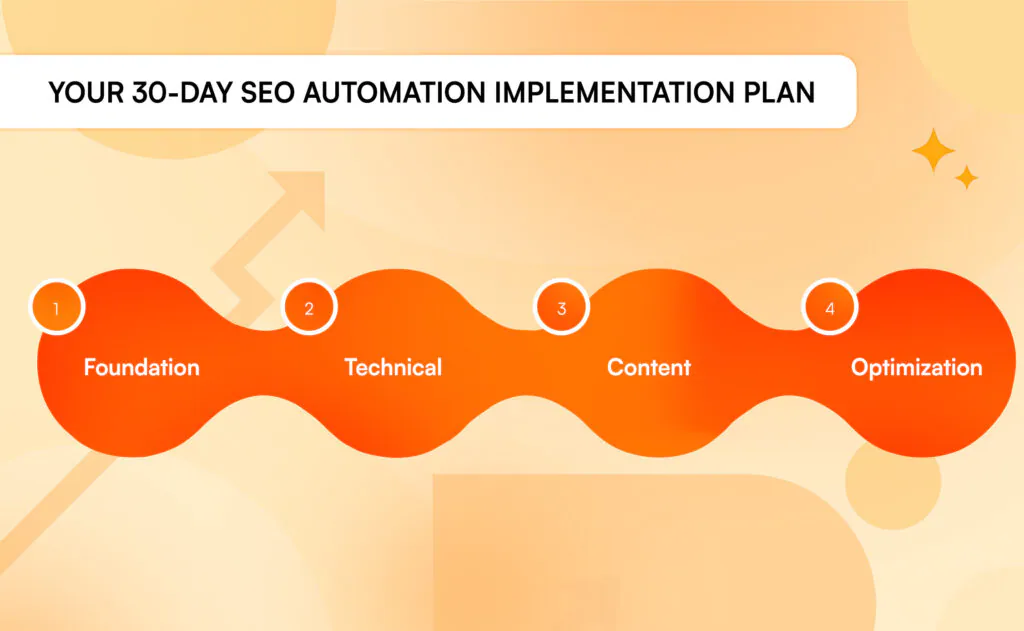
Week 1: Foundation Layer
Set up rank tracking for 100-500 core keywords in AccuRanker or SE Ranking. Connect Google Search Console and GA4 to reporting tools. Create your first automated dashboard showing current organic performance. Configure alerts for ranking drops of 3+ positions. This establishes a baseline measurement.
Week 2: Technical Monitoring
Run your first full site crawl with Screaming Frog or Sitebulb. Prioritize and fix P0 issues (broken links on conversion pages, missing meta tags on product pages). Set up continuous monitoring with daily crawls. Configure technical alerts for new issues. This prevents technical problems from killing conversions.
Week 3: Content Workflows
Run competitor gap analysis to identify 50-100 keyword opportunities. Generate content briefs automatically for top 10 priorities. Set up internal linking automation for existing content. Begin tracking content performance against business metrics. This starts building your revenue-focused content pipeline.
Week 4: Optimization & Measurement
Implement SERP feature optimization for top 10 keywords. Set up backlink monitoring for competitors. Create attribution reporting connecting keywords to MQLs. Review the first month’s data and adjust workflows. Calculate time saved and revenue impact. This closes the loop on measurement.
Common pitfalls to avoid:
- Don’t automate strategy. Tools can’t understand your ICP or positioning.
- Don’t over-rely on AI content generation. Google’s algorithm update penalized this.
- Don’t ignore data accuracy validation. Garbage in, garbage out.
- Don’t skip RevOps alignment. SEO must connect to pipeline metrics.
- Don’t create tool overload without integration. Three connected tools beat ten disconnected ones.
Measuring ROI: How to Prove SEO Automation Success
B2B SaaS buyers need proof. Track these metrics to demonstrate automation value.
- Time Saved: Measure hours spent on SEO tasks before and after automation. Manual technical audits taking 80 hours vs. 3 hours with automation shows clear savings. Multiply saved time by hourly cost to calculate dollar value.
- Content Output Increase: Track content pieces published monthly. Automation should increase velocity by 2-3x. If you published 8 pieces manually, automation should enable 16-24 pieces at equivalent quality.
- Organic MQL Growth: This is the metric that matters most. Track month-over-month organic MQL growth. According to First Page Sage, B2B SaaS SEO generates an average 702% ROI. Your organic MQLs should grow 20-30% quarter-over-quarter with proper automation.
- CAC Reduction: Calculate customer acquisition cost including organic channel investment. Automation reduces cost per MQL by 30-50% typically. If paid channels cost $200 per MQL, organic should be $60-$100 with automation scaling your output.
- Revenue Attribution: Connect keywords to closed-won revenue. Use multi-touch attribution for 6-12 month sales cycles. Position-based models give 40% credit to first touch, 40% to last touch, 20% to middle interactions. Show CFO which keywords generated which deals.
The formula for full ROI calculation:
SEO Automation ROI = [(MQL Value × MQL Increase) + (Time Saved × Hourly Cost) – Automation Costs] / Automation Costs × 100
Example: 20 additional MQLs monthly at $500 value each = $10,000. Plus 40 hours saved at $100/hour = $4,000. Total benefit = $14,000. Minus $2,000 in tool costs = $12,000 net benefit. ROI = 600%.
Target 400-500% ROI (4x-5x return) as a good benchmark. SEO often exceeds this because organic compounds over time, while paid channels require continuous spend.
Third Meta: SEO Automation That Guarantees Revenue Outcomes
Traditional agencies optimize for rankings. Third Meta optimizes for pipeline contribution.
We’re India’s first Human + AI Growth-as-a-Service agency built for B2B SaaS companies. Our model is different: we guarantee MQL and SQL targets, or you don’t pay. This changes everything about how SEO automation gets implemented.
Our approach combines strategic thinking from experienced SaaS marketers with AI-powered execution. Humans handle your positioning, ICP targeting, and content strategy. AI handles technical optimization, content production at scale, and predictive forecasting. You get speed without sacrificing quality.
The automation stack we implement connects directly to your RevOps system. Search Console data flows to Semrush/Ahrefs, which feeds HubSpot, which syncs to Salesforce. Every keyword gets attributed to the pipeline. Every ranking improvement gets connected to revenue. No vanity metrics. No “rankings are up 50%” without MQL context.
We’ve served 200+ B2B SaaS clients with an average 300% ROI improvement within six months. Our pilot-to-long-term conversion rate is 78%, most agencies resist pilots because it exposes underperformance. We require them because we’re confident in our outcomes.
| What Traditional Agencies Do | What Third Meta Does |
| Optimize for traffic and rankings | Guarantee MQL and SQL targets |
| Monthly retainers with no outcome accountability | Performance-based pricing with a 30-day termination clause if targets aren’t met |
| Generic strategies applied to all clients | Custom RevOps-aligned automation for your ICP |
| Resist pilots and outcome guarantees | Require 90-day pilots to prove results before long-term commitment |
| Report on SEO metrics (rankings, traffic) | Report on business metrics (MQLs, pipeline, closed-won revenue) |
| “SEO takes 12 months” excuses | 5-10 MQLs in first 90 days or refund |
Our pricing starts at $2.5K/month with guaranteed MQL and SQL targets. We offer 90-day pilots ($15K-$20K total) so you can see results before committing long-term. Six-month minimum commitment with performance bonuses when we exceed targets.
We specialize in three areas competitors can’t match: outcome guarantees that hold us accountable to revenue metrics, Human + AI execution that combines strategic thinking with automated implementation, and future-proof AI visibility with proven AIO optimization frameworks, while competitors are still figuring it out.
Ready to Connect SEO Automation to Pipeline Growth?
See how Third Meta guarantees MQL targets with outcome-based SEO automation. Book a 30-minute outcome planning session.
Frequently Asked Questions
SEO automation uses software to handle repetitive SEO tasks without manual intervention. Tools continuously monitor your site, analyze competitors, track rankings, and generate optimization recommendations while humans focus on strategy and decision-making.

Sr. Content Writer
Vamshi Vadali is Third Meta's Content Team Head and the guy who banned fluff from all blog posts. He specializes in SEO, GEO (Generative Engine Optimization), and AEO (Answer Engine Optimization): the trifecta that gets B2B SaaS content ranking in both Google and ChatGPT. Vamshi doesn't write content. He engineers MQL machines. His philosophy? Good writing needs data and clarity, not buzzwords. He writes like a CFO reads: straight to the outcomes. When he's not optimizing for AI Overviews, he's debating whether LLMs prefer Oxford commas.