“AI didn’t kill SEO. It made weak SEO irrelevant, and strong SEO more valuable than ever.”
According to Forrester’s 2025 B2B Buying Study, B2B buyers now complete 68% of their purchase journey before speaking to a salesperson. They research. They compare. They read. And they do it through search, including AI-powered search.
If your brand isn’t visible in that window, your pipeline dries up quietly, long before a demo request ever comes in.
This isn’t a debate about whether SEO “still works.” That question is outdated. The real question is whether your B2B team can afford to hand organic pipeline to competitors who are investing while you’re pulling back.
This blog covers every angle teams are asking about right now. From whether to hire in-house SEOs, to how AI changed the rules, to what it actually takes to win organic in 2026.
The Real Question Is Not “Does SEO Work in 2026.” It’s “Can You Afford to Ignore SEO?”
Every few years, someone declares SEO is dead. In 2012, it was Panda and Penguin. In 2019, it was voice search. In 2023, it was ChatGPT. In 2026, it is AI search, SEO is still here.
The companies that paused investment during each of those “SEO is dead” cycles spent the next 12 to 18 months trying to recover ground that competitors quietly took.
2026 is that moment again, except the stakes are higher.
AI has changed how search works, not whether search works. Google processes over 8.5 billion searches per day. B2B buyers use search at every stage of their journey like, awareness, evaluation, shortlisting, and validation.
At the core, even in 2026, the search channels changed, and the medium evolved. The behavior didn’t.
“The companies that will win in the AI era are those that understand AI changes the interface of search, not the intent behind it.”
– Rand Fishkin
Cutting SEO in response to AI is like canceling your sales team because Zoom calls feel impersonal. The channel shifted. The need didn’t.
What Changed in Search and Why It Demands More SEO, Not Less
Search in 2026 is more complex than it was two years ago. That complexity doesn’t reduce the need for SEO. It raises the bar for doing it well.
AI Overviews Don’t Kill Organic. They Reward the Well-Optimized.
Google’s AI Overviews (AIO) pull answers from pages that are already well-optimized, authoritative, and structured. They don’t replace the top-ranked content. They cite it. If your content is thin, generic, or poorly structured, AIO ignores it. If it’s deep, specific, and authoritative, AIO amplifies it.
As per the 2025 research, it was found that pages appearing in AI Overviews saw 25-35% more brand impressions even when click-through rates dropped. Visibility in AI answers is now a top-of-funnel trust signal.
Your buyers see your brand cited in an AI answer before they ever visit your site. That’s influence, not irrelevance.
The teams winning AIO placement today invested in SEO 12-18 months ago. Teams cutting SEO today are ceding that ground to competitors right now.
Zero-Click Doesn’t Mean Zero Value
Yes, as per SparkToro research, 60-77% of searches end without a click. The surface-level read is alarming. The deeper reading is different. Mostly zero-clicks happen only for Top-of-the-funnel (TOFU) keywords.
Zero-click searches still transfer brand recognition. When a B2B buyer sees your company cited three times in AI summaries across different queries, that repetition builds authority. By the time they’re ready to evaluate vendors, your brand already has a head start. This is how modern B2B buying decisions get influenced, not through a single click, but through repeated, trusted exposure across the research journey.
SEO is no longer just a traffic channel. It’s a brand authority channel. Treating it as the former and ignoring the latter is a strategic mistake.
The B2B Buyer’s Journey Got Longer, Not Shorter
AI tools made it easier for buyers to research independently. As a result, they do more of it. Gartner reports that the average B2B buying group now involves 6-10 decision makers, each conducting independent research before a group consensus forms.
That means your content needs to reach the CFO asking about ROI, the VP of Engineering asking about integrations, and the CMO asking about pipeline attribution. Often through the same organic search channel, at different stages. One well-structured content strategy covers all of them. No other channel does that at the same cost per outcome.
6 Reasons B2B Teams Absolutely Need SEO and Content in 2026
This is where the decision gets concrete. Here are the reasons that should settle the debate for any B2B SaaS team weighing whether to invest in SEO this year.
- Your Competitors are being cited in AI answers, you’re not.
- 68% of the B2B Buying Journey Happens Before Sales Talks to Anyone
- Paid Acquisition Costs Keep Rising. Organic Compounds.
- AI Tools Write Content. They Don’t Build Topical Authority.
- Pipeline Attribution Now Has an Organic Layer You Can’t Ignore
- Your ICP Is Searching Right Now. With or Without You.
1. Your Competitors Are Being Cited in AI Answers. You’re Not.
AI Overviews, ChatGPT responses, Perplexity answers, all of them pull from indexed, authoritative content. Right now, for your core B2B keywords, one of three things is true. Your content is being cited, a competitor’s content is being cited, or neither. The first outcome wins the pipeline. The second hands it away. The third means you’re invisible.
HubSpot’s 2025 State of Marketing report found that 71% of B2B marketers said AI-driven search changes made organic visibility more important, not less. The brands that appear in AI-generated answers at the top of the funnel earn a trust advantage that paid ads can’t replicate, because AI Overviews don’t run ads.
This is a window. It won’t stay open. The teams building structured, authoritative content today are claiming AIO real estate that will be harder to displace in 12 months.
2. 68% of the B2B Buying Journey Happens Before Sales Talks to Anyone
Your sales team is brilliant. They’re also missing most of the buying process. By the time a prospect books a demo, they’ve already read 7-10 pieces of content, compared 3-5 vendors, and formed a mental shortlist. If your brand wasn’t part of that research phase, you’re starting behind on a call that might never come.
“Marketing’s job is to make the sales conversation shorter by doing the education upfront.”
SEO and content are the primary tools for being present during that pre-sales research phase. They’re not nice-to-have awareness plays. They’re direct pipeline inputs. Every blog that ranks for a problem your ICP is searching for is a silent salesperson working 24/7.
3. Paid Acquisition Costs Keep Rising. Organic Compounds.
Average B2B SaaS CPCs is at $8-$25 per click in competitive categories, and climbing year-on-year. A mid-funnel content piece that ranks organically and drives 500 visits per month costs the same after month six as it did on day one. A paid ad stops the moment you stop paying.
The math is straightforward. A single well-optimized pillar page driving 300 qualified organic sessions per month, at a $15 CPC equivalent, represents $4,500/month in equivalent paid media value, running indefinitely.
Teams that build organic assets compound that value over time. Teams that rely only on paid are running a treadmill they can never step off.
4. AI Tools Write Content. They Don’t Build Topical Authority.
This is the most misunderstood point in the “AI replaces SEO” argument. Yes, AI can generate content at scale. So can your competitors. When everyone publishes AI-generated content on the same topics, the quality floor rises, and the differentiation that actually ranks comes from original data, expert perspective, structured depth, and topical authority built over time.
Google explicitly rewards E-E-A-T: Experience, Expertise, Authoritativeness, and Trustworthiness. None of those are generated by AI alone. They’re built through consistent, expert-led content strategy, the kind that requires a human SEO and content team to plan, execute, and refine.
“AI makes content cheap to produce. It makes genuine expertise more valuable, not less.”
B2B buyers, especially enterprise buyers, can tell the difference between a generic AI article and content written by someone who actually understands their problem. The latter builds trust. The former gets ignored.
5. Pipeline Attribution Now Has an Organic Layer You Can’t Ignore
Modern B2B revenue attribution is multi-touch. A prospect might find you through an organic blog post, re-engage through a retargeting ad, attend a webinar, and then book a demo. When you remove SEO from that sequence, you don’t just lose traffic. You remove the first touchpoint that started the relationship.
B2B Buyer Survey found that 55% of B2B buyers said they consumed three or more pieces of vendor content before reaching out. SEO is what puts that content in front of them at the right moment. Without organic visibility, your content marketing investment, including blogs, case studies, and whitepapers, loses its primary distribution channel.
6. Your ICP Is Searching Right Now. With or Without You.
This one is simple. Your ideal customers are typing queries into Google, ChatGPT, and Perplexity today. They’re looking for solutions to problems your product solves. If your content doesn’t answer those queries, a competitor’s content will. The search volume doesn’t pause while you debate whether SEO is worth it.
Organic search drives 53% of all website traffic across B2B industries, more than paid, social, and email combined. That’s not a channel you walk away from. That’s the channel.
Should B2B Teams Hire In-House SEOs or Work With an Agency?
This is the second most common question after “does SEO still work?” The honest answer is: it depends on what you’re optimizing for.
Here’s a clean breakdown:
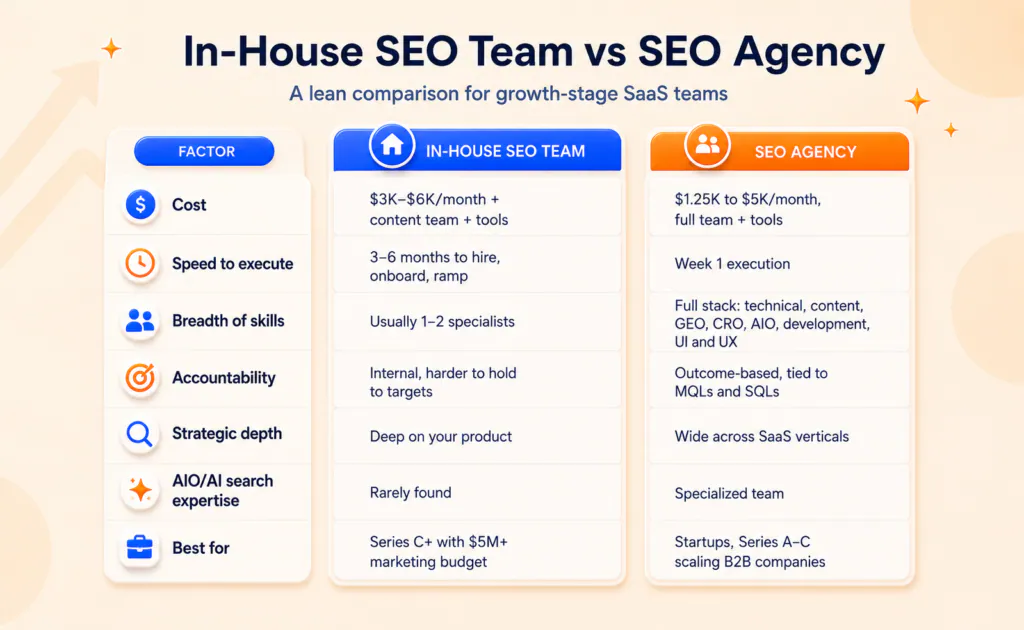
The honest recommendation for most B2B SaaS teams at startup level and Series A to Series C is to start with an agency that has outcome guarantees.
Build an organic pipeline with proven frameworks. Once SEO is contributing predictable MQLs, hire in-house to own strategy and keep the agency for execution depth.
What you shouldn’t do is hire one junior in-house SEO, give them no budget for content or tools, and expect enterprise-level results. That’s the most common and most expensive SEO mistake B2B teams make.
Why ThirdMeta Is the Right SEO Partner for B2B SaaS Teams in 2026?
Traditional agencies track rankings. ThirdMeta tracks revenue.
That distinction matters in 2026 more than it ever has. When every agency offers “AI-powered SEO,” the real differentiator is whether they can connect their work to your pipeline and stand behind it with a guarantee.
- Outcome guarantees with real accountability. ThirdMeta is India’s first Human + AI Growth-as-a-Service agency built for B2B SaaS and the only one that guarantees MQL and SQL targets. If the numbers aren’t hit, clients don’t pay. That’s not a marketing line. It’s the contract.
- Human strategy + AI execution. Experienced SaaS marketers set the strategy. AI-powered systems accelerate content production, technical audits, and predictive forecasting. The result is agency-speed execution with senior-level thinking, without the senior-level price tag.
- AIO-first content architecture. While most agencies are still figuring out what AI Overviews mean for rankings, ThirdMeta has proven frameworks for getting B2B SaaS clients cited in AIO results. That’s a meaningful edge as AI-driven search becomes the primary discovery layer for B2B buyers.
- Full-stack growth, not just SEO. ThirdMeta integrates SEO with CRO, technical implementation, and RevOps alignment. Organic strategy feeds directly into sales processes, not just traffic dashboards.
Proof that holds up:
- 200+ B2B SaaS clients served
- Average 300% ROI improvement within 6 months
- 78% pilot-to-long-term client conversion rate
- 5-10 MQLs delivered in the first 90 days for qualifying clients
- Zero traffic loss track record on technical SEO migrations
| Traditional SEO Agency | ThirdMeta | |
| Success metric | Rankings, traffic | MQLs, SQLs, pipeline |
| Accountability | Monthly reports | Outcome guarantees |
| AI search readiness | Catching up | Proven AIO frameworks |
| Pricing model | Retainer (pay regardless) | Performance-tied |
| B2B SaaS focus | Generic | Built specifically for SaaS |
| Time to first results | 6-12 months | 90 days |
Ready to Turn Organic Into a Predictable Pipeline Channel?
Stop debating whether SEO works in 2026. Start building the system that makes it work for your revenue targets.
Book a 30-minute Outcome Plan with ThirdMeta. See exactly how many MQLs organic can realistically generate for your pipeline, with a guarantee behind it.
Frequently Asked Questions
Yes, and it’s more important than it was two years ago. AI search tools cite authoritative content, B2B buyers research independently for longer, and organic is the only channel that compounds in value over time. B2B SaaS teams that reduce SEO investment in 2026 are ceding pipeline to competitors who aren’t.

Sr. Content Writer
Vamshi Vadali is Third Meta's Content Team Head and the guy who banned fluff from all blog posts. He specializes in SEO, GEO (Generative Engine Optimization), and AEO (Answer Engine Optimization): the trifecta that gets B2B SaaS content ranking in both Google and ChatGPT. Vamshi doesn't write content. He engineers MQL machines. His philosophy? Good writing needs data and clarity, not buzzwords. He writes like a CFO reads: straight to the outcomes. When he's not optimizing for AI Overviews, he's debating whether LLMs prefer Oxford commas.