

Quick Answer: SEO for fintech is the practice of optimizing a financial technology website to rank for high-intent B2B and consumer searches while meeting Google's stricter E-E-A-T and YMYL standards for money-related content.
Picture the scene: a fintech marketing lead scopes a thirty-article content cluster, briefs the writers, and watches six pieces make it to publish before legal review backs up for two months. Meanwhile, competitors with faster compliance sign-off keep publishing, keep ranking, and keep taking the bottom-funnel keywords that cluster was supposed to win. That's the failure mode behind most fintech SEO. Not a bad keyword list, a content calendar that never planned for a review queue in the first place.
PwC's Global Compliance Survey 2025 found that 90 percent of financial-services executives say compliance requirements have grown more complex over the last three years. Most fintech SEO plans still get built as though that review layer doesn't exist.
TL;DR
SEO for fintech has to clear E-E-A-T and YMYL review, not just rank for keywords
Compliance review is the real bottleneck on content clusters, not writing capacity
Bottom-funnel, product-specific keywords convert better than broad financial terms
Calculators and interactive tools capture high-intent search demand directly
AI and generative search now require concise, structured, factual answers
Results typically take longer here than in less regulated verticals
What Is SEO for Fintech?
SEO for fintech is the work of building a financial technology website that ranks, and stays ranked, by combining E-E-A-T (Experience, Expertise, Authoritativeness, Trustworthiness), YMYL compliance, and content aimed squarely at the bottom of the funnel. Financial decisions carry real stakes, so search engines hold fintech sites to a stricter bar on accuracy and security than most other B2B categories ever have to clear.
When SEO Is a Great Acquisition Channel for Fintech?
SEO earns its keep for fintech once a product has enough proven use cases to target specific, bottom-funnel searches instead of broad, expensive financial terms. A company still explaining what its product does in general terms isn't going to out-rank an established player on a term like “business loans,” no matter how much content it publishes.
Once product-market fit is clear, intent-driven content can outrank paid ads on cost per lead
Compliance-reviewed content keeps working long after a paid campaign budget runs out
Organic traffic compounds, which matters most for products with long consideration cycles
SEO becomes weaker, not stronger, if compliance can't keep pace with publishing volume
How SEO Marketing Is Different for Fintech
Fintech SEO breaks from standard B2B SEO in one important way: Google treats financial content as YMYL, which means a single inaccurate claim about rates, risk, or eligibility can suppress an entire domain's rankings, not just the one page. Author credentials, cited sources, and security signals carry weight here that they simply don't in most SaaS categories.
Every claim about numbers, rates, or eligibility needs a named, credentialed reviewer
Generic financial keywords are dominated by banks and incumbents with decades of authority
Trust signals like SSL, physical addresses, and regulatory disclosures affect rankings directly
A compliance review queue, not a content calendar, is usually the real constraint
“Google doesn’t grade fintech content on effort. It grades it on whether a wrong number ever made it past review.”
Why Most Fintech Content Clusters Stall Before They Rank?
Most fintech SEO plans fail for a simple reason: they treat compliance as a final check instead of a step in the production line. A thirty-article cluster gets scoped in a single planning meeting, then six articles ship before legal review backs up and the rest sit unpublished for months.
A pillar page and ten cluster articles get drafted in the first sprint
Legal review clears two articles a week, not ten
The cluster launches half-finished, so internal linking and topical authority never fully form
Google rewards completed clusters, so a stalled one underperforms a smaller, finished one
The agencies that get this right scope cluster size to compliance throughput, not writing capacity.
“A content cluster that ships six articles out of thirty isn’t behind schedule. It’s a different, weaker asset than the one that got approved.”
Core Fintech SEO Strategies
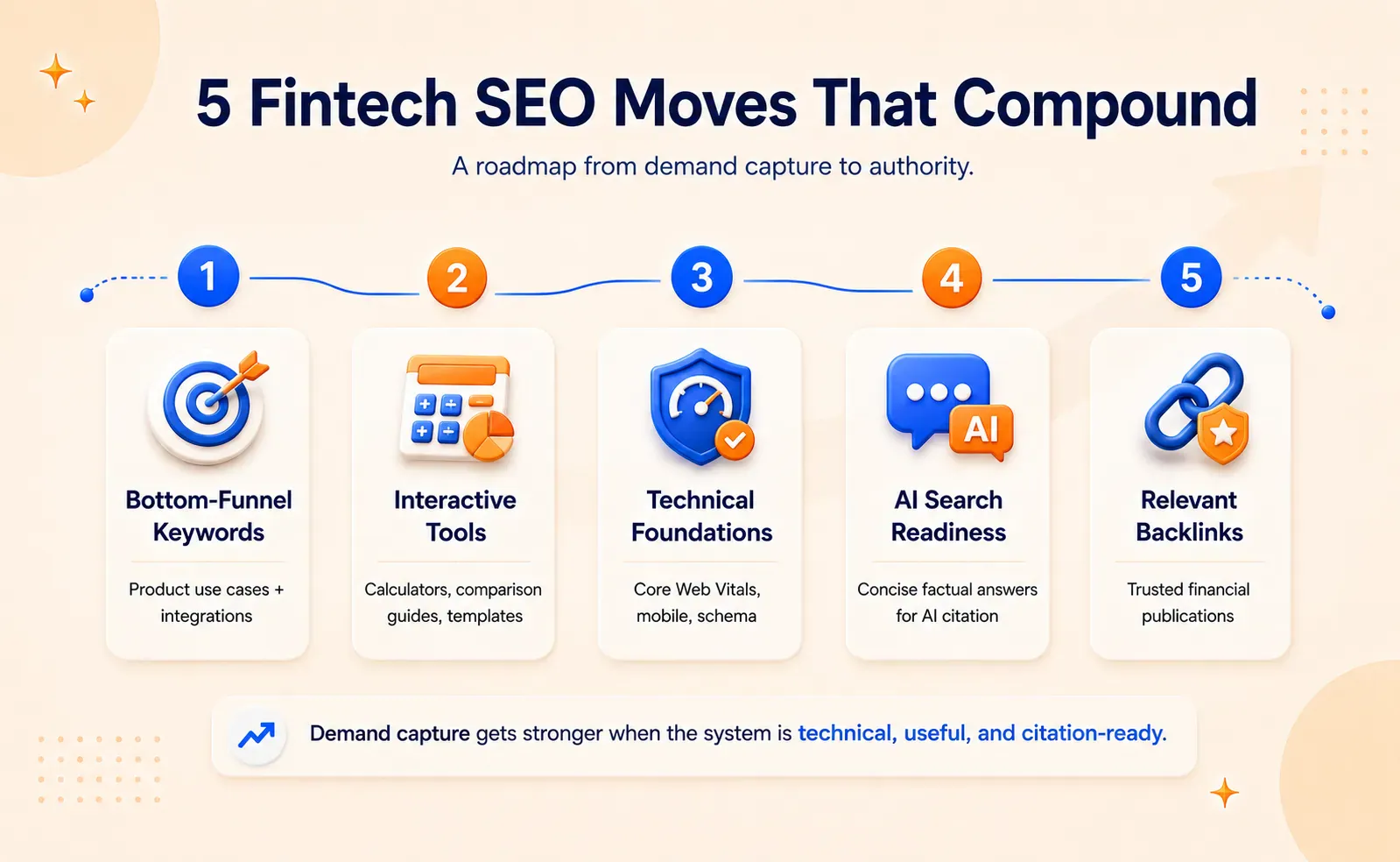
Target bottom-funnel keywords: Focus on specific product use cases and integrations instead of broad, high-competition financial terms.
Build interactive tools: Calculators, comparison guides, and templates capture high-intent search demand that static articles miss.
Fix technical foundations first: Core Web Vitals, mobile usability, and correct schema markup for financial products and FAQs.
Optimize for AI and generative search: Structure answers to be concise and factual enough for ChatGPT and Google AI Overviews to cite directly.
Earn relevant backlinks: Prioritize placements on trusted financial publications over volume-based link networks.
Fintech SEO Trends to Consider
Heading into 2026, three shifts matter most for fintech specifically. AI-driven search is now a genuine traffic source, so content needs passage-level structure that a generative engine can lift cleanly without distortion.
E-E-A-T enforcement keeps tightening, so author credentials and compliance sign-off are turning into ranking factors, not just legal formalities buried in a footer. And interactive, tool-based content is outperforming static articles on the same bottom-funnel keywords, since a calculator answers the query outright instead of describing how a reader might answer it themselves.
Why Work With ThirdMeta on Fintech SEO?
If your last content cluster launched half-finished because compliance couldn't keep pace, that's exactly the gap our fintech practice is built around. We scope content production to your actual review capacity, not a generic publishing calendar borrowed from a less regulated client.
Compliance-paced clusters, sized to your legal review throughput instead of ignoring it
E-E-A-T built into the brief from day one, with credentialed reviewers and cited sources planned before a draft even starts
AI-visibility included, so content is structured for citation in AI Overviews and ChatGPT alongside standard rankings
Across recent engagements, clients using this model have cut CAC by as much as 38 percent. See how we scope a fintech content plan your compliance team can actually keep up with.
This isn't the right fit for a pre-launch fintech still finalizing its regulatory approvals. Content strategy works best once the product's compliance posture is settled, not while it's still in flux.
Conclusion
SEO for fintech earns its category by respecting the compliance layer that most SEO plans ignore, not by matching a generic content-cluster template built for a less regulated industry. A smaller, fully reviewed cluster beats a large, half-published one every time.
Choosing the right approach means asking how a content plan is scoped against your legal review capacity before a single article gets drafted. That question decides whether your clusters actually finish, or stall out at article six.
Frequently Asked Questions
It's optimizing a financial technology website to rank for high-intent searches while meeting Google's E-E-A-T and YMYL standards for money-related content.

Sr. Content Writer
Vamshi Vadali is Third Meta's Content Team Head and the guy who banned fluff from all blog posts. He specializes in SEO, GEO (Generative Engine Optimization), and AEO (Answer Engine Optimization): the trifecta that gets B2B SaaS content ranking in both Google and ChatGPT. Vamshi doesn't write content. He engineers MQL machines. His philosophy? Good writing needs data and clarity, not buzzwords. He writes like a CFO reads: straight to the outcomes. When he's not optimizing for AI Overviews, he's debating whether LLMs prefer Oxford commas.