
B2B SaaS teams rarely have a content shortage. They have old blogs with search history, outdated angles, weak CTAs, and no clear path from reader interest to demo intent.
A content optimization strategy fixes that gap by turning existing pages into stronger search, AI, and sales support assets. The business case is stronger in 2026 because buyers research deeply before contacting sales. A 2025 6sense report found that buyers purchase from one of their Day One shortlisted vendors 95% of the time which means old content must influence buyers before the first sales conversation.
TL;DR
- Prioritize blogs with rankings, impressions, backlinks, or buyer relevance first.
- Optimize for pipeline movement not just traffic recovery.
- Use GSC, GA4, CRM, SERP, and CTA data together.
- Add answer-first sections for AI Overviews, ChatGPT, Gemini, and Perplexity.
- Fix conversion paths before publishing more top-funnel content.
- Track demos, assisted leads, and CRM movement after republishing.
What Does a Content Optimization Strategy Actually Fix?
A content optimization strategy fixes the gap between what an old blog says and what today’s buyer, SERP, and AI answer system expects. It is not only about updating dates, replacing statistics, or adding more keywords.
For B2B SaaS, the real work is identifying what has decayed. A page can lose traffic, search intent match, trust, conversion value, AI visibility, or sales usefulness.
|
Decay Type |
What ThirdMeta Looks For |
What It Means |
|
Search decay |
Clicks, impressions, CTR dropped in GSC |
Page lost SERP competitiveness |
|
Intent decay |
Current SERP answers a different query angle |
Blog answers an old version of the search |
|
Conversion decay |
Traffic exists but demo or form movement is weak |
Page attracts readers but does not guide them |
|
AI visibility decay |
H2s are vague and answers are buried |
AI systems struggle to extract clean answers |
|
Sales usefulness decay |
Page misses objections heard on calls |
Sales cannot use it during deal education |
The optimization plan should be based on the type of decay not the age of the blog.
Why Traffic-Led Optimization Fails to Create Pipeline
A traffic-led optimization fails because it improves visibility before it understands buyer movement. A blog can recover rankings and still fail commercially if the reader has no clear reason to take the next step.
The standard playbook says: update stats, add keywords, fix links, and republish. That helps but it does not answer the revenue question: what should this reader do after this page?
A blog with 5,000 visits and zero demo assists is not a content win. It is a leaking acquisition asset. A refresh should be judged by whether the page moves the right reader closer to a qualified conversation not by traffic recovery alone.
Which Old Blogs Are Worth Optimizing First?
A content optimization strategy should prioritize pages with existing search value and strong revenue proximity. ThirdMeta uses a Pipeline Pull Score to decide which pages deserve attention first.
|
Signal |
What ThirdMeta Checks |
Strong Candidate |
|
Ranking distance |
Keywords in positions 4 to 20 |
Easier to lift than starting fresh |
|
CTR gap |
High impressions, low clicks |
Title and meta undersell the page |
|
Revenue proximity |
Topic connects to demo, pricing, or pain |
Better pipeline potential |
|
AI answer gap |
Page lacks definitions, tables, FAQs |
Better AI visibility opportunity |
The best optimization candidates are not the oldest blogs. They are pages closest to page-one visibility and pipeline influence.
The ThirdMeta Optimization Method: Diagnose Revenue Leakage Before Editing
ThirdMeta’s content optimization strategy starts by finding where the page leaks value. The edit comes later because rewriting before diagnosis usually creates a cleaner version of the same weak page.
The method connects five views: search data, SERP behavior, buyer intent, conversion path, and AI visibility. That distinction separates editorial optimization from revenue-led optimization.
Step 1: Search Diagnosis
ThirdMeta opens GSC and maps four signals for every candidate URL: query movement, ranking distance, CTR gap, and impression trend. These four signals tell different stories.
A page with high impressions and low CTR has a clickability problem the title or meta promise is not matching what buyers expect to find. A page with falling impressions and stable CTR has a query mismatch problem it is no longer competing for the right searches. A page with ranking distance in positions 8 to 20 has a depth problem it is close to page one but not yet trustworthy or comprehensive enough to earn it.
The page does not get rewritten until the failure type is clear. Writing before diagnosis produces a cleaner article with the same underlying problem.
Step 2: SERP Diagnosis
ThirdMeta reviews what the current SERP is rewarding for every target keyword. SERPs shift. A query that previously rewarded definition-led content may now reward comparison-led, framework-led, or case study-led content.
This changes everything downstream: the H1 framing, the H2 order, the intro promise, the depth of examples, and the CTA path. Optimizing against the old SERP is how teams publish updates that still feel outdated the moment they go live.
ThirdMeta also maps the SERP for featured snippet format, AI Overview structure, and People Also Ask patterns. These signal the answer structure that Google and AI systems are already rewarding.
Step 3: Buyer Diagnosis
ThirdMeta checks whether the page answers current buyer questions. For B2B SaaS, those questions almost always involve cost, implementation time, alternatives, proof, use cases, and sales risk not just definitions or category explanations.
This is where sales call data becomes the most valuable input in the entire process. The objections prospects raise during discovery calls are the exact gaps most blogs never address. ThirdMeta pulls those objections into the optimization brief so the rewritten page does the same job a strong sales rep would do in a first conversation.
A page that answers buyer objections before the sales call shortens the sales cycle. That is pipeline value not just content value.
Step 4: Conversion Diagnosis
ThirdMeta audits whether the CTA matches the reader’s stage. A TOFU reader who just learned what a term means is not ready for a demo CTA. A BOFU reader who is comparing vendors needs proof, pricing context, and a direct consultation path not another educational article link.
This step also covers internal linking. ThirdMeta maps where the optimized blog sits in the buyer journey and which pages should naturally follow it. An optimized blog is not a standalone asset it is a node in a content network that moves readers toward qualified conversations.
Missing internal links to comparison pages, case studies, or pricing content are one of the most common and most fixable revenue leaks in B2B content libraries.
Step 5: AI Visibility Diagnosis
ThirdMeta checks whether AI systems including Google AI Overviews, ChatGPT, Gemini, and Perplexity can extract clean answers from the page. This requires a different structure than traditional SEO writing.
AI systems do not reward vague paragraphs. They need clear answer units: direct definitions in the first sentence of each H2 section, short FAQ answers, named entities, structured tables, and specific claims that can stand alone without context.
ThirdMeta audits every H2 opening, every definition block, and every FAQ section to ensure they produce extractable answers. A page that AI systems can cite becomes a trust signal for buyers who are researching through AI before they ever visit a vendor site.
How Google and AI Algorithm Shifts Make Old Blogs Lose Visibility Faster
Before you can understand why old blogs decay, you need to understand the two types of algorithm changes that are accelerating that decay in 2026.
Type 1: Google Core Updates: Quality and Usefulness Signals
Google’s core updates evaluate whether content is helpful, reliable, original, and written with genuine expertise. These updates ask: does this page make the reader better off than any competing page on the same query?
For B2B SaaS content, this creates a clear rule. A blog cannot hold its position on historic authority if the page now repeats generic advice, hides the answer behind lengthy introductions, or ignores the current buyer language in its category. Freshness alone is not enough a page with a new publish date and the same shallow substance will still lose ground.
Core updates also penalize content that looks like it was written primarily for search engines rather than buyers. Keyword stuffing, vague H2s, and padded word counts are now signals against a page, not neutral factors.
Type 2: AI Search Changes: Answer Extraction and Citation Logic
AI Overviews, ChatGPT, Gemini, and Perplexity have introduced a second layer of algorithm behavior that most content teams have not yet adapted to. These systems do not rank pages they extract answers from pages. The selection criteria are different.
AI systems favor pages with direct answer structures: a clear definition in the first sentence, entity-rich language, structured tables, and short FAQ answers. They also favor pages that are semantically comprehensive covering the full scope of a topic with specific evidence, not just surface-level explanations.
A Pew Research Center study found that users clicked a traditional search result in only 8% of visits when a Google AI summary appeared, compared with 15% when no AI summary appeared. That shift changes the optimization goal. The aim is not just to rank it is to be the source AI systems cite, which then drives higher-intent clicks from buyers who already trust the answer.
Why Both Changes Matter Together
The combination of core update quality signals and AI extraction logic means that old blogs face pressure from two directions at once. A page that survives a core update may still lose AI visibility if its structure does not support answer extraction. A page optimized for AI may still lose organic rankings if it lacks depth and originality.
ThirdMeta’s optimization process addresses both simultaneously improving the substance and the structure so a page earns rankings, AI citations, and buyer trust at the same time.
Should You Optimize, Rewrite, Merge, or Kill the Page?
Not every declining blog deserves an optimization. The right action depends on what the page still has and what it is missing.
|
Action |
Use When |
Business Decision |
|
Optimize |
Page has rankings, backlinks, or impressions |
Keep URL and improve depth |
|
Rewrite |
Topic is valuable but content is weak |
Keep intent, rebuild content |
|
Merge |
Two pages target similar keywords |
Combine and redirect |
|
Kill or redirect |
No traffic, links, or business value |
Remove or redirect |
The common mistake is optimizing everything because it exists. That is not strategy that is CMS guilt with a spreadsheet.
What Changed After ThirdMeta Optimized Its Own Blog Pages?
ThirdMeta’s own GSC data shows what optimization work looks like in practice. Over a 60-day window after optimization work began, clicks increased from 111 to 143 and CTR improved from 7.2% to 7.3% even as impressions declined slightly. That combination signals better query matching, not just more visibility.
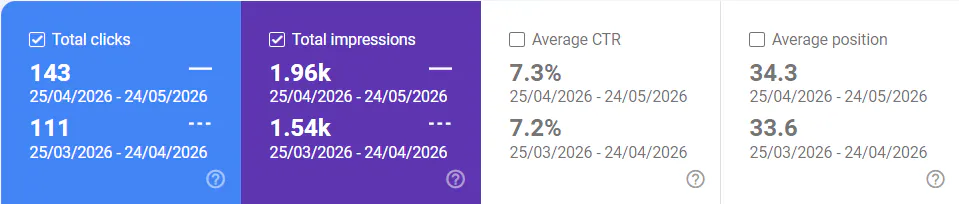
The most visible opportunity in the data is CTR repair. Total clicks grew from 111 to 143 a 29% increase while total impressions moved from 1.54k to 1.96k over the same period. CTR held steady at 7.3% compared to 7.2% the previous period, and average position improved marginally from 33.6 to 34.3. The page already has growing visibility, but position depth means the title and meta angle need stronger alignment with buyer intent to pull higher-quality clicks. That is an optimization problem, not a new-content problem.
Old Blogs Should Not Sit Like Archived Assets
A content optimization strategy is not a maintenance task. It is a revenue recovery system for pages that already have search history, buyer context, and unused conversion potential.
For B2B SaaS teams, the best optimizations fix search intent, AI readiness, internal links, proof, CTAs, and tracking together. When that work is done well, old blogs stop acting like archives and start supporting qualified pipeline.
For teams with old blogs, weak CTR, and unclear demo movement, the next step is not another content calendar. Book a ThirdMeta demo and bring the top 10 declining URLs.
FAQs
A content optimization strategy updates old content for current search intent, AI answer structure, and conversion goals. For B2B SaaS, it should also support pipeline movement not just traffic recovery.
Comparison, AI, and SEO pages need review every 3 months. BOFU blogs every 3 to 6 months. Evergreen explainers can follow a 6 to 12 month cycle.
Optimization is better when a page already has rankings or backlinks. New blogs work better for uncovered topics. The right strategy uses both based on intent gaps and pipeline proximity.
It fixes weak buyer paths updating CTAs, internal links, proof sections, and objection-led content so readers move from research to action faster.