Quick Answer: Enterprise SaaS SEO is the practice of building organic search visibility for large software companies so content influences an entire buying committee across a months-long sales cycle, not a single searcher.
Key points covered in this article:
- Enterprise SaaS SEO targets buying committees, not individual searchers
- The Empty-Seat Test shows which committee roles your content misses
- PLG and sales-led SaaS need different SEO content models
- AI search now intercepts research-stage enterprise queries
Enterprise SaaS SEO is the discipline of earning organic search visibility for large software companies whose deals are decided by a committee, not a single buyer. That definition changes everything about how the work is run.
A VP of Demand Generation at a $50M ARR platform faces a different problem than a startup marketer. Their site holds thousands of pages across several product lines, and a sales cycle that runs three to nine months. Standard SEO tactics were not built for that environment.
Gartner‘s survey finding that 74% of B2B buyer teams show unhealthy conflict during the buying decision process explains why ranking alone never moves enterprise pipeline. This playbook covers the buying-committee model, a five-minute diagnostic, and how to tie enterprise SaaS SEO to revenue. Teams that want execution support can review our SaaS SEO services.
TL;DR
- Enterprise SaaS SEO is won by reaching every seat on the buying committee, not by ranking alone.
- The Empty-Seat Test reveals in five minutes which committee roles your content fails to convince.
- A PLG company and a sales-led company need different enterprise SaaS SEO content models, and building the wrong one wastes a year.
- Pipeline attribution requires three connected layers: Search Console visibility, GA4 conversion events, and CRM revenue data.
- AI search engines now answer research-stage enterprise queries, so content must be built for citation, not only ranking.
What Is Enterprise SaaS SEO, and Why Does Standard SEO Break at Scale?
Enterprise SaaS SEO is the practice of building organic search visibility for software companies large enough that no single keyword decides a deal. Standard SEO tactics break here because the stakes and the scale change at once. A mid-market blog post chases a ranking, while an enterprise program moves a pipeline figure the CFO reviews every quarter.
What makes a SaaS company “enterprise” here?
The label is less about employee count and more about deal structure. Once a purchase needs sign-off from procurement, security, and a budget owner, the SEO problem changes shape. Companies like Salesforce and HubSpot built organic engines around this reality, and a $30M ARR vertical SaaS firm with committee-led deals faces the same task.
Why does scale change the work?
An enterprise site has thousands of URLs across several product lines, which makes crawl budget, internal linking, and template quality real constraints. One broken title-tag template can degrade ten thousand pages at once.
Strong B2B SaaS keyword research keeps that page volume pointed at revenue rather than vanity terms. Enterprise SaaS SEO is not harder SEO, it is SEO where every decision carries a multiplier on both the upside and the downside.
Why Enterprise SaaS SEO Loses Deals Even When It Ranks
Enterprise SaaS SEO can rank a page in position one and still lose the deal it was built to win. Most guides describe the work as regular SEO made bigger. The real defining feature is the buying committee, and content has to reach all of it.
Gartner‘s survey showing 61% of B2B buyers prefer a rep-free buying experience means most of the committee forms an opinion before a salesperson is involved. A VP of Demand Generation, an IT security reviewer, and a finance approver each search for different things.
Across our B2B SaaS work, the most common pattern we see is a content library that speaks fluently to the champion and goes silent for every other seat at the table. The champion is sold, and the deal still stalls in security review.
Enterprise SaaS SEO that generates pipeline maps content to every committee role: a use-case page for the practitioner, a security and integration page for the IT reviewer, a pricing and ROI page for finance. Each of those pages is a lead generation asset, measured by the deals it supports, not the sessions it earns.
“The defining constraint of enterprise SaaS SEO is not page volume but the fact that organic search must win over an entire buying committee no salesperson ever meets.”
Treat enterprise SaaS SEO as a volume exercise and you build a large site that still loses deals.
The Empty-Seat Test: A 5-Minute Enterprise SaaS SEO Diagnostic
The fastest way to find what your enterprise SaaS SEO is missing is the Empty-Seat Test, a five-minute diagnostic you can run today. It turns the buying-committee idea into a checklist. Run it on your last three lost enterprise deals.
- List the seats. For each lost deal, write down every buying-committee role that needed convincing: champion, practitioner, IT or security, finance, and the executive sponsor.
- Match each seat to a page. For every seat, name the specific page on your site built to answer that role’s main question. Be strict, because a generic blog post does not count.
- Mark the empty seats. Any role without a dedicated page is an empty seat. That is where the deal had no content support.
- Count the pattern. Across three deals, the seat that sits empty most often is your single highest-priority enterprise SaaS SEO project.
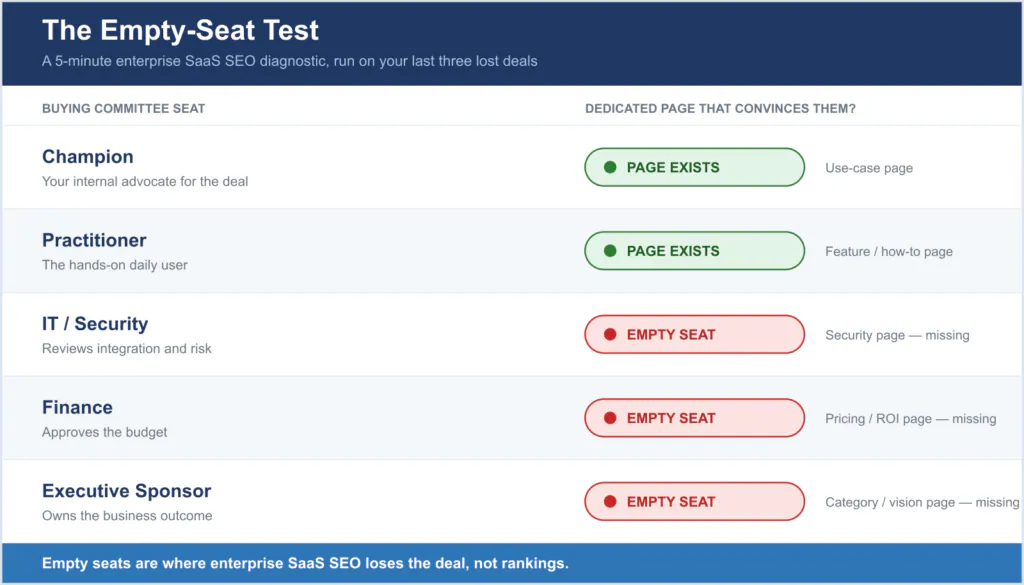
The Empty-Seat Test applied to a single deal: two seats covered, three seats with no page is where pipeline leaks.
The Empty-Seat Test works because it measures coverage, not traffic. A site can rank well and still leave three seats empty in every deal.
| If the Empty-Seat Test left you with more empty seats than pages, that gap is your pipeline problem, not your traffic. See how we build committee-mapped SEO |
Why PLG and Sales-Led SaaS Need Different SEO Playbooks
Enterprise SaaS SEO is not one model. A product-led company like Notion and a sales-led company like Workday need different content because their conversion events differ. PLG content leads to self-serve signups, while sales-led content produces demo requests that feed the committee.
Building the wrong model is the most expensive enterprise SaaS SEO mistake, because it can take a year to notice. The table below shows where the two motions diverge.
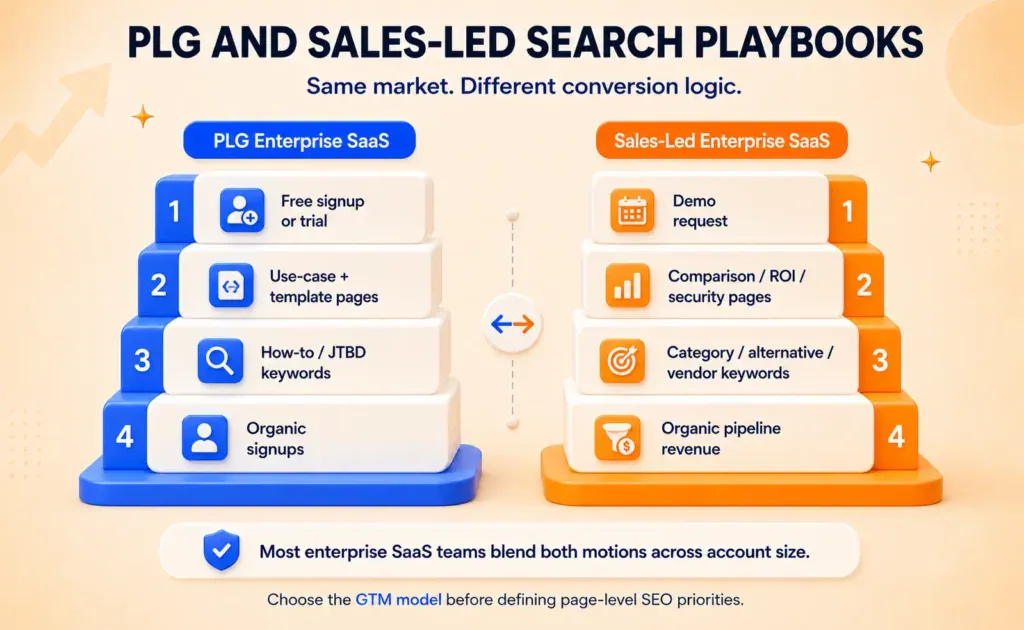
Many enterprise SaaS companies run a hybrid: self-serve at the low end, sales-led for large accounts. Your SaaS go-to-market strategy decides the content mix, so confirm it before briefing a single page.
How to Make Enterprise SaaS SEO a Number the CFO Trusts
Enterprise SaaS SEO becomes a number the CFO trusts only when it connects to revenue through three data layers, not a rankings dashboard. A position-three page with no demo requests is worth less than a position-eight page that feeds pipeline. Each layer answers a different question, and a gap in any one breaks the chain.
- Visibility layer (Google Search Console). Track which queries and pages earn impressions and clicks. This shows what the buying committee is actually searching for.
- Conversion layer (GA4). Tag demo requests, trial signups, and pricing-page views as events. This connects a specific organic page to a buyer action.
- Revenue layer (CRM). Pass the lead source into the CRM so closed deals carry an organic attribution.
The pattern we see most often is a program that can prove traffic but goes quiet the moment a CFO asks which deals it sourced. The visibility layer alone never survives a budget review. Pair these three layers with conversion rate optimization so the pipeline you can finally measure also converts.
| If you cannot trace a single closed deal back to an organic page, attribution is the first thing worth fixing. Talk to us about SEO pipeline attribution |
Your Buyers Now Research in AI: The 2026 Enterprise SaaS SEO Shift
In 2026, AI search has moved a large share of research-stage queries away from blue links. Enterprise SaaS SEO now has to earn citations inside AI answers, not only rankings on a results page. The buying committee runs much of its early research through ChatGPT, Perplexity, and Google AI Overviews.
Semrush‘s 2025 study found 58.5% of US searches end without a click. Consider an IT reviewer evaluating vendors: they ask an AI assistant for the top platforms in a category and read the summary. If your page is not cited there, you are outside the consideration set, regardless of your Google ranking.
Content that earns AI citations is built for extraction. Each section opens with a direct, self-contained answer, names specific tools and roles, and carries clear entities. Our AI SEO guide covers the structural rules in detail.
Enterprise SaaS SEO in 2026 is a two-front task: rank for the queries that still produce clicks, and get cited for the ones that do not.
Three Signs Your Enterprise SaaS SEO Is Quietly Failing
Failing enterprise SaaS SEO rarely looks like a traffic crash. It looks like rising impressions and flat pipeline, which is harder to catch and easier to fund for too long. Three signs catch it early.
Is your traffic arriving with no intent?
The site ranks for broad informational terms the buying committee never searches. The signal is high sessions and near-zero demo requests.
Does your content cover only one seat?
Content speaks to the champion and ignores the IT and finance seats. The signal is deals that stall after the first sales call.
Is one template dragging down thousands of pages?
A flaw in a shared page template degrades many URLs at once. The signal is a sudden ranking drop across a whole page type.
One honest caveat: enterprise SaaS SEO is the wrong investment for a company without a defined ICP or product-market fit. If you do not yet know which committee you are selling to, fix that before scaling content.
Why Should You Choose ThirdMeta?
Most enterprise SaaS SEO falls short because it runs as a content factory disconnected from sales. ThirdMeta builds it as a pipeline function. We start with your ICP and a committee map, then brief content against the deals you actually want to close.
- Committee-mapped content, so the IT reviewer and finance approver each find a page built for them
- Three-layer attribution wired from Search Console through GA4 into your CRM
- A GTM-matched content model, built for PLG, sales-led, or hybrid motions
- AI search structuring, so pages earn citations in ChatGPT and AI Overviews
- Technical SEO governance for large multi-product sites
We work as a full execution partner, not a strategy deck. For one B2B SaaS client, KlearStack, this approach grew qualified demos from 10 to 55 a month over an 18-month engagement.
- Unlike content-only agencies, we connect every page to a CRM revenue number
- Unlike traditional SEO firms, we structure content for AI search citation, not only rankings
- Unlike strategy consultancies, we execute the technical and content work ourselves
If your enterprise SaaS SEO has produced traffic but not pipeline, the fix is structural, not more blog posts.
| Ready to make organic search answerable to revenue? Book a demo with ThirdMeta |
Conclusion
Enterprise SaaS SEO is won by the company that treats organic search as a pipeline function answerable to revenue. The volume of pages matters far less than whether each one reaches a real seat on the buying committee. Rankings are an input, and closed deals are the output that survives a budget review.
A SaaS company that builds enterprise SaaS SEO this way stops guessing which content works. It can trace a closed deal to the page that started it, brief new content against named committee roles, know when to bring in a specialist SEO partner, and defend the channel when the CFO asks what it returned. That is the difference between an SEO cost and an SEO engine.
FAQs
Enterprise SaaS SEO must influence a buying committee, not one searcher. Deals need sign-off from procurement, security, and finance. Content has to reach every seat. Scale and stakes are both higher than mid-market SEO.How long does enterprise SaaS SEO take to generate pipeline?
Most enterprise SaaS SEO programs show pipeline impact in six to nine months. Technical fixes can move rankings sooner. Committee-stage content takes longer to compound. The sales cycle itself adds further delay.
It depends on speed and existing skill depth. An agency brings technical and content execution faster. An in-house team holds deeper product context. Many companies run a hybrid.
Use three data layers across the cycle. Search Console tracks visibility early. GA4 records demo and trial events. The CRM ties closed revenue back to the original organic page.
Most enterprise SaaS SEO programs show pipeline impact in six to nine months. Technical fixes can move rankings sooner. Committee-stage content takes longer to compound. The sales cycle itself adds further delay.Should an enterprise SaaS company hire an agency or build SEO in-house?
It depends on speed and existing skill depth. An agency brings technical and content execution faster. An in-house team holds deeper product context. Many companies run a hybrid, which our guide to choosing in-house vs agency explains.How do you measure enterprise SaaS SEO when the sales cycle is long?
Use three data layers across the cycle. Search Console tracks visibility early. GA4 records demo and trial events. The CRM ties closed revenue back to the original organic page.

Isha Chaudhari is a content strategist specialising in B2B technology and enterprise software. She writes on AI, finance automation, and the operational challenges facing modern business teams. Her work focuses on making complex technology decisions accessible to the people who have to act on them.