You have probably already seen it on a call. A prospect shows up having compared you against two competitors you never heard them mention, and when you ask where that shortlist came from, the answer is ChatGPT.
That is the part most founders miss until it costs a deal. Your buyers are not starting on Google and clicking through to your site anymore. They ask an AI which tool solves their problem, and they treat its answer as the shortlist. If your brand is not named in that answer, you are not ranking lower. You are not in the room.
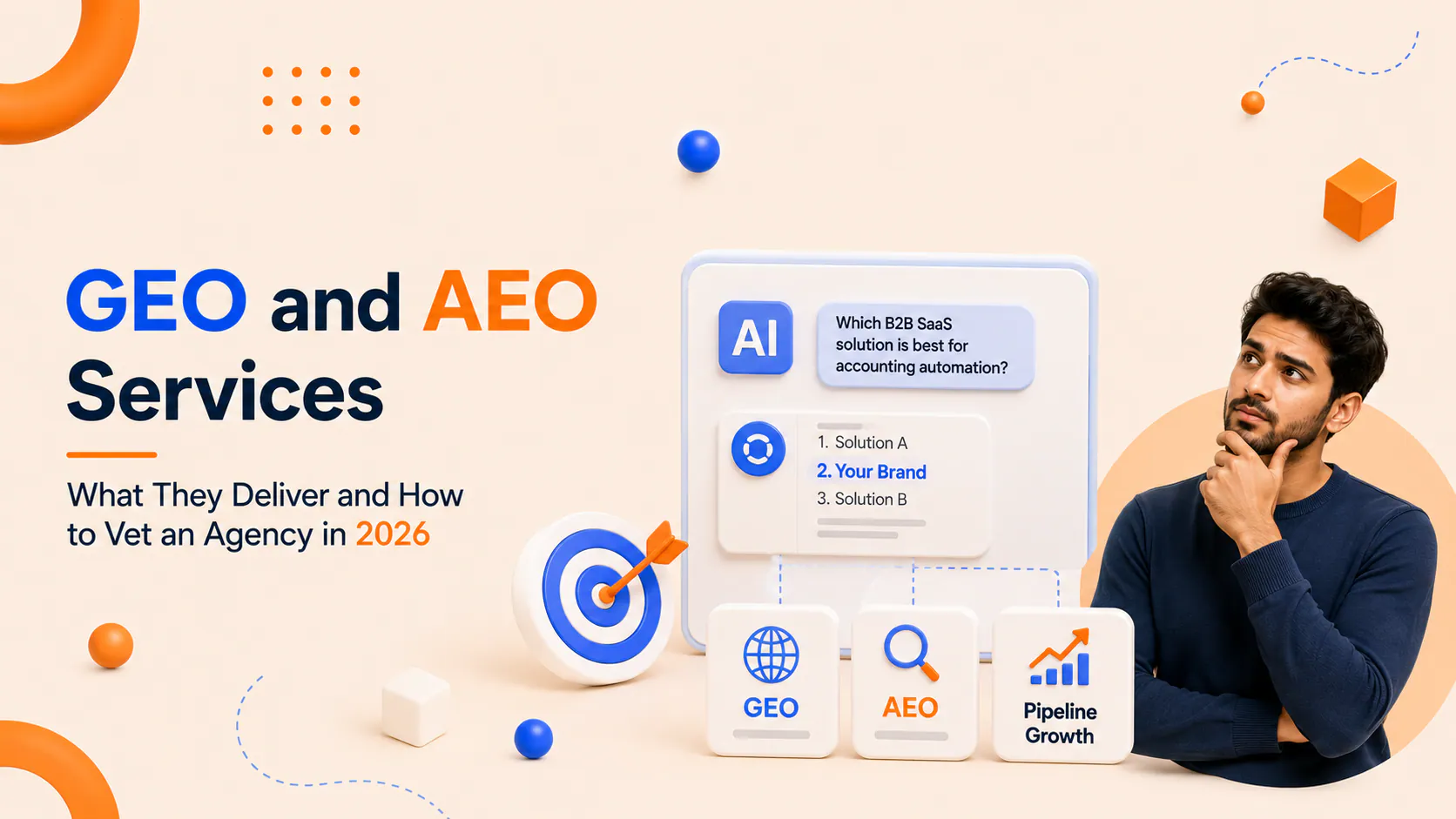
GEO and AEO are the services that put you back in it. This guide walks through what they actually deliver, what results to expect and how fast, and the exact framework to vet an agency so you never pay an SEO shop to relabel its old work. By the end, you will be able to sit on any agency call and know, inside four questions, whether they can move your AI visibility or not.
TL;DR
- Your buyers now start in AI, not Google. G2 reports generative AI chatbots are the number-one source for B2B vendor shortlists at 17.1%, and 51% of buyers begin research inside a chatbot.
- GEO and AEO are not SEO with a new label. The deliverables, the measurement, and the surfaces are different.
- Expect leading indicators (citations appearing, answer share growing) within a quarter, not overnight. Any agency promising page-one AI citations in 30 days is the same red flag as an SEO shop promising rank-one in a month.
- Use the CITE Framework, Coverage, Instrumentation, Traceable methodology, and Evidence, to separate a real partner from an SEO shop that added AI-ready to its homepage.
- For B2B SaaS, AI-search citation is still largely uncontested, which makes it a rare channel where a focused program can win quickly.
Why AI Visibility is Now a Pipeline Problem, Not a Vanity Metric
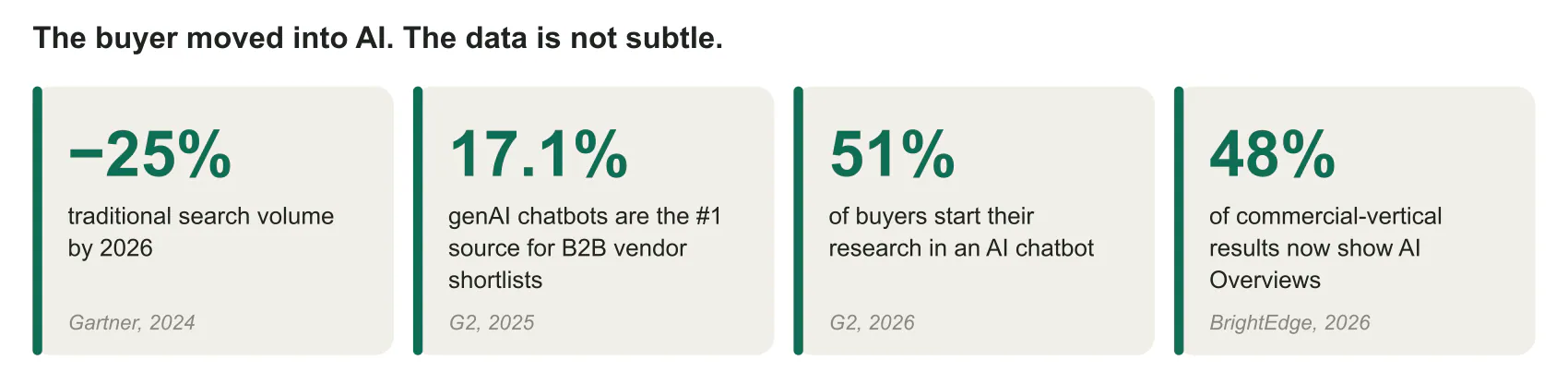
The buyer journey moved into AI faster than most pipelines noticed. Sources: Gartner (2024), G2 (2025 to 2026), BrightEdge (2026).
The buying journey moved. Gartner projects traditional search engine volume will fall 25% by 2026 as buyers shift to AI assistants. Forrester‘s 2026 Buyers’ Journey research found generative AI named the single most meaningful research source by B2B buyers, ahead of vendor websites, product experts, and sales reps.
For commercial queries, the change is already visible. BrightEdge tracking shows AI Overviews on 48% of results across nine commercial verticals by March 2026, up 58% year over year, with B2B technology among the highest. If your category gets answered by an AI and your brand is not in that answer, you are not losing a ranking. You are losing the shortlist before the buyer ever clicks.
That is the shift GEO and AEO services exist to address. The goal is not traffic. It is the named, cited answer when your buyer asks an AI which tool to use.
GEO vs AEO vs SEO: what each one actually buys you
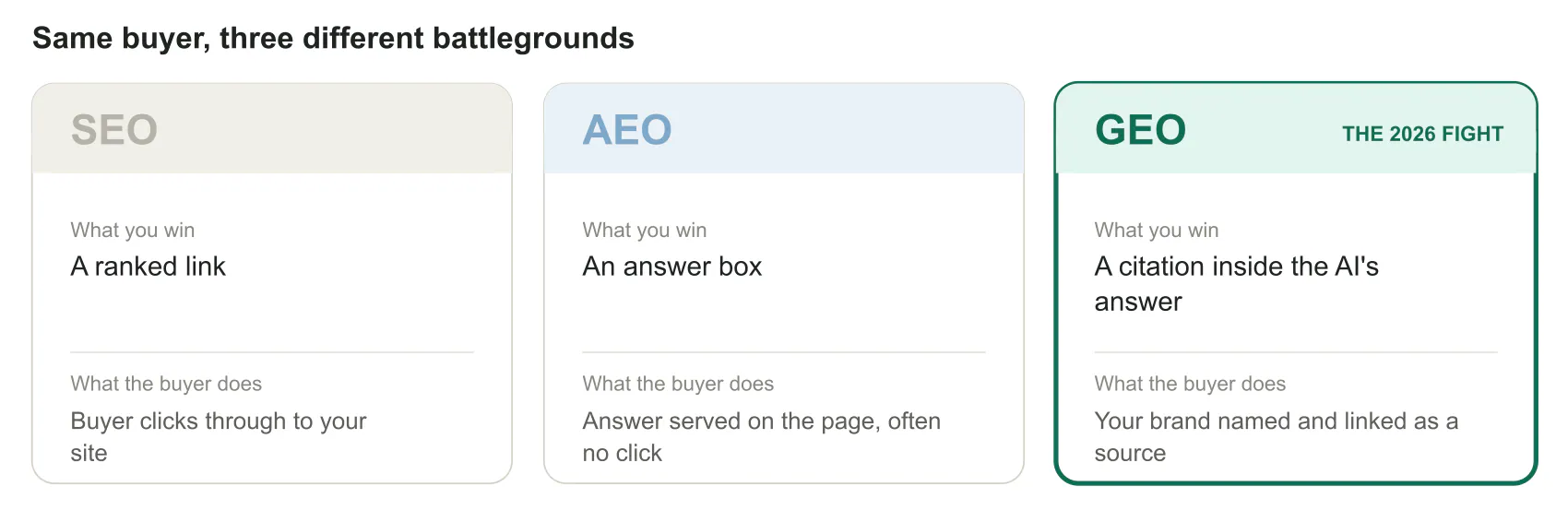
SEO wins a link, AEO wins the answer box, GEO wins a citation inside the generated answer. A serious program runs all three.
These get used loosely, so here is the practical split. SEO earns ranked links on a results page, and the buyer still clicks and reads. AEO, answer engine optimization, earns the direct answer: featured snippets, People Also Ask, voice results, and AI Overview answer boxes, often without a click. GEO, generative engine optimization, earns a citation inside a generated answer from ChatGPT, Perplexity, Gemini, or Copilot, where the model names and links your brand as a source.
In practice the three overlap, and a serious program runs them together. SEO authority still feeds what AI models trust, AEO structures your content to be quotable, and GEO makes sure you are the entity the model reaches for. Treating any one in isolation is where most AI SEO engagements fall short.
What GEO and AEO Services Actually Deliver?
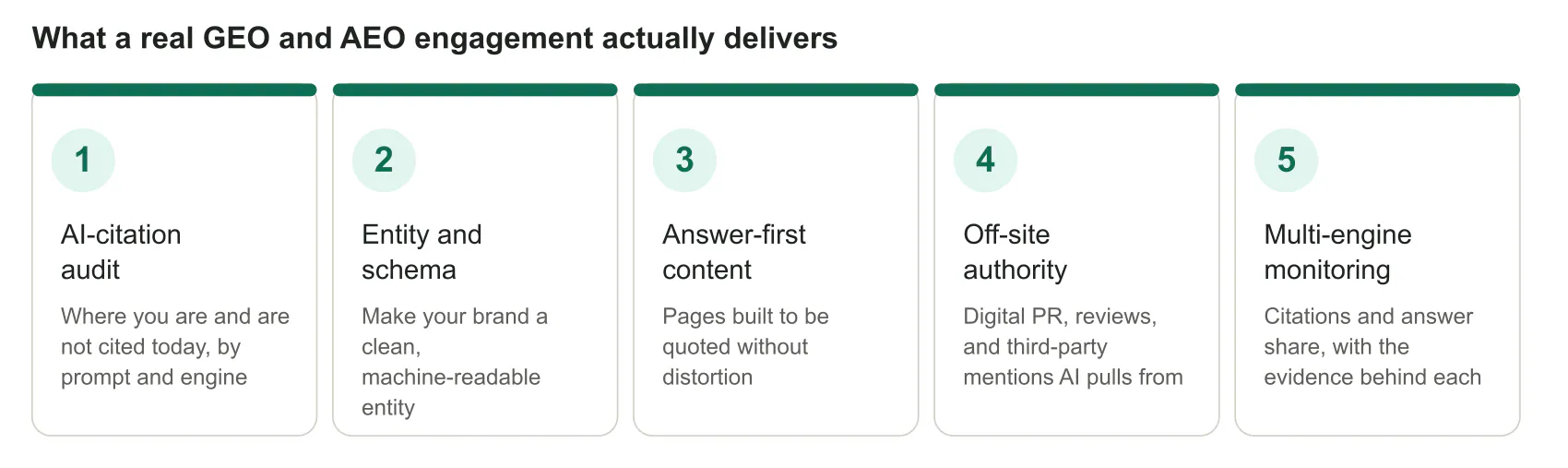
A credible engagement touches your site, your structured data, and the wider web at once.
A credible engagement is more than mentioning AI in your content. The real scope:
- AI-citation audit. A baseline of where your brand is and is not cited today across ChatGPT, Perplexity, Gemini, Copilot, and AI Overviews, scored against the prompts your buyers actually use.
- Entity and schema work. Making your brand a clean, machine-readable entity: structured data, consistent entity signals, and a knowledge-graph presence the models can resolve.
- Answer-first content. Pages built to be quoted: clear claim sentences, defined terms, comparison tables, and FAQs an AI can lift without distortion.
- Off-site authority and digital PR. AI models pull heavily from third-party sources. Brand mentions, review platforms, and earned placements matter as much as your own site. An agency optimizing only your website is working a fraction of what the models read.
- Multi-engine monitoring. Ongoing tracking of citations and answer share across engines, with the prompt, answer, source, and timestamp behind every data point.
What Results to Expect, and How Fast?
Set expectations honestly, because this is where bad engagements are sold. What can move inside a quarter: your first citations appearing on priority prompts, answer share climbing on the questions closest to a buying decision, and entity coverage improving. What does not move overnight: broad citation dominance across every prompt and engine. AI answers are volatile, models update, and citation sets shift week to week.
The right scoreboard is leading indicators tied to pipeline, not a single vanity number. Citations on bottom-of-funnel prompts, the kind a buyer asks right before a demo, are worth more than a hundred citations on a generic definition query. Pair the citation data with demo-page conversion and you can see whether AI visibility is actually feeding the funnel.
The CITE Framework: How to Vet a GEO/AEO Agency in Four Questions
The market filled with agencies that rebranded overnight. Many added AI-ready to their service pages without changing a single deliverable, still tracking keywords and reporting traffic. Use these four questions to tell them apart.
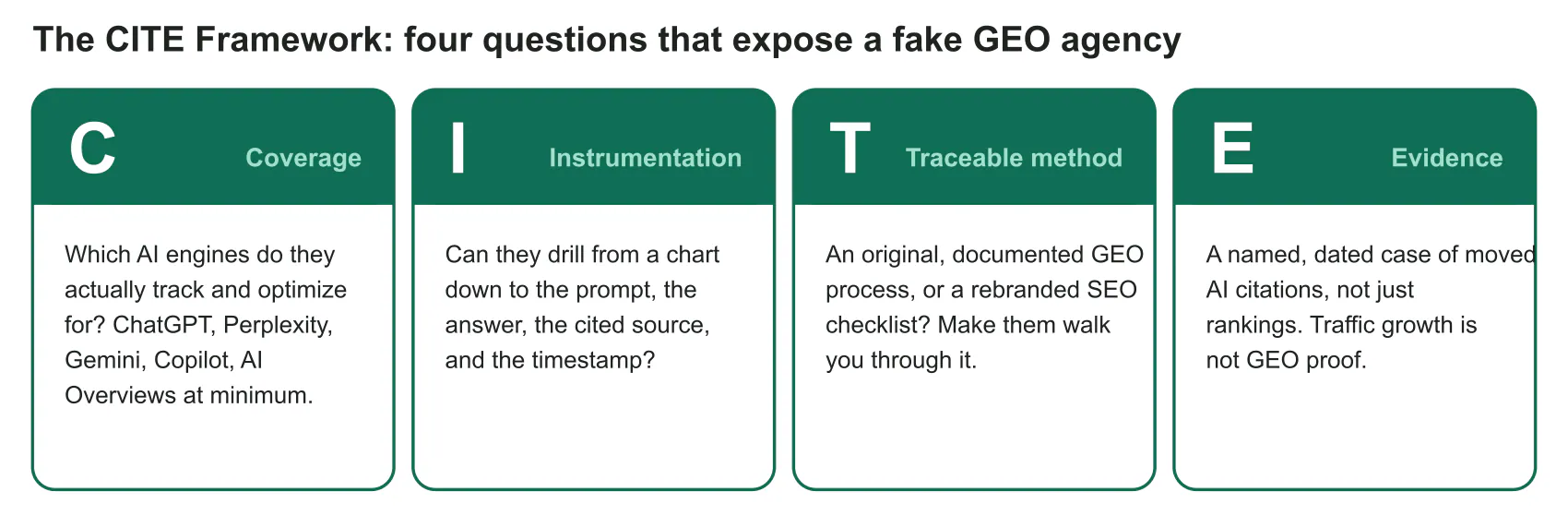
The CITE Framework: an agency that answers all four cleanly is doing the work. One that dodges instrumentation or evidence is selling a relabeled SEO retainer.
C, Coverage. Which engines do they actually track and optimize for? The minimum is ChatGPT, Perplexity, Gemini, Copilot, and Google AI Overviews. We optimize for AI without a named engine list is a tell.
I, Instrumentation. Can they drill from a chart down to the underlying prompt, the answer text, the cited source, and the timestamp? If they can only show a polished aggregate score with no evidence behind it, they cannot diagnose or defend the work.
T, Traceable methodology. Do they have a documented, original GEO and AEO process, or a rebranded SEO checklist? Ask them to walk through how they handle entity reinforcement, schema, answer-first structure, and off-site citations. Vagueness here is the loudest red flag.
E, Evidence. Can they show a named, dated case where they moved a brand’s AI citations, not just rankings? We grew organic traffic is not GEO proof. This brand went from zero to cited on these prompts, by this date is.
Seven red flags that signal an SEO shop in GEO clothing
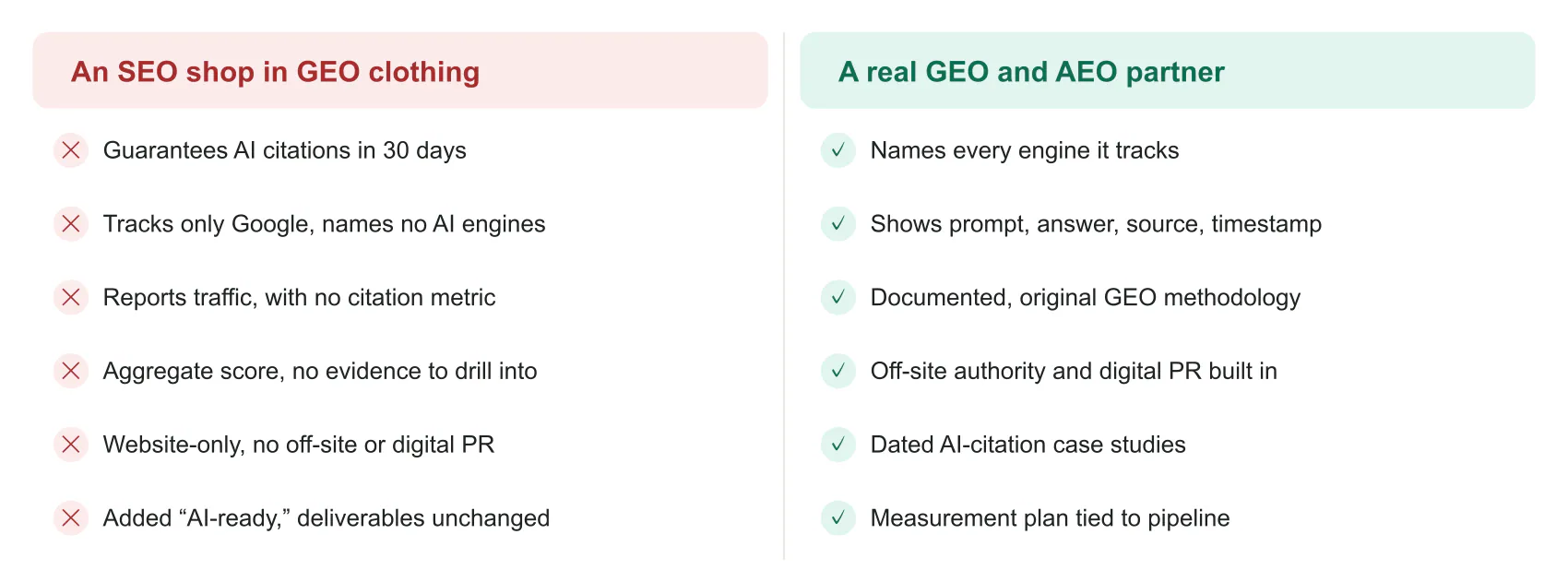
If you see three or more red flags, you are looking at an SEO engagement with new vocabulary.
- Guarantees page-one AI citations or a fixed citation count in 30 days.
- Cannot name the engines it tracks, or tracks only Google.
- Reports traffic and keyword rankings, with no AI-citation or answer-share metric.
- Shows aggregate scores but cannot drill into prompt, answer, source, and timestamp.
- Optimizes only your website, with no off-site, digital PR, or review-platform work.
- Added AI-ready or GEO to its service pages, but the deliverables list is unchanged.
- Has no measurement plan for how it will prove AI visibility moved.
What GEO and AEO Services Cost in 2026?
Pricing is still settling, but the broad shape: specialist GEO and AEO programs commonly run from roughly $3,000 to $12,000 per month, depending on scope, engine coverage, and how much off-site and digital PR work is included. Project-based audits sit lower, full programs with content and authority building sit higher. India-delivered programs in INR retainers can clear lower than US floors.
The number that matters is not the retainer. It is whether the program is tied to a pipeline-adjacent outcome, or just to a citation-count dashboard. Treat any quote without a measurement plan as incomplete.
How ThirdMeta runs GEO and AEO for B2B SaaS
ThirdMeta builds AEO and GEO into a full-funnel program rather than selling it as a standalone trick. Every engagement reports against inbound demos and MQLs, with AI-citation and answer share as the leading indicators that feed them.
The reason this is worth doing now, especially for B2B SaaS, is timing. AI-search citation in most B2B categories is still largely uncontested, which makes it a rare channel where a focused program can earn ground before competitors notice.
For KlearStack, a document-AI platform, repositioning content around the real buyer and claiming an uncontested category helped move inbound demos from 10 to 55 a month and triple MQLs over 18 months. The same principle drives the GEO work: own the answer in a category no one else is defending yet.
If you want to know where you stand, the starting point is the AI-citation audit: a clear read of where you are and are not cited today, and what it would take to change it.
Get your AI-citation Audit
If your buyers are asking AI which tool to choose, the only question that matters is whether your brand is in the answer. ThirdMeta will run an AI-citation audit across ChatGPT, Perplexity, Gemini, and AI Overviews, show you exactly where you stand on your buying-intent prompts, and map what it takes to move it.
Ready to see whether AI names you in the answer? Book your AI-citation audit
FAQ
AEO optimizes content to be served as a direct answer, including snippets, People Also Ask, and AI Overview answer boxes. GEO optimizes for being cited as a source inside a generated answer from ChatGPT, Perplexity, Gemini, or Copilot. Most real programs run both alongside SEO.
Expect first citations on priority prompts and rising answer share inside a quarter. Broad citation coverage across every engine takes longer and keeps shifting, because AI answers are volatile. Anyone guaranteeing fast, fixed results is a red flag.
You can start: clean up schema, write answer-first content, and track citations on your top prompts. Agencies add value on off-site authority, digital PR, entity work, and multi-engine instrumentation, which are harder to run in-house at scale.
Track citations and answer share across named engines on your buying-intent prompts, with the prompt, answer, source, and timestamp behind each data point, then tie it to demo conversion. Avoid agencies that report only a single aggregate AI visibility score.

Sr. Content Writer
Vamshi Vadali is Third Meta's Content Team Head and the guy who banned fluff from all blog posts. He specializes in SEO, GEO (Generative Engine Optimization), and AEO (Answer Engine Optimization): the trifecta that gets B2B SaaS content ranking in both Google and ChatGPT. Vamshi doesn't write content. He engineers MQL machines. His philosophy? Good writing needs data and clarity, not buzzwords. He writes like a CFO reads: straight to the outcomes. When he's not optimizing for AI Overviews, he's debating whether LLMs prefer Oxford commas.