
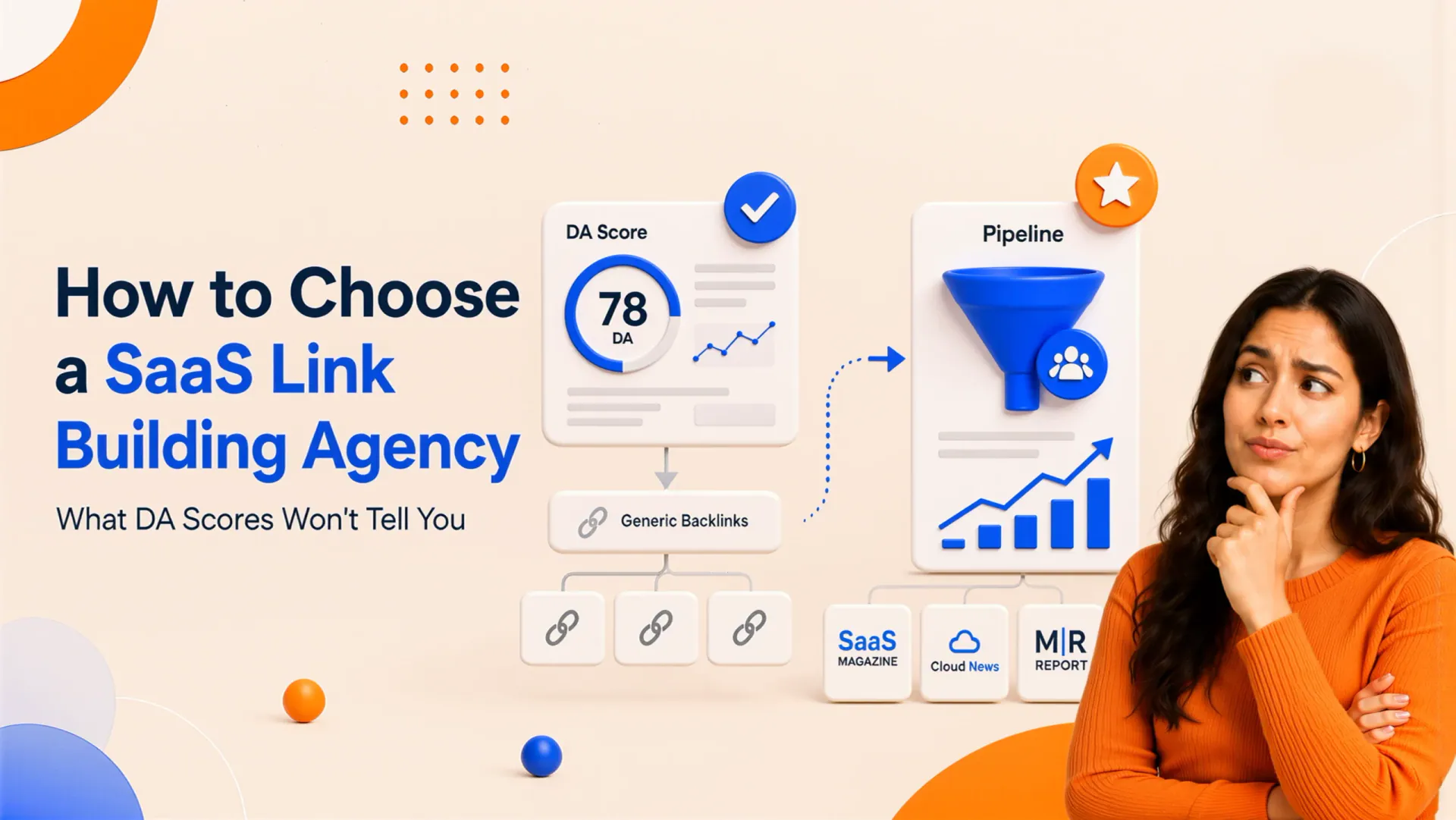
Most SaaS marketers evaluate link building agencies the same way. They ask for a sample link report, check the Domain Authority of the target sites, and compare pricing. If the DA looks respectable and the budget fits, they sign.
Three months later, they have 30 new backlinks and the same number of demo requests. The links are real. The DA scores are solid. The pipeline has not moved.
The problem is not the links. It is the framework used to evaluate them.
This guide gives you a better one. Before you talk to another agency, read this.
TL;DR
|
The Metric Every SaaS Team Uses to Pick a Link Building Agency (And Why It Gets It Wrong)
Domain Authority is a score calculated by Moz based on a site’s backlink profile. Google does not use it as a ranking signal. It is a useful shorthand for site quality but a poor predictor of whether a link will drive qualified traffic to a B2B SaaS product.
The reason is simple: DA measures how many links a domain has, not whether that domain’s readers resemble your buyers. A DA-70 link from a general tech blog read mostly by developers means less to your pipeline than a DA-35 link from the industry newsletter your target VP of Operations reads every Tuesday.
Across the B2B SaaS engagements we run at ThirdMeta, the highest-converting backlinks consistently come from sources a client’s sales team would recognize without prompting: vertical trade publications, analyst community blogs, practitioner newsletters. The average DA on those properties is 30-45, rarely above 60. Volume looks modest on paper. Demo conversion rates tell a different story.
When you evaluate a SaaS link building agency on DA alone, you are measuring the tool, not the outcome. The right question is not “how high is their average DA?” It is “which publications does my ICP actually trust?”
See how ThirdMeta approaches this in our SaaS link building service.
The ICP-Source Matrix: How to Judge Link Quality Before You Sign
Before you talk to any agency, map your ICP’s reading stack across three tiers. This is the ICP-Source Matrix, and it takes about 30 minutes to build. It will save you considerably more time later.
Tier 1: Where Your Buyers Follow the News
These are the publications, newsletters, and community aggregators your target buyer checks regularly. For a VP of Operations evaluating invoice processing software, that might be APQC’s supply chain blog, Spend Matters, or a specific finance operations Substack. Links from Tier 1 sources drive direct referral traffic from an already-warmed audience.
Tier 2: Where Your Buyers Learn Best Practices
Thought-leadership sites, how-to guides, and practitioner communities your ICP consults when they have a problem to solve. For B2B SaaS, this includes category-specific blogs, LinkedIn newsletters with named practitioners, and integration partner documentation sites. Links from Tier 2 build topical authority with Google and surface discovery traffic.
Tier 3: Where Your Buyers Build Shortlists
Review platforms (G2, Capterra, TrustRadius), comparison sites, and curated agency listicles used during active vendor evaluation. Links here capture buyers in the decision stage and produce the highest demo conversion rates of any link type. For a practical example of Tier 3 positioning, see how ThirdMeta structures its SaaS link building agency page.
When evaluating any agency, ask this directly: “Show me three links you have built in the past six months for a SaaS company with a similar ICP. Walk me through which tier each one targets.”
Agencies that think in your buyer’s reading stack answer with publication names and explain placement intent. Agencies that think in DA answer with metrics. That distinction alone narrows the shortlist faster than any scorecard.
Your GTM Model Changes Which Backlinks Drive Demos
A product-led growth SaaS and a sales-led SaaS need fundamentally different link profiles. Most SaaS link building agencies build the same link types for both, which is why results vary so widely across clients with similar budgets.
For PLG SaaS
The highest-value links come from product directories (Product Hunt, G2, Capterra, AlternativeTo), integration partner pages (Zapier, Make, Slack App Directory), and tool comparison content that ranks for product-category queries. These sources sit directly in the self-serve evaluation path. A DA-40 link from a “best tools for [job-to-be-done]” listicle that ranks page one beats a DA-70 link from a broad tech publication for driving trial sign-ups.
For Sales-Led SaaS
Demo intent is built earlier in the buying cycle through credibility signals that validate the vendor to a buying committee. Links from analyst-adjacent publications, vertical trade journals, and practitioner-authored roundups matter because they appear in the research phase before a prospect initiates any contact with sales.
Ask any shortlisted agency which GTM model they have worked with most, then ask how their link building strategy differs between the two. For a deeper breakdown of PLG vs. sales-led and what each requires from your content and SEO motion, see our SaaS GTM strategy guide. For the tactics side, our B2B SaaS link building strategies guide covers the full execution layer.
The 7-Question Vetting Script for Your First Agency Call
Most buyer guides tell you what criteria matter. Here is the actual conversation to have in your first 30 minutes with any SaaS link building agency.
1. “Walk me through a campaign you ran for a SaaS company in our vertical. Which publications did you target and why?”Agencies thinking in ICP-source terms will answer with publication names and explain the audience match. Agencies thinking in DA terms will answer with metrics.
2. “How do you approach link building differently for a PLG SaaS vs. a sales-led SaaS?”Push past “we customize to your goals.” Ask for specific examples of how the link targets changed.
3. “What is your typical monthly link velocity and how do you avoid triggering Google’s quality filters?”Legitimate outreach-based campaigns build 4-15 links per month for most SaaS clients. Promises of 50+ links monthly warrant scrutiny about acquisition methods.
4. “Can you show us two live links you have built in the past six months, with the referring page and the anchor context?”Non-negotiable. No live examples means no further conversation.
5. “What reports do you share and how do you measure success beyond links built?”Look for: referral sessions from linked domains, keyword position movement on target pages, and organic traffic trends on linked content.
6. “What happens if a link loses value after a Google update? Do you replace it?”This separates agencies focused on long-term health from those optimizing for a monthly deliverable count.
7. “What kind of SaaS client is the wrong fit for your approach?”Every reputable agency has an honest answer. If they say “we work well for everyone,” weight that claim accordingly.
One honest note: if your SaaS product has not reached product-market fit, link building is the wrong investment at this stage. Fix your ICP definition and core messaging first. Backlinks to a page that does not convert will not improve the situation. Our SaaS SEO strategy guide covers the right sequencing in more detail.
How to Know If Your Link Building Is Generating Demos, Not Just Traffic?
The attribution chain from a live link to a booked demo has four steps. Most SaaS marketing teams measure only the first one.
Step 1: Link placement, the link goes live on a publication.
Step 2: Referral traffic, sessions arrive at your site from that domain.
Step 3: Qualified engagement, those sessions visit high-intent pages: pricing, demo, comparison.
Step 4: Conversion, a demo is booked or a form is submitted.
To close this loop, set UTM parameters on every linked anchor page before the campaign launches: utm_source=[publication-name]&utm_medium=referral&utm_campaign=link-building. This feeds into GA4 as a tracked referral source you can follow to demo conversion.
Review monthly, not quarterly. If a link is generating sessions but no qualified engagement after 60 days, the publication’s audience does not match your ICP. That is useful information to take back to your agency and use to redirect the campaign.
The referral demo numbers from link building are small, typically one to three per month per active campaign in a well-run B2B SaaS program. But they close at a higher rate than most other channels because those buyers arrived via a source they already trusted.
For the broader SEO-to-pipeline attribution picture, see our pipeline selection guide.
Red Flags That Signal an Agency Is Selling Links, Not Pipeline
These patterns tend to appear early. Watch for them in month one.
A spike in links in month one, then a decline. Legitimate campaigns build steadily over time. Front-loaded delivery often signals network-based placements that do not require sustained editorial outreach.
All links pointing to the homepage. Pipeline-driving links go to product pages, comparison pages, demo pages, or well-ranked blog content. A portfolio of homepage links builds domain authority on paper but rarely drives qualified referral sessions.
No editorial context around the link. If the linking page has no organic traffic, no other meaningful outbound links, and exists primarily to host your anchor, it is a decorative placement, not a functional one.
Reports showing links built only, no referral data. You should see referral sessions from linked domains in GA4. If your agency cannot point to this in their monthly report after 60 days, ask why.
Pricing below $500 per month. At that price point, the economics do not support genuine editorial outreach. Quality outreach-based link placements cost $150-$500 per link in the current market (early 2026). Below that, the links come from somewhere cheaper, and cheaper usually means riskier.
What to Budget and When to Expect Results in 2026?
Market rates for SaaS link building agencies range from $2,000 to $15,000 per month, depending on link velocity, domain quality targets, and whether content creation is included. The median retainer for a B2B SaaS company at Series A-B stage runs $3,000-$6,000 per month.
Timeline expectations in 2026 are shorter than they were in 2024. Google’s quality filters now operate at the page level, not just the domain level. That means placement quality matters more and raw quantity matters less. Expect meaningful organic ranking movement in 3-4 months on targeted keywords rather than six.
One angle specific to 2026: links from publications that appear in Google’s AI Overview citations carry a compounding signal. If a source is trusted enough for Google’s AI to cite it in a generated answer, a link from that source signals topical authority more strongly than a same-DA link from an un-cited domain. Most SaaS link building agencies have not mapped AI Overview citation sources into their outreach targets yet. ThirdMeta builds this into our AEO and GEO services, ask how it connects to your link strategy.
If you are ready to build a link program designed around where your ICP reads, not what DA scores say, book a call with the ThirdMeta team. We will audit your current backlink profile and show you where the ICP-source gaps are before you commit to anything.
FAQ
A SaaS link building agency secures editorial backlinks to your SaaS website from relevant publications, directories, and partner sites. Unlike general link building services, SaaS-focused agencies understand B2B buyer journeys, GTM models, and the publications your ICP consults during evaluation. Quality agencies connect backlink activity to pipeline metrics, not just link counts.
Retainers typically run $2,000-$15,000 per month in 2026. Quality outreach-based link placements cost $150-$500 per link. Anything significantly below that range suggests a different acquisition method. Factor in whether content creation is included in the retainer or priced separately.
Plan for 3-4 months before you see consistent ranking movement on target keywords. Referral traffic from high-quality placements can appear within days of a link going live. Demo attribution runs on a 90-120 day cycle for most B2B SaaS funnels, reflecting the typical research-to-decision timeline of a qualified buyer.
Yes, but the strategy changes. If you are producing strong content that is not ranking, link building accelerates its authority signal. If you have links but no content optimized for your ICP’s queries, links alone will not drive demos. See how ThirdMeta structures the two together in our B2B SaaS content marketing service. The programs are designed to feed each other, not operate independently.
Ready to build a link program your ICP will actually find? ThirdMeta’s link building campaigns are built around your buyer’s reading stack, not DA targets. The KlearStack team scaled from 10 to 55 inbound demos per month over 18 months. Link building was one of three pillars.
Book a call: https://thirdmeta.in/book-a-demo