
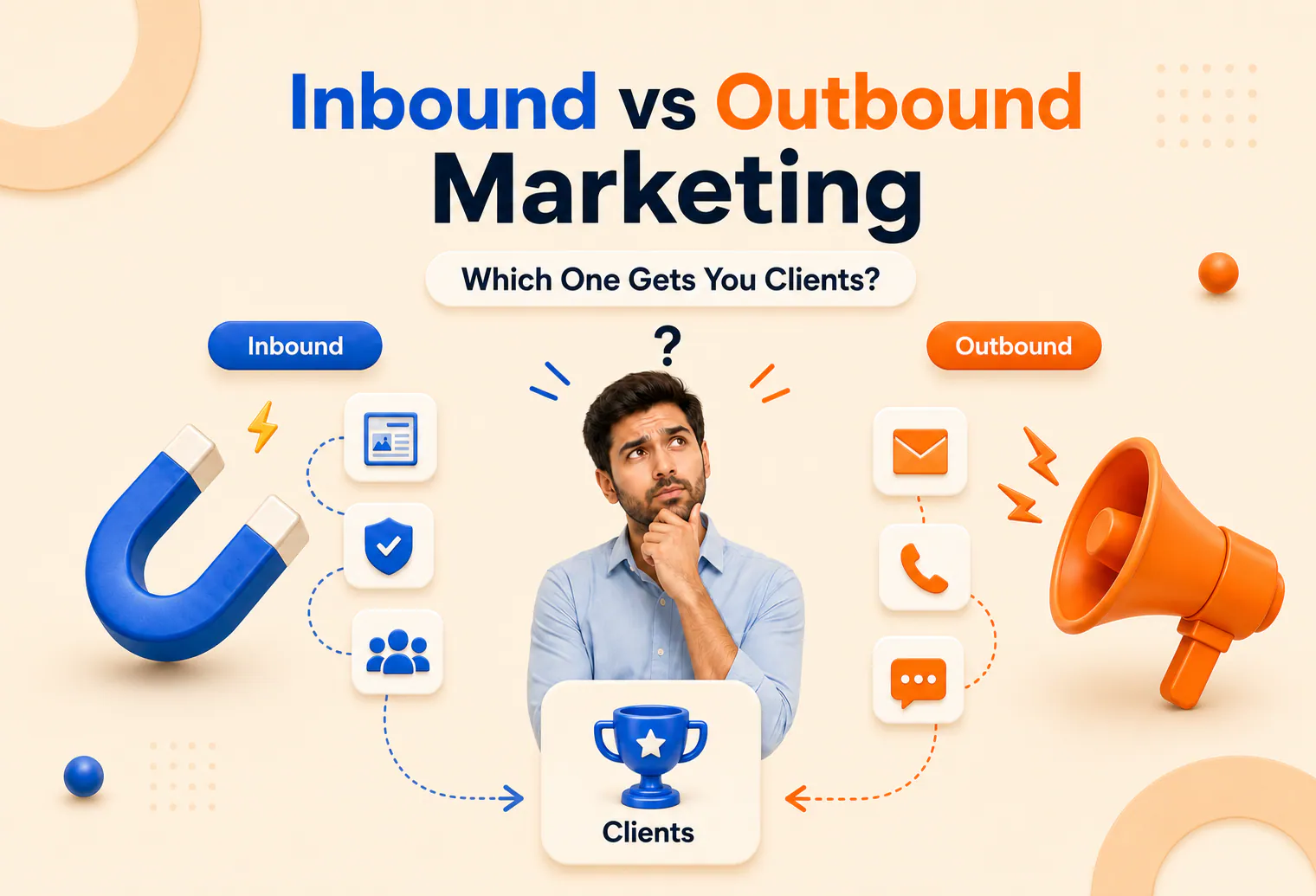
Quick Answer: Inbound marketing attracts buyers through content, SEO, and organic channels that pull them toward your brand. Outbound marketing reaches buyers directly through cold email, LinkedIn outreach, and paid media. For B2B companies, the right channel depends on your revenue stage, sales cycle length, and average contract value.
Key points covered in this article:
- Why inbound and outbound attract buyers at completely different stages of a purchase decision
- The metric most B2B teams optimize for and why it gives them the wrong answer
- Which channel fits your current revenue stage
- What happens when both channels run without a connected pipeline system
- How to decide which channel actually produces clients for your ICP
You have been producing content for six months. Traffic is growing, but your demo calendar is not moving. Or you have been running cold outreach, getting replies, but nothing is converting to signed deals.
Both channels look active. Neither is producing clients.
This is not a content problem or an outreach problem. It is a channel selection and system problem. According to 6sense’s 2024 Buyer Experience Report, 81% of B2B buyers already have a preferred vendor when they make first contact with a seller meaning most of the purchase decision forms before any channel even gets access to the buyer. This article tells you which channel fits your stage and how to build a SaaS GTM strategy that produces revenue, not just activity.
TL;DR
- Inbound marketing pulls buyers toward your brand through content, SEO, and owned channels; outbound pushes your message to a defined audience through direct outreach and paid media
- Inbound leads cost 61% less per lead on average but cost per lead is not the same as cost per client acquired
- 95% of B2B deals are won by vendors already on the buyer’s Day One shortlist, before formal evaluation begins
- The right channel depends on your stage: outbound-first before $1M ARR, blended from $1M to $5M, inbound-weighted above $5M
- Running both channels without shared CRM attribution produces data that looks good and tells you nothing useful
What Is Inbound Marketing and Why Does It Take Longer Than You Think?
Inbound marketing attracts buyers by creating content they are already searching for during their research phase. Instead of reaching out to a buyer, inbound content appears when the buyer is actively looking through search results, comparison articles, and LinkedIn posts.
The primary inbound channels for B2B include SEO, blogging, organic social, and email nurture sequences. A comparison article that ranks on the first page of Google today can generate qualified traffic for three to five years without additional spend. That compounding effect is the core case for inbound.
The honest limitation is time. Inbound typically takes six to twelve months before organic traffic converts into qualified demo requests at volume. A B2B content marketing strategy that compounds requires consistent publishing, deliberate keyword targeting, and a distribution system not just content produced whenever the calendar allows.
What Inbound Marketing Actually Looks Like in B2B
Inbound for B2B is not the same as inbound for B2C. A VP of Operations searching “best field service management software for manufacturing” is not casually browsing; they have a specific problem, a procurement timeline, and a mental shortlist forming before they speak to any vendor.
The content formats that drive qualified B2B traffic are comparison pages, use-case articles, integration guides, and evaluation-stage posts that answer the questions buyers have three weeks before they fill out a demo form. Generic “what is” content brings awareness but rarely brings demo-ready buyers. SEO for B2B teams requires a keyword architecture built around buyer intent, not search volume.
The Stat That Should Change How You Budget Your Marketing
Most inbound vs outbound comparisons focus on cost per lead. The number is real: inbound leads cost 61% less per lead on average than outbound.
But cost per lead is not the number that determines whether a channel produces clients. Cost per closed deal is. Here is the stat that changes the entire calculation:
“95% of the time, the vendor that wins a B2B deal is already on the buyer’s initial shortlist before any formal vendor contact begins.”
6sense B2B Buying Statistics, 2025
This means the channel that earns you a place on the buyer’s pre-evaluation shortlist is worth more than the channel that reaches the buyer after they have already ranked their options. Inbound content appearing during the anonymous research phase does exactly this. Outbound that arrives after a buyer has already shortlisted vendors is fighting an uphill battle and paying a higher cost per lead to do it.
A content strategy generating 400 organic leads per month with a 0.4% demo-to-close rate produces fewer clients than an outbound program generating 50 targeted conversations per month with an 8% close rate. The comparison only becomes meaningful at the deal level. Most B2B teams never get this far in their analysis.
“The best marketing doesn’t feel like marketing.”
– Tom Fishburne, Founder, Marketoonist
For B2B: the channel that fits most naturally into your buyer’s research process is the one most likely to produce clients at your specific ICP and contract value.
What Is Outbound Marketing and When Does It Stop Burning Budget?
Outbound marketing sends a defined message to a defined audience without waiting for that audience to search for you. The primary outbound channels in B2B include cold email, LinkedIn outreach, paid search, direct mail, and event sponsorship.
The core strength of outbound is speed. A targeted sequence reaching VP-level buyers at mid-market manufacturing companies can produce its first qualified conversation within two weeks of launch. For early-stage B2B companies without domain authority or organic traffic, outbound is often the only realistic path to B2B SaaS lead generation before organic content has time to build.
The core weakness is dependency. The moment outbound effort stops, pipeline stops. A company that builds its entire growth motion on cold outbound is renting its pipeline rather than owning it. Outbound also becomes less effective as ICP targeting widens the narrower and more precisely defined your prospect list, the higher your reply and meeting-booked rates.
What Modern B2B Outbound Actually Looks Like in 2026
Effective B2B outbound in 2026 is not high-volume generic cold email. The programs that consistently produce qualified pipeline use AI-assisted prospecting tools to identify trigger events funding rounds, leadership changes, and hiring signals and build personalized sequences around those specific triggers.
Cold email reply rates for untargeted B2B outreach now sit well below 2% for most industries. Well-targeted outbound to a tightly defined ICP with messaging built around a specific trigger event consistently reaches 8 to 15% reply rates. The difference between those two numbers is the difference between burning budget and running a system.
Inbound vs Outbound Marketing: The Full Breakdown
|
Feature |
Inbound Marketing |
Outbound Marketing |
|
Approach |
Buyer comes to you (pull) |
You go to the buyer (push) |
|
Primary Channels |
SEO, content, organic social, email nurture |
Cold email, LinkedIn outreach, paid search, events |
|
Cost Per Lead |
Lower; grows cheaper as content matures |
Higher; stays consistent regardless of tenure |
|
Time to First Pipeline |
6 to 12 months |
Days to weeks |
|
Lead Quality at Entry |
Mixed intent; nurture phase required |
Higher intent when ICP is tightly defined |
|
Compounding Effect |
Yes; content continues generating traffic |
No; stops when effort stops |
|
Best Buyer Stage Reached |
Research phase, before evaluation begins |
Pre-search or trigger-event stage |
|
Scalability |
Scales with content output |
Scales with budget and headcount |
|
Attribution Difficulty |
Multi-touch tracking required |
Direct response tracking |
One gap both channels share: neither tells you by default which interactions produced the deals that actually closed. A B2B content distribution strategy that generates traffic without tracking conversion to revenue is as incomplete as an outbound program that reports meetings booked without connecting them to won deals.
Which Strategy Fits Where You Are Right Now?
The right channel is not a philosophical choice. It is a stage decision. Here is how to read your current situation.
Stage 1: Pre-revenue to $1M ARR
You do not have domain authority, established case studies, or organic search traffic. Inbound takes longer to compound than your runway allows for initial pipeline.
Outbound is the primary motion at this stage: tight ICP definition, personalized sequences, trigger-based targeting. B2B startup marketing strategy at this stage is nearly always outbound-first, with light content production running in parallel to begin building domain authority for later.
Stage 2: $1M to $5M ARR
You have real customers, real case studies, and a validated ICP built from actual closed deals. Begin building inbound infrastructure: comparison pages, use-case articles, and integration guides targeting the exact search terms your best-fit buyers use three weeks before they request a demo.
Continue outbound in parallel, but start tracking which channel produces your best-fit clients at the deal level. This is where choosing the right B2B marketing channels starts to separate growing companies from those that plateau.
Stage 3: $5M ARR and above
Organic demand from inbound is now generating enough qualified traffic to reduce outbound dependency on core ICP segments. Shift budget weight toward content, SEO, and thought leadership. Maintain outbound for new verticals and enterprise accounts where organic content cannot reach decision-makers at sufficient volume.
Running Both Channels Without a System Is the Fastest Way to Waste Your Marketing Budget
Every inbound vs outbound article ends with the same conclusion: “the best approach combines both.” This is correct. It also produces no results unless the system behind it is built deliberately.
In our work with B2B SaaS teams, the most common failure mode looks exactly like this: inbound and outbound run in parallel with separate metrics, separate reporting, and no shared definition of what qualified looks like. The marketing team reports MQL volume from organic content. The sales team reports meetings booked from outbound sequences. Neither number connects to revenue closed.
Six months later, leadership cannot identify which channel produced last quarter’s best clients. The next budget decision is made on opinion, not evidence. Whether to keep this work in-house or agency marketing often comes down to whether the internal team has capacity to build the attribution layer alongside active execution.
“89% of B2B buyers now use generative AI in at least one area of their purchasing process and rated it among the most impactful information sources across all buying phases.”
Forrester Buyers’ Journey Survey, 2024
In 2026, this adds a new layer. Your inbound content must appear in AI Overview results and LLM citation lists not just on Google page one. Understanding how to rank on AI Overview is now as important as ranking on Google for inbound to work at all. Your outbound sequences must account for buyers who arrive at a demo call having already synthesized competitor comparisons through ChatGPT. Both channels require a more precise execution standard than they did 24 months ago.
The actual question is: which channel, at which ICP definition and message, produces closed deals at the lowest total cost from first touch to signed contract? That requires unified CRM attribution, channel-level conversion tracking from lead to closed-won, and a shared ICP that both marketing and sales apply to qualify leads. Without that infrastructure, “do both” means two teams spending in opposite directions with no shared definition of success.
Why B2B SaaS Teams Work With ThirdMeta to Build Their Growth System
Most B2B SaaS teams do not have a channel problem. They have a system problem. Inbound and outbound are running as separate workstreams with separate metrics and no attribution connecting channel activity to revenue.
ThirdMeta builds growth systems that connect inbound content to outbound pipeline, and both to closed revenue. Specifically:
- ICP-aligned content targeting the comparison, use-case, and evaluation search terms your best-fit buyers use during their anonymous research phase
- Outbound sequences built on trigger events and role-specific pain, not generic volume
- CRM-connected attribution tracking from first content touch to closed-won deal
- A content architecture that indexes for both traditional search and AI Overview results simultaneously
We work with B2B SaaS companies between $1M and $15M ARR – the stage where the channel decision has the highest consequence for growth trajectory. If you cannot identify which channel produced your three best clients from last quarter, that is the starting point.
Which of your current marketing activities is actually producing pipeline? Find out with ThirdMeta.
Conclusion
Inbound and outbound marketing are not competing strategies. They are tools with different build times, different cost profiles, and different roles in the B2B buyer’s purchase process. The channel that wins clients for your business depends on your revenue stage, your ICP, and whether your execution is connected to a system that tracks deals not just leads.
The B2B teams that consistently produce qualified pipeline run both channels with a shared ICP definition, a connected attribution model, and a clear definition of qualified that applies from first content touch through to closed deal. The question worth asking is not which channel is better. It is: do you know, with accuracy, which of your current marketing activities is producing clients worth keeping?
FAQs
Inbound marketing attracts buyers through content and organic channels they are already using during their research phase. Outbound marketing reaches buyers directly through cold email, paid ads, or LinkedIn outreach before they initiate contact. The structural difference is whether the buyer comes to you or you go to the buyer.
Inbound produces a lower cost per lead over time, but it takes 6 to 12 months to build organic demand. Outbound has a higher cost per lead but generates pipeline faster. For B2B teams, cost per closed deal is the more accurate comparison metric, and it depends on how tightly each channel’s ICP is defined.
Yes, and for most B2B SaaS companies above $1M ARR, a combined approach produces better pipeline quality than either channel alone. A combined approach requires a shared ICP definition, unified CRM attribution from first touch to closed deal, and consistent reporting that connects marketing activity to revenue rather than lead volume.
Early-stage B2B SaaS companies without established domain authority should prioritize outbound for initial pipeline. Inbound infrastructure comparison pages, use-case content, keyword-targeted articles should be built in parallel from the first paying customers onward, so organic demand begins compounding before outbound becomes a budget constraint.