Backlinks remain one of Google’s top three ranking factors, according to their official search documentation (Google Search Central, 2024). A Backlinko study analyzing 11.8 million Google search results found that the number one result has an average of 3.8 times more backlinks than positions two through 10 B2B SaaS companies face a different challenge than traditional businesses when building links.
Your sales cycles stretch 6-12 months, your products are technical, and your buyers are skeptical.
- Why do your competitors rank higher despite having similar products and features?
- How can you build domain authority when your product is highly technical and serves a niche market?
- What link-building tactics actually drive qualified demos instead of just vanity traffic metrics?
Most B2B SaaS companies approach link building as an isolated tactic. They chase high domain authority sites without considering relevance or revenue impact.
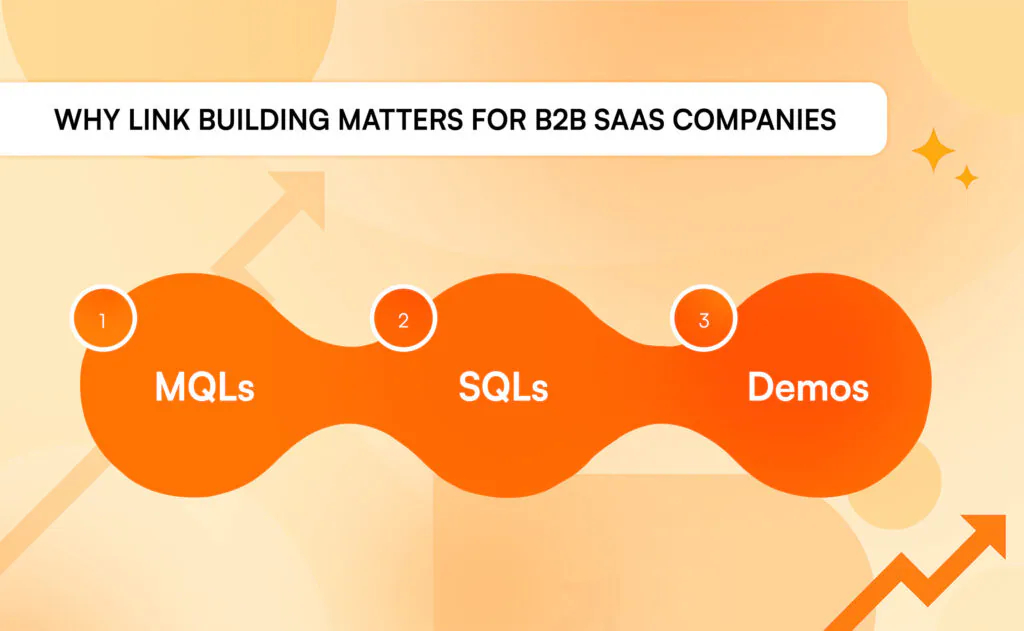
We’ve seen companies spend thousands on links that drive zero pipeline. This guide shows you how to build links that connect to actual business outcomes: MQL rates, SQL conversions, and demo bookings.
Key Takeaways
- B2B SaaS link building requires vertical-specific strategies because generic tactics fail to attract qualified buyers in technical markets
- Quality backlinks must align with topical relevance and buyer intent stages, not just domain authority scores
- Integration partner links and product embeds create passive link acquisition that compounds over time without ongoing outreach costs
- Systems-based link building connects organic visibility to CRM data, letting you track pipeline attribution from specific referring domains
- Quick-win tactics like unlinked brand mentions deliver results in weeks, while data assets build authority over months
- Vertical-specific content assets perform better than generic SaaS content because they speak directly to industry pain points
- Revenue metrics like MQL-to-SQL conversion rates matter more than vanity metrics like total backlinks or traffic volume
What Is Link Building for SaaS?
Link building for SaaS is the process of acquiring hyperlinks from other websites to your SaaS company’s domain. These backlinks signal to search engines that your content has value and authority.
For B2B SaaS companies, link building focuses on earning links that drive qualified pipeline rather than just traffic.
The approach differs from traditional SEO because SaaS buyers research differently. They evaluate multiple solutions over weeks or months.
They read comparison content, check review sites, and ask peers for recommendations. Your link building strategy needs to account for this longer buying journey, a concept we explore further in our guide on SaaS GTM strategy.
How B2B SaaS Link Building Differs from B2C?
B2C link building often targets high-traffic consumer sites. The goal is brand visibility and clicks. B2B SaaS link building targets industry publications, technical communities, and professional networks. A single link from an HR tech publication can drive more qualified demos than ten links from general business sites.
B2C companies can use tactics like viral content or influencer partnerships. B2B SaaS needs thought leadership and data-driven content. Your buyers want proof, not hype. They click links to compare features, read case studies, and verify your claims.
The Role of Link Building in SaaS Sales Cycles
SaaS sales cycles involve multiple stakeholders. An individual contributor might find your content through a search. They share it with their manager. The manager evaluates your product against competitors. Link building helps you appear at every stage of this process.
Links from relevant sites build trust before prospects ever visit your site. When a DevOps engineer sees your tool mentioned on Stack Overflow, that carries weight.
When a CFO sees your pricing analysis linked from a finance publication, they take notice. These third-party validations matter in B2B buying decisions.
Why Link Building Matters for B2B SaaS Companies
Link building directly impacts your ability to compete in organic search. B2B SaaS categories are getting more crowded every year. Your competitors are actively building their backlink profiles. If you’re not, you’re falling behind.
The benefits extend beyond search rankings. Quality backlinks drive referral traffic that converts better than cold traffic. They reduce your customer acquisition costs over time. They create compound growth that paid channels can’t match.
Impact on Pipeline Generation
Links from high-intent content drive qualified prospects. A link from a “best project management tools” article reaches buyers actively evaluating solutions. A mention in an industry newsletter reaches professionals already interested in your category. This targeted exposure fills your pipeline with better leads.
We track link attribution through UTM parameters and CRM integration. This lets us see which referring domains drive demos. One client saw a single link from an HR tech publication generate 47 demo requests over six months. That link costs less to acquire than a week of paid ads.
The key metrics to track include:
1. Demo booking rate from organic traffic
Organic visitors from quality backlinks book demos at higher rates. They’ve already validated your solution through third-party content. They arrive with intent.
2. MQL rate from referring domains
Not all referral traffic qualifies as marketing qualified leads. Track which domains send visitors who match your ICP. Focus link-building efforts on similar sites.
3. SQL conversion from backlink sources
The ultimate test is whether backlinks drive sales-qualified leads. Some links generate traffic but poor-fit prospects. Others drive a smaller volume but higher quality. Our B2B SaaS content marketing approach emphasizes this alignment between content and qualified pipeline.
4. Time-to-close for backlink-sourced deals
Prospects who discover you through backlinks often move faster through sales. They’ve done more research before reaching out. They understand your value proposition better.
5. Customer LTV by acquisition channel
Links from certain verticals or publications attract better long-term customers. Track this to prioritize link building in specific industry segments.
Long-Term ROI vs Paid Channels
Paid ads stop working when you stop paying. Links keep driving traffic and conversions for months or years. A well-placed link compounds in value as the referring page builds its own authority.
The initial investment in link building is higher than launching paid campaigns. But the long-term cost per acquisition drops dramatically. One software company we work with now gets 60% of its demos from organic channels. Their CAC from organic is one-third of their paid CAC.
What Makes a High-Quality SaaS Backlink?
Not all backlinks help your rankings or pipeline. Low-quality links can actually hurt your domain authority. Search engines have gotten better at identifying manipulative link schemes. You need links that pass both algorithmic and business value tests.
Quality matters more than quantity in B2B SaaS. Ten relevant links from industry sites outperform 100 links from generic directories. Focus on acquiring backlinks that your target buyers actually see and trust.
Topical Relevance vs Generic Authority
A link from Forbes might have high domain authority. But if the article is about celebrity news, it won’t help your DevOps tool rank. Topical relevance means the linking page covers related subjects. A link from a technical blog post about CI/CD pipelines has more SEO value for your DevOps tool.
Search engines understand context through semantic analysis. They can tell when a link makes sense in context versus when it’s forced. Natural, relevant links pass more ranking power. They also drive better traffic because readers are already interested in your category.
This concept is important for AI Overview optimization as well, where topical authority matters even more.
Evaluating Link Opportunities
Before pursuing any link, assess five key factors:
- Domain authority and rating: Use tools like Ahrefs or Moz to check the site’s authority. Look for domains with DR 40+ for SaaS. Higher is better, but relevance matters more.
- Topical relevance to your category: The linking page should cover topics your buyers care about. For a CRM tool, links from sales blogs make sense. Links from cooking sites don’t.
- Page traffic and engagement: A link from a high-traffic page drives more referral visits. Check the page’s organic traffic in SEO tools. Pages ranking for relevant keywords are ideal.
- Editorial context and placement: Links placed naturally in content perform better than footer links. The surrounding text should make the link logical. Forced links look spammy.
- Anchor text optimization: The clickable text should relate to your target keywords. But over-optimization triggers spam filters. Mix exact-match anchors with branded and natural variations.
Quality assessment prevents wasted outreach effort. It also protects your domain from toxic backlinks. Some link opportunities look good but carry hidden risks like PBN networks or link farms.
Common Link Building Mistakes SaaS Companies Make
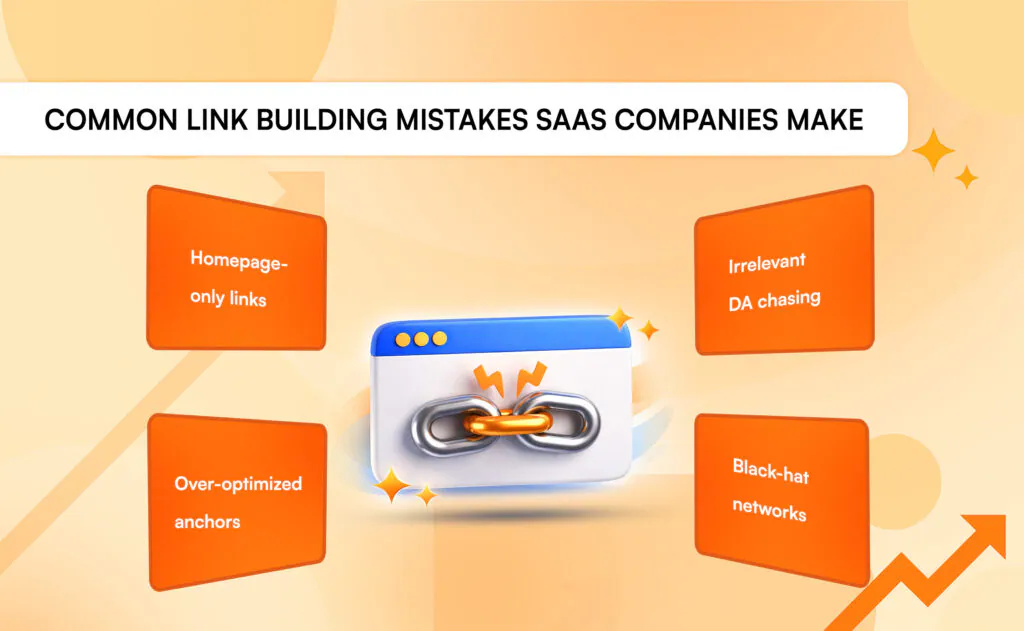
Most B2B SaaS companies waste budget on ineffective link building. They follow tactics that worked five years ago or strategies meant for e-commerce. These mistakes hurt your domain authority and waste resources.
We audit backlink profiles regularly for clients. The same patterns appear across companies. Avoiding these mistakes accelerates your results and protects your investment.
1. Focusing only on homepage links
Homepage links help with brand searches. But they don’t help your product pages or comparison content rank. You need links pointing to the pages that drive conversions. This resulted in:
- Product comparison pages that never rank despite good content
- Blog posts with strong information but no backlink support
- Landing pages that convert well but get zero organic traffic
2. Ignoring topical relevance for high DA
A DA 80 link from an irrelevant site won’t move the needle. A DA 50 link from an industry publication will. Many companies chase authority scores and ignore whether the link makes sense. Consequences included:
- Links that drive traffic but wrong-fit visitors
- Backlinks that don’t improve rankings for target keywords
- Referral visitors who bounce immediately due to poor fit
3. Over-optimizing anchor text
Using exact-match keywords in every anchor text looks manipulative. Search engines penalize this pattern. Natural links use varied anchor text, including brand names, URLs, and generic phrases. This resulted in:
- Algorithmic penalties that drop rankings across the site
- Manual review flags that require disavowing links
- Lost credibility with both search engines and readers
4. Using black-hat tactics
Buying links from PBN networks or link farms might work short-term. Long-term, it tanks your domain. Google’s algorithms detect these patterns. Recovery from a penalty takes months. Consequences included:
- Complete deindexing from search results
- Loss of all organic traffic overnight
- Months of work to clean up bad links and recover
5. Not connecting links to revenue metrics
Building links without tracking pipeline impact is guesswork. You need attribution from referring domains to demos booked. Without this, you can’t tell which link building efforts drive results. This resulted in:
- Continued investment in channels that don’t convert
- Inability to prove ROI to leadership
- Missed opportunities to double down on what works
6. Neglecting internal linking
External links get attention, but internal links matter too. They distribute authority across your site. They guide visitors to conversion pages. Poor internal linking wastes the value of external backlinks. Consequences included:
- High-authority pages that don’t share link equity with product pages
- Visitor confusion about next steps after reading content
- Lower conversion rates from organic traffic
7. Buying low-quality links
Cheap links from Fiverr or bulk link services hurt more than help. They come from spam sites that Google already flagged. The short-term ranking bump isn’t worth the long-term damage. This resulted in:
- Association with bad neighborhood sites in Google’s graph
- Toxic backlink profiles that require expensive cleanup
- Wasted budget that could have funded quality content
These mistakes share a common thread—focusing on quantity over quality. B2B SaaS link building rewards patience and relevance over volume and speed. Working with a specialized SaaS link building agency helps avoid these common pitfalls.
Core Link Building Strategies for B2B SaaS
Effective link building combines multiple tactics executed consistently. No single strategy works for every SaaS company. Your vertical, product maturity, and resources all factor into which strategies to prioritize.
We organize tactics by implementation timeline. This helps you plan resource allocation and set realistic expectations. Quick wins provide early results while you build long-term assets.
Quick Wins (0-3 Months)
These tactics deliver backlinks within weeks. They require less content creation and more outreach effort. Start here to show early progress while planning longer-term strategies.
1. Unlinked brand mentions: Companies mention your brand or product without linking. Find these with Google searches or tools like Ahrefs Content Explorer. Reach out and request they add a link. Most agree since they already referenced you.
2. Broken link building: Find broken links on relevant sites. Offer your content as a replacement. This helps the site owner fix dead links while earning you a backlink. Works well for evergreen content topics.
3. Internal linking optimization: Audit your existing content for internal linking gaps. Add contextual links from high-authority pages to conversion-focused pages. This distributes link equity across your site.
4. Competitor backlink analysis: See where your competitors get links. Use Ahrefs or SEMrush to export their backlink profiles. Prioritize sites that link to multiple competitors. They’re likely open to linking to you.
5. Integration partner links: Your product likely integrates with other tools. Request links from their integration directories. These are easy asks since the partnership already exists.
Medium-Term (3-6 Months)
These strategies require more planning and content creation. They build sustainable link acquisition channels rather than one-off wins. Results appear over weeks as outreach campaigns scale.
6. Guest posting on industry sites: Write expert content for publications your buyers read. Include contextual links back to relevant pages on your site. Focus on industry-specific sites over general marketing blogs.
7. Digital PR and journalist outreach: Create newsworthy content like original research or product launches. Pitch journalists through platforms like HARO or direct outreach. Media coverage includes backlinks and brand visibility.
8. Product reviews and testimonials: Offer to review tools and services you use. Many B2B software companies link to customer testimonials. This creates reciprocal linking opportunities with complementary products.
9. Podcast appearances: Guest on industry podcasts to share expertise. Most shows link to guests’ companies in show notes. Audio content is less competitive than written content for link building.
10. Expert roundups: Contribute expert quotes to roundup posts. Many publications create “X experts share their thoughts on Y” articles. They link to each contributor’s company.
Long-Term Assets (6-12 Months)
These tactics require significant upfront investment. They create linkable assets that earn backlinks passively over time. The payoff comes from compound growth as assets gain visibility.
11. Original research and data studies: Publish unique data about your industry. Other sites cite your research and link back as the source. One research report can earn hundreds of backlinks over years.
12. Free tools and calculators: Build interactive tools related to your product category. Users share helpful tools, earning natural backlinks. Ahrefs’ free backlink checker exemplifies this strategy.
13. Industry benchmark reports: Compile anonymized customer data into benchmark reports. Compare performance across company sizes, industries, or regions. Media and analysts link to credible benchmarks.
14. Comprehensive guides and pillar content: Create the definitive guide to topics in your space. Long-form, authoritative content attracts links from shorter articles that reference it. Update annually to maintain relevance.
15. Product embed features: Let users embed your product on their sites. Include a “Powered by [Your Company]” link in the embed code. This creates passive backlinks as usage grows.
16. Conference speaking and webinars: Present at industry conferences or host webinars. Event sites link to speaker profiles. Webinar recordings can be repurposed into linkable content.
17. Resource page link building: Find resource pages listing tools or content in your category. Request inclusion if your product fits. Resource pages often have high authority and drive qualified traffic.
18. Strategic content partnerships: Partner with complementary companies on co-created content. Each partner promotes to their audience and links to the asset. This amplifies reach and backlink potential.
Each strategy works best in specific contexts. Early-stage SaaS companies should focus on quick wins and medium-term tactics. Established companies with resources can invest in long-term assets that compound value.
Vertical-Specific Link Building Strategies
Generic SaaS link building misses opportunities specific to your vertical. HR tech companies need different tactics than DevOps tools. Your buyers read different publications, attend different events, and trust different authorities.
Vertical-specific link building targets the channels your ICP actually uses. This improves both link quality and referral traffic conversion. We’ve seen vertical-focused campaigns deliver 3x better results than broad SaaS tactics.
HR Tech & Talent Management SaaS
HR professionals read industry publications like HR Executive and SHRM. They attend HR Tech conferences and participate in SHRM local chapters. Your link building should target these channels.
- Target HR publications and communities: Pitch guest posts to HR Dive, HR Executive, and industry newsletters. Join HR professional communities on LinkedIn and Reddit. Share insights and include links where relevant.
- Create hiring trend reports: Publish data on hiring trends, compensation benchmarks, or employee retention. HR leaders cite this research in their own content. Media covers interesting trends in the talent space.
- Partner with HR associations: Sponsor SHRM chapters or regional HR associations. Many provide member directories or resource pages with sponsor links. This also opens doors for speaking opportunities.
Marketing & Sales SaaS
Marketing and sales professionals consume content from sources like MarketingProfs, Sales Hacker, and G2. They test new tools frequently and share recommendations. Link building should focus on comparison content and tool directories.
- Create marketing benchmark data: Publish email open rate benchmarks, conversion rate data, or channel performance studies. Marketers constantly search for industry benchmarks to gauge their performance.
- Target marketing publications: Write for MarTech, AdAge, and marketing-focused newsletters. Share tactical content that demonstrates your expertise. Include examples from your product where relevant.
- Build industry calculators: Create ROI calculators, pricing comparison tools, or performance forecasting calculators. Marketers love tools that help them justify budget or prove results.
DevOps & Developer Tools
Developers trust technical content more than marketing content. They find tools through Stack Overflow, GitHub, and developer communities. Link building must provide genuine technical value.
- Focus on technical documentation: Create detailed implementation guides, API documentation, or integration tutorials. Developers link to helpful technical resources in their own projects.
- Target developer communities: Answer questions on Stack Overflow with links to your docs. Contribute to relevant GitHub discussions. Share technical blog posts on Hacker News and Reddit’s programming communities.
- Open source contributions: Release open source tools or libraries related to your product. Developers link to useful open source projects. This also builds developer community goodwill.
FinTech & Financial SaaS
Financial services buyers need to see regulatory compliance and security credentials. They read industry publications like American Banker and attend FinTech conferences. Link building must address trust and compliance.
- Financial compliance content: Write about regulatory changes, compliance best practices, or security standards. Financial institutions link to authoritative compliance resources.
- Industry regulation guides: Create guides explaining GDPR, SOC 2, or financial industry regulations. Compliance teams reference these guides when evaluating tools.
- Partner with financial publications: Contribute expert commentary to American Banker, The Financial Brand, or regional financial publications. Financial decision-makers read industry media regularly.
Vertical SaaS (Healthcare, Legal, Construction, etc.)
Highly regulated or specialized verticals require deep industry knowledge. Link building needs to demonstrate that understanding. Generic SaaS content won’t resonate with specialized buyers.
- Industry-specific case studies: Publish detailed case studies showing results for companies in the vertical. Include real metrics and customer names if possible. Industry peers link to relevant case studies.
- Regulatory content: Address industry-specific regulations like HIPAA for healthcare or AIA contracts for construction. Compliance questions drive significant search volume in regulated industries.
- Professional association partnerships: Join industry associations and contribute to their content programs. Many associations maintain member resource libraries or vendor directories.
The right vertical focus makes every link building dollar work harder. A healthcare SaaS should spend time on HIMSS conference content, not generic software sites.
Building a Systems-Based Link Building Approach
Link building works best when integrated with your other growth channels. Isolated link building campaigns miss opportunities for synergy. Your content strategy, paid ads, and sales process should all support link acquisition.
We call this systems-based link building. It treats backlinks as outputs of a connected system rather than isolated tactics. This approach compounds results across channels.
Connecting Links to Pipeline Metrics
Track referring domain data in your CRM. Tag organic leads with their initial traffic source. This lets you see which backlinks drive a qualified pipeline. You can then prioritize similar link opportunities.
Set up UTM parameters for link-building campaigns. Track the referring domain, campaign name, and content type. When prospects convert, this data flows into your CRM. You can calculate ROI per link or per referring domain.
Create monthly reports showing MQL rate by referring domain. Identify which publications or communities send the highest-quality traffic. Focus future outreach on similar sources.
Attribution and Measurement Setup
First-touch attribution shows which links initially brought prospects to your site. Last-touch attribution shows which links converted them. Both matter for understanding link value.
Use multi-touch attribution if your CRM supports it. This credits multiple touchpoints in the buyer journey. A prospect might discover you through a backlink, return through search, then convert from a paid ad. Multi-touch attribution captures this complexity.
- SEO and content strategy: Create linkable assets as part of your content calendar. Every pillar page or research report should have a link building plan. Content teams and link builders should coordinate rather than work in silos.
- Paid advertising campaigns: Use links to boost the organic rankings of pages you’re running paid ads to. This reduces CPC over time as organic visibility improves. It also provides free traffic after you pause ads.
- CRM and sales processes: Feed backlink attribution data into sales conversations. When SDRs see a prospect came from an industry publication link, they can reference that in outreach. This personalization improves connection rates.
- Product marketing initiatives: Time link building campaigns around product launches. Build links to launch announcements and new feature pages. This creates search visibility as prospects research new capabilities.
- Customer success stories: Turn customer results into case studies that earn links. Use sales call insights to create content addressing common objections. Link building and sales should share insights regularly.
Systems compound value over time. Individual tactics plateau. A systems approach creates flywheel effects where each channel makes others more effective.
Implementation: Your 90-Day Link Building Roadmap
Starting link building feels overwhelming without a clear plan. This roadmap breaks the first 90 days into achievable steps. Each month builds on the previous one.
Adjust timelines based on your resources. A single marketer will move slower than a dedicated team. Focus on consistent progress over speed.
Month 1: Foundation
The first month focuses on analysis and planning. You’re setting up the infrastructure for sustainable link building. This groundwork makes months 2 and 3 more productive.
Week 1-2: Audit current backlink profile
- Export your backlink profile from Ahrefs or SEMrush
- Identify your highest-authority backlinks
- Find toxic links that need disavowing
- Document your current domain rating and referring domains
Week 2-3: Identify competitor link gaps
- Export top 3 competitors’ backlink profiles
- Find domains linking to 2+ competitors but not you
- Create a target list of 50-100 link opportunities
- Prioritize by domain authority and topical relevance
Week 3-4: List integration partners
- Document all current product integrations
- Check each partner’s integration directory
- Note whether you’re listed and if links exist
- Prepare outreach to partners missing your link
Week 4: Create outreach list and set up tracking
- Build outreach list with contact info for targets
- Set up UTM parameter system for link tracking
- Configure CRM to capture referring domain data
- Create link building dashboard for reporting
Month 2: Quick Wins
Month two executes quick-win tactics. These require less content creation and more outreach. They provide early backlinks to show progress.
Week 5-6: Claim unlinked mentions
- Search for unlinked brand mentions
- Prioritize high-authority sites
- Send personalized outreach emails
- Follow up with non-responders after one week
Week 6-7: Fix broken links
- Find broken links on target sites using Ahrefs
- Match broken links to your content topics
- Reach out offering your content as replacement
- Track which broken link outreach converts best
Week 7-8: Launch integration partnerships
- Email integration partners requesting directory links
- Offer to write integration guide if needed
- Set up links from your integration pages back
- Document partner response rates for future reference
Week 8: Start guest post outreach
- Identify 20 target publications for guest posts
- Create pitch templates specific to each
- Send initial outreach batch
- Begin drafting accepted guest posts
Month 3: Scaling
Month three continues quick wins while starting long-term assets. You’re building momentum and planning sustainable link acquisition channels.
Week 9-10: Publish first data asset
- Finalize research report or industry benchmark
- Design visual assets and charts
- Create landing page for asset download
- Prepare promotion and outreach plan
Week 10-11: Continue outreach campaigns
- Send second batch of guest post pitches
- Follow up on pending link requests
- Track response rates and optimize templates
- Begin outreach for original research citations
Week 11-12: Measure and optimize
- Review backlinks acquired in 90 days
- Calculate cost per link by tactic
- Identify which tactics drove best results
- Analyze referral traffic quality by source
Week 12: Plan long-term content
- Map out Q2 linkable asset calendar
- Identify topics for comprehensive guides
- Plan free tool or calculator if applicable
- Set goals for Q2 based on Q1 learnings
Budget Allocation by Channel
Early-stage SaaS should allocate budget weighted toward quick wins. Established companies can invest more in long-term assets. A typical allocation looks like:
Quick win tactics require more labor than budget. You’re spending time on outreach and relationship building. Medium-term tactics need content creation budget for guest posts and PR assets. Long-term tactics require development resources for tools or data analysis capabilities.
Team Structure and Responsibilities
Small teams should focus on fewer tactics executed well. Large teams can run parallel efforts across all strategies. Common role splits include:
A single marketer should pick 3-4 tactics and execute consistently. Trying everything leads to nothing done well. As teams grow, specialize roles for better results.
Measuring Link Building Success: Metrics That Matter
Tracking the right metrics separates effective link building from busy work. Vanity metrics like total backlinks don’t connect to business outcomes. Focus on metrics that indicate revenue impact.
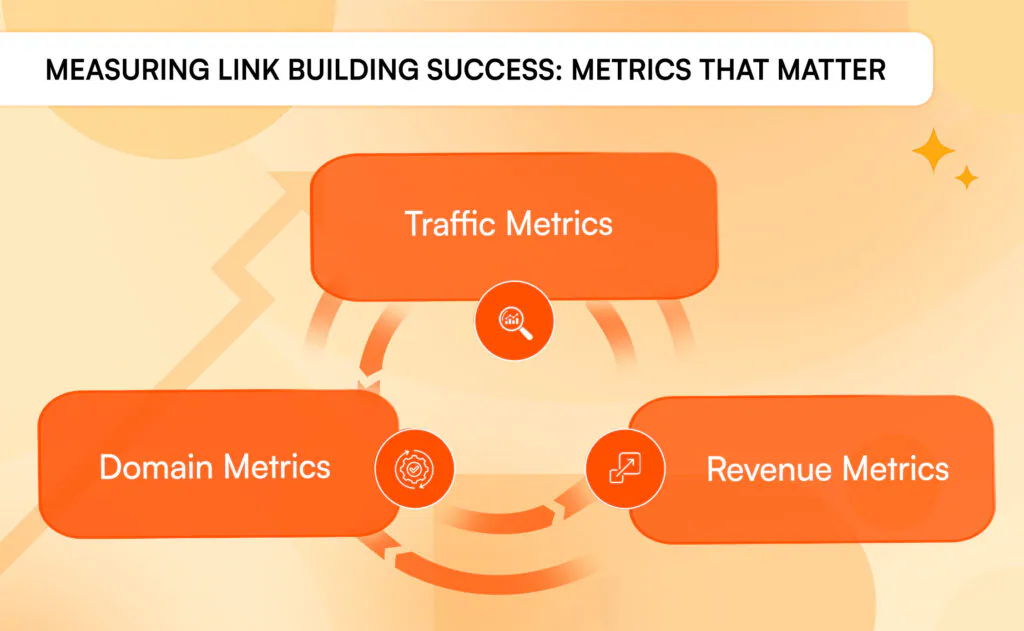
We track link building performance at three levels—domain metrics, traffic metrics, and revenue metrics. Each level provides different insights into what’s working.
Setting Up Attribution in Your CRM
Connect your SEO tools to your CRM for full attribution visibility. This requires some technical setup but provides invaluable insights. You can see exactly which backlinks drive pipeline.
Tag all organic leads with their referring domain when possible. Use hidden form fields to capture UTM parameters. Flow this data into your CRM lead records. Sales teams can see where prospects discovered you.
Create custom reports showing MQL rate by referring domain. Calculate average deal size for customers acquired through backlinks. Compare this to other channels to prove ROI.
Tools for Link Tracking
- Ahrefs: Track referring domains, domain rating, and new backlinks. Set up alerts for new links and lost links. Use Content Explorer to find unlinked mentions.
- SEMrush: Monitor backlink profile changes and compare to competitors. Track keyword rankings for pages getting new links. Identify toxic links that need disavowing.
- Google Search Console: See which sites link to specific pages. Monitor internal links and external links separately. Identify your most-linked content.
- Google Analytics 4: Track referral traffic from backlinks. Set up goals for demo requests and content downloads. Create segments for traffic from high-value referring domains.
- CRM integration tools: Use Zapier or native integrations to flow attribution data into your CRM. This connects links to actual revenue outcomes.
The metrics that matter most for B2B SaaS include:
Domain Metrics:
- Referring domains growth (target: 10-15% monthly increase)
- Domain rating improvement (target: +5 points per quarter)
- Link quality score (ratio of relevant to total links)
Traffic Metrics:
- Organic traffic from backlinks (track in GA4)
- Referral traffic quality (bounce rate under 40%)
- Time on site from links (target: 2+ minutes)
Revenue Metrics:
- Demo bookings from organic (target: 15%+ of total demos)
- MQL rate from organic traffic (target: match or beat paid channels)
- SQL conversion rates (organic should convert at 60%+ of paid rate)
- Pipeline attributed to links (track multi-touch attribution)
Revenue metrics justify link building investment to leadership. They show the channel’s contribution to business growth. Without this attribution, link building remains a cost center rather than a revenue driver.
Why Should You Choose ThirdMeta?
B2B SaaS companies need link building tied to actual pipeline results. Your current approach might build links that drive wrong-fit traffic or miss revenue attribution entirely. ThirdMeta connects link building to the metrics that matter for your business.
Solutions That Matter:
- Systems-based link building integrated with SEO, content, and CRM
- Vertical-specific strategy development for your industry and ICP
- Revenue attribution setup connecting backlinks to demos and deals
- 90-day proof sprints with measurable pipeline KPIs
Proven Performance in B2B SaaS:
Link Quality: “Focus on industry-relevant backlinks that drive qualified traffic, not vanity metrics” Pipeline Focus: “Generate 55+ qualified inbound leads monthly with consistent MQL rates”
Conversion Impact: “Achieve 75% MQL qualification rates and 65% MQL→SQL conversion from organic”
Your marketing operations need execution tied to business outcomes. ThirdMeta is a revenue-led B2B SaaS marketing agency specializing in qualified pipeline generation. Our systems connect link building to actual sales results through CRM attribution.
Key Platform Capabilities:
- Modern SEO incorporating AI Overviews and GEO for LLM visibility
- Link building strategies informed by sales call insights and buyer objections
- Full attribution setup tracking referring domains to closed revenue
- Integration partner and product-led growth link acquisition tactics
Smart SaaS companies measure marketing by pipeline contribution, not activity. ThirdMeta helps you build organic channels that compound revenue over time through systematic link building.
Ready to build a link strategy that drives qualified demos? Request a Strategy Call.
Conclusion
B2B SaaS link building succeeds when it focuses on vertical-specific tactics and revenue outcomes. Generic strategies waste budget on links that don’t drive qualified pipeline. The companies winning at organic growth treat link building as a system integrated with content, sales, and product.
Start with quick wins to show early results. Build long-term assets that earn passive backlinks. Track attribution to prove ROI and optimize spending. Your vertical-specific approach will outperform generic SaaS tactics every time.
Frequently Asked Questions
B2B SaaS link building differs by targeting industry publications and professional communities specifically. It focuses on qualified pipeline generation over traffic volume alone. Regular link building aims for high-traffic consumer sites and brand visibility.

Sr. Content Writer
Vamshi Vadali is Third Meta's Content Team Head and the guy who banned fluff from all blog posts. He specializes in SEO, GEO (Generative Engine Optimization), and AEO (Answer Engine Optimization): the trifecta that gets B2B SaaS content ranking in both Google and ChatGPT. Vamshi doesn't write content. He engineers MQL machines. His philosophy? Good writing needs data and clarity, not buzzwords. He writes like a CFO reads: straight to the outcomes. When he's not optimizing for AI Overviews, he's debating whether LLMs prefer Oxford commas.