According to BrightEdge, ChatGPT mentions brands 3.2x more often than it cites them with links, marking a shift from traditional SEO to brand recommendations. Yet most B2B SaaS companies don’t even know if they appear in ChatGPT results.
This creates a problem. With over 5.8 billion monthly visits to ChatGPT, buyers research solutions without ever clicking through to your website. They ask ChatGPT for recommendations and make decisions based on what AI suggests.
This guide shows you how to rank on ChatGPT using proven strategies that drive brand visibility in AI-powered search. No theory. Just tactics that work.
What Does “Ranking on ChatGPT” Actually Mean?
Ranking on ChatGPT means your brand appears in AI-generated responses when users search for solutions in your category. Unlike Google’s link-based rankings, ChatGPT’s visibility depends on brand mentions and not citations.
Brand mentions occur when ChatGPT includes your company name in conversational responses without clickable links. Citations happen when your brand receives attribution with a link. Research shows ChatGPT mentions brands 3.2x more than it cites them, meaning mentions drive primary visibility while citations remain secondary.
This changes everything. Traditional SEO focused on earning backlinks to rank higher. ChatGPT optimization focuses on building authority signals so AI models “trust” your brand enough to recommend it.
Why ChatGPT Visibility Matters for B2B SaaS
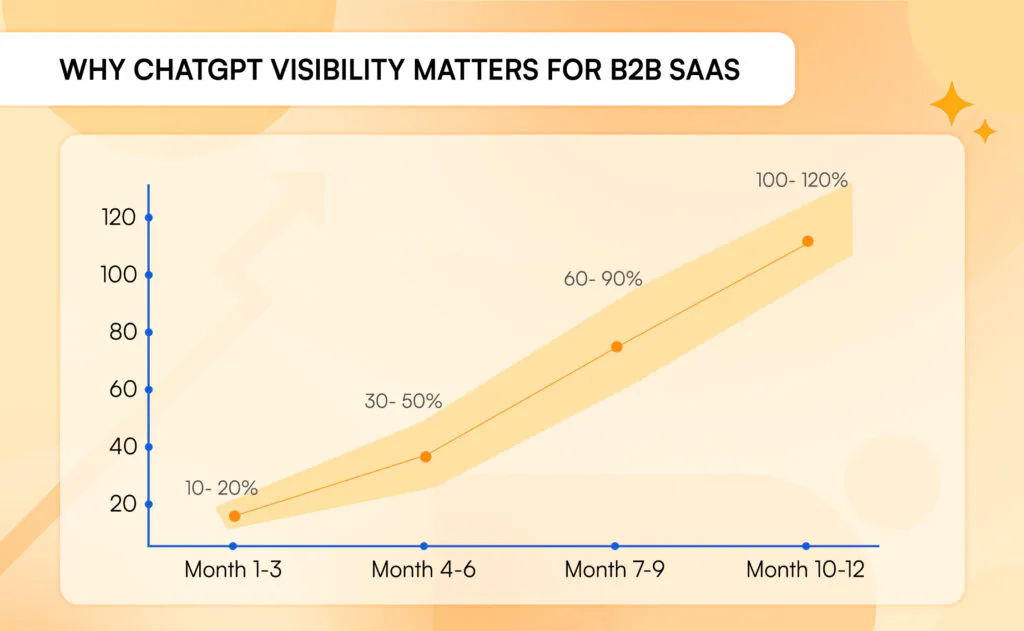
ChatGPT reached 5.8 billion monthly visits in September 2025, showing a 7.606% increase from the previous month. B2B buyers use AI search to discover and evaluate solutions before talking to sales teams. which is why SaaS SEO agencies are expanding their focus beyond Google rankings.
Here’s the reality check: If your SaaS company doesn’t appear when prospects ask ChatGPT “What’s the best [category] for companies like mine?”, you’re invisible to a growing segment of high-intent buyers. AI search visitors convert at 4.4x higher rates than traditional organic search visitors, making ChatGPT visibility directly tied to pipeline growth.
How ChatGPT Decides Which Brands to Mention
ChatGPT doesn’t rank websites using algorithms like Google. It generates responses based on patterns in its training data and real-time web search results.
ChatGPT focuses on content closely aligned with the user’s question and organized to facilitate the extraction of useful details. The platform prioritizes three factors when determining which brands to mention:
- Authority signals: Content from reliable sources demonstrating expertise, credibility, and strong reputations helps ChatGPT deliver accurate responses.
- Relevance and depth: Specific, meaningful, and detailed information builds trust and positions your brand as a subject matter expert.
- Structured writing: Well-organized content improves readability for both readers and AI, making it easier to extract key information.
Think of it this way: ChatGPT learns which brands to recommend based on how frequently those brands appear near relevant keywords across trusted sources. The more your brand name appears alongside industry terms in high-quality content, the more likely ChatGPT will recommend you.
The Brand Mentions vs. Citations Dynamic
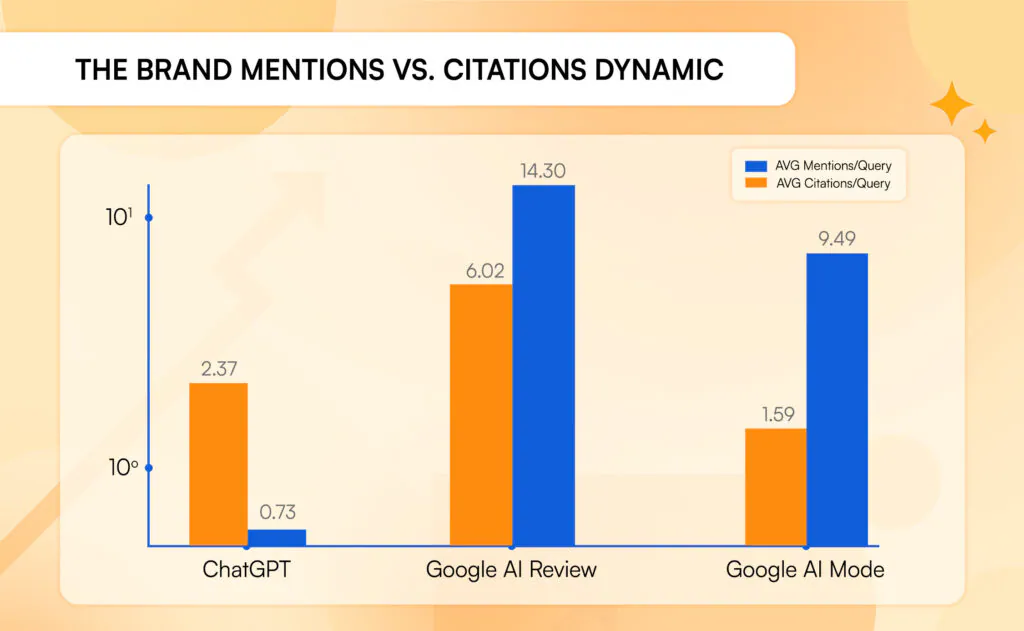
ChatGPT mentions 3.2x MORE brands than it cites (2.37 mentions vs. 0.73 citations per query), while Google AI Overview cites 2.4x MORE than it mentions (14.30 citations vs. 6.02 mentions).
This creates a split landscape. Google AI still emphasizes source attribution. ChatGPT operates like a recommendation engine, suggesting brands based on trust signals rather than showing you where to find more information.
For B2B SaaS companies, this means traditional content marketing alone won’t cut it. You need a strategy that builds brand authority across the web—not just on your own site.
A Proven ChatGPT Optimization Framework
Our team did some digging into the way ChatGPT understands search. We call it the “ChatGPT visibility framework” as it combines strategic and step-wise execution to position B2B SaaS brands in AI search results.
1. Prompt Research & Competitive Intelligence
Start by identifying the exact prompts your ideal customers use when asking ChatGPT for recommendations.
How to execute prompt research:
Create a list of 20-30 prompts your ICP would ask ChatGPT about your solution category. Include comparison queries (“best [category] for [use case]”), problem-solution queries (“how to [solve specific problem]”), and buying intent queries (“which [tool] should I choose for [situation]”).
Test each prompt in ChatGPT and document which brands appear. Track whether you’re mentioned, how competitors rank, and what language ChatGPT uses to describe each solution.
Identify content gaps by analyzing why certain brands appear consistently. Look for patterns in how they’re described and which features ChatGPT highlights.
This research reveals exactly what signals ChatGPT trusts when recommending solutions in your category.
2. Authority-Building Content Strategy
ChatGPT recommends brands it perceives as authoritative. ThirdMeta builds that authority through a multi-channel content approach.
Create high-authority content assets:
Publish original research, industry reports, and data-driven insights that establish your SaaS company as a thought leader. These assets get cited by other publications, creating authority signals ChatGPT recognizes.
Write detailed comparison content that positions your solution fairly against competitors. ChatGPT references these when users ask comparison questions.
Develop comprehensive how-to guides that solve specific problems your ICP faces. Structure these guides with clear headings, bullet points, and action steps that AI can easily parse.
Distribution matters as much as creation:
ThirdMeta doesn’t just publish content on your blog. We get it referenced across high-authority publications through strategic outreach and digital PR.
Guest posts on industry-leading sites create brand mentions alongside relevant keywords. When ChatGPT encounters your brand name repeatedly on trusted domains, it learns to associate your company with expertise in your category.
3. Third-Party Validation & Brand Mentions
The currency of large language models is not links. The currency of large language models is mentions—specifically, words that appear frequently near other words across the training data.
Build brand mentions across the web:
Target “best of” lists and review sites: Get featured in industry roundups like “Top [Category] Tools for [Industry]” on high-traffic sites. These listings create strong association between your brand and category keywords.
Activate review platforms: Encourage satisfied customers to leave detailed reviews on G2, Capterra, and TrustRadius. ChatGPT references these platforms when users ask for real user feedback.
Engage in community discussions: Answer questions on Reddit, Quora, and industry forums where your ICP seeks advice. Provide value first, mention your solution naturally when relevant.
Secure industry awards and recognition: Winning or being nominated for awards creates authoritative signals. Highlight these prominently on your site and in PR efforts.
Each mention strengthens ChatGPT’s association between your brand and your solution category.
4. Technical Optimization for AI Visibility
Make your website and content easy for AI to understand and extract information from.
Structure content for AI parsing:
Use clear heading hierarchies (H1, H2, H3) that organize information logically. Each section should answer a specific question or address one topic completely.
Implement schema markup (FAQ schema, HowTo schema, Product schema) to help AI understand your content structure and extract key information.
Create answer-first content sections where the first 2-3 sentences directly answer the heading question. ChatGPT often pulls these direct answers into responses.
Submit to Microsoft Bing: ChatGPT relies on the same ranking signals as Microsoft Bing. Optimizing for Bing improves your chances of appearing in ChatGPT results.
Add your site to Bing Webmaster Tools, submit your sitemap, and monitor indexation. Bing’s crawl coverage directly influences what content ChatGPT can access.
5. Content Freshness & Ongoing Optimization
ChatGPT prioritizes current information. Stale content reduces your chances of being mentioned.
Update high-performing content quarterly with new statistics, recent case studies, and current industry trends. Change the “last updated” date to signal freshness.
Monitor your ChatGPT visibility regularly by searching relevant prompts. Track changes in mentions and adjust your strategy based on what’s working.
You can automate your Ranking on ChatGPT with ThirdMeta
ThirdMeta’s Human + AI approach automates content monitoring and optimization while our strategists analyze results and refine tactics. You can get your brand mentioned on relevant ChatGPT queries and searches with ThirdMeta
ThirdMeta’s Outcome Guarantee approach
Most agencies charge for activities—blog posts published, backlinks built, rankings achieved. ThirdMeta guarantees outcomes: MQLs, SQLs, and pipeline contribution.
- Our pricing model: $2.5K/month starting price with guaranteed MQL and SQL targets. If we don’t hit your numbers, you don’t pay.
- Our track record: 60% organic traffic growth in 3 months, 75% Inbound Leads marked as MQLs, 5K+ Keywords ranked in AI Overviews and AI Engines.
Why companies choose ThirdMeta: We’re not an SEO agency that happens to understand AI. We’re an outcome-focused growth partner that combines strategic SaaS marketing expertise with AI-powered execution to drive predictable pipeline from organic channels.
How to Track Your ChatGPT Visibility
You can’t improve what you don’t measure. Tracking brand mentions in ChatGPT requires a systematic approach.
Manual Tracking Method
Search your target prompts in ChatGPT every 2-4 weeks. Document which brands appear, their positioning, and the language used to describe them.
Create a spreadsheet with columns for: prompt, your brand mentioned (yes/no), competitors mentioned, position in response, and descriptive language used.
This manual method works for monitoring 10-20 high-priority prompts. For comprehensive tracking, use specialized tools.
AI Visibility Tracking Tools
Several platforms now offer ChatGPT brand mention tracking:
- GenRank: Monitors brand mentions, citation share, and competitor visibility in ChatGPT responses. Runs prompts automatically and analyzes results.
- SpyFu’s SpyGPT: Searches 250+ million ChatGPT queries to identify where your brand appears and where competitors outrank you.
- Keyword.com’s AI Tracker: Tracks AI visibility scores, sentiment, and average rankings over time across multiple AI platforms.
These tools automate the tracking process, but they’re limited to queries in their databases. Supplement automated tracking with manual searches for your specific target prompts.
Understanding Brand Mentions: The New Ranking Currency
Nearly half of prompts contain zero brand mentions, but commercial intent language (like “deals” or “where to buy”) drives 4–8x higher mentions than informational queries.
This data reveals an opportunity: optimize for commercial-intent keywords and buying-focused prompts to maximize brand mentions.
Commercial vs. Informational Queries
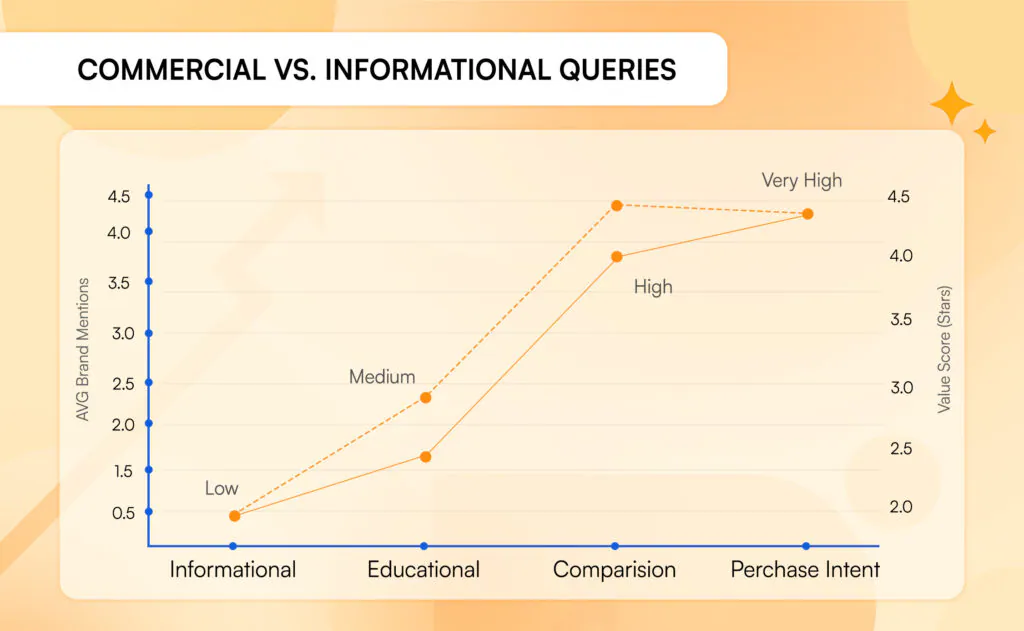
Informational prompts (“What is [concept]?” or “How does [technology] work?”) generate fewer brand mentions. ChatGPT focuses on explaining concepts rather than recommending specific solutions.
Commercial prompts (“Which [tool] is best for [use case]?” or “Where can I buy [product]?”) trigger significantly more brand mentions. ChatGPT interprets these as recommendation requests and suggests specific brands.
For B2B SaaS companies, focus content and authority-building efforts around commercial-intent queries. These drive visibility when prospects are actively evaluating solutions.
The Platform Disagreement Opportunity
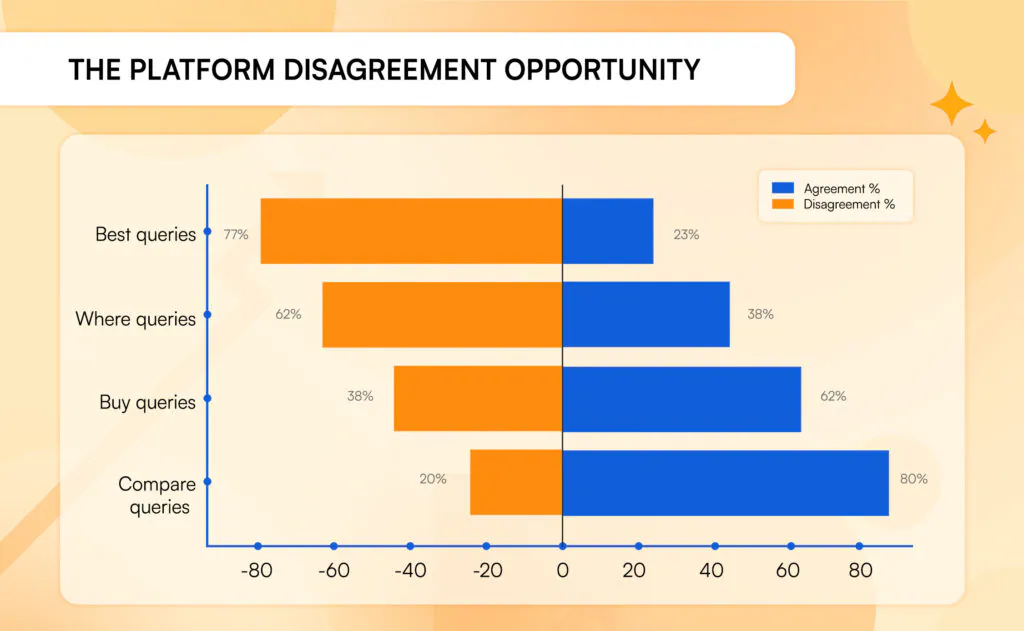
ChatGPT and Google’s AI Mode and AI Overviews disagreed on brand recommendations 61.9% of the time, with only 17% of queries producing the same brands across all three platforms.
This fragmentation creates opportunity. Different AI platforms use different signals to determine which brands to mention. You can’t optimize once and rank everywhere—but you can use platform-specific strategies to maximize total visibility.
- ChatGPT: Relies heavily on training data patterns and brand co-occurrence with category keywords across trusted sources.
- Google AI Overview: Prioritizes current SERP rankings and cites more sources per query.
- Perplexity: Balances brand mentions with extensive source citations, favoring transparent, well-researched content.
A comprehensive strategy targets all three platforms. ThirdMeta’s approach builds the foundational authority signals that work across AI platforms while applying platform-specific optimizations for maximum impact.
Advanced ChatGPT Ranking Strategies
Once you’ve built the foundation with content and authority signals, these advanced tactics accelerate ChatGPT visibility.
- Optimize for GEO (Generative Engine Optimization)
Generative Engine Optimization differs from traditional SEO. It focuses on making content easily digestible for AI models.
Answer-first structure: Start every major content section with a direct, complete answer in the first 2-3 sentences. ChatGPT often extracts these as-is into responses.
Use structured formats: Tables, comparison grids, and numbered lists help AI extract information cleanly. When ChatGPT sees well-structured data, it’s more likely to reference your content.
Include conversational queries as headings: Write H2 headings as questions users would actually ask ChatGPT. This improves the relevance match between your content and user prompts.
- Strategic Influencer & Partner Collaborations
Collaborating with well-known figures in the industry helps amplify your brand’s reach. ChatGPT often factors in content from widely discussed or endorsed brands when providing recommendations.
Identify 5-10 influencers or thought leaders in your space who have a strong online presence. These could be popular LinkedIn creators, YouTube educators, or podcast hosts.
Collaborate on content that naturally mentions your solution. This could be guest podcast appearances, joint webinars, or co-created research reports.
When influential voices discuss your brand positively across multiple platforms, ChatGPT’s training data captures these signals as trust indicators.
- Reddit & Community Engagement Strategy
Reddit appears frequently in ChatGPT training data. Strategic engagement in relevant subreddits can influence AI visibility.
Find 3-5 subreddits where your ICP discusses problems your solution solves. Common B2B SaaS subreddits include r/SaaS, r/b2bmarketing, r/startups, and industry-specific communities.
Provide genuine value through detailed answers to questions. Don’t spam product mentions—offer insights first, mention your solution when it’s truly relevant.
Quality over quantity matters. One comprehensive, highly-upvoted comment explaining a concept and naturally mentioning your solution provides more authority signal than dozens of low-effort posts.
Common ChatGPT Ranking Mistakes to Avoid
Companies waste time and resources on tactics that don’t move the needle for AI visibility.
Mistake 1: Focusing only on your own website content without building third-party brand mentions. ChatGPT needs to see your brand discussed across multiple trusted sources.
Mistake 2: Using generic, textbook content that doesn’t demonstrate unique expertise. ChatGPT prioritizes content showing genuine authority and original insights.
Mistake 3: Ignoring technical SEO and site structure. If crawlers can’t access your content properly, it won’t make it into AI training data or real-time search results.
Mistake 4: Not tracking results systematically. Without regular monitoring, you can’t identify which tactics drive ChatGPT visibility improvements.
Mistake 5: Expecting instant results. Like traditional SEO, ChatGPT optimization requires 3-6 months of consistent effort to see measurable improvements in brand mentions.
ThirdMeta’s framework avoids these pitfalls through strategic planning and proven execution.
Ready to Dominate ChatGPT Search Results?
ThirdMeta guarantees pipeline growth through outcome-based ChatGPT optimization for B2B SaaS companies. No vanity metrics. No hiding behind “SEO takes time” excuses. Just real MQLs, SQLs, and revenue contribution—or you don’t pay.
Our Human + AI approach combines strategic SaaS marketing expertise with AI-powered execution to position your brand where high-intent buyers search: in ChatGPT results.
What you get with ThirdMeta:
- Proven ChatGPT visibility framework with measurable results
- Guaranteed MQL and SQL targets tied to your growth goals
- 90-day pilot program to prove value before long-term commitment
- Full-stack approach: SEO + CRO + content + RevOps alignment
- 750+ Keywords ranked in AI Overviews and SERP Features
Stop letting competitors own the conversation in AI search. Start building ChatGPT visibility that drives pipeline.
Book a 30-Minute Outcome Plan →
Frequently Asked Questions
Most B2B SaaS companies see initial brand mentions within 3-6 months of consistent optimization. Significant competitive positioning improvements typically appear within 6-12 months. The timeline depends on your current authority signals, competitive landscape, and execution consistency.
Yes. Traditional SEO focuses on earning backlinks to rank in search engine results pages. ChatGPT optimization focuses on building brand authority signals across trusted sources so AI models recommend your brand. While foundational SEO practices help, ChatGPT visibility requires additional tactics like strategic brand mentions, review site optimization, and GEO-specific content structuring.
ThirdMeta’s outcome-based approach starts at $2.5K/month with guaranteed MQL and SQL targets. Our 90-day pilot program ranges from $15K-$20K total, where we prove value with real pipeline contribution before you commit long-term. Traditional agencies may charge more without guaranteeing business outcomes.
Not exactly. ChatGPT doesn’t have fixed ranking positions like Google SERPs. Instead, track brand mention frequency, positioning in responses, sentiment, and competitor mentions. Use tools like GenRank or SpyGPT for automated tracking, supplemented with manual searches for your highest-priority prompts.
No. ChatGPT learns brand associations from patterns across the entire web, not just your own site. You need third-party brand mentions on trusted publications, review platforms, community forums, and industry sites. ThirdMeta builds this external authority through strategic content distribution and digital PR.
ChatGPT mentions brands 3.2x more than it cites them, while Google AI Overview cites 2.4x more than it mentions. ChatGPT operates as a recommendation engine based on trust signals. Google AI emphasizes source attribution and traditional SERP rankings. Both matter, but require different optimization approaches.
Absolutely. AI search visitors convert at 4.4x higher rates than traditional organic search visitors. With buyers increasingly using AI to research solutions before engaging sales, ChatGPT visibility directly impacts the pipeline. Early movers in ChatGPT optimization gain competitive advantages while most companies are still figuring out the basics.

Sr. Content Writer
Vamshi Vadali is Third Meta's Content Team Head and the guy who banned fluff from all blog posts. He specializes in SEO, GEO (Generative Engine Optimization), and AEO (Answer Engine Optimization): the trifecta that gets B2B SaaS content ranking in both Google and ChatGPT. Vamshi doesn't write content. He engineers MQL machines. His philosophy? Good writing needs data and clarity, not buzzwords. He writes like a CFO reads: straight to the outcomes. When he's not optimizing for AI Overviews, he's debating whether LLMs prefer Oxford commas.