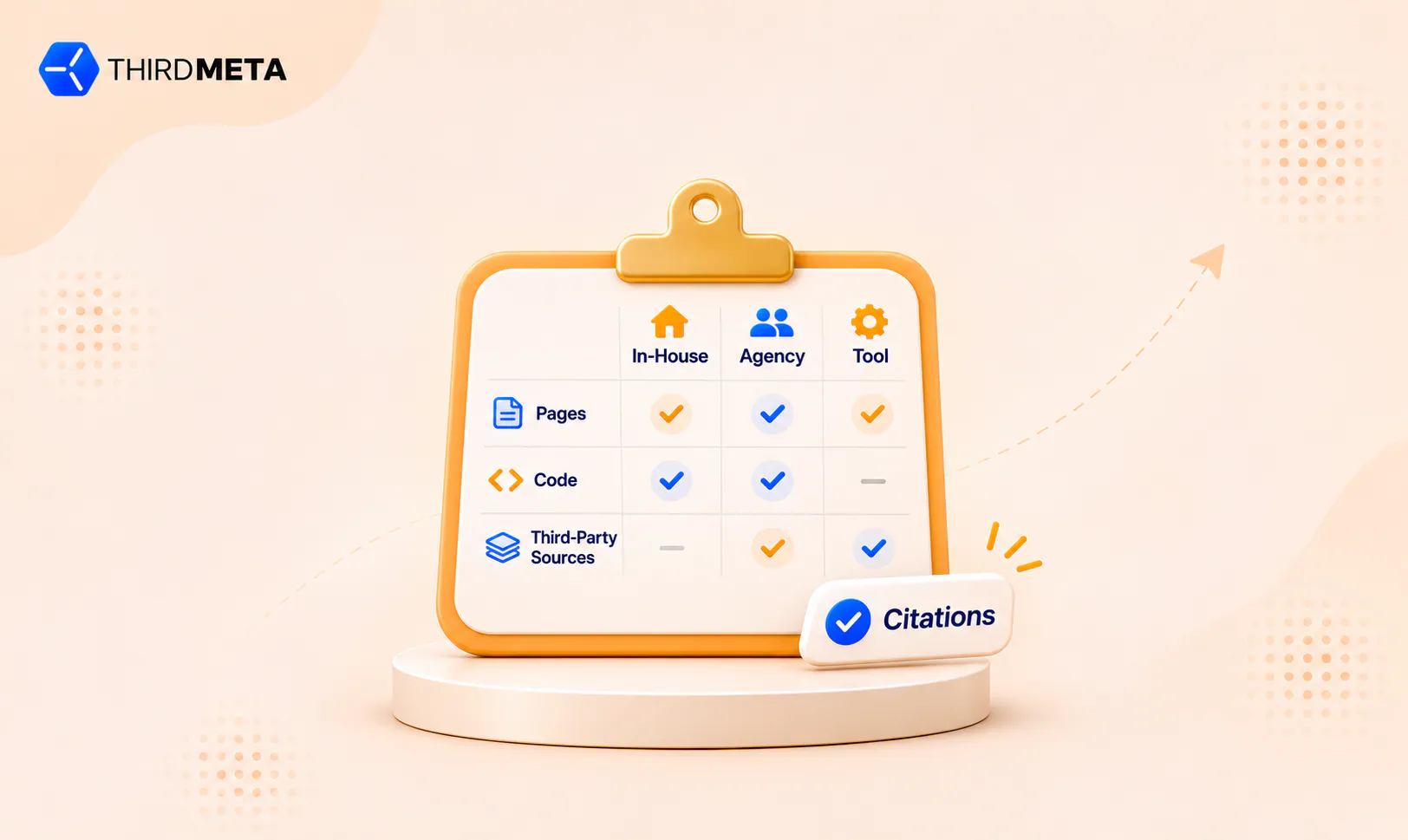
Quick Answer: The in-house GEO vs agency decision depends on who can change the pages, code and third-party sources AI engines read. Keep GEO in-house when you own all three, hire an agency when you own none, and treat a GEO tool as measurement, not a fix.
Key points covered in this article:
What in-house, agency and tool each change
Why control versus speed is the wrong frame
A three-owner test that picks the model
Cost drivers for each option, without guesswork
In-house GEO vs agency is a decision about who will change what AI engines say about your brand, and most teams frame it as a budget question instead. Generative engine optimization is the work of getting a brand named and cited in ChatGPT, Perplexity and Google AI Overviews. Some of that work sits on your site, and much of it sits on other people's.
For a head of marketing at a B2B SaaS company, the brief usually arrives from above. The CEO saw a competitor named in ChatGPT, and the board deck now has an AI visibility line with no owner, no budget and no baseline.
G2's April 2026 research found that 51% of B2B software buyers now start research with an AI chatbot more often than with Google. This guide compares the three ways to respond, with a test you can run in 15 minutes, and links to our AEO and GEO services where an agency fits.
TL;DR
In-house GEO, a GEO agency and a GEO tool each change different things, and tools change nothing directly.
Heads of marketing should choose by ownership of content, technical work and off-site mentions.
Count those three owners first, then pick the model the count points to.
Teams with all three owners keep GEO in-house and buy a tool for tracking.
Teams missing off-site ownership usually need an agency for that piece only.
Agree the measurement plan before any contract or software purchase.
What does in-house GEO vs agency vs tool mean in practice?
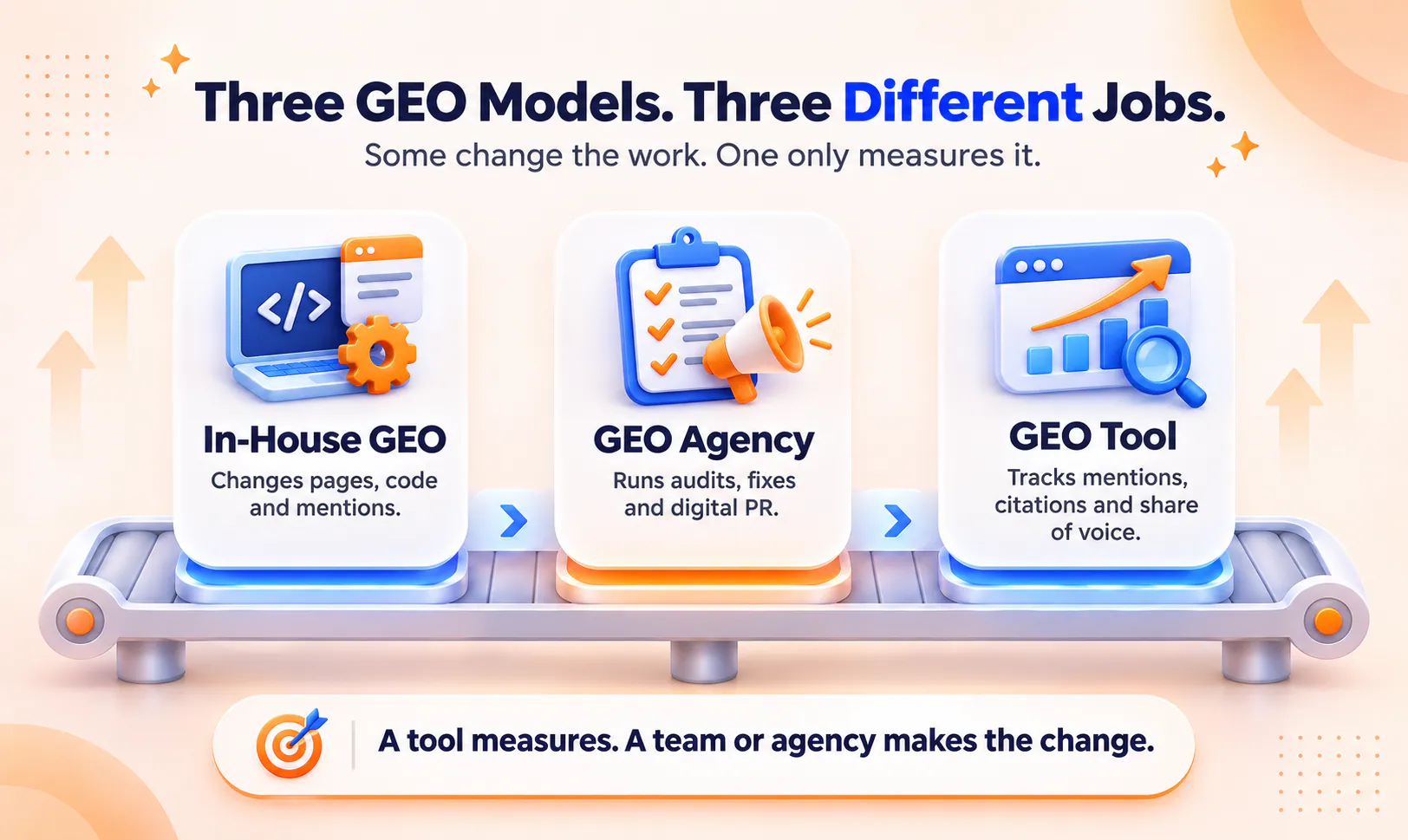
In practice, in-house GEO means your own team changes pages, code and outside mentions; an agency does that work for you; and a GEO tool tracks how often AI engines name you. Only the first two change anything. The tool tells you whether the changes worked.
In-house GEO
Your SEO or content marketer rewrites bottom-of-funnel pages, a developer ships schema and crawler access, and someone pitches your brand onto review sites and lists. It keeps product knowledge close. It also needs time from three people who usually have other jobs.
A GEO agency
An agency runs the audit, writes and restructures pages, handles technical fixes through your developers, and earns third-party mentions through digital PR. You still need one internal approver. Without one, drafts wait for weeks and the retainer pays for waiting.
A GEO tool
Tools such as Profound, Peec AI, Semrush's AI toolkit and Ahrefs Brand Radar run prompts across engines and report mentions, citations and share of voice. They show the gap clearly. They cannot rewrite a page, fix a robots.txt rule or get you onto a G2 category page.
That is why a tool is a measuring device, not a model. Our guide on how to check whether ChatGPT recommends your SaaS covers the manual version of what these tools automate.
Is the in-house GEO vs agency choice really about control versus speed?
No. Most comparisons say in-house gives control and an agency gives speed, but neither matters if nobody can change the sources AI engines read. The real question is ownership: who can change your pages, your code and what other sites say about you.
The usual framing: keep GEO in-house for brand control, outsource it for faster results, or split the difference with a hybrid. It sounds balanced. It skips the part where AI answers are built mostly from pages you do not own.
The better framing: Ahrefs's study of 75,000 brands found branded web mentions correlate with AI visibility at 0.66 to 0.71, while link metrics showed very weak correlations. If mentions on other sites move AI answers, then off-site ownership decides the model. Our breakdown of where AI engines find B2B SaaS brands maps those sources.
"A GEO tool will show you the same missing citation every week. Only a person with access to the source can make it go away."
What we see across our B2B SaaS work: the first GEO fix is rarely a new page. It is usually correcting what a review site, a listicle or an old press piece already says about the product.
In-house GEO vs agency vs tool: how do the three compare?
The three options differ most on what they can change and what they cost you in internal time. The table compares them on the points that decide the fit for a B2B SaaS team.
Factor | In-house GEO | GEO agency | GEO tool |
Changes your pages | Yes, if a writer has time | Yes, with your approval | No |
Changes code and crawler access | Yes, if dev time exists | Through your developers | No |
Earns third-party mentions | Rarely, needs PR skill | Yes, if PR is in scope | No |
Tracks citations and share of voice | Manually or with a tool | Usually included | Yes |
Time to first change | Weeks to months of learning | 2 to 4 weeks after the start | Same day, for tracking |
Hidden cost | Your team's time | An internal approver's time | Someone to act on the reports |
Read the table by columns, not rows. A team can mix them, and most do, but each column still needs a named person who acts on it.
If your AI visibility report shows the same gaps every month, the missing piece is an owner, not a dashboard. |
In-house GEO or agency: which fits your team? Run the Three-Owner Test
The Three-Owner Test picks the model by counting who owns the three things AI answers depend on: on-site content, technical changes and third-party mentions. The count, not the budget, tells you whether to stay in-house, hire an agency or split the work.
Name the content owner. Someone who can rewrite a pricing, comparison or alternatives page within two weeks.
Name the technical owner. A developer who can ship schema, crawler rules and page fixes inside one sprint.
Name the off-site owner. Someone who can get your brand onto review sites, category lists, LinkedIn and community threads.
Count the names. Three means in-house plus a tool. Two means in-house plus an agency for the missing piece. One or zero means agency-led with one internal approver.
These cut-offs are our rule of thumb, not an industry standard. Take a Series A fintech SaaS in Bengaluru with one content marketer, developers booked on product work and no PR function (an illustrative case). It scores one, so an agency-led model with the content marketer as approver fits better than a new tool.
When does in-house GEO beat an agency, and when does an agency win?
In-house GEO wins when you already own the three areas and the product needs deep internal knowledge to explain. An agency wins when off-site work is the gap, or when nobody internal has time to act. The questions below cover the common cases.
Can an existing SEO person run GEO in-house?
Yes, for the on-site part. Page structure, schema and answer-first writing build on SEO skills. Off-site mentions and digital PR are a different job, and that is where most in-house GEO stalls.
When is a GEO agency the faster route?
When leadership wants a baseline and movement within one quarter, and your team is already full. An agency arrives with prompt sets, a source map and PR contacts. Ask for the plan to hand parts back to your team later.
Should you hire a GEO agency or an SEO agency first?
Hire for the gap. If your pages do not rank or get crawled, SEO comes first. If you rank but AI answers name competitors, GEO is the gap, and our GEO services buyer's guide lists the questions to ask.
What we see across our B2B SaaS work: teams that buy a tool first often watch the same gap for six months. The tool was right every week, and nobody owned the fix.
If you have a GEO budget line but no plan for who does the work, start with the owners. |
What does in-house GEO vs agency cost, and what drives the number?
The cost of in-house GEO vs agency is driven by scope, not by the label. In-house costs show up as salary time and tool seats; agency costs show up as a retainer. Five factors move either number.
Engines and prompts tracked. More engines and a larger prompt set mean more tracking and more pages to fix.
Pages to rebuild. Comparison, pricing and alternatives pages take the most work and earn the most citations.
Developer access. Fast access lowers cost; a two-month dev queue raises it on any model.
Off-site scope. Digital PR and review-site work is the most labour-heavy part of GEO.
Reporting depth. Linking AI visibility to pipeline in your CRM takes setup on either side.
For market ranges, see our GEO agency cost per month guide. Gartner's 2026 CMO Spend Survey found CMOs allocate 15.3% of marketing budgets to AI, though only 30% feel ready to scale that capability. As of 2026, the money is usually there before the owners are.
How do you split in-house GEO and agency work without paying twice?
A hybrid GEO model works when each owner area has exactly one party responsible, written down before the work starts. It fails when the agency and the in-house team both "own" content and neither owns off-site mentions.
The common split: your team owns product facts and approvals, and the agency owns page rebuilds, technical tickets and digital PR. One tracking tool is shared, so both sides read the same numbers.
The rule that saves money: do not pay an agency to track what your tool already tracks, or buy a tool your agency already runs. Pick one source of reporting and tie it to pipeline, as our budget split across SEO, AEO and GEO explains.
If an agency and your team both claim the same work, you are paying twice for one owner. |
Why Should You Choose ThirdMeta?
Most teams come to us after buying a GEO tool such as Profound or Peec AI, seeing the gaps clearly, and finding nobody free to fix them. ThirdMeta fills the owner seats your team is missing and reports the result in your CRM.
Rebuilds comparison, pricing and alternatives pages to be cited in AI answers
Ships schema and crawler fixes as tickets your developers can merge
Earns third-party mentions on the lists and review sites AI engines read
Tracks citations across ChatGPT, Perplexity and Google AI Overviews
Links AI-referred visits to MQLs and pipeline in your CRM
Our KlearStack case study shows this AEO and SEO model for a B2B document AI company. If you pass the Three-Owner Test with three names, keep GEO in-house and buy a tool instead.
vs WebFX: we work only with B2B SaaS and tech, so prompts come from your buyers' language.
vs tool-only setups: we change the sources, not just report on them.
vs SEO-only agencies: off-site mentions and digital PR are in scope from the start.
If you scored one or two owners, the next step is choosing which seat to fill first. Book a GEO review with ThirdMeta and we will show you.
Conclusion
The in-house GEO vs agency decision is settled by ownership, not by preference. AI engines build answers from your pages, your code and other people's pages, and every option has to name who changes each one.
Count your owners this week, before you sign a retainer or a software contract. A team that knows its count buys exactly the help it lacks, and its AI visibility reports start showing fixes instead of the same gaps. If you need help choosing a partner after that, our AEO and GEO services page explains how we work.
Frequently Asked Questions
Hire a GEO agency if nobody owns off-site mentions. Keep GEO in-house if you own content, code and mentions. Most B2B SaaS teams own one or two of those. They usually need an agency for the gap only.

Sr. Content Writer
Vamshi Vadali is Third Meta's Content Team Head and the guy who banned fluff from all blog posts. He specializes in SEO, GEO (Generative Engine Optimization), and AEO (Answer Engine Optimization): the trifecta that gets B2B SaaS content ranking in both Google and ChatGPT. Vamshi doesn't write content. He engineers MQL machines. His philosophy? Good writing needs data and clarity, not buzzwords. He writes like a CFO reads: straight to the outcomes. When he's not optimizing for AI Overviews, he's debating whether LLMs prefer Oxford commas.