
Quick Answer: Allocating budget across SEO, AEO, and GEO works by treating AEO and GEO as optimization layers on your existing SEO investment, not a new line item, and by auditing content quality before assigning any percentage split.
Key points covered in this article:
Generic 60/70% splits ignore your actual content quality
A 5-minute audit reveals if you're ready to reallocate
PLG and sales-led motions need different splits
What to defund first, and what never to cut
How to prove the reallocation reached pipeline, not citations
Allocating budget across SEO, AEO, and GEO is a sequencing decision before it is a percentage decision: content already earning organic rankings has to clear a quality bar before any dollar moves toward AI-search work.
Most B2B SaaS marketing leaders inherit this question mid-quarter, when a CFO asks why the SEO retainer hasn't shrunk now that ChatGPT and Perplexity are eating search share. A VP of Marketing at a 200-person SaaS company gets stuck between an agency pitching an AEO package and a board deck still measured in organic sessions.
According to G2's 2026 Answer Economy research showing 51% of B2B software buyers now start research with an AI chatbot more than Google, the reallocation question is unavoidable. This piece walks through the sequencing, starting with the audit before any percentage gets decided.
TL;DR
A Content Debt Ratio audit should happen before any SEO, AEO, or GEO percentage gets assigned.
PLG and sales-led B2B SaaS motions need different splits, not the same stage-based table.
Defund thin, unstructured pages first; never cut the technical foundation AI engines crawl to cite you.
VP Marketing and growth leads should track pipeline and demo requests, not citation counts, to prove reallocation worked.
Rebalancing search budget without a content audit wastes the AEO or GEO line item entirely.
What Does "Allocating Budget Across SEO, AEO, and GEO" Actually Mean?
Allocating budget across SEO, AEO, and GEO means deciding what share of existing search spend goes toward traditional ranking work versus AI-answer-specific work, not adding two brand-new line items. AEO (Answer Engine Optimisation) targets featured snippets and direct-answer boxes. GEO (Generative Engine Optimisation) targets citations inside ChatGPT, Perplexity, and Gemini.
Most vendors sell these as separate disciplines with separate retainers. Google's own Search Central guidance, updated in 2026, says otherwise: optimising for generative AI search is still SEO, built on the same technical health and content. That usually keeps the budget with the same VP Marketing or Head of Growth who already owns the SEO line, not a new specialist hire.
This distinction does not help everyone. A site with unresolved crawlability or Core Web Vitals problems will not benefit from any AEO or GEO reallocation until the technical foundation is fixed, no matter how the percentages are split.
Why Is the 60/70% SEO Budget Split Everyone Quotes the Wrong Starting Point?
The AI Overview answer to this query recommends 60 to 70% SEO, 15 to 20% AEO, and 15 to 20% GEO. Ask three sources and the numbers move, because a fixed percentage cannot know whether existing content already produces AEO- and GEO-compatible output.
Two camps dominate the search results, and they contradict each other. One hands you a percentage table. The other, backed by Google's own documentation, argues GEO and AEO are not separate disciplines at all, making a fixed percentage a category error.
Both camps skip the actual first move: auditing whether current pages answer questions directly, carry structured data, and earn third-party citations. A team with strong technical SEO and thin content needs a different split than a team with weak SEO and strong content, a diagnostic most SEO engagements skip.
Across the B2B SaaS engagements we run, teams asking for a rigid AEO percentage almost always share the same root problem: their SEO content was already too generic to earn an AI citation before the budget question came up.
"A fixed percentage split can't diagnose content quality, and content quality, not the percentage, decides whether AI engines cite you at all."
If you're staring at a percentage table that doesn't account for your actual content quality, that's the gap a proper audit closes before you spend another dollar. See how the audit works
What's Your Content Debt Ratio Before You Reallocate a Single Dollar?
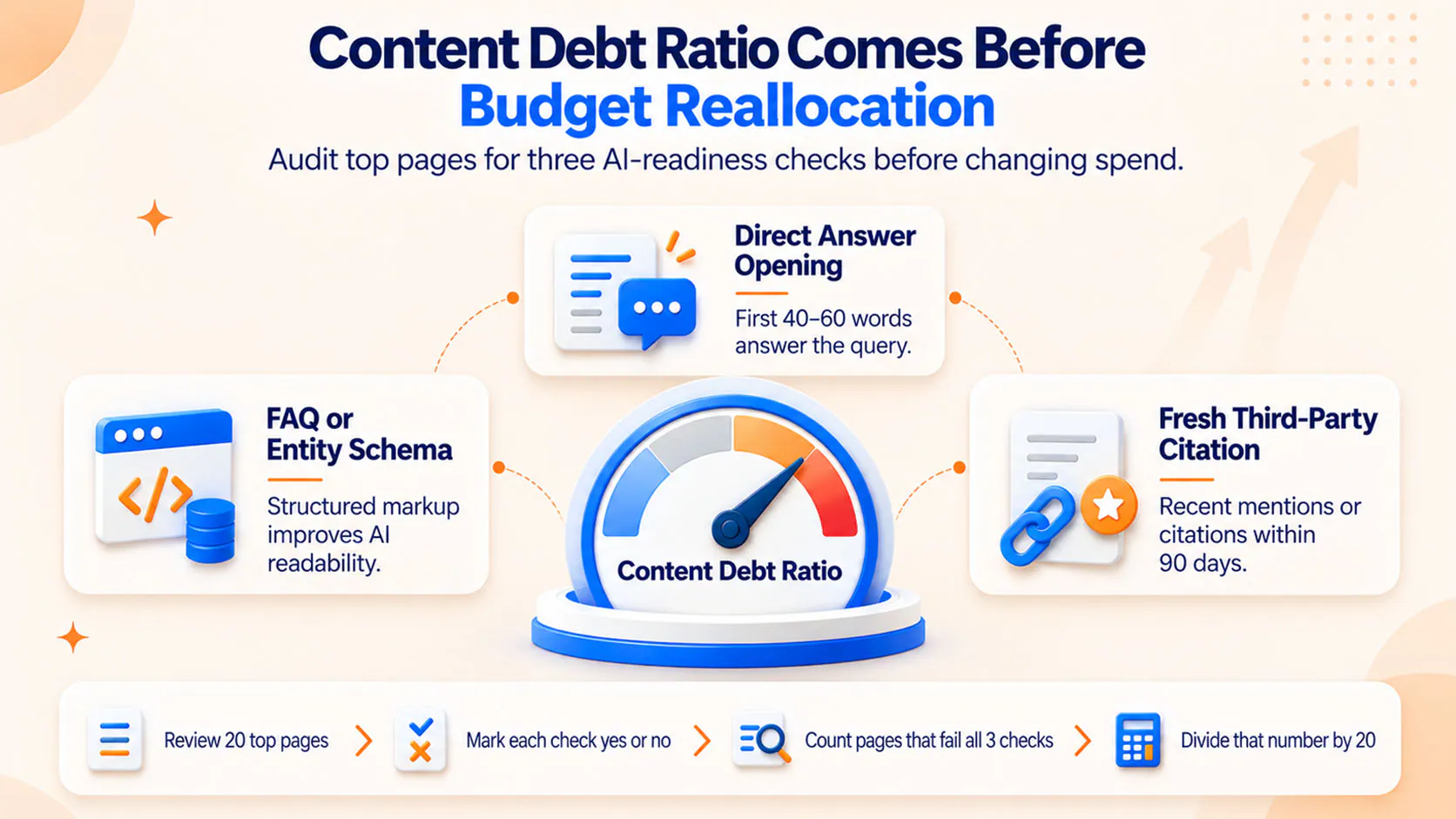
Your Content Debt Ratio is the percentage of top pages that fail three AI-readiness checks, and it should be the first number a VP Marketing calculates, not the SEO-to-AEO split. Score the top 20 landing and blog pages against three yes/no checks in under five minutes.
Does the first 40 to 60 words directly answer the query, with no throat-clearing?
Does the page carry FAQ or entity schema markup?
Has it earned a third-party citation or mention in the last 90 days?
Divide the pages that fail all three by 20. If more than half fail, that is the Content Debt Ratio, and no AEO or GEO percentage fixes it.
Forrester's 2026 survey found 94% of B2B buyers used AI during their most recent purchase, so that debt gets exposed fast. The next dollar goes into rewriting those pages, because thin, generic content is what AI engines skip when citing sources.
Should PLG and Sales-Led B2B SaaS Companies Split SEO, AEO, and GEO Budget the Same Way?
No. A product-led growth motion and a sales-led motion send buyers through different research paths, so the same split under-funds one channel for each. PLG buyers self-serve through comparison and how-to content; sales-led buyers rely more on category-education content a rep can walk through.
Motion | Where AI search shows up first | Where to weight the split |
PLG (self-serve, freemium) | Comparison pages, "alternative to" queries, pricing questions | GEO-heavy: an AI citation can replace the demo-request step |
Sales-led (enterprise, longer cycle) | Category-education content, vendor-shortlist research | AEO-heavy: direct-answer content a rep can reference live |
Gartner's survey of 645 B2B buyers found 45% used GenAI primarily to research vendors and products, exactly the shortlist stage GEO affects most. A Head of Growth on a PLG motion loses more by underfunding GEO, since a missed citation costs a signup. A sales-led team loses more by underfunding AEO content a rep never gets to reference, the kind of proof B2B buyers now demand from an SEO vendor.
If your team runs a PLG motion but funds AEO like a sales-led company, that mismatch is costing you self-serve signups right now. Get a motion-specific split
What Should You Stop Spending On in SEO Before Funding AEO or GEO?
Cutting the wrong SEO line item to fund AEO or GEO is the most common mistake here, usually three specific spend categories still running on autopilot.
Volume-based content briefs. Paying for word count instead of passage-first answers wastes budget twice: once on the page, and again when it fails every AEO check.
Backlink packages with no citation strategy. Links help rankings, but they do nothing for GEO unless the linking site is a source AI engines actually pull from.
Generic technical audits repeated quarterly. Once a site passes Core Web Vitals and crawlability, repeating the same audit is budget that could fund content debt repair instead.
Stop paying for these three before adding a single AEO or GEO deliverable to the retainer.
How Do You Prove a Budget Reallocation From SEO to AEO/GEO Actually Worked?
Citation counts and AI Overview mentions are not proof a reallocation worked. Proof means the budget shows up in pipeline, the same way any SEO spend gets tracked.
One 200-person SaaS client moved 20% of its SEO retainer into GEO content last quarter:
AI citation mentions rose from 4 to 31 in the tracked query set.
Demo requests from organic and AI-referral traffic in the CRM rose by only 3, not 27.
Citations were landing on definitional pages with no path to a demo, not on the comparison pages buyers actually convert from.
What we see across our B2B SaaS work is that citation growth and pipeline growth move independently more often than teams expect, so tracking only one produces a misleading verdict. The fix was not more GEO spend. It was moving the GEO budget toward the page types the fintech content playbook already showed were converting.
If your AEO or GEO spend has never once shown up in a CRM report, that's the gap to close before adding another dollar. See the pipeline tracking approach
Why Should You Choose ThirdMeta?
If a percentage table still hasn't decided where the next SEO dollar goes, that's the gap ThirdMeta's growth engagements close, starting with the content audit most vendors skip.
A Content Debt Ratio audit across top pages before any budget conversation
A stage-and-motion-specific split for PLG or sales-led B2B SaaS teams
Pipeline attribution that ties AEO/GEO spend to demos, not citations
Technical SEO foundations fixed before a single AEO deliverable gets funded
Unlike agencies selling AEO as a bolt-on, ThirdMeta treats it as one layer of an existing SEO program, and reports against CRM pipeline instead of citation counts.
If a percentage split is the only deliverable your last SEO conversation produced, book a working session and get the audit instead.
Conclusion
How to allocate budget across SEO, AEO, and GEO is really a question about content quality, sequencing, and which motion a company runs, not a percentage borrowed from an AI Overview. A fixed split ignores whether pages already answer questions directly, or whether buyers self-serve.
For a B2B SaaS marketing lead who acts on this, the shift is concrete: fewer dollars into volume-based content and generic audits, more into fixing content debt, and every dollar tracked against pipeline instead of citation counts. That is the version of this reallocation that survives a board meeting.
Frequently Asked Questions
Optimizing for AEO and GEO means restructuring existing SEO content, not building a separate program. Rewrite openings to answer the query directly. Add FAQ and entity schema markup. Earn third-party mentions on sites AI engines already trust.

Technical Content Strategist