
![Marketing Strategy for B2B Startups [4-Part Foundation to Onboard Your First 5 Customers]](https://tgzqdlxcvlliociqrqgu.supabase.co/storage/v1/object/public/blog-media/b852828099aaa5e20b54ef87f527be44056d8245e5b9aea522f499f1d7d5ca5b.webp)
Quick Answer: A marketing strategy for B2B startups is a sequenced four-layer framework: define who you serve, then how you want to be perceived, then what you say, then where you communicate. Most early-stage startups skip the first three layers and start at channels, which is why their marketing fails before campaigns go live.
Key points covered in this article:
- B2B startup marketing fails when channels precede positioning
- ICP definition is the highest-leverage step in the framework
- Positioning answers how the market should perceive the company
- Channel selection depends on where the ICP already pays attention
- First 5 customers come from founder-led tactics, not paid media
A marketing strategy for B2B startups works in one direction only, which is from customer definition to channel deployment, never the other way around. The order is the main strategy. If you reverse it, then the marketing budget gets spent before the foundation is built.
For most founders, “marketing strategy” means three browser tabs:
- A competitor’s LinkedIn page,
- A SaaS blog about ICP, and
- An unstarted Notion doc
The work of sequencing the framework, who first and channels last, gets postponed until pipeline gets bad enough to force it. By then, the agency invoices had already been paid.
A report by CB Insights, found that 43% of analysed startup shutdowns since 2023 trace back to poor product-market fit, with running out of capital the proximate cause in 70% of cases. Most founders read that as a product problem. It is more often a marketing strategy problem of the same shape.
Key Takeaways on B2B Marketing Strategies
- Build in sequence: Targeting >> Positioning >> Messaging >> Channels. The order is non-negotiable for B2B startups.
- Name your ICP at the company level: List 30 to 50 actual companies, not abstract categories.
- Positioning is the most under-built layer: Choose a defensible dimension and a named enemy.
- Messaging earns weight through founder-led, opinionated content, not generic SaaS copy.
- Channels are downstream of strategy: Pick where your defined ICP already pays attention.
- Tier execution by budget: Founder-led trust at Tier 1, infrastructure at Tier 2, compounding at Tier 3.
Why Most B2B Startup Marketing Fails Before It Begins
B2B startup marketing fails before a single campaign goes live, not because founders pick the wrong tactics, but because they pick tactics in the wrong order. The pattern repeats across nearly every early-stage Indian B2B SaaS company we have worked with.
A founder hires a content agency in month 1 for SEO-led growth. By month 2, an outbound motion gets layered on through Apollo or Lemlist. Month 3 adds paid ads on Google and LinkedIn. By month 5, pipeline is thin, attribution is messy, and CAC is a guess.
The standard diagnosis is that the channels were wrong. The actual diagnosis is different: the company tried to communicate before it knew what to say, and tried to say things before it knew who was listening. None of the channels were the problem. The order was the problem.
Acquisition costs make this expensive. A report by Benchmarkit, found that the median B2B SaaS company now spends $2.00 in sales and marketing to acquire $1.00 of new ARR, with bottom-quartile companies at $2.82. Channel-first execution at those rates is not just inefficient. It is a runway-shortening mistake.
The 4 Golden Rules of B2B Startup Marketing Strategy
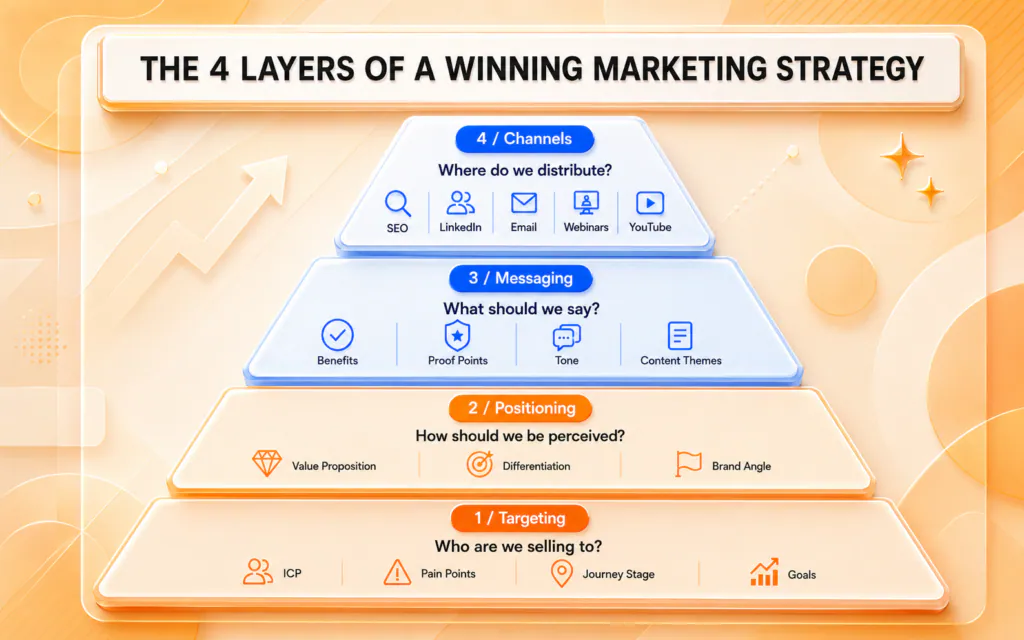
The 4 golden rules of B2B startup marketing strategy work as a SEQUENCE, not a checklist. Each rule sets the input the next one needs. Skip a rule, and every downstream decision compounds the same error.
The market sells the opposite. Most early-stage advice pushes founders toward multi-channel orchestration, always-on demand generation, and “test everything” experimentation. That advice serves agencies, ad platforms, and content vendors. It does not serve founders trying to land their first 5 customers on an 18-month runway.
According to Paddle’s CAC research, customer acquisition costs across B2B SaaS have risen 60 percent over the past five years. The cost of running marketing tactics out of order has never been higher.
Rule 1: You need to know WHO your audience is
You cannot decide how to be perceived by a market you have not yet defined. Segmentation, ICP, and buyer journey come first. Everything downstream assumes this is settled.
Rule 2: You need to define HOW you want to be perceived
Positioning sets the frame for messaging. Without a clear answer to how the company wants to be perceived, every message is a guess. Value proposition, brand posture, and named enemy all live here.
Rule 3: You need to know WHAT to say
Messaging is a substance. Channels are containers. Spamming emails without a clear message, or hosting webinars without a value proposition, is a Rule 3 violation that burns more budget than any channel mistake will.
Rule 4: You need to define a set of channels WHERE you will actually deploy
Once the first three layers are set, channel selection becomes mechanical. You go where your defined ICP already pays attention, and you ignore the rest.
It sounds simple. It is even easier to mess up. The reason it gets messed up is always the same: “We need quick results.” But quick results without the right foundations are sandcastle results. They look like something today and have to be rebuilt tomorrow.
Part 1: Targeting: Who Are Your Customers?
Targeting means who specifically buys from you, and why them, not someone else. For a B2B startup, the answer must name companies, not categories, and decision-makers, not titles.
“Mid-market SaaS companies” is not targeting. “Series A B2B SaaS companies in India with 30 to 60 engineers and no head of growth” is targeting.
The Targeting layer has 6 components that all feed into one another. Each builds on the last, and the work cannot be outsourced to a junior marketer.
- Segmentation
Segmentation cuts the total market into groups that share buying behaviour. For B2B startups, the sharpest segmentation is rarely vertical (fintech, edtech). It is usually motion (PLG vs sales-led) or company state (post-PMF, founder-led, scaling under a first CMO hire).
- Ideal Customer Profile (ICP)
The ICP names the company, not the person. Funding stage, employee count, tech stack, geography, vertical, growth motion. For early-stage startups, the ICP should describe 30 to 50 actual companies the founder can name, not a profile abstract enough to fit thousands.
- Pains
Pains are the specific operational moments where the buyer feels the problem. Not “they want to grow faster.” Specifically: “the head of marketing is presenting MQL targets to the board for a third quarter, and inbound is flat.”
- Objectives
What does the buyer need to achieve in the next 90 days? Objectives are the trigger events that move a deal from interest to evaluation. Without them, the buyer journey is a flat plane with no entry point.
- Journey
The buyer journey maps the path from problem awareness to vendor selection. For B2B startups, this is typically 90 to 150 days. Knowing where the buyer is on the journey tells you what content, message, and channel will move them.
- Customer statement
A one-line statement that names who you serve and how. Example: “We help India-based B2B SaaS founders post-PMF build an organic pipeline before they hire a CMO.”
Most B2B startup marketing fails here, at the “Targeting” stage, before it ever reaches channels. The founder skips the work and outsources execution.
Note:
The cheapest investment a B2B startup can make is 40 hours invested in narrowing this layer. Everything downstream gets cheaper as a result.
If your team is shipping content and outbound while your ICP is still defined as “B2B SaaS companies,“Book a sequencing review before you spend another quarter on the wrong channels.”
Part 2: Positioning: How Do You Want to Be Perceived?
Positioning is the deliberate act of placing your company in the buyer’s mental category. For a B2B startup, this means choosing what you are, what you are not, and who you are explicitly against. Positioning is not branding. It is the strategic decision that determines what your messaging argues for.
5 main components that define positioning at the foundation layer. Each gets a written, defended answer before any external content goes out:
- Value proposition: Specific outcome you create for the defined ICP
- Differentiation: Dimension on which you are demonstrably different from the next-best alternative
- Brand posture: How you show up, whether founder-led, technical, contrarian, or premium
- Tone of voice: Operating texture of every communication
- Enemy: Named competitor, status quo, or category assumption you reject
Consider an India-based B2B SaaS startup selling document automation software to BFSI accounts payable teams. The category is already populated by KlearStack, HyperVerge, and at least eight other players.
- Generic positioning would look like, “we help finance teams automate documents”. This says nothing.
- Sharper positioning chooses a defensible dimension: 99%+ accuracy on unstructured invoices, or zero-engineering setup for non-technical AP leads.
Whatever the dimension, it has to be defensible, demonstrable, and uncomfortable for the next-best alternative to copy. Brand posture is where most early-stage startups go wrong. A challenger posture earns trust faster than a peer posture. An authority posture earns it faster than either, and it is the founder’s call to make.
Part 3: Messaging: What Are You Going to Say?
Messaging is the layer where positioning becomes language. It is what the website says, what the cold email opens with, what the sales deck argues, and what the founder posts on LinkedIn for B2B founders. Without a defined messaging layer, every piece of content is a fresh translation, and the brand starts contradicting itself in 90 days.
Six questions, answered in writing before any content ships, define the messaging layer for a B2B startup:
- What are the benefits the buyer cares about?
Benefits are outcomes, not features. Ex. “Cut invoice processing time from 14 days to 3” is a benefit. “AI-powered OCR engine” is a feature. For B2B startups, benefits get quantified or get cut.
- What capabilities support those benefits?
Capabilities are the product or service strengths the buyer’s evaluation team will scrutinise. For early-stage startups, three crisp capabilities beat eleven vague ones.
- What is your point of view?
Point of view is the argument the brand carries. It is what the founder believes about the market that the market itself does not yet agree with. Without one, content reads competent and forgettable.
- What stories ground your message?
Story is how messaging becomes memory. For B2B startups, the founding story, the first customer story, and the inflection story (the moment the product became defensible) carry the most weight.
- What is your tone?
Tone is the consistent voice across formats. Domain-savvy, dry, technical, premium, or founder-led: pick one, and do not switch every quarter.
- What content pillars contain it all?
Three to five pillars define what the company publishes about and what it ignores. Pillars sit at the intersection of buyer pain, founder expertise, and category position. They make output consistent and editorial decisions fast.
Part 4: Channels: Where Will You Communicate?
Channels are containers, not strategy. They carry the messaging built in step 3 to the audience defined in step 1. The mistake almost every B2B startup makes is choosing channels by industry default rather than by where the defined ICP actually pays attention.
The default B2B startup channel list is wide: LinkedIn, YouTube, Instagram, podcasts, webinars, email, sales calls. Not all of them earn equal weight at every stage. Below is the practical fit for an early-stage Indian B2B SaaS startup pre-Series A.
| Channel | Best Fit For | Condition |
| SEO (To generate inbound leads) | All ICP defined Companies who wish to generate inbound leads with a 6+ month runway | Compounds after month 3; zero pipeline before that. Amazing results after 2 quarters. |
| LinkedIn(Founder-led) | Senior B2B buyers (VP+), India and US | Requires 3 to 5 founder posts a week |
| Email (outbound, named-account) | Mid-market and enterprise ICPs | Only works after positioning is sharp |
| Webinars | Mid-funnel buyers in evaluation mode | Needs an audience already built elsewhere |
| Sales calls (founder-led) | Enterprise deals, discovery | Highest signal, lowest scale |
| Podcast (own) | Long-cycle category education | Compounds over 12 to 18 months, not 90 days |
| Instagram / YouTube short-form | Brand surface with junior-buyer overlap | Diminishing returns for high-ACV B2B |
| Email (owned newsletter) | Nurture for warm audience | Works only with a real content engine behind it |
In 2026, Top-of-funnel volume matters less, and trust-building channels (founder LinkedIn, podcasts, named-account email) matter more. Channels chosen from a defined ICP outperform channels chosen from a trend list, every quarter.
How to Land Your First 5 Customers [Channel-based Execution by Budget Tier]
Landing your first 5 B2B customers does not require a marketing budget. It requires a sequenced playbook the founder can execute personally, with paid spend added only when the playbook is proven. Each tier below assumes Targeting, Positioning, and Messaging are already locked. Without them, no tactic at any budget will compound.
Tier 1: Zero-Budget Tactics (₹0 to ₹50,000 / $0 to $600 per month)
These tactics rely on founder time, not media spend. They build the asymmetric advantage early-stage founders actually have, direct access to the market and a credible voice on it.
- Founder-led LinkedIn: 3 posts per week, narrow content pillars, opinion-led. Comment thoughtfully on 10 ICP-relevant posts daily. Reach compounds visibly by week 12.
- Named-account outbound: List 100 ICP companies. Find the decision-maker on LinkedIn. Send 20 personalised messages a day, founder to founder. No automation. Target 5 conversations or demos per week.
- Community participation: Join 3 industry communities (SaaSBoomi, Pavilion, India SaaS) where the ICP is active. Contribute, do not pitch. The reputation effect is measurable in 60 days.
- Case study from beta users: One detailed customer story from a beta user. Numbers, specifics, named results. This becomes the highest-converting asset on the website.
Tier 2: Low-Budget Tactics (₹50,000 to ₹2,00,000 / $600 to $2,400 per month)
This tier adds tooling and modest spend without hiring an in-house team.
- SEO foundation: 1 to 2 mid-funnel blogs per week, targeting bottom-of-funnel intent (alternative pages, comparison pages, use-case pages). Create 2 to 3 Bottom-of-funnel (BOFU) blogs in a month. BOFU blogs can generate leads in month 2. Plan accordingly.
- Cold email infrastructure: Smartlead, Instantly, or Reply.io with rotating domains. Personalised first lines. Open rates above 60% mean the list is right; below 30% means the ICP needs sharpening.
- Webinar with one ICP-aligned partner: Co-host with a non-competitor selling to the same ICP. Combine email lists. 200 to 300 registrations per session is normal at this stage.
- Founder podcast appearances: 2 per month on shows the ICP listens to. Trade insight for the audience. Compounds quickly.
Tier 3: Growth-Stage Tactics (₹2,00,000+ / $2,400+ per month)
This tier compounds the foundation built in Tiers 1 and 2.
- Content-led SEO at scale: 3 to 5 content pieces per week including bottom-of-funnel (BOFU) blogs, programmatic SEO for long-tail intent, technical SEO baseline. This is where partnering with a specialist growth agency becomes more efficient than hiring in-house.
- Performance marketing on bottom-funnel intent only: Run Google Ads on competitor brand names, “alternative to” keywords, and category comparison terms where the buyer is already evaluating vendors. Invest a small budget and test the results in your category.
- Newsletter sponsorships: Sponsor trusted niche newsletters (Letterdrop, beehiiv, vertical-specific). Trust transfers from the newsletter to the brand. CPL is materially lower than LinkedIn ads.
- ABM motion on top 50 named accounts: Coordinated LinkedIn ads, founder outbound, gifting, custom landing pages. CAC drops 30 to 40 percent versus general-audience ads when targeting is sharp.
- Ecosystem and partner-led growth: According to Pavilion, 60% of SaaS leaders increased their ecosystem-led growth focus in 2024. Integration partners, co-marketing alliances, and referral pipelines are the highest-margin growth channels at scale.
None of these tactics is novel. The differentiator is the order: founder-led trust at Tier 1, infrastructure at Tier 2, multiplication at Tier 3. Skip the order, and you arrive at Tier 3 with no audience to amplify and no message worth scaling.
If your foundation is built and you are ready to compound beyond Tier 1, book a 30-minute call with our growth team.
Why Should You Choose ThirdMeta?
Most B2B startups in India do not need another marketing agency. They need a strategy partner who will sequence the framework before deploying a single tactic. ThirdMeta works with founder-led B2B SaaS companies post-PMF, when Targeting, Positioning, and Messaging are still under-defined and channel spend is starting to scale.
Our engagement covers the full sequenced framework, not isolated deliverables:
- ICP and positioning sprint: 4-week foundation engagement that locks Targeting, Positioning, and Messaging before any channel spend
- Content-based SEO at scale: Long-tail intent capture for B2B startups serving named-account ICPs
- Founder-led content systems: ghostwritten LinkedIn, podcast booking, and authority content built around the founder’s point of view
- Sales enablement assets: Decks, one-pagers, comparison pages built from sharpened positioning
- Growth diagnostics: quarterly audits of pipeline, CAC, and channel ROI against your defined ICP
Note:
All these engagements are outcome-focused to drive leads and not just complete deliverables.
We work primarily with Indian B2B SaaS companies in AI Tech, Fintech, EdTech, document automation, and field service software. Our model is built for founders who want compounding output, not one-off deliverables.
How we compare to the alternatives:
- vs. Content agencies: we sequence positioning before content, not after. We do content-based SEO that generates inbound leads, not just complete deliverables.
- vs. Paid-media specialists: we treat channel selection as a downstream decision, not the strategy
- vs. In-house hiring: we deploy a full growth team in 30 days at lower cost than a single CMO hire.
Honest Disclosure of this Blog
The above framework is not built for post-Series B companies, an existing brand book, and a multi-product portfolio. If that is you, your problems are different.
If your B2B startup has paying customers, defined product, and a marketing strategy that still starts with channels, the next conversation is about sequencing. Book a 30-minute strategy call and we will map your foundation gaps in one session.
Conclusion
A marketing strategy for B2B startups is built in one direction only. Define who you serve, then how you are perceived, then what you say, then where you say it. The order is the strategy, and reversing it is the most expensive mistake an early-stage founder can make.
For the founder who applies this framework, the first 5 customers stop feeling like luck. The ICP gets named, positioning gets sharpened, messaging gets repeated, and the right channels narrow to the two or three that actually convert.
In 2026, with CAC rising and sales cycles lengthening, the marketing strategy that beats every alternative is the one built bottom-up from the customer, not top-down from the latest trend. The next move is to put 40 hours on the calendar for the foundation work, before the next quarter’s content budget gets approved.
Frequently Asked Questions
A marketing strategy for a B2B startup is built in four sequenced layers. First, define your ICP, pains, and buyer journey. Then set positioning and messaging before choosing channels. Skip the sequence, and channel spend will not convert.

Isha Chaudhari is a content strategist specialising in B2B technology and enterprise software. She writes on AI, finance automation, and the operational challenges facing modern business teams. Her work focuses on making complex technology decisions accessible to the people who have to act on them.