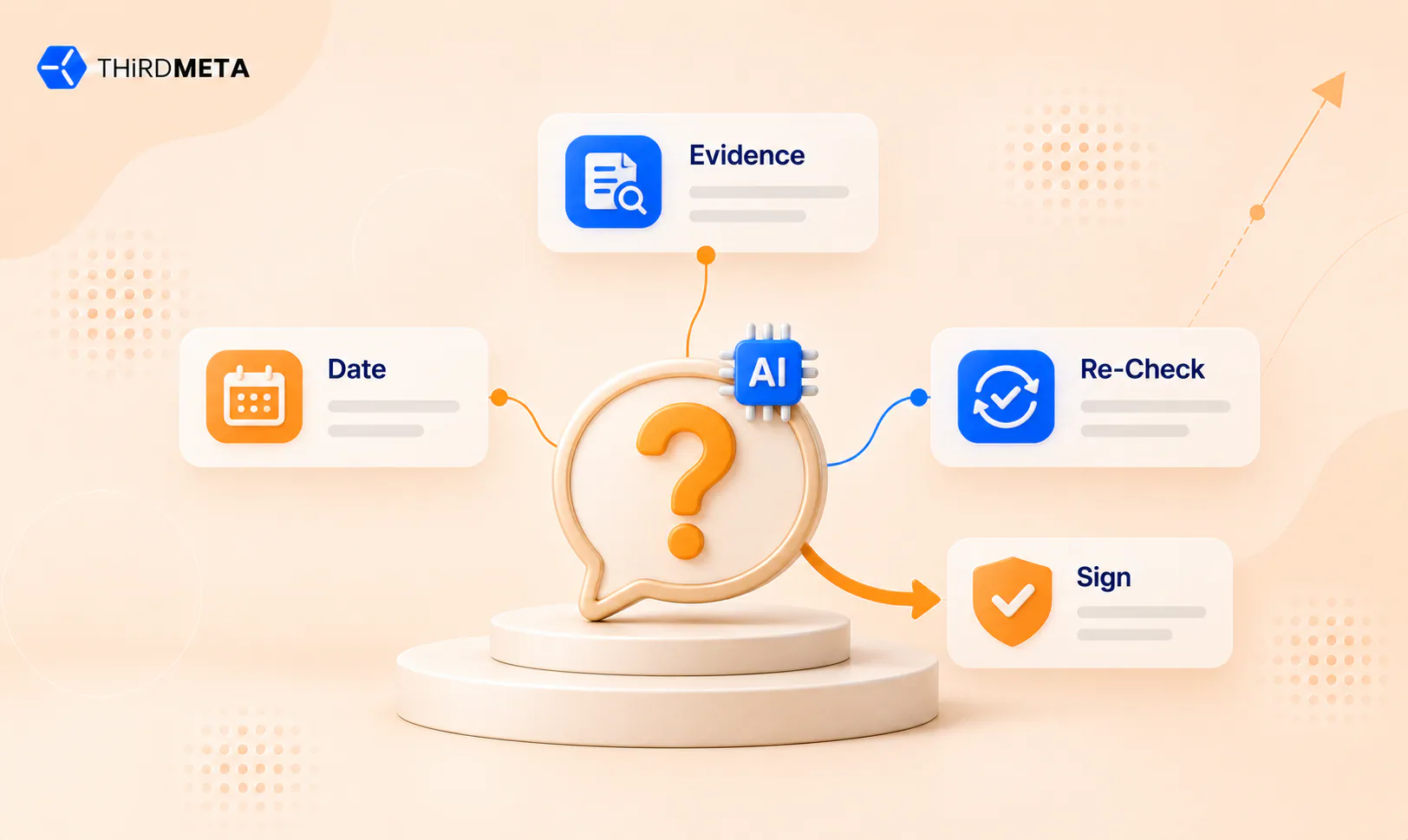
Quick Answer: The questions to ask an SEO agency about AI are the ones whose answers arrive as artifacts you can open and re-run: a prompt list, a dated run log, a cited-source list and a CRM-linked report. Tool lists and case-study adjectives fail that test.
Key points covered in this article:
Ask only questions that return an artifact
Tool lists show spend, not results
The Re-Run Test takes about 20 minutes
Contracts should name what you keep
The questions to ask an SEO agency about AI are the ones that return something you can open, date and repeat yourself. An answer such as "we use the latest AI tools" returns nothing you can check.
A CMO at a Series B SaaS company holds three proposals that all promise AI search optimisation. The head of growth cannot tell which agency has run it on a real client. The CFO wants evidence before approving a six-month retainer.
Forrester's 2026 B2B Brand and Communications Survey found that the share of marketers expecting higher agency budgets fell 13 points in a year, while more than half call AI readiness an important selection criterion and few are satisfied with delivery. Our guide to asking a B2B SEO agency for proof covers attribution claims; this one covers the AI-specific claims.
TL;DR
Ask an SEO agency about AI only through questions whose answers are artifacts you can open.
A tool list shows what an agency buys, not what it has changed for a client.
The Re-Run Test lets a CMO check five past prompts on the call.
Run counts and dates matter more than any single screenshot of a citation.
Contracts should name the prompt set, the cadence and what you keep on exit.
Fit depends on your team: a tool may serve a team with a strong in-house owner.
What Makes a Question About AI Worth Asking an SEO Agency?
A question is worth asking when its answer is an artifact: something dated, openable and repeatable by you. "Which prompts do you track?" passes. "How do you approach AI search?" does not.
Three properties separate the two kinds:
Openable: a file, a log or a report, not a promise on a call.
Dated: it shows when the work was done and when it was measured.
Repeatable: you can run part of it yourself and compare.
Questions that pass these tests are harder for an agency to answer well, which is the point.
Our guide to checking whether ChatGPT recommends your SaaS shows what a prompt set and run log look like. A weak answer costs you a conversation. A weak answer after signing costs you a quarter.
Is "Which AI Tools Do You Use?" the Right Question to Ask an SEO Agency?
No. A tool list shows what an agency pays for, and most buyers can buy the same tools in an afternoon. The Forrester survey above points the same way: marketers are adopting AI themselves, so a tool list adds nothing they lack.
"An agency's AI tool list shows what it buys; a re-runnable prompt log shows what it has actually done."
What we see across our B2B SaaS work: buyers ask about tools and rarely ask who keeps the prompt library when the contract ends. The second question decides how much of the work you can carry in-house later, as our comparison of in-house GEO and agency explains.
As of 2026, the better first question is outcome-shaped: what changed in a client's AI answers after the work, and on what dates? That question has an answer in a log, or it has no answer.
You are comparing proposals that all list the same tools. |
How Do You Check an Agency's AI Claims Yourself? Run the Re-Run Test
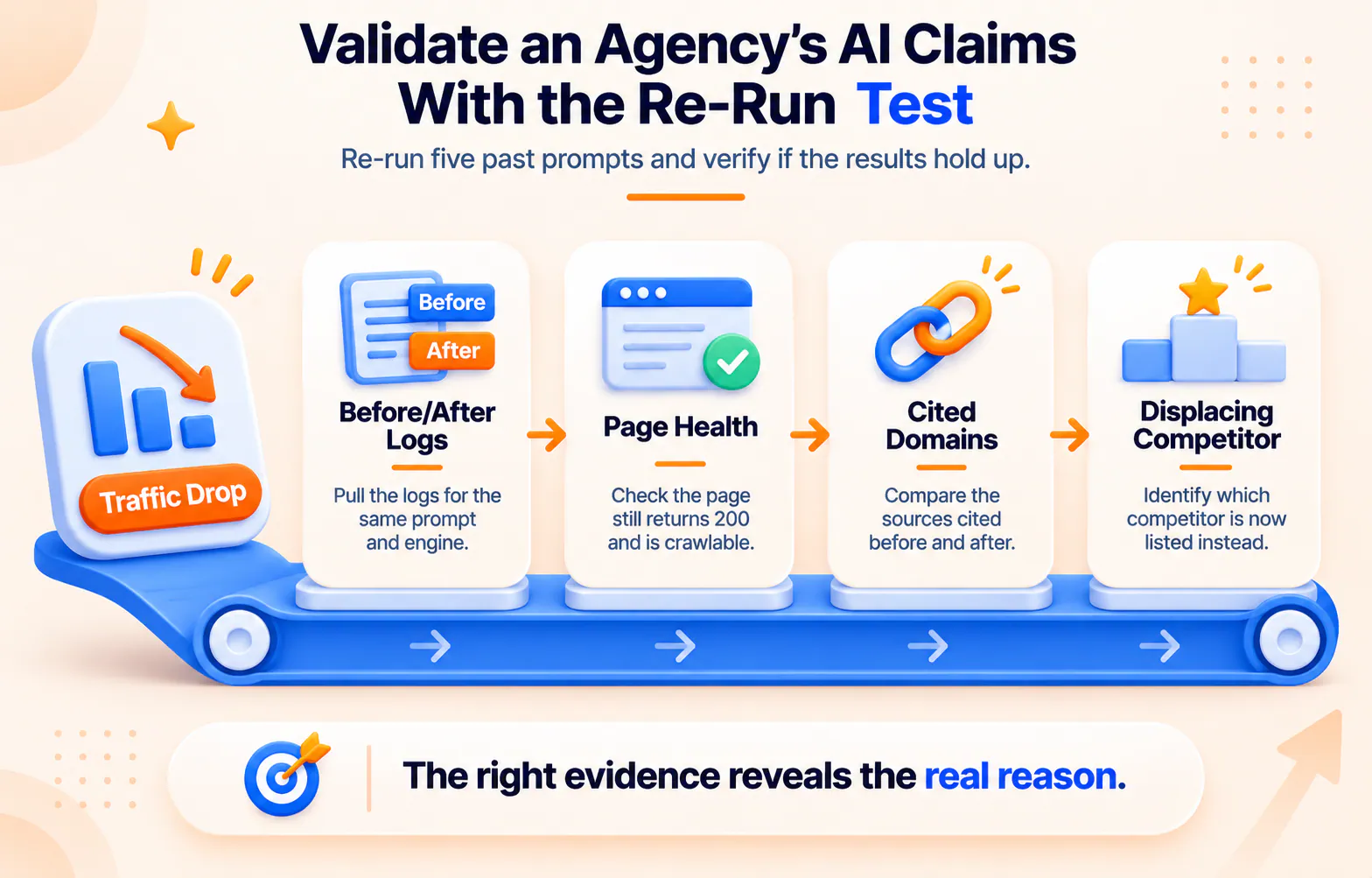
The Re-Run Test asks an agency for five prompts it tracked for a past client, then has you run them yourself on the call. It takes about 20 minutes and needs no AI tool beyond a logged-out ChatGPT or Perplexity session. It checks whether the agency's reported result can be reproduced by someone with no stake in it.
Run it in four steps:
Ask for five prompts tracked for a past client, with the dates and the named rate the agency reported. An anonymised category is fine.
Run each prompt five times in a fresh, logged-out session on one engine.
Compare your named rate and cited domains with theirs. Small gaps are expected, because answers vary run to run.
Ask what changed between the two dates, and which change the agency thinks moved the answer.
A worked example, illustrative rather than a client result. An agency reports a brand moving from 1 of 5 to 4 of 5 on "best expense software for mid-market finance teams". You run it five times and see 3 of 5, with the same two review sites cited that the report listed.
That is a reproduction. If you saw 0 of 5 with entirely different sources, the report needs an explanation.
The test has limits. A client under NDA may rule out real prompts, so accept an anonymised category or the agency's own site. An agency that refuses every version is telling you something.
Which Seven Questions Should You Ask, and What Proof Should Come Back?
Seven questions cover the work an AI search engagement actually contains. Each is paired with the artifact that should come back and the answer that should worry you.
Question | Artifact to ask for | Red flag |
1. Which prompts do you track, and how are they chosen? | Prompt list tied to buyer roles and sales calls | Prompts invented by a tool, or all branded |
2. How many runs per prompt, on which engines, on which dates? | Dated run log | One screenshot |
3. How do you tell noise from change? | A written rule | "AI is volatile," with no rule |
4. Which sources cite us, and which should? | Cited-domain list with ranked gaps | A rankings report only |
5. Who does the work, and what do tools do versus people? | Named roles; tool list with each tool's function | The tool list as the whole answer |
6. How will this connect to demo requests? | CRM field or form change plan | Mentions as the only KPI |
7. What do I keep if I leave? | Prompt library, logs, baseline | Data locked in the agency's platform |
Question 4 deserves attention because sources shape shortlists. G2's 2026 Buyer Behavior Report found that review sites at 38% overtook AI chatbots at 37% as the top source shaping software shortlists, so an agency that ignores third-party profiles is missing half the picture.
Our guide to where AI engines find B2B SaaS brands shows how a cited-source list is built, and the GEO and AEO services guide explains what the work contains.
Why Does Run-to-Run Variance Make Agency Reports Hard to Trust?
AI answers change between runs, so a report built on one screenshot proves little. AirOps's State of AI Search report found that only 30% of brands stay visible from one AI answer to the next, and about 20% across five consecutive runs. A citation that appeared once may not appear again.
Compare two ways an agency might report the same quarter:
Report A: a screenshot of one answer that names the brand, dated once.
Report B: 12 prompts, five runs each, two dates, named rate 1 of 5 in month one and 4 of 5 in month three.
Report B can be checked, repeated and argued with. Report A cannot. If the agency's report looks like A, ask for the underlying runs before you accept the claim.
This also explains why price ranges for AI search work vary so widely. Our post on what a GEO agency costs per month explains cost by function, and run counts and reporting depth are part of that.
What Should an AI Search Contract Say About Scope, Reporting and Exit?
A contract should name what is measured, how often and what you keep, because AI search work is easy to describe vaguely. Five terms close most of the gaps:
Scope: the named prompt set and the engines covered, not "AI visibility."
Cadence: how many runs per prompt, how often, reported when.
Targets: targets agreed in writing and reported monthly. An agency that guarantees citations is promising what nobody controls.
Ownership: you own the prompt library, the logs and the baseline.
Exit: on leaving, the agency hands over all of the above in a usable format.
Teams that can hire in-house may prefer to keep part of this work internally. Write the handover terms so that choice stays open.
Why Should You Choose ThirdMeta?
ThirdMeta answers the seven questions with artifacts: a citation-gap read before any scope is quoted, a prompt set and run log you keep, and reporting tied to demo requests in your CRM.
A prompt list built from your sales calls and lost deals.
Dated run logs with five runs per prompt.
A ranked gap list, not a dashboard.
Named people on the work.
90-day proof sprints with KPIs tied to your CRM.
We are not the right fit if you want a dashboard and an in-house owner already exists; a tool is cheaper for that team.
Tool-only vendors: track mentions; they do not change which sources name you.
Generalist SEO retainers: report rankings, which can stay flat while AI mentions fall.
See our case studies, or run the Re-Run Test on us: book a call and bring five prompts.
Conclusion
The best questions to ask an SEO agency about AI return artifacts: prompts, run logs, cited sources and a CRM-linked report. The Re-Run Test turns those artifacts into a 20-minute check you control.
A buyer who asks these seven questions comes out of the call knowing what the agency has done, what you will keep and how to leave. For a wider view of providers, see our list of the best AEO and GEO agencies for B2B SaaS.
Frequently Asked Questions
Ask which prompts they track, how many runs and dates, and how they separate noise. Ask for the cited-source list. Ask what you keep on exit. Each answer should arrive as an artifact.

Sr. Content Writer
Vamshi Vadali is Third Meta's Content Team Head and the guy who banned fluff from all blog posts. He specializes in SEO, GEO (Generative Engine Optimization), and AEO (Answer Engine Optimization): the trifecta that gets B2B SaaS content ranking in both Google and ChatGPT. Vamshi doesn't write content. He engineers MQL machines. His philosophy? Good writing needs data and clarity, not buzzwords. He writes like a CFO reads: straight to the outcomes. When he's not optimizing for AI Overviews, he's debating whether LLMs prefer Oxford commas.