

SaaS SEO budgets grew 7.2% in 2025, according to research by Gripped and SeoProfy even as organic click-through rates declined and AI Overviews began absorbing a larger share of search results. The channel is still getting more investment.
The question most B2B SaaS teams are getting wrong is how to size that investment for their specific business, not for a benchmark average built from companies with entirely different unit economics.
This guide is written for CMOs, Growth Leads, and VP Marketing at B2B SaaS companies between $1M and $50M ARR who are either setting an SEO budget for the first time or reassessing a programme that is not producing attributable pipeline.
For context on how SEO connects to your broader content programme, see our guide to B2B SaaS content marketing strategy.
Key Takeaways
- SEO delivers 702% ROI for B2B SaaS, but breaks even at seven months. Budget against that timeline, not a 90-day expectation.
- Size benchmarks are the wrong input. ACV, LTV, and CAC determine the right number not headcount.
- AEO is a 2026 budget line item, not a bonus. AI Overviews appear in 31% of queries. Either optimise for citation or accept declining organic returns.
- Allocation matters as much as total spend. Content (30–50%), links (20-30%), technical SEO (15–25%), tools (10-20%) split to your actual constraint.
- Measuring at month three will always look like failure. The break-even is month seven.
What Is a SaaS SEO Budget?
A SaaS SEO budget is a documented allocation of marketing spend across the activities that produce organic search visibility, qualified traffic, and demo-ready leads. It is different from a content calendar spend or a general digital marketing line.
A working SaaS SEO budget connects every pound or dollar allocated to a specific programme output: keyword rankings that match your ICP’s search vocabulary, domain authority that closes the gap on category competitors, and technical foundations that prevent your content from being indexed poorly.
For a VP Marketing at a B2B SaaS company in a competitive category ITSM, IDP, CRM, visitor management the SEO budget is not a brand investment. It is a pipeline investment.
The three questions it must answer are: which buyer types are we trying to reach through organic search, what commercial action do we want them to take, and what does it cost to produce and sustain the visibility that drives that action?
What SaaS SEO Actually Costs in 2026
The ranges are real, even if they are wide.
Small and early-stage B2B SaaS companies typically spend $500-$3,000 per month. That covers foundational keyword research, on-page optimisation, and basic content production. Mid-market companies 50 to 500 employees, targeting multiple buyer personas generally run $5,000–$15,000 per month.
That budget spans content velocity, competitor gap analysis, technical audits, and link building. Enterprise SaaS operations investing in programmatic content, international targeting, and in-depth analytics routinely spend $11,500–$21,500 per month or more.
Organic search currently drives approximately 53% of total SaaS website visits, making it the single largest traffic source ahead of paid, referral, and social combined. That number explains sustained budget growth. It does not tell you what your specific budget should be.
What a SaaS SEO Budget Actually Covers
Before sizing the total, it helps to understand what the budget is buying.
Content creation absorbs the largest share typically 30–50% of total SEO spend. This covers blog posts, pillar pages, comparison content, and ICP-specific case studies. Standard blog production runs $150–$600 per post; in-depth guides and pillar pages start at $300 and scale with scope.
Content quality determines whether a page compounds in rankings over 18 months or sits on page two indefinitely. Treating it as a commodity line is the fastest way to produce a content programme with impressive publish velocity and no pipeline contribution.
Link building and digital PR typically takes 20–30% of the budget. For B2B SaaS competing in crowded categories, domain authority gaps are often the primary reason a well-optimised page underperforms. Guest placements, editorial outreach, and partnership content are the mechanisms. None of them are fast. All of them compound.
ThirdMeta’s SaaS link building service is built specifically for B2B SaaS companies in competitive verticals where authority-building is the actual ranking constraint.
Technical SEO warrants 15–25%. Site speed, structured data, crawlability, and Core Web Vitals don’t generate content but they determine whether the content you’re producing gets indexed and ranked efficiently.
Companies that deprioritise technical work typically discover the problem when a content programme six months in has produced strong content and no ranking movement.
Tools and analytics account for the remaining 10–20%. Ahrefs or Semrush for keyword and competitor intelligence, Google Search Console and GA4 for performance tracking, and in 2026, tools that track AI Overview citations and AEO performance.
The Benchmark Problem: Why Company Size Is the Wrong Starting Point
Here is the standard advice: B2B SaaS companies should allocate 20–30% of their total marketing budget to SEO, which itself sits at roughly 8% of ARR the median from SaaS Capital’s 2025 survey of 700+ private B2B SaaS companies. Run those numbers and you get a tidy figure.
The problem is that those benchmarks blend companies with fundamentally different economics. A SaaS product priced at $99 per month and a B2B platform with a $50,000 annual contract value are not the same SEO exercise.
The enterprise platform has a longer sales cycle, higher customer lifetime value, more competitive SERPs, and buyers who run independent research for weeks before engaging sales. Organic search generates 44.6% of all B2B revenue but that figure means something different depending on what your buyer’s research journey actually looks like.
The companies that get SaaS SEO budgets right don’t start with size. They start with three numbers: average contract value (ACV), customer lifetime value (LTV), and target customer acquisition cost (CAC).
David Skok, whose SaaS metrics work at For Entrepreneurs has shaped how a generation of B2B operators think about unit economics, has argued consistently that the LTV:CAC ratio ideally 3:1 or better should govern all marketing investment decisions, not percentage-of-revenue heuristics that flatten this distinction.
If your ACV is $1,200 and your LTV is $3,600, a $3,000/month SEO budget producing a handful of closed deals per quarter looks very different from a business where ACV is $48,000 and LTV is $192,000. In the second case, a single closed deal from organic justifies months of spend. The benchmark approach doesn’t capture this at all.
An honest note: SEO is not the right primary channel if your business needs revenue in the next 90 days. First Page Sage’s 2026 data puts B2B SaaS SEO break-even at seven months. That is a genuine constraint. If you are pre-product-market-fit or facing a runway pressure, paid search and outbound will produce faster pipeline. SEO is a compounding asset plan the budget against that timeline or don’t use it as a performance justification tool.
The 2026 Budget Line Most SaaS SEO Plans Are Missing
In 2026, Google AI Overviews appear in 31% of all search results. When an AI Overview is present, organic click-through rates drop to approximately 8%, compared to 15% for standard results. Position-one CTR has declined from 28% to 19% year-over-year.
This is not a crisis it is a recalibration. And it changes what a SaaS SEO budget needs to include.
Companies that earn citations inside AI Overviews receive 35% more organic clicks and 91% more paid clicks than those that don’t appear. AEO-optimised content structured for answer engine citation rather than pure keyword ranking shows 3x higher citation rates.
That means passage-extractable writing, named entities, question-first H2 structure, FAQ schema, and the kind of authority signals that make Google’s AI engine trust a source enough to surface it directly. ThirdMeta’s AIO and GEO services are built specifically around this layer of visibility.
For a B2B SaaS SEO budget in 2026, AEO is not an experimental add-on. It is a core line item.
How to Calculate Your SaaS SEO Budget: Three Methods
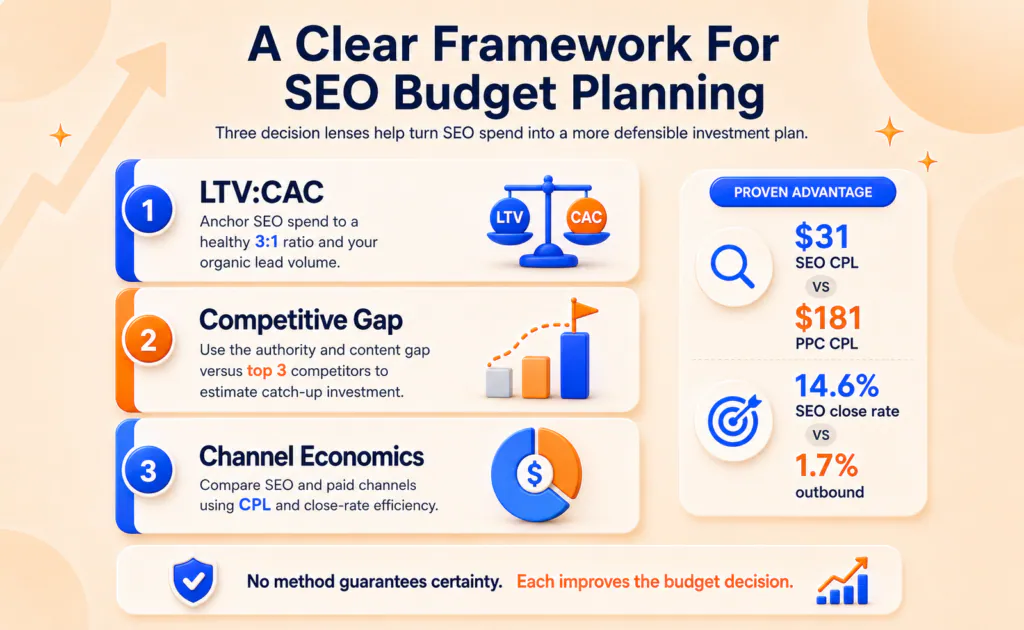
Method 1 – LTV-based. Establish your target LTV:CAC ratio (3:1 is standard for healthy SaaS growth). Determine your SEO-specific CAC target based on the volume of leads organic search currently generates or is projected to generate. Set the budget at a level that keeps projected SEO CAC within that target. Adjust quarterly as data accumulates.
Method 2 – Competitive gap analysis. Pull the domain authority and content volume of the top three organic competitors for your primary keywords. The gap between your current position and theirs represents the investment required to close it within a defined timeframe. This method produces a resource estimate tied to a specific competitive outcome rather than an abstract percentage.
Method 3 – Channel comparison. Research by SeoProfy puts SEO’s average cost-per-lead at $31 versus approximately $181 for PPC an 84% cost advantage. SEO leads also close at 14.6% versus outbound’s 1.7% (SmartBug Media, 2026).
If your paid search is generating leads at $150–$200 each, a well-executed SEO programme at $40–$60 per lead is a straightforward budget allocation argument.
None of these methods produce certainty. All of them produce better decisions than “companies our size spend X.”
Mistakes That Inflate SaaS SEO Budgets Without Producing Results
Spreading budget evenly without diagnosing the constraint. A technically sound site with thin content needs content investment, not another audit. A content-rich site with poor domain authority needs link building, not more articles. The budget allocation should reflect where your programme is actually stuck, not a default split.
Treating tools as the programme. Ahrefs, Semrush, and Surfer are instruments. The programme is the strategy and execution those tools inform. Overinvesting in software subscriptions while underinvesting in production and outreach is a common mistake in early-stage SaaS marketing teams.
Ignoring the content refresh cycle. SaaS blogs that update existing posts quarterly grow organic traffic 27% faster than those that publish only new content. A budget allocated entirely to new content while neglecting existing pages leaves compounding ranking potential on the table.
Measuring too early. A programme evaluated at month three against a seven-month break-even benchmark will always appear to be failing. Build the measurement framework to match the investment horizon, and set that expectation with stakeholders before the first post goes live.
Why Should You Choose ThirdMeta for SaaS SEO?
Most SaaS SEO programmes stall at the traffic phase because they are built around publishing schedules, not pipeline accountability. ThirdMeta’s SEO programmes are built around a single output: qualified demos and attributable pipeline.
What ThirdMeta delivers for B2B SaaS SEO:
- ICP-mapped keyword research tied to your buyer’s actual search vocabulary, not category-level volume
- Stage-specific content covering awareness through evaluation, not just top-of-funnel blogs
- Attribution setup in GSC and HubSpot or Salesforce so every content piece is accountable to pipeline signals
- AIO and GEO optimisation built into every piece published in 2026 not a separate add-on
- Link building and domain authority programmes for B2B SaaS companies in IDP, HRMS, CRM/FSM, visitor management, and compliance software verticals
ThirdMeta currently runs SEO programmes for B2B SaaS companies where buying committees are multi-stakeholder and organic content has to do real persuasion work across a 60–180 day sales cycle. There is no generic playbook here.
If your SEO programme has been running for six months or more and is not generating attributed demos, a strategy review is the right starting point not more content. Book a review call with ThirdMeta and we will audit what is working and what is not.
Conclusion
A SaaS SEO budget is only as useful as the pipeline it is sized to generate. Getting that right requires starting from your unit economics ACV, LTV, CAC not from what companies your size are spending. It requires allocating across content, links, technical SEO, and AEO in proportion to your actual constraint, not a default formula.
And it requires building a measurement framework that matches the seven-month break-even reality of the channel, not a 90-day reporting cycle.
The B2B SaaS teams doing this well in 2026 are treating organic search as a demand generation channel with the same accountability structure as paid acquisition: named ICP targets, attributed pipeline tracking, and quarterly reviews where the conversation is about closed revenue contribution, not session counts.
If you want to build an SEO programme that operates at that level, start here.
FAQs
Small B2B SaaS: $1,500–$3,000/month. Mid-market: $5,000–$15,000/month. Enterprise: $11,500–$21,500+. The right number comes from ACV, LTV, and CAC not headcount.
20–30% of total marketing spend is the standard benchmark. High-ACV companies with long sales cycles often need more. Early-stage companies with tight runway often need less.
Seven months to break-even, 702% average ROI over the campaign lifetime (First Page Sage, 2026). Results vary by competitive intensity and domain authority at the start.
For long-term pipeline: yes. SEO costs $31 per lead vs $181 for PPC, and closes at 14.6% vs 1.7% for outbound. For pipeline needed inside 90 days: paid search is faster. Most mature programmes run both.
Content (30–50%), link building (20–30%), technical SEO (15–25%), tools and analytics (10–15%), and in 2026, a dedicated AEO/GEO allocation.

Sr. Content Writer
Vamshi Vadali is Third Meta's Content Team Head and the guy who banned fluff from all blog posts. He specializes in SEO, GEO (Generative Engine Optimization), and AEO (Answer Engine Optimization): the trifecta that gets B2B SaaS content ranking in both Google and ChatGPT. Vamshi doesn't write content. He engineers MQL machines. His philosophy? Good writing needs data and clarity, not buzzwords. He writes like a CFO reads: straight to the outcomes. When he's not optimizing for AI Overviews, he's debating whether LLMs prefer Oxford commas.