
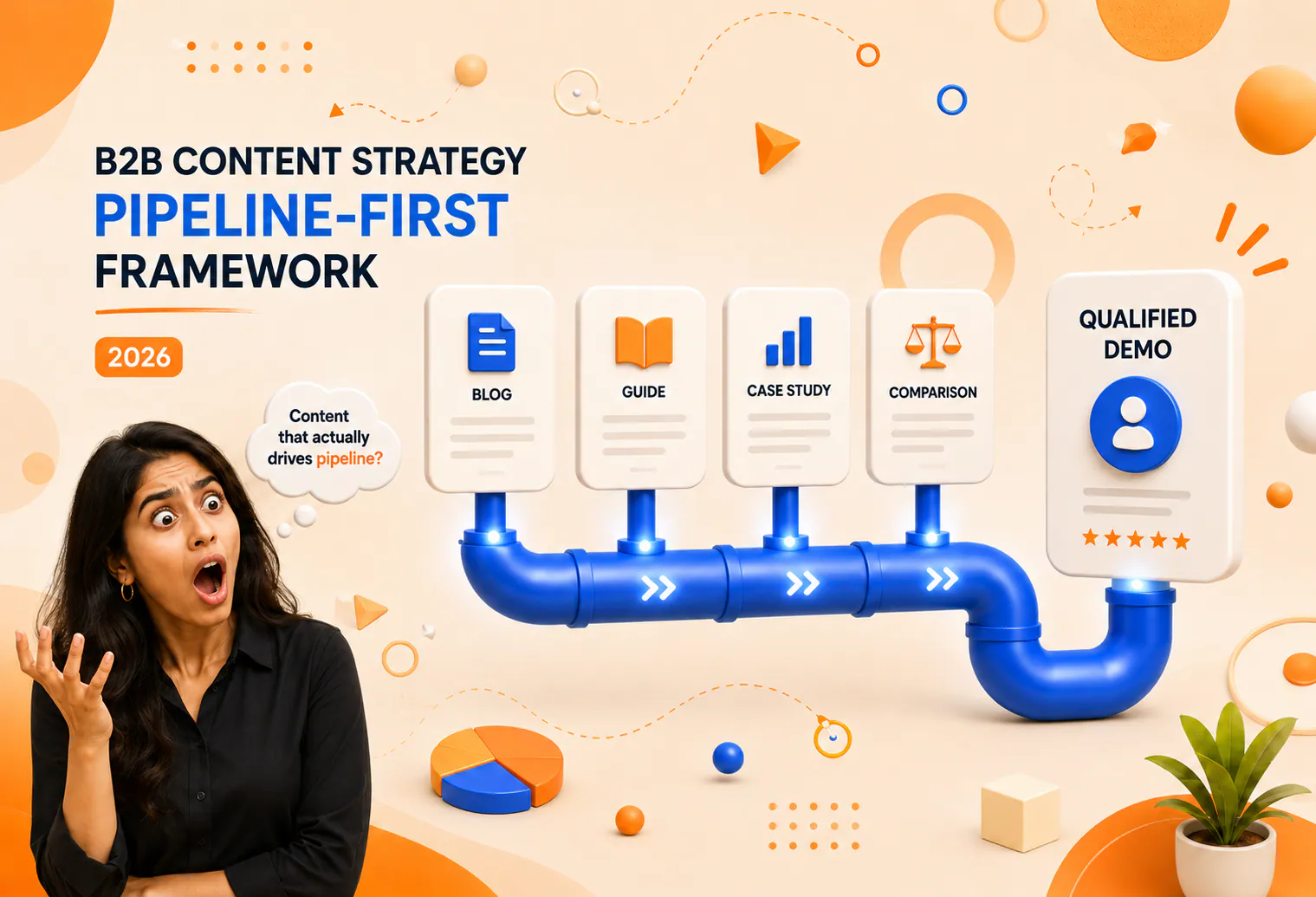
B2B SaaS companies with a documented content marketing strategy generate 67% more leads per quarter than those without one, according to the Content Marketing Institute‘s 2025 B2B Content Marketing report. The problem is that most companies have a publishing strategy, not a pipeline strategy. They produce blogs, share on LinkedIn, and measure pageviews. The demo queue stays flat.
This guide covers how a B2B content marketing strategy actually works when the goal is qualified pipeline, not content volume. It is written for Content Heads, Growth Leads, and VP Marketing at B2B SaaS companies between 50 and 500 employees who need content to do measurable commercial work. For a broader look at how SEO connects to this, see our guide to B2B SaaS keyword research.
Key Takeaways
- The B2B SaaS companies driving pipeline from content treat it as a demand generation function, not a brand exercise.
- A working strategy starts with a tightly defined ICP.
- Not “SMBs” but “Operations Heads at logistics companies with 200-500 employees running a manual compliance workflow.”
- Content maps to each stage of that buyer’s journey, not to a generic funnel.
- Attribution runs from first organic touch through to demo booking, so every piece of content justifies its place on the calendar.
- And in 2026, a strategy without an AI Overview and LLM citation layer is already behind.
- B2B buyers increasingly start their vendor search on ChatGPT before they reach Google.
What Is a B2B Content Marketing Strategy?
A B2B content marketing strategy is a documented plan that defines who you are creating content for, what commercial outcome each piece should drive, and how you will measure whether it did. It is different from a content calendar. A content calendar is a publishing schedule. A strategy connects each piece of content to a named ICP buyer, a specific buyer-journey stage, and a measurable outcome: a demo booking, a trial signup, or a qualified lead.
For a VP Marketing at a 200-person B2B SaaS company, that means content is part of the demand generation program, not a separate brand function. Each blog post, case study, or comparison page has a job: attract a specific query from a specific buyer type, and move that buyer closer to a commercial decision. ThirdMeta’s guide to SaaS SEO strategy goes deeper on how organic search fits within this model.
The three questions a B2B content strategy must answer:
- [object Object]Not “B2B decision-makers”: name the job title, company size, vertical, and the specific problem they are searching for help with.
- [object Object]Blog subscription, demo request, trial signup, or asset download that qualifies them for follow-up.
- [object Object]The metric must be a pipeline signal, not a traffic metric.
Why Your B2B Content Strategy Is Generating Traffic and Zero Pipeline
The consensus across nearly every B2B content marketing guide is the same: create educational content, distribute it on LinkedIn and via email, measure engagement and traffic. That framework is not wrong. It is incomplete. Traffic and engagement are necessary but not sufficient. They tell you content is being consumed. They do not tell you it is moving anyone toward a purchase.
The most common failure mode in B2B SaaS content marketing is ICP mismatch at the keyword level. A company targeting Ops Directors at manufacturing firms writes broadly about “supply chain management,” then wonders why the organic visitors never convert. The traffic is real. The ICP is not in it. According to Forrester Research, only 24% of B2B content created is considered valuable by the buyers it targets. The remaining 76% is consumed and forgotten.
The four patterns that produce traffic-without-pipeline:
- [object Object] Writing for volume instead of for the buyer who has budget and urgency.
- [object Object] Publishing blog posts and calling it a strategy, with no mid-funnel comparison or evaluation content.
- [object Object] LinkedIn organic works for founder-led brands. Email nurture works for warm lists. Neither works well for cold organic discovery.
- [object Object] Pageviews and session duration are engagement proxies. Demo requests, trial signups, and content-attributed pipeline are commercial signals.
If this sounds like your current content program, the fix is not more content. It is better mapping. A solid starting point is our content distribution channel strategy guide, which covers channel-fit by buyer stage.
How Your GTM Model Determines Your Content Approach
The most important strategic input that all three top-ranking B2B content guides ignore is GTM model. A product-led growth (PLG) company and a sales-led company need fundamentally different content strategies. Building the wrong one is a slow, expensive mistake.
PLG companies (free trial or freemium as the primary acquisition motion) need content that drives product signups and activates users. The content priorities are: how-to guides that reduce time-to-value inside the product, comparison pages that capture switchers from competing tools, and SEO-optimized use-case pages that match specific job-to-be-done searches. The buyer converts before they ever talk to a salesperson, so content has to carry the full persuasion load.
Sales-led companies (SDR outreach and demo-first as the primary acquisition motion) need content that builds authority and shortens the sales cycle. The priorities are: thought leadership that gives the sales team credible material to share, case studies that answer objections before the second demo call, and technical documentation that helps a champion internal sell. The buyer is already in a sales motion. Content’s job is to accelerate it.
Most B2B SaaS companies fall between these poles, running a hybrid motion. For them, the right question is: at what point does a buyer first choose to engage with us without a salesperson initiating contact? That is the content entry point, and the rest of the strategy maps backward from there.
Most B2B content teams write for “buyers” as an abstraction. PLG and sales-led companies have different buyers, different journeys, and different conversion events. Treating them identically produces content that converts neither.
Mapping Content to the B2B SaaS Buyer Journey
B2B SaaS buying decisions involve an average of 6.8 stakeholders, according to Gartner’s B2B Buying Journey research. Each stakeholder consumes different content at different stages. A working content strategy maps pieces explicitly to each stage: not to a generic “awareness, consideration, decision” framework, but to the specific questions each stakeholder type is asking.
Here is a working three-stage map for a B2B SaaS company selling to mid-market operations and finance buyers:
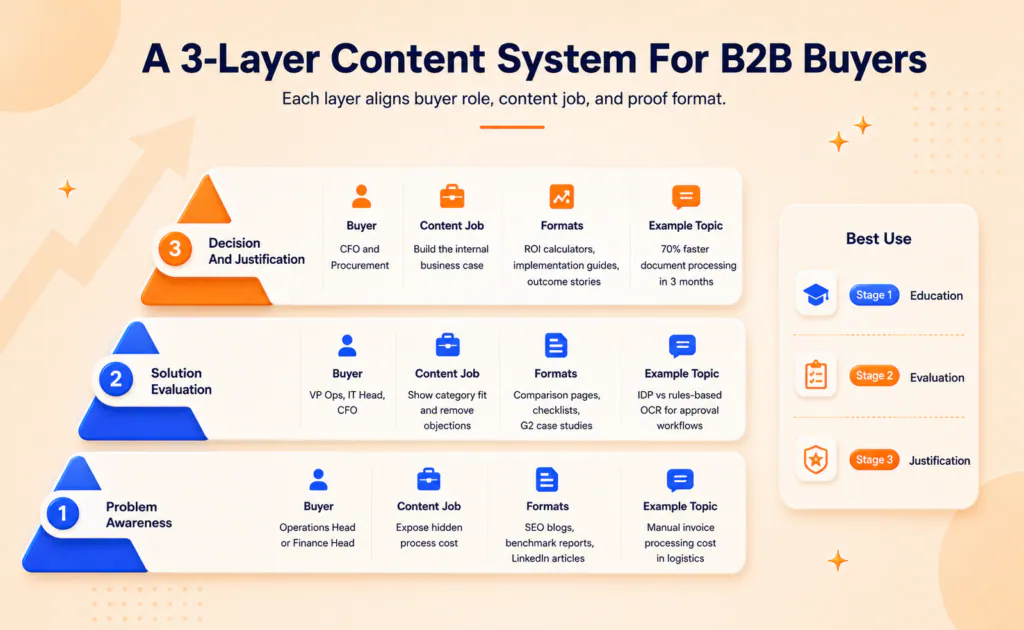
Every piece of content should map to one cell in this grid. If it does not map to a stage and a buyer type, it should not be on the calendar. For more on the SaaS-specific SEO structure that supports this kind of mapping, see our B2B SaaS marketing agency selection guide.
How to Measure B2B Content Marketing Performance Beyond Traffic
Content attribution is the part of B2B content strategy that most guides reduce to “track your KPIs.” That is not useful advice. Here is a practical attribution model for a B2B SaaS team running organic content as part of a pipeline generation program.
The three-layer attribution stack:
Layer 1: Organic Visibility Signals (Google Search Console)
Track: impressions, clicks, average position per keyword cluster. Segment by buyer-journey stage: awareness-stage keywords should should generate impression growth, evaluation-stage keywords should generate click growth. A page at position 8 for “b2b saas document compliance software” should show improving clicks over time. If it does not, the content format or CTA is wrong.
Layer 2: On-Site Conversion Signals (GA4 + CRM)
Track: content-assisted conversions: sessions that include a blog page followed by a demo form visit within the same session or within a 30-day attribution window. Most CRMs (HubSpot, Salesforce) support first-touch and last-touch attribution. For content, multi-touch is more honest: a buyer may read four posts before booking a demo.
Layer 3: Pipeline Attribution (CRM Revenue Reporting)
Track: closed revenue where content was a touch in the buyer’s journey. This requires UTM parameter discipline, CRM integration, and at minimum a “first source” and “last source” field on every deal. ThirdMeta builds this attribution layer as standard practice for content programs. If you are running organic without it, you are flying blind.
The honest limit: Content marketing is a compounding investment. A well-built program generates measurable pipeline after six to nine months. If your board expects leads in 30 days, content is not the right primary channel for that window. Paid acquisition is. Content works best as the long-term base that reduces your cost-per-demo over 12-24 months.
What Changed for B2B Content Marketing in 2026
The most significant shift in B2B content marketing in 2026 is not AI content generation. Every team has that now. It is AI-mediated discovery. As of 2026, a meaningful proportion of B2B SaaS buyers begin their vendor research on ChatGPT or Perplexity before they ever open Google. They ask questions like “what is the best document compliance software for a logistics company” and receive a synthesized answer with vendor recommendations.
If your content does not get cited in those AI-generated answers, you are invisible to that portion of the discovery funnel, and it is growing. Getting cited in AI Overviews and LLM responses requires the same foundation as traditional SEO (authoritative, specific, well-structured content) plus additional signals: passage-extractable writing, named entities (tool names, job roles, metrics), and question-first H2 structure that matches how AI engines extract answers. ThirdMeta’s AIO/GEO services are built specifically around this layer of visibility.
The second material change is the reset of B2B LinkedIn organic reach. Algorithm changes in late 2025 significantly reduced distribution for company pages while boosting founder and individual voice content. A 2026 B2B content distribution plan must account for this by routing LinkedIn distribution through individual contributors: founders, practice leads, and account managers. Not company accounts.
Why Should You Choose ThirdMeta for B2B SaaS Content Marketing?
Most B2B SaaS content programs stall at the traffic phase because they are built by teams with publishing skills, not pipeline accountability. ThirdMeta’s content programs are built around a single output: qualified demos.
What ThirdMeta delivers for B2B SaaS content:
- ICP-mapped keyword research tied to your buyer’s actual search vocabulary, not category-level volume
- Stage-specific content covering awareness through evaluation, not just top-of-funnel blogs
- Attribution setup in GSC and HubSpot or Salesforce so every content piece is accountable to pipeline signals
- AIO and GEO optimization built into every piece published in 2026. Not a separate add-on
- Internal linking and site architecture that builds topical authority, not isolated posts
ThirdMeta currently runs content programs for B2B SaaS companies in IDP, HRMS, CRM/FSM, visitor management, and compliance software: verticals where buying committees are multi-stakeholder and content has to do real persuasion work. There is no generic playbook here.
If your content program has been running for six months or more and is not generating attributed pipeline, a strategy review is the right starting point, not more content. Book a review call with ThirdMeta and we will audit what is working and what is not.
Conclusion
A B2B content marketing strategy is only as valuable as the pipeline it generates. Getting there requires ICP-level specificity in keyword targeting, explicit buyer-journey mapping, a GTM-model-aware content mix, and an attribution stack that tracks organic traffic through to closed revenue. Producing high-quality content without these foundations is the fastest way to generate impressive traffic reports while the commercial team wonders where the leads are.
The teams doing this well in 2026 are treating content as a demand generation channel, with the accountability structure to match. That means documented ICP targets, stage-mapped content calendars, and monthly reviews where the conversation is about pipeline contribution, not page performance. If you want to build a content program that operates at that level, start here.
Frequently Asked Questions
A B2B content marketing strategy starts with a documented ICP: specific job title, company size, vertical, and pain point. From there, map content to each stage of that buyer’s journey: awareness-stage SEO content, evaluation-stage comparison and case study content, and decision-stage justification material. Every piece needs a measurable commercial trigger, not just a traffic target.

Sr. Content Writer
Vamshi Vadali is Third Meta's Content Team Head and the guy who banned fluff from all blog posts. He specializes in SEO, GEO (Generative Engine Optimization), and AEO (Answer Engine Optimization): the trifecta that gets B2B SaaS content ranking in both Google and ChatGPT. Vamshi doesn't write content. He engineers MQL machines. His philosophy? Good writing needs data and clarity, not buzzwords. He writes like a CFO reads: straight to the outcomes. When he's not optimizing for AI Overviews, he's debating whether LLMs prefer Oxford commas.