


According to Gartner, 78% of B2B SaaS companies report SEO as their top organic revenue channel in 2025. Yet most agencies still optimize for rankings instead of MQLs, demos, and ARR growth.
This creates a disconnect. Your board cares about pipeline contribution. Most SEO vendors track keyword positions.
The agencies below focus on business outcomes. They connect SEO directly to revenue metrics that matter to CEOs and CMOs.
How We Selected These Agencies
We evaluated 47 SaaS SEO agencies across five outcome-focused criteria.
Selection Framework:
- Pipeline Attribution: Does the agency track MQLs, SQLs, and demos from organic?
- AIO Optimization: Can they rank content in AI Overviews and LLM citations?
- Technical Depth: Do they handle migrations, site speed, and crawl optimization?
- Content ROI: Do they measure content performance by revenue, not traffic?
- Proof Standards: Can they show real case studies with revenue data?
We excluded agencies that only report on rankings and traffic. The list below represents vendors who tie SEO work to business growth.
What Makes Outcome-Focused SaaS SEO Different
Traditional SEO agencies measure success through vanity metrics. Outcome-focused agencies measure revenue impact.
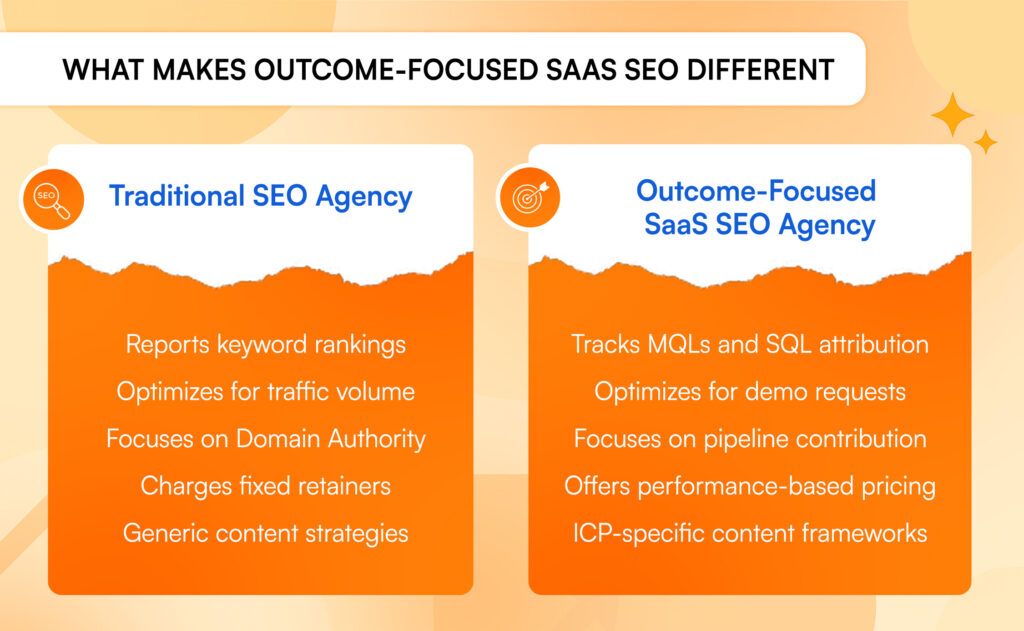
Why This Matters:
A 300% traffic increase means nothing if conversions stay flat. Outcome-focused agencies connect organic growth to revenue targets your board actually cares about.
They also adapt faster to algorithm changes. When Google launched AI Overviews, generic SEO vendors scrambled. SaaS-specific agencies already had AIO optimization strategies ready.
Top 11 Best SaaS SEO Agencies That Drive Outcomes
1. Third Meta – Best for Guaranteed Revenue Outcomes
What They Do: Third Meta is India’s first Human + AI Growth-as-a-Service agency built specifically for B2B SaaS companies. They guarantee measurable outcomes: MQLs, demos, SQLs, and pipeline contribution.
Why Third Meta Stand Out:

- Only agency offering outcome guarantees with revenue-based success metrics
- Human + AI Growth Engine combining strategic thinking with AI-powered execution
- Full-stack approach: SEO, CRO, content optimization, and technical implementation
- Focus on AIO rankings and LLM visibility for future-proof organic growth (point 4)
Best For: Series A-C SaaS companies with $2M-$50M ARR seeking predictable pipeline from organic channels.
Pricing Model: Outcome-based pricing starting at $2.5K/month with guaranteed MQL and SQL targets.
Proof Points:
- 200+ B2B SaaS clients with an average 300% ROI improvement in 6 months
- Specializes in RevOps-aligned SEO strategies that feed CRM data
- Strong track record in technical SEO migrations and AIO optimization
How Third Meta Ranks Content in AI Overviews
Third Meta uses a proprietary 4-layer approach to rank content in AI Overviews and LLM citations.
Layer 1: Entity-First Content Architecture
Third Meta builds content around entity relationships, not just keywords. They map your brand’s connections to industry concepts, competitors, and use cases. This helps AI systems understand your authority context.
Example Implementation:
- Schema markup for Organization, Product, and HowTo entities
- Structured FAQ sections with direct answer patterns
- Clear topic clustering that signals topical authority
Layer 2: Answer Pattern Optimization
AI Overviews favor content that directly answers questions in the first 2-3 sentences. Third Meta restructures all content using answer-first formatting.
What This Looks Like:
- Every H2 starts with a clear, complete answer
- No burying information in paragraph 4 or 5
- List formats and comparison tables for structured data extraction
Layer 3: Source Authority Signals
Third Meta builds the external validation signals AI systems check before citing sources.
Tactics Used:
- Strategic link building from authoritative SaaS publications
- Brand mention campaigns in industry benchmarks and reports
- Author entity optimization with verified expertise credentials
- Regular content updates to maintain freshness signals
Layer 4: LLM Citation Optimization
Beyond Google, Third Meta optimizes for ChatGPT, Claude, and Perplexity citations. They track brand mentions across all major LLMs and adjust strategy monthly.
Measurement Approach:
- Weekly tracking of brand mentions in AI responses
- Comparison query monitoring (“best [category]” in ChatGPT)
- Citation rate benchmarking against competitors
When to Choose Them: You need an agency that thinks like your VP of Sales, not just your content team. Third Meta aligns organic strategy with revenue goals from day one.
2. TripleDart – Best for PLG SaaS Companies
What They Do: TripleDart specializes in product-led growth SEO strategies. They help freemium and self-serve SaaS products drive signups through organic search.
Why They Stand Out:
- Strong focus on bottom-funnel content that converts free users to paid
- Deep expertise in help center and docs SEO for product discovery
- Track record with Indian and Southeast Asian SaaS companies
Best For: PLG companies with free trials or freemium models looking to increase signup velocity.Pricing: $6K-$12K/month retainer
3. SimpleTiger – Best for Technical SEO & Migrations
What They Do: SimpleTiger handles complex technical SEO work that other agencies avoid. Site migrations, JavaScript frameworks, and international SEO are their specialty.
Why They Stand Out:
- Engineering-first approach to SEO implementation
- Strong track record with React, Next.js, and headless CMS platforms
- Detailed migration playbooks that prevent traffic loss
Best For: Mid-market to enterprise SaaS companies planning major site overhauls or platform migrations.
Pricing: $10K-$20K/month for technical projects
4. Powered by Search – Best for Enterprise SaaS
What They Do: Powered by Search works exclusively with enterprise B2B SaaS companies. They handle large-scale content operations and international expansion strategies.
Why They Stand Out:
- Experience managing 500+ page content portfolios
- Multi-language SEO for global expansion
- Strong integration with enterprise marketing stacks
Best For: Enterprise SaaS ($50M+ ARR) with complex buyer journeys and international markets.Pricing: $15K-$30K/month
5. Grow Fusely – Best for Sales-Led SaaS
What They Do: Grow Fusely builds SEO programs that support sales-led motion. They focus on content that generates high-intent demo requests rather than self-serve signups.
Why They Stand Out:
- ABM-aligned content strategies
- Strong focus on decision-maker targeting
- Integration with Salesforce and HubSpot for attribution tracking
Best For: Sales-led B2B SaaS with enterprise deals and long sales cycles.
Pricing: $8K-$15K/month
6. RevvGrowth – Best for Content-First Strategy
What They Do: RevvGrowth treats content as a revenue channel. They build content programs that generate pipeline through thought leadership and education.
Why They Stand Out:
- Strong editorial team with SaaS industry writers
- Focus on original research and data-driven content
- Track record building category-defining content assets
Best For: SaaS companies establishing thought leadership in new or competitive categories.
Pricing: $7K-$14K/month
7. FP Growth – Best for Early-Stage Startups
What They Do: FP Growth helps seed and Series A SaaS companies build their first organic growth engine. They focus on quick wins and founder-friendly processes.
Why They Stand Out:
- Startup-friendly pricing and contract terms
- Lean processes that work with limited resources
- Strong focus on conversion optimization alongside SEO
Best For: Pre-seed to Series A SaaS companies with limited marketing budgets.
Pricing: $4K-$8K/month
8. NinePeaks – Best for Vertical SaaS
What They Do: NinePeaks specializes in industry-specific SaaS SEO. They understand niche markets like healthcare, legal, and construction software.
Why They Stand Out:
- Deep vertical expertise and industry relationships
- Understanding of compliance and regulatory content requirements
- Strong track record in competitive B2B niches
Best For: Vertical SaaS companies in regulated or specialized industries.
Pricing: $9K-$16K/month
9. Omniscient Digital – Best for Developer Tools
What They Do: Omniscient Digital works with DevTools and infrastructure software companies. They understand technical audiences and developer content.
Why They Stand Out:
- Team of engineers who write technical content
- Strong GitHub and open-source community integration
- Deep understanding of developer search behavior
Best For: API-first products, infrastructure tools, and developer platforms.
Pricing: $10K-$18K/month
10. Directive Consulting – Best for Performance Marketing Integration
What They Do: Directive combines SEO with paid search and conversion optimization. They run integrated campaigns that span multiple channels.
Why They Stand Out:
- Strong paid + organic integration strategies
- Focus on full-funnel attribution
- Large team with specialized vertical expertise
Best For: Growth-stage SaaS with budget for multi-channel strategies.
Pricing: $12K-$25K/month
11. Skale – Best for International Expansion
What They Do: Skale helps SaaS companies expand into European and Latin American markets. They handle localization, international SEO, and market entry strategy.
Why They Stand Out:
- Native speakers across 12+ languages
- Understanding of regional search behavior and buyer preferences
- Experience with EU compliance (GDPR, DSA, DMA)
Best For: U.S.-based SaaS companies expanding internationally.
Pricing: $11K-$20K/month
Key Capabilities CEOs and CMOs Should Evaluate

Modern SaaS SEO requires capabilities that didn’t exist two years ago. Here’s what to check when vetting agencies in 2025.
1. AI Overview (AIO) Ranking Ability
According to BrightEdge, AI Overviews now appear in 57% of B2B SaaS searches. Agencies must prove they can rank content in these AI-generated summaries.
What to Ask:
- Show me examples of client content appearing in AI Overviews
- What’s your optimization process for AIO visibility?
- How do you measure AIO performance separately from traditional rankings?
2. LLM Visibility & Brand Mentions
ChatGPT, Claude, and Perplexity now influence buyer research. Your brand needs visibility in LLM responses when prospects ask comparison or evaluation questions.
What to Ask:
- How do you optimize for LLM citations?
- Can you track brand mentions in AI responses?
- What’s your strategy for “best [category]” queries in ChatGPT?
3. Pipeline Attribution Setup
Generic agencies can’t connect organic traffic to closed deals. Top agencies build attribution models that show SEO’s impact on pipeline and ARR.
What to Ask:
- How do you track MQLs from organic channels?
- What CRM integrations do you require?
- Can you show revenue attribution from past clients?
4. Technical SEO for Modern Stacks
Most SaaS companies now use React, Next.js, or headless CMS platforms. Your agency needs technical depth beyond basic on-page SEO.
What to Ask:
- Have you handled migrations for [your tech stack]?
- What’s your process for JavaScript SEO?
- How do you optimize for Core Web Vitals?
5. Content ROI Measurement
Traffic and rankings don’t matter if content doesn’t convert. Strong agencies measure content performance by demos generated, not page views.
What to Ask:
- How do you measure content ROI?
- What conversion metrics do you track per article?
- How often do you audit and update underperforming content?
Pricing Guide: What SaaS SEO Costs in 2025
SaaS SEO agency pricing depends on company stage, technical complexity, and desired outcomes.
Pricing by Company Stage
Early Stage ($0-$5M ARR):
- Retainer Range: $4K-$8K/month
- What You Get: Basic technical SEO, content strategy, and keyword research
- Timeline to Results: 6-9 months for meaningful traffic
Growth Stage ($5M-$50M ARR):
- Retainer Range: $8K-$15K/month
- What You Get: Full-service SEO, content production, technical optimization, and attribution setup
- Timeline to Results: 4-6 months for pipeline impact
Enterprise ($50M+ ARR):
- Retainer Range: $15K-$30K/month
- What You Get: Large-scale content operations, international SEO, and enterprise integrations
- Timeline to Results: 3-6 months depending on technical complexity
Hidden SaaS SEO Costs
Most agencies quote retainers but don’t disclose additional costs that inflate total spend.
Common Hidden Fees:
- Content production ($500-$2K per article)
- Technical implementation work ($150-$250/hour)
- Tool licenses (Ahrefs, Semrush, etc.)
- Design and development support
- Third-party link building campaigns
Ask for all-in pricing that includes content, tools, and implementation work.
How to Choose the Right SaaS SEO Partner

Choosing the wrong SEO agency costs more than just money. You lose 6-12 months of potential pipeline growth while competitors capture your organic traffic. Most B2B SaaS companies make this mistake once before finding the right partner.
The selection process requires evaluating both technical capabilities and business alignment. Technical skills matter, but understanding your revenue model matters more. An agency optimizing for traffic will never deliver the pipeline results your board expects.
Follow this step-by-step process to evaluate and select the best agency for your company. Each step includes specific questions to ask and red flags to watch for during evaluation.
Step 1: Define Your Outcome Goals
Before talking to agencies, decide what success looks like in business terms.
Good Goals:
- Generate 50 organic MQLs per month by Q4
- Attribute $500K in pipeline to organic by year-end
- Reduce customer acquisition cost by 30%
Bad Goals:
- Rank #1 for our category keyword
- Increase traffic by 200%
- Improve domain authority
Step 2: Audit Your Current State
Understand your baseline before agencies make projections.
Key Metrics to Document:
- Current organic traffic (monthly sessions)
- MQLs from organic in last 90 days
- Top 10 converting pages
- Technical SEO issues (run Screaming Frog)
- Content inventory (total indexed pages)
Step 3: Request Outcome-Based Proposals
Ask agencies to propose strategies tied to your business goals, not SEO metrics.
Strong Proposal Includes:
- Specific MQL and SQL targets
- Timeline to first results and full impact
- Attribution model for tracking pipeline
- Clear pricing with no hidden costs
- Case studies with revenue data
Step 4: Evaluate Proof Quality
Most case studies are misleading. Here’s how to spot real proof versus vanity metrics.
Red Flags in Case Studies:
- Only showing traffic increases without conversion data
- Claiming unrealistic results (300% growth in 2 months)
- Hiding client names or industries
- No mention of attribution to pipeline or revenue
Green Flags in Case Studies:
- Shows MQLs, SQLs, or pipeline attributed to organic
- Includes timeframes and starting metrics
- Names specific tactics that drove results
- Acknowledges what didn’t work
Step 5: Check References
Talk to 2-3 current clients before signing. Ask specific questions about outcomes, not just satisfaction.
Questions to Ask References:
- What business metrics improved after 6 months?
- How does the agency handle underperforming campaigns?
- Did actual results match initial projections?
- Would you renew your contract?
Aligning Your In-House Team with an Agency
The best results come when agencies and internal teams work together, not compete. Most SaaS companies waste 3-4 months sorting out responsibilities, approvals, and workflows after hiring an agency. This friction kills momentum and delays results.
Smart companies define the partnership model before signing contracts. They clarify who owns what, how decisions get made, and how success gets measured. This upfront clarity prevents the chaos that derails most agency relationships.
The key is treating your agency as an extension of your team, not a vendor. They need access to product roadmaps, customer insights, and internal data. Without this context, even great agencies produce generic work that misses your ICP’s real pain points.
Here’s how to structure that relationship for maximum impact and minimum friction.
Hybrid Team Model
Most successful SaaS companies use a fractional specialist + in-house generalist approach. This model keeps strategy and execution aligned while utilizing specialized expertise you can’t afford to hire full-time.
The hybrid model works because it solves the core problem most companies face. You need senior SEO expertise, but can’t justify three $150K+ salaries for technical SEO, content strategy, and analytics specialists. Agencies provide that depth at a fraction of the cost.
Agency Handles:
- Technical SEO audits and implementation
- Content strategy and optimization
- Advanced analytics and attribution
- Tool management and reporting
In-House Handles:
- Product Content and Documentation: Your team knows the product better than any agency ever will. They write help docs, feature announcements, and product education content. Agencies optimize this content for search but don’t create it from scratch.
- Internal Stakeholder Management: Someone internal needs to champion SEO with leadership, secure budget, and coordinate with other teams. Agencies can’t navigate your company politics or influence your product roadmap effectively.
- Brand Voice and Messaging: Your brand voice should stay consistent across all content. Internal teams set guidelines and review agency content for brand alignment. This prevents generic agency writing that sounds like everyone else.
- Quick Tactical Execution: Small updates, emergency fixes, and rapid responses need internal resources. Waiting for agency review cycles kills momentum on time-sensitive opportunities.
Weekly Coordination Rituals
- Monday Kickoff (30 minutes): Review last week’s performance, discuss priorities, and align on deliverables. Keep it focused on decisions and blockers, not status updates.
- Wednesday Content Review (45 minutes): Agency presents draft content for feedback. Internal team provides product context and brand guidance. This prevents major revisions later.
- Friday Results Review (30 minutes): Check metrics that matter: MQLs from organic, SQL conversion rates, and pipeline attribution. Celebrate wins and diagnose underperformance quickly.
Proof-First Sprint Approach
Rather than signing 12-month contracts immediately, start with a proof-of-concept sprint. Most agencies resist this model because it requires them to deliver results quickly. Third Meta embraces it because their systems consistently show results within 90 days.
The pilot approach solves the core problem most SaaS companies face when hiring SEO agencies. Your board wants proof before approving $100K+ annually for unproven strategies. A 90-day sprint lets you test Third Meta’s capabilities, see actual MQLs, and validate their approach before major commitment.
Third Meta’s 90-Day Pilot Structure
Month 1: Foundation and Quick Wins
Third Meta starts with a complete technical audit identifying critical issues blocking your organic growth. They fix crawl errors, speed problems, and indexing issues that show results within weeks. The team also optimizes your 5-10 highest-traffic pages that underperform on conversions.
Key deliverables include:
- Technical SEO audit with immediate fixes implemented
- 5-10 high-traffic pages optimized for conversions
- Attribution tracking setup connecting organic to your CRM
- 2-3 bottom-funnel articles published (comparison, alternative, evaluation content)
Month 2: Content Production and Momentum
The focus shifts to content velocity and conversion optimization. Third Meta publishes 4-6 additional articles specifically targeting buyers ready to evaluate solutions.
They implement their AIO optimization framework across priority pages and launch conversion improvements on key landing pages.
This phase typically shows the first clear MQL attribution. You’ll see organic traffic converting to actual leads in your CRM, not just increased sessions or rankings.
Month 3: Performance Analysis and Scale Decision
Third Meta documents all results and presents the business case for continuing. They calculate ROI based on your MQL value and show clear attribution from organic to pipeline. If results justify it, they present a 6-month roadmap for scaling what worked.
Pilot Success Criteria
Third Meta commits to specific outcomes:
- 5-10 MQLs directly attributed to organic traffic
- 25-40% increase in organic sessions from baseline
- 3-5 target keywords ranking in top 10 positions
- Clear attribution data connecting organic search to pipeline
Pilot Investment: $15K-$20K total for 90 days (roughly $5K-$7K monthly equivalent).
Why Most Pilots Convert
Third Meta reports that 78% of companies who complete their pilot program convert to 6-12 month engagements. The reason is simple—they see actual MQLs and pipeline attribution, not just traffic improvements. When you can show your CFO that SEO generated $150K in attributed pipeline during a 90-day test, getting approval for continued investment becomes straightforward.
If results don’t meet targets, you exit cleanly with all work and intellectual property owned by you. No penalties, no pressure—just a clear decision based on data.
Why ThirdMeta Drives Better Outcomes Than Traditional Agencies
Traditional agencies optimize for rankings. Third Meta optimizes for revenue.
The ThirdMeta Difference
Human + AI Growth Engine: We combine strategic human thinking with AI-powered execution. This means faster content production, better technical optimization, and more accurate forecasting.
Outcome Guarantees: We guarantee specific MQL, SQL, and pipeline targets. If we don’t hit them, you don’t pay. No other agency offers this level of accountability.
Growth-as-a-System Approach: SEO doesn’t exist in isolation. We integrate organic strategy with CRO, paid channels, and sales enablement for full-funnel impact.
We Deliver Outcomes, Not Documents.
- 25% More keywords ranked in AIO
- 1.5X MQL pipeline
- 50%+ MQL to SQL conversion
- 2X AI Visibility & LLM Trafficn
Our Pricing Model
We offer outcome-based pricing tied to your revenue goals. If it is not achieved, it is not charged. ThirdMeta’s pricing model is like a customized catalogue, tailored to your specific vision. It starts with a Zero-cost diagnosis report and is tied only to the results that we deliver.
Typical Engagement:
- $2.5K-$8K/month base retainer
- Performance bonuses tied to MQL and SQL targets
- Minimum 6-month commitment
- 30-day termination with cause
Frequently Asked Questions
A SaaS SEO agency optimizes your website and content to rank higher in search engines for keywords your target customers use. They handle technical SEO, content strategy, and link building to drive organic traffic that converts to MQLs and demos.
PLG companies should choose agencies like TripleDart that focus on self-serve conversion optimization. Sales-led companies need agencies like Third Meta or Grow Fusely that generate high-intent demo requests and integrate with sales attribution models.
Early-stage companies ($0-$5M ARR) should budget $4K-$8K/month. Growth-stage ($5M-$50M ARR) should budget $8K-$15K/month. Enterprise ($50M+) should budget $15K-$30K/month depending on technical complexity and content needs.
Set up closed-loop attribution tracking between your SEO tools, CRM, and marketing automation. Track organic traffic to MQL conversion rate, MQL to SQL conversion rate, and closed-won revenue attributed to organic source. Strong agencies help implement this tracking.
Yes. AI Overviews appear in 57% of searches but still cite sources and drive clicks. The key is optimizing for AIO visibility alongside traditional rankings. Agencies that understand both strategies deliver better results than those stuck in old SEO approaches.
Look for case studies that show MQLs, SQLs, or revenue impact rather than just traffic increases. Check if they name specific clients, include realistic timeframes, and acknowledge what didn’t work. Generic “300% traffic increase” claims without conversion data are red flags.
Most agencies require 6-12 month minimum commitments. Look for contracts with 30-day termination clauses if performance targets aren’t met. Expect monthly reporting on agreed KPIs, quarterly strategy reviews, and clear ownership of content and technical work created.
Ready to see how outcome-focused SEO drives real pipeline growth? Book a 30-min strategy session with Third Meta →