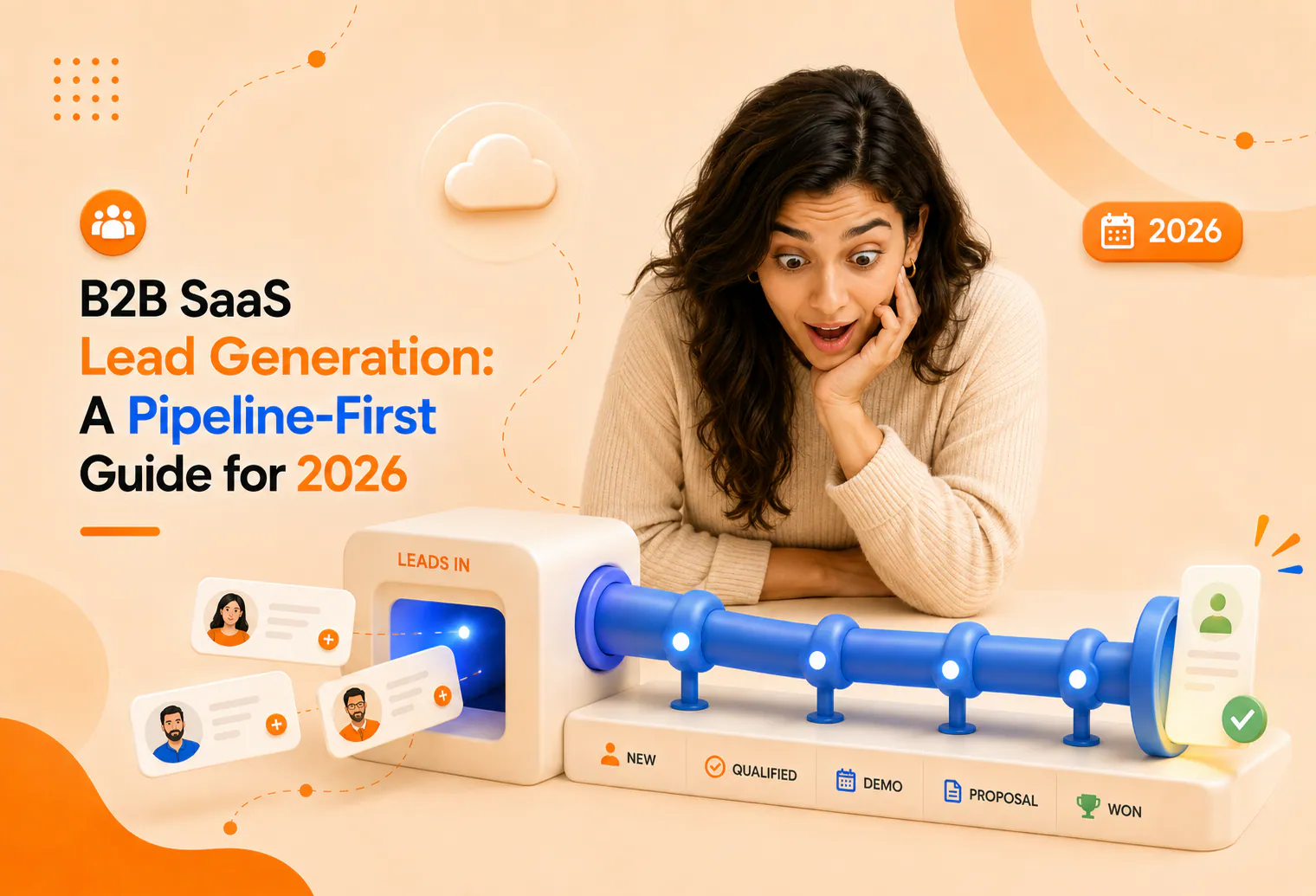
Quick Answer: B2B SaaS lead generation is the process of attracting and converting high-fit buyers into qualified demo requests or free trial sign-ups. It works when the channel mix matches your GTM model (PLG, sales-led, or hybrid) and your ICP’s research behavior. When it does not match, you generate traffic, not pipeline.
Key points covered in this article:
- Why PLG and sales-led SaaS companies need different lead gen channel stacks
- The three-layer pipeline attribution model: GSC, GA4, and CRM connected
- The 5 channels with the strongest demo conversion rate for B2B SaaS in 2026
- What shifted in 2026 and what your lead gen program needs to adjust now
B2B SaaS lead generation fails most often not because of budget or channel selection, but because the program is built around no specific buyer. A Marketing Head at a 150-person sales-led SaaS company does not face the same lead gen problem as a Growth Lead at a 300-person PLG company. Most published frameworks treat them as if they do.
The outcome is predictable: a blog library generating impressions but no demo requests, paid campaigns producing MQLs the sales team will not work, and a quarterly board question about why marketing spend is not converting to pipeline. The channels are running. The architecture is wrong.
According to Gartner, B2B buyers spend only 17% of their total purchase process interacting with vendors, which means 83% of the decision happens through content, search, and peer review channels you control. This guide covers how to build a B2B SaaS lead generation program that maps to your GTM model and produces qualified demo bookings, not just traffic.
Key Takeaways
- The lead gen channel that works for your competitor will not work for you if your GTM models differ.
- B2B SaaS buyers complete 83% of their purchase research independently, meaning inbound channels are active in deals before your sales team is aware of them.
- A sales-led SaaS company should prioritize SEO on commercial-intent keywords and LinkedIn ICP targeting, not a 10-channel list.
- Pipeline attribution connects three layers: GSC for impressions, GA4 for conversions, and CRM for revenue.
- As of 2026, AI overview appearances are a measurable inbound lead gen signal for B2B SaaS, not a vanity metric.
What Is B2B SaaS Lead Generation, and Why Does It Stop at Traffic?
B2B SaaS lead generation is the process of attracting buyers who match your ICP criteria, moving them through awareness to evaluation, and converting that attention into a qualified demo request or free trial activation. The SaaS context matters: SaaS buyers self-educate before engaging sales, which makes inbound channels active in deals before any direct vendor interaction occurs.
The breakdown from traffic to pipeline is almost always a conversion architecture failure, not a volume failure. Most programs measure impressions, sessions, and form fills. Pipeline-first lead gen tracks one metric: the assisted demo rate, meaning the percentage of prospects who engaged with at least one owned content piece before booking a demo within 30 days.
What qualifies as a lead in B2B SaaS?
In B2B SaaS, a lead is a named person at an ICP-matching company who has shown active buying intent. A demo request, free trial activation, gated content download with a business email, or a direct response to an outbound LinkedIn sequence all qualify.
An anonymous blog session does not, and this distinction determines which conversion events belong in GA4 and which sources get attributed revenue in the CRM.
Why traffic volume is the wrong primary metric
High organic traffic with low demo bookings points to one of three root causes: the keyword portfolio targets awareness-stage queries that never reach decision-stage pages; the CTAs on high-traffic pages do not match the reader’s stage; or the page experience mismatches the intent of the click that drove the visit.
Fixing the top five highest-traffic pages on these dimensions typically produces a faster pipeline improvement than publishing ten new posts.
B2B SaaS lead generation is a conversion architecture problem before it is a channel problem. GTM model alignment comes first; channel selection follows.
The Lead Gen Mistake That Costs B2B SaaS Teams Six Months of Budget
Every B2B SaaS lead gen guide recommends the same 10 to 15 tactics: SEO, content marketing, LinkedIn outbound, cold email, paid ads, webinars, referral programs, and free trials.
The shared assumption is that running more channels simultaneously produces more pipeline. For resource-constrained teams, this assumption reliably fails.
Running 10 lead gen channels with a marketing team of three and a $25,000 monthly budget means no individual channel receives enough execution depth to reach its output threshold.
SEO takes 4 to 6 months to produce pipeline results. Paid ads require sustained creative testing before cost per demo becomes acceptable.
Cold outreach requires sequence management, inbox handling, and a qualified ICP list before the first message sends. Spreading resources equally across all three at 30% capacity produces low-quality execution across all three.
“The B2B SaaS teams that build pipeline fastest are not running more channels than their competitors. They are running fewer channels with deeper execution and a direct line from each channel to a demo booking.”
The correction is to select two or three channels based on your GTM model, fully resource each one, and measure only pipeline-stage outcomes: demo bookings, free trial activations, and closed revenue from those conversions. Add a channel only after the first two are producing consistent qualified pipeline.
| If your lead gen program is running but your demo bookings are not growing, the issue is almost always execution depth, not channel count.See how ThirdMeta builds pipeline-first lead gen programs |
B2B SaaS Lead Generation by GTM Model: PLG, Sales-Led, and Hybrid
The most important variable in any B2B SaaS lead generation strategy is the go-to-market model. A PLG company and a sales-led company are solving fundamentally different pipeline problems, and the same channel mix applied to both produces suboptimal results for both.
Research from Gartner shows the average B2B buying group for a complex software solution involves 6 to 10 stakeholders, which means a lead gen program for a sales-led company must build awareness across multiple roles simultaneously, not just the one who submits the demo form.
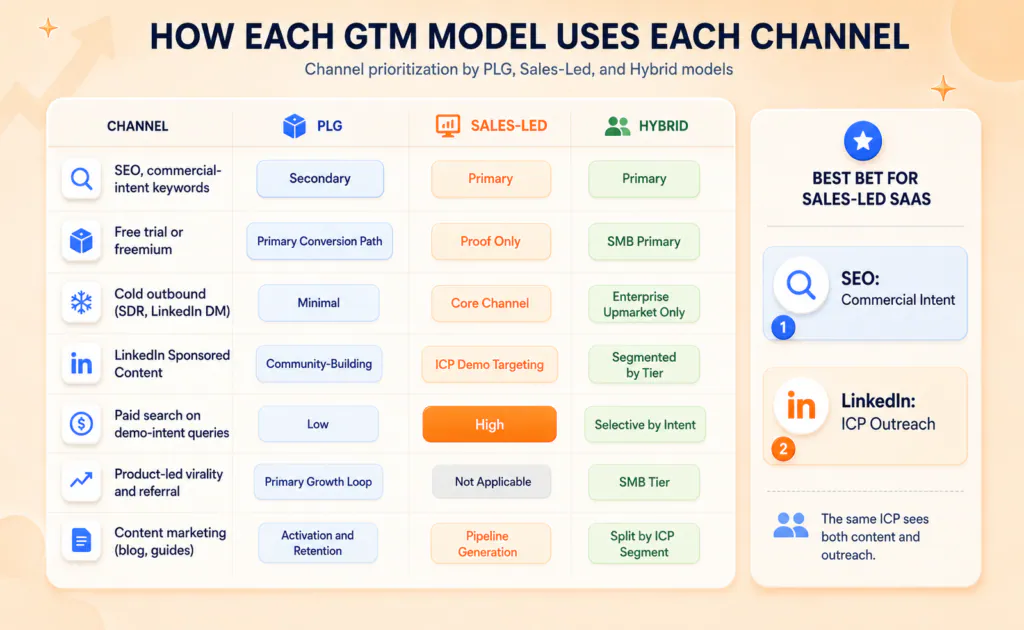
For a sales-led B2B SaaS company between 100 and 500 employees, the two highest-leverage investments in 2026 are SEO targeting commercial-intent keywords and a structured LinkedIn ICP outreach program.
These two channels reinforce each other: organic content builds brand familiarity that improves cold outreach response rates from the same ICP.
For a PLG company, lead gen shifts to free trial activation quality, in-product engagement loops, and community-driven content that drives organic sign-ups. Demo-focused outbound applies only at the enterprise tier.
Skipping the GTM alignment step is the primary reason most B2B SaaS lead gen programs operate below their potential. Teams that get it right consistently see the same or lower budget produce measurably higher demo volume within two quarters of realignment.
The 5 Channels That Drive Demo Bookings for B2B SaaS
For sales-led and hybrid B2B SaaS companies, these five channels produce the most consistent pipeline in 2026. The ranking reflects time-to-first-pipeline, not long-term volume potential, because most teams need to show pipeline contribution within a quarter.
1. SEO on commercial-intent keywords
Commercial-intent keywords (“best [category] software for [vertical],” “[competitor] alternative,” “[category] demo”) attract buyers actively evaluating options rather than researching a problem.
These pages convert at 3 to 5x the rate of awareness-stage content because the searcher has already defined their need. According to BrightEdge‘s 2024 Channel Performance Report, organic search accounts for more than 50% of all trackable web traffic across B2B industries, and a single well-built SaaS SEO content page targeting a commercial keyword continues producing demo requests for 12 to 24 months after publication.
2. LinkedIn ICP targeting
LinkedIn is the highest-accuracy B2B audience platform for reaching decision-stage buyers by job title, company size, and vertical. A combination of founder or VP Marketing content cadence and Sponsored Content campaigns targeting defined ICP criteria drives both brand recall and direct demo requests.
The critical variable is audience specificity: campaigns targeting “software decision-makers” produce a fraction of the conversion rate of campaigns targeting “Head of Operations at logistics companies, 200 to 500 employees.”
3. Structured cold outreach
Cold email and LinkedIn DM outreach produces the fastest time-to-demo of any channel when the ICP list is precise. In 2026, tools like Apollo.io and Clay enable personalization at volume, which has raised the baseline for what constitutes a credible outbound sequence.
A message referencing the prospect’s funding stage, category-specific pain point, or recent operational challenge outperforms a generic introduction by a wide margin. List quality and sequence design are the rate-limiting variables, not the technology.
4. Paid search on demo-intent queries
Google Ads on demo-intent queries (“[category] pricing,” “[competitor] vs [you],” “[category] demo”) converts at higher rates because the searcher is near the end of their buying process.
For B2B SaaS with an annual contract value above $12,000, the unit economics typically justify the CPC. Running paid search on informational keywords produces traffic, not demos.
5. Gated content tied to ICP pain points
A gated asset built around the ICP’s active operational problem converts at a far higher rate than a generic resource.
An asset titled “The Demo Conversion Benchmark for B2B SaaS Marketing Teams” filters for buyers actively working on that specific problem. These downloads also feed B2B content distribution programs and email nurture sequences without requiring additional paid budget.
| Running these channels without a connected attribution model means you cannot distinguish which ones are generating qualified pipeline versus just traffic.Book a lead gen strategy session with ThirdMeta |
How to Build Pipeline Attribution for Your B2B SaaS Lead Gen Program
Pipeline attribution connects each lead gen channel to a closed deal. Without it, budget decisions default to impression volume and form fill counts rather than actual revenue contribution. The three-layer model below connects each measurement point in sequence.
Step 1: GSC as the impressions layer
Google Search Console shows which queries drove organic visits to which pages, and at what ranking position. For lead gen attribution, track commercial-intent pages separately from informational blog content. A commercial page generating 600 monthly impressions and 30 clicks produces 30 ICP-level visits per month from buyers in active evaluation mode.
Step 2: GA4 as the conversion layer
Set up conversion events for: demo form submission, free trial activation, gated content download, and pricing page visit. After 60 days, the channel producing the most demo form submissions is your highest-converting lead gen source, regardless of total traffic volume.
Most teams discover at this stage that one deprioritized channel accounts for a disproportionate share of qualified conversions.
Step 3: CRM as the revenue layer
Map each closed deal to its first-touch and last-touch source before the demo booking. In HubSpot or Salesforce, check the lead source field on every closed-won opportunity and review which content pieces appeared in the activity log before the demo was scheduled.
After 90 days of connected data, the attribution chain runs from keyword impression to closed revenue, replacing disconnected channel reports with a single decision-making view.
Teams that connect all three layers reallocate budget more accurately within two quarters and consistently see higher demo-to-pipeline conversion rates from the channels they scale.
What Changed for B2B SaaS Lead Generation in 2026
Two shifts in 2025 and early 2026 have changed how effective lead gen programs are built for B2B SaaS.
AI overview visibility is now a measurable inbound signal
Google’s AI Overviews appear for a growing share of commercial and informational queries in the software category. A B2B SaaS company whose content is cited in AI Overviews for target keywords receives brand impressions from buyers forming vendor preferences before they click through to any website.
Building content for AIO citation through entity-specific, passage-first formatting is now a distinct component of a lead gen program, not an SEO add-on. ThirdMeta’s AIO and GEO services are built to place B2B SaaS content inside AI-generated answers at the specific keyword level.
AI-powered outreach has raised the personalization baseline
Tools like Clay, Apollo.io, and Artisan.co now enable SDR teams to send highly personalized sequences at volume. As of 2026, a generic email sequence that was acceptable practice in 2022 now competes against AI-personalized messages referencing the prospect’s growth stage, recent job change, or category-specific pain point.
Response rates for non-personalized B2B outreach have declined measurably, and the implication for program setup is a higher upfront investment in data enrichment and sequence design before the first message sends.
Why Should You Choose ThirdMeta for B2B SaaS Lead Generation?
Most B2B marketing agencies apply the same channel template across every client. ThirdMeta builds lead gen programs from the GTM model and ICP outward: the channel stack, content structure, and attribution setup are all derived from the client’s buyer profile and growth stage, not a pre-built playbook.
For sales-led SaaS companies, ThirdMeta’s programs combine:
- B2B SaaS keyword research mapped to commercial and demo-intent queries, not informational traffic
- SEO and content execution targeting the exact job titles and industries that close into revenue
- Pipeline attribution setup connecting GSC, GA4, and CRM from the first week
- ICP-specific outbound strategy designed around the same buyer profile as the content program
One honest trade-off: ThirdMeta’s content-led programs take 4 to 6 months to produce meaningful pipeline. If your priority is demo bookings in the next 30 days, a paid search or SDR-led program should lead, with content-led SEO building in parallel.
If you are at a B2B SaaS company with 50 to 500 employees and your content program is generating traffic but not qualified demo requests, this is the specific gap ThirdMeta is built to close.
| Ready to replace a channel list with a pipeline architecture built for your GTM model?Book your pipeline strategy session |
Conclusion
B2B SaaS lead generation is not a channel selection problem. It is a GTM model alignment problem. The teams that generate consistent demo pipeline do not run more channels than their competitors; they run the right two or three channels for their specific buyer and execute each one to full depth.
For Marketing Heads and Growth Leads at 50 to 500 person B2B SaaS companies, the shift from traffic-focused to pipeline-focused lead gen starts with one decision: which channels map to your GTM model, and which metrics prove they are producing demos, not just visitors.
Frequently Asked Questions
B2B SaaS lead generation is the process of attracting and converting buyers at ICP-matching companies into qualified demo requests or free trial sign-ups. It differs from generic B2B lead gen because SaaS buyers complete most of their evaluation independently before talking to sales. Inbound channels like SEO, content marketing, and AIO visibility are therefore active in SaaS deals earlier and more heavily than in most other product categories.

Sr. Content Writer
Vamshi Vadali is Third Meta's Content Team Head and the guy who banned fluff from all blog posts. He specializes in SEO, GEO (Generative Engine Optimization), and AEO (Answer Engine Optimization): the trifecta that gets B2B SaaS content ranking in both Google and ChatGPT. Vamshi doesn't write content. He engineers MQL machines. His philosophy? Good writing needs data and clarity, not buzzwords. He writes like a CFO reads: straight to the outcomes. When he's not optimizing for AI Overviews, he's debating whether LLMs prefer Oxford commas.