
Quick Answer: A data-driven marketing agency is one whose channel, budget, and messaging decisions come from measured performance data rather than instinct or a fixed playbook, and whose claims hold up against your own CRM and pipeline numbers, not just its own dashboard.
Key points covered in this article:
Dashboards alone don't make an agency data-driven, decisions do
The Last Decision Test reveals real data-driven agencies in minutes
PLG and sales-led SaaS companies need different data entirely
Red flags predicting a dashboard will never reach your CRM
A data-driven marketing agency makes channel, budget, and messaging decisions based on measured performance rather than fixed playbooks or gut instinct. Almost every agency pitching a B2B SaaS company today will claim this exact label.
For a Marketing or Growth Head evaluating finalists this quarter, the claim is hard to verify from the outside. Most show up with a dashboard, a few channel metrics, and a case study slide. Very few can point to one decision their data actually reversed.
Forrester's 2024 Marketing Survey found 64% of B2B marketing leaders don't trust their own organization's marketing measurement for decision-making. This piece covers what separates a data-driven agency from a data-reported one, a five-minute test for any finalist, and what changes when picking one for a B2B SaaS marketing pipeline.
TL;DR
A data-driven marketing agency changes real budget and channel decisions because of data, not just reports on it
The Last Decision Test asks any finalist agency to name the one call their data reversed last quarter
PLG and sales-led B2B SaaS Growth Heads need different data models, so a generic reporting stack signals a generic agency
Most agencies that call themselves data-driven have simply never been asked to prove it with a real decision
A real evaluation compares decision history and CRM integration, not the design quality of the dashboard
What Actually Makes a Marketing Agency "Data-Driven"?
A data-driven marketing agency ties every channel, budget, and messaging decision to measured performance instead of a fixed playbook applied to every client. It can show which specific number changed which specific decision, not just which numbers it tracks. That distinction matters more than the definition, because almost any agency can meet the definition on a slide.
Most finalist agencies already run Google Analytics 4, a CRM sync, and a monthly deck, the same baseline most SaaS SEO agencies offer by default. That infrastructure is common, not rare: Forrester's same 2024 survey found 59% of CMO dashboards were already tracking some pipeline or revenue sourcing metric. It proves an agency can report, not that it is driven by what the report says.
The rest of this piece treats "data-driven" as a claim to verify, not a label to accept, starting with the specific failure mode behind most agencies that use the term loosely.
Why Most Data-Driven Marketing Agencies Are Actually Just Data-Reported
Every competitor writing about data-driven marketing agencies defines the term the same way: an agency with dashboards, reports, and named metrics. That definition is incomplete, and it lets almost any agency qualify. The accurate version is narrower: a data-driven agency is one where a specific number, on a specific date, changed a specific decision.
Across our B2B SaaS work, the tell shows up in one moment: asked what a metric actually changed, not what it measures, most account teams go quiet. The tell is timing, not tooling. A data-driven agency can name a specific week a channel got cut or a budget moved, and the number that caused it; a data-reported agency can only point back to the dashboard.
"A dashboard nobody has ever used to reverse a bad channel or budget call is a reporting habit dressed up as a strategy."
In 2026, that gap is harder to hide behind a well-designed dashboard. Gartner's 2026 CMO Spend Survey found CMOs now allocate 15.3% of marketing budgets to AI, though only 30% feel ready to scale that capability. Most agencies can now generate a polished dashboard in an afternoon with the same AI tools their clients have. A dashboard was a differentiator in 2020; by 2026 it is closer to a baseline, pushing the real differentiator toward the kind of GTM strategy work that a dashboard alone can't show.
You're about to compare finalists who all claim to be data-driven, with no easy way to tell who's telling the truth. Talk to ThirdMeta about your GTM data setup
That distinction is the entire test worth running before signing with any finalist. The next section turns it into a question you can ask on a single call.
The Last Decision Test: How to Vet a Data-Driven Marketing Agency in 5 Minutes
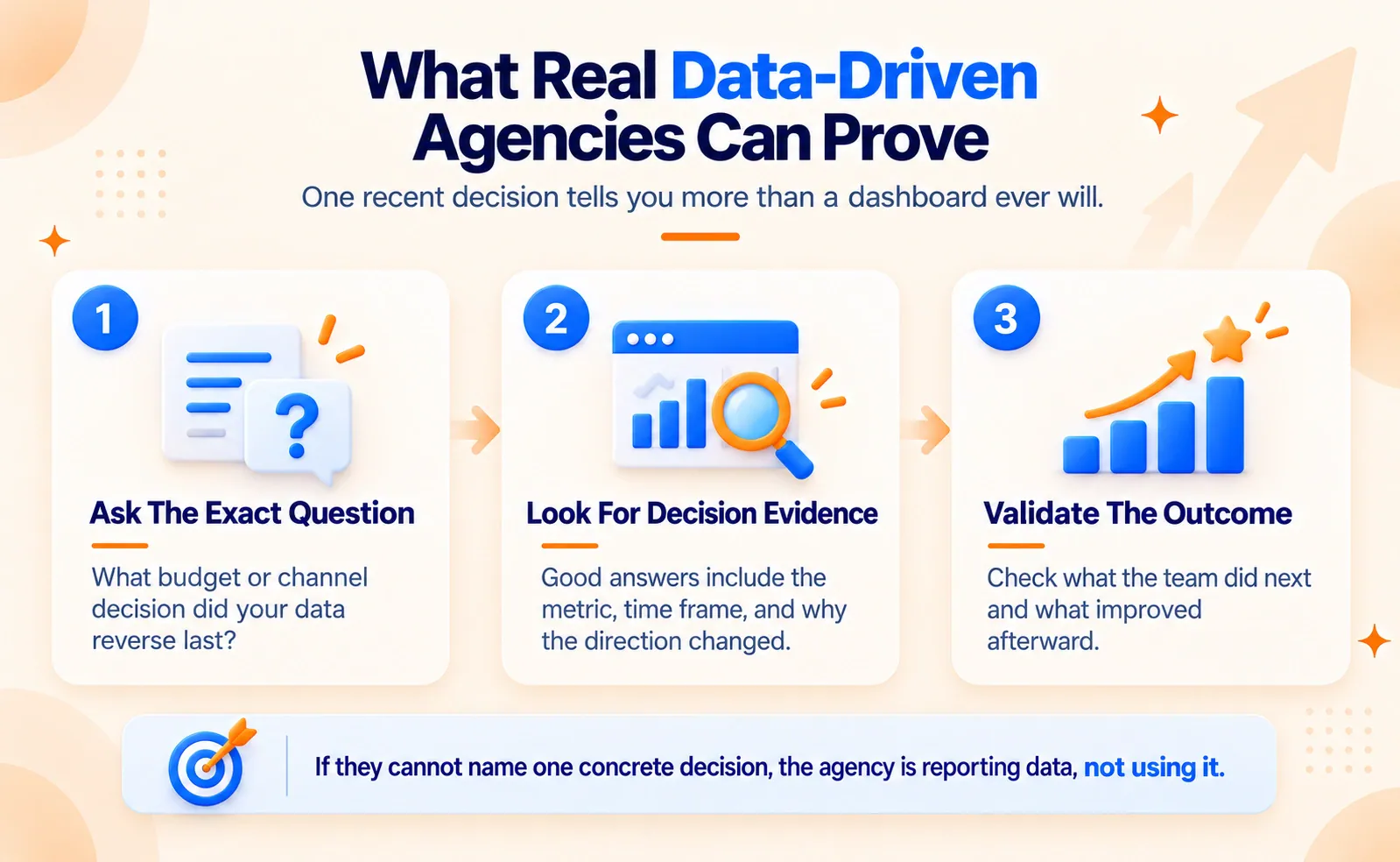
The Last Decision Test is a single question that separates data-driven agencies from data-reported ones in one call. Ask every finalist: what is the last budget or channel decision your data reversed, and what did the number say before and after? An agency that cannot answer with a specific decision, a specific number, and a specific date is data-reported, whatever its pitch deck says.
Running the test takes three steps, on a live call or in a reference conversation with an existing client. Push on vague answers instead of accepting them. The goal is one concrete example, not a philosophy of measurement.
Ask the exact question. "What's the last budget or channel decision your data reversed, and what did the number say before versus after?"
Listen for specificity. A real answer names the channel, the metric, and roughly when it happened, not "we optimize continuously based on performance."
Ask what happened next. A data-driven agency can describe what they did differently afterward and what changed as a result.
Run this on three finalist calls this week and the pattern becomes obvious fast. Agencies that pass answer within seconds, because the decision is memorable to the team that made it. It is the same specificity gap that shows up when evaluating SEO agencies at the Series A stage.
What a Data-Driven Marketing Agency Looks Like for a B2B SaaS Company
A data-driven marketing agency should track different signals for a product-led growth company than for a sales-led one, because the decisions each business makes are different. A PLG company lives on activation and expansion data inside the product; a sales-led company lives on pipeline velocity and win-rate data inside the CRM.
PLG SaaS scenario: the agency should be pulling product usage data, often from the app itself or a tool like Amplitude, to see which acquisition channel produces users who actually activate. A content piece that drives signups but not activation is a vanity win the agency should flag, not celebrate.
Sales-led SaaS scenario: the agency needs visibility into CRM stages, not just form fills, because a channel producing demo requests that never progress past discovery is quietly expensive. This is the GTM-model-specific diligence most generic agencies skip. It also assumes stable channels and real volume already exist; a pre-product-market-fit company still rewriting messaging weekly gets more from fast qualitative feedback than a formal attribution system.
An agency running the identical report for both business types has not adapted to either one. That is a fair question to ask a finalist directly, and one worth checking against a documented client engagement rather than a pitch-deck claim.
Red Flags Your Data-Driven Marketing Agency Won't Survive Contact With Your CRM
Four red flags predict that an agency's data-driven claim will not survive contact with your CRM. Each is easy to check in a single sales call. None require access to the agency's internal systems, only specific questions.
The dashboard only shows channel metrics, never pipeline stages. If the agency cannot connect clicks or rankings to a CRM stage or a lower customer acquisition cost, the data stops at the top of the funnel by design.
Every monthly report looks structurally identical. A genuinely data-driven process changes the report when the data changes, not on a fixed template regardless of results.
Case studies cite growth percentages without a baseline. A 200% increase from 40 monthly visitors is a different claim than the same percentage from 4,000.
No one on the account can describe the client's sales cycle. Speaking only in traffic and impressions means the claim stops at analytics, not revenue.
Across our B2B SaaS work, the account teams that struggle most with red flag four report to a marketing generalist who has never seen the CRM directly. None of these four disqualify an agency alone. What matters is whether it admits which apply right now, rather than deflecting.
If two or more of these red flags sound like your current agency, the conversation with them is overdue. Get a second opinion from ThirdMeta
How to Compare Data-Driven Marketing Agencies Side by Side
Comparing data-driven marketing agencies side by side means scoring finalists on the same five dimensions, not the polish of their pitch deck. A simple table makes the gap between agencies that report data and agencies that act on it visible fast. Score each finalist honestly, including the one you already use if this is a renewal decision.
Dimension | Data-reported agency | Data-driven agency |
Dashboard | Channel metrics only: clicks, sessions, rankings | Connected to CRM stages or product usage data |
Decision history | Cannot name a specific reversed decision | Names a specific decision, number, and date |
Reporting cadence | Same template every month regardless of results | Report structure changes based on what happened |
GTM awareness | One generic report for every client | Different signals tracked for PLG versus sales-led accounts |
Case study baselines | Growth percentages without starting numbers | Baseline and absolute numbers included unprompted |
A finalist scoring well on three or more rows is worth a second conversation. One scoring well only on the dashboard row is the data-reported pattern from earlier in this piece, regardless of how the pitch describes it.
Why Should You Choose ThirdMeta?
If your current agency cannot pass the Last Decision Test, that gap is where ThirdMeta's Growth-as-a-System model operates: SEO, paid, content, and RevOps run as one system tied to CRM stages, not separate channels reporting separate metrics.
Reporting tied to pipeline stage and revenue, not just channel traffic
Separate playbooks for PLG activation data and sales-led CRM data
A named decision log for every account, reviewed monthly with the client
Across our B2B SaaS engagements, including document-AI and ops-software platforms, this shows up as a shared dashboard the client's own team can query directly, not a static PDF.
Unlike agency directories, we show the decision log behind the work, not just a profile
Unlike broad-service shops, our reporting ties to your CRM from week one, not after a quarter of setup
The fastest way to see whether this fits your GTM model is a direct conversation about your sales cycle and CRM setup, not a generic capabilities deck.
Curious whether your current agency would pass the Last Decision Test?
Book a working session with ThirdMeta
Conclusion
Being data-driven is a claim every agency can make and almost none can prove without a specific decision to point to. The Last Decision Test turns that claim into a question you can ask on one call, and the red flags here turn a vague evaluation into a concrete one.
A Marketing or Growth Head who runs this test on every finalist stops comparing pitch decks and starts comparing decision histories instead. That shift changes which agency gets picked, and what it stays accountable for a quarter later. For sequencing that decision against budget, see how to allocate spend across SEO, AEO, and GEO.
Frequently Asked Questions
Data-driven marketing means basing channel, budget, and messaging decisions on measured performance, not instinct. For an agency, every recommendation should trace back to one specific number. Ask for one decision the data actually reversed to verify it.

Sr. Content Writer
Vamshi Vadali is Third Meta's Content Team Head and the guy who banned fluff from all blog posts. He specializes in SEO, GEO (Generative Engine Optimization), and AEO (Answer Engine Optimization): the trifecta that gets B2B SaaS content ranking in both Google and ChatGPT. Vamshi doesn't write content. He engineers MQL machines. His philosophy? Good writing needs data and clarity, not buzzwords. He writes like a CFO reads: straight to the outcomes. When he's not optimizing for AI Overviews, he's debating whether LLMs prefer Oxford commas.