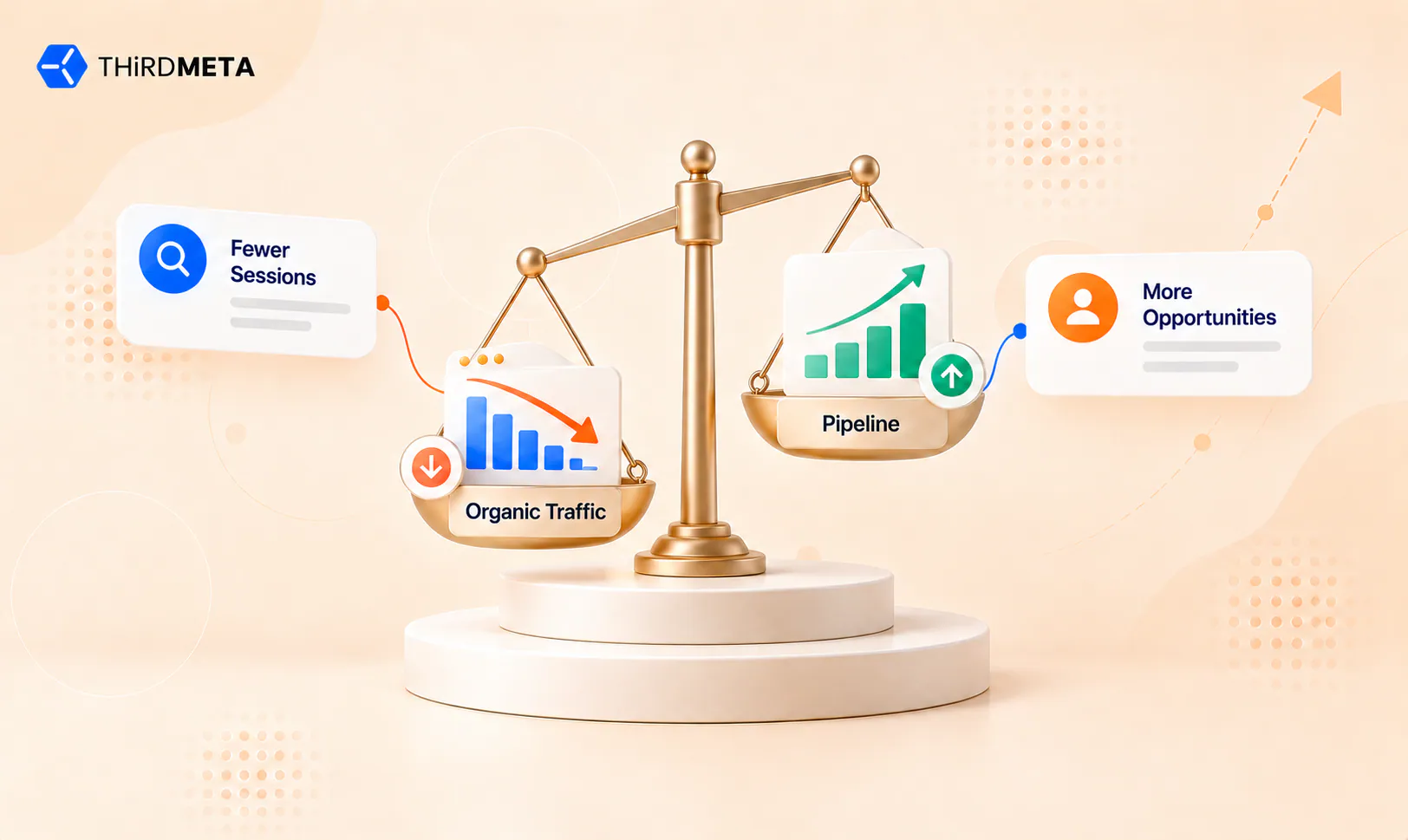
Quick Answer: Organic traffic down, pipeline up is a pattern where search sends fewer visits while organic-sourced opportunities rise. It is good news only if commercial-page sessions held and buyers still credit search or an AI tool.
Key points covered in this article:
Sessions can fall while organic pipeline rises
Pipeline lags traffic by one sales cycle
Two questions sort the result into four readings
Report pipeline, self-reported source and citations, not sessions
Organic traffic down, pipeline up is a real pattern in B2B SaaS. It can mean healthy filtering, borrowed pipeline or misplaced credit. The numbers alone do not say which.
A Head of Growth at a 100-person SaaS company usually meets it in a board deck. Sessions fell, the agency report shows rankings and the CRM shows more demos, yet nobody can link them.
Pew Research Center found people clicked a traditional result in 8% of visits with an AI summary, against 15% without one. This guide gives a two-question test and the metrics that replace sessions in SaaS SEO reporting.
TL;DR
Heads of Growth at B2B SaaS companies should treat falling sessions with rising pipeline as a hypothesis, not a result.
Split organic sessions into informational and commercial pages before reading any trend.
Shift organic-sourced opportunities back by the median closed-won sales cycle.
Ask two questions: did commercial sessions hold, and do buyers still name search or an AI tool?
Report pipeline, self-reported source, branded clicks and citation share in place of total sessions.
Retire year-over-year impressions and average position across September 2025.
Can Organic Traffic Fall While Pipeline Rises in B2B SaaS?
Yes, because AI answers absorb informational queries first, and those visitors rarely become opportunities. As of 2026 the loss is measurable: Ahrefs estimated that AI Overviews cut position-1 click-through by about 58% between December 2023 and December 2025. The estimate rests on a modeled baseline across 300,000 keywords.
Buyers still research, but they now do it before the click. 6sense's 2025 B2B Buyer Experience Report found the winning vendor was already on the buyer's Day One shortlist 95% of the time. That demand can reach the CRM later as a direct visit or a branded search.
The same chart also has bad readings, covered next. Our guide to ranking in Google AI Overviews covers the visibility side.
Is Organic Traffic Down and Pipeline Up Always Good News?
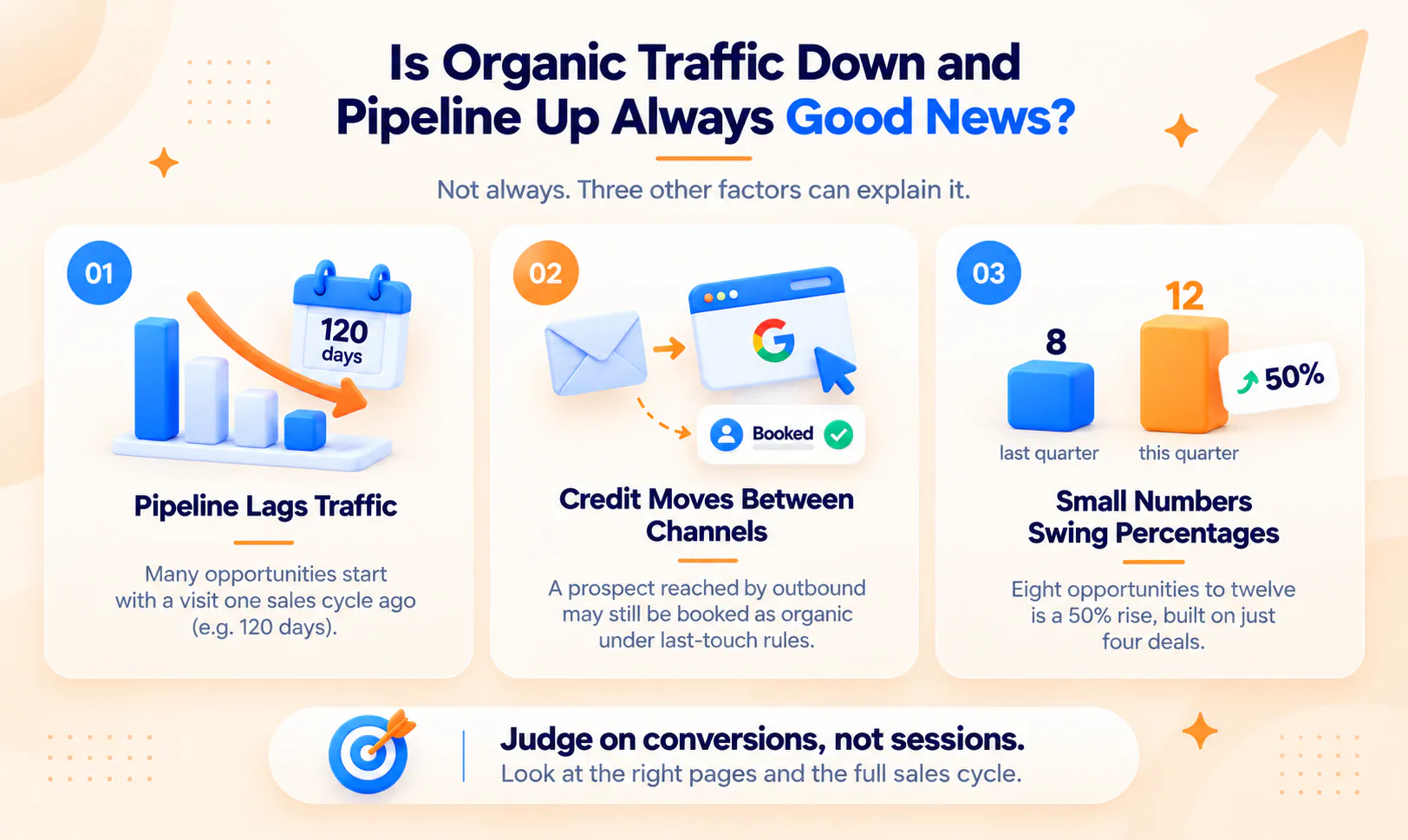
No. Pipeline that rises while traffic falls is a hypothesis, because three other explanations produce the same chart. The usual advice, to judge on conversions and ignore sessions, skips all three.
"Pipeline that rises while commercial-page sessions fall is a hypothesis with a deadline, and the deadline is your median sales cycle."
Pipeline lags traffic. An opportunity created this quarter often began with a visit one sales cycle ago. With a 120-day cycle, this quarter's pipeline measures last quarter's sessions.
Credit moves between channels. A prospect reached by outbound email who then opens a pricing page from Google is booked as organic under last-touch rules in HubSpot or Salesforce. Organic gains credit for work outbound did.
Small numbers swing percentages. Eight organic opportunities last quarter and twelve this quarter is a 50% rise built on four deals. Under ten a quarter, review the deals one by one; that is our rule of thumb.
What we see across our B2B SaaS work: teams that read this pattern correctly start from the pages that lost sessions. A drop on blog posts reads very differently from a drop on pricing pages. Our guide to what proves ROI from a B2B tech SEO agency covers how far to trust attribution claims.
Pipeline up, sessions down, and nobody can say which of the three readings is true? |
How Do You Read Organic Traffic Down, Pipeline Up? Run the Held-and-Heard Test
Traffic down and pipeline up has four possible meanings, and the Held-and-Heard Test separates them with two questions. Did commercial-page sessions hold, and do buyers still say they heard of the company through search or an AI tool? With four numbers in hand, the read takes about 15 minutes.
Split organic sessions in GA4 into two rows by landing page: informational (blog posts, guides) and commercial (pricing, comparison, service and demo pages).
Pull organic-sourced opportunities from HubSpot or Salesforce and shift them back by the median closed-won sales cycle.
Count new opportunities whose "How did you hear about us?" answer names Google, search or an AI tool.
Compare the commercial row and the self-reported line with the same quarter last year. Within 10% either way counts as held, which is our rule of thumb.
Find the reading in the table below and take its next move.
Two answers give four readings. Each has its own cause and next move.
Reading | What the lines show | Next move |
Healthy shed | Commercial sessions held; buyers still name search or AI | Informational clicks left. Keep the program and stop headlining total sessions. |
Credit shift | Commercial sessions held; buyers name other channels | Organic is getting last-touch credit. Audit source rules before moving budget. |
Clickless demand | Commercial sessions fell; buyers name search or AI | Buyers find the brand in answers and arrive direct. Track citations and branded search. |
Borrowed pipeline | Commercial sessions fell; buyers name other channels | Pipeline is the lagged harvest of older traffic. Fix commercial pages now; the dip lands one cycle later. |
What we see across our B2B SaaS work: the self-reported field is the cheapest fix and the one most often left blank. A demo form that asks nothing about how the buyer found the company hides demand that never clicked. Our guide to B2B SaaS lead generation and pipeline attribution covers the CRM source rules.
Which Metrics Replace Sessions When Organic Traffic Is Down and Pipeline Is Up?
Report three layers in place of total sessions: attributed pipeline, demand that cannot be clicked and visibility that analytics cannot see. Sessions stay as context, never as the headline.
Pipeline you can attribute
Report organic-sourced opportunities and pipeline value per quarter, shifted by the sales cycle. Add opportunities per 1,000 organic sessions, plus win rate and cycle length against other sources. A rising ratio on falling sessions is the mark of a healthy shed.
Demand you cannot click
Add the self-reported source share and branded search clicks from Google Search Console, meaning queries that contain the company name. Buyers who first meet a brand in an AI answer often search the name later. Those visits land in branded organic or Direct, so sessions understate search.
Visibility you cannot see in analytics
AI engines send some visits with a referrer such as chatgpt.com, and many arrive as Direct. GA4 therefore gives a floor, not a count. Track citation share on a fixed prompt set, using the method in our guide to checking whether ChatGPT recommends your SaaS.
Five numbers fit on one slide: organic-sourced pipeline, opportunities per 1,000 sessions, self-reported share, branded clicks and citation share. The pages behind those citations are mapped in our guide to where AI engines find B2B SaaS brands.
Board deck still leading with sessions and rankings? |
Does Organic Traffic Down, Pipeline Up Mean the Same Thing for PLG and Sales-Led SaaS?
No. The lag between a visit and revenue differs by go-to-market model, so the same chart means different things. The two examples below are illustrative, not client data.
Product-led, 40 people, 14-day trial. Organic signups fell while paid accounts held.
Set the lag at trial length plus upgrade time, about 30 days, and read monthly.
Paid accounts per 1,000 sessions rising is a healthy shed. Paid accounts falling a month later is borrowed pipeline.
Sales-led, 120 people, 120-day median cycle. Organic-sourced opportunities rose while pricing-page sessions fell.
Shift opportunities back 120 days and read quarterly.
Hold the verdict until the next two quarters confirm it.
Hybrid companies use the longer lag for enterprise deals and the shorter one for self-serve plans. The model sets the lag, and our guide to SaaS GTM strategy covers the model choice itself.
What Should You Stop Reporting When Organic Traffic Is Down and Pipeline Is Up?
Stop reporting any number that moved for reasons unrelated to demand: total sessions as a headline, year-over-year impressions and average position. A dashboard full of them is a report, not a decision, as our guide to spotting a data-driven marketing agency shows. Three questions come up most in board reviews.
Is total organic traffic still a KPI?
No. It mixes informational visits that rarely convert with commercial visits that do. Report the two rows from the Held-and-Heard Test, and keep the total as a footnote.
Are Search Console impressions comparable across September 2025?
No. Google stopped honoring the &num=100 parameter that rank trackers used, and Search Engine Land reported that most sites saw impressions fall. Compare clicks, not impressions, across that date.
Is rank-tracker position still a KPI?
Only next to AI Overview presence. A position-1 ranking on a keyword with an AI Overview earns far fewer clicks than the same ranking without one. Report position for commercial keywords only, beside click-through.
Dropping these numbers shortens the deck and ends arguments that start with a chart nobody can act on. Nobody has ever lost a board vote to a missing average-position chart.
Why Should You Choose ThirdMeta to Read Your Organic Traffic and Pipeline?
A pipeline number that holds up in a board review needs someone who reads the pattern, not a dashboard that prints it. ThirdMeta reports pipeline first and sessions second, so a deck that now leads with GA4 totals or rank-tracker averages leads with opportunities instead.
Sessions split by page intent, so informational loss shows apart from commercial rows
Opportunities shifted by your own median sales cycle, pulled from HubSpot or Salesforce
A self-reported source field on the demo form, mapped to the CRM
A quarterly Held-and-Heard read on one page, with the next move for each reading
Citation share on a fixed prompt set, run with the method in our ChatGPT guide
The first read needs three exports: GA4 landing pages, the CRM opportunity list and the demo-form answers. We are not the right fit if the CRM cannot record opportunity source and nobody will own the field. Below roughly ten organic-sourced opportunities a quarter, no report can read this pattern, ours included.
Agencies that headline meetings booked, such as growth.cx, or ROAS and cost per demo, such as GrowthSpree, report the front of the funnel. We add the lagged opportunity line.
AI-visibility tools such as Profound and Peec AI show citation share. We tie citations to opportunities through the self-reported field.
Our case studies show the reporting in use. The first step is a read of your last four quarters.
Four quarters of data and no reading you can defend to a CEO? |
Conclusion
Organic traffic down with pipeline up stays a hypothesis until two questions are answered. Did commercial-page sessions hold, and do buyers still say they found the company through search or an AI tool? The answers give four readings, and only one of them is good news with no deadline.
A Head of Growth who runs the test this quarter walks into the next board meeting with one reading, one lag date and five numbers in place of sessions. The conversation moves from whether SEO still works to which reading the company is in.
Frequently Asked Questions
Measure SEO success when organic traffic is down with pipeline, not sessions. Track organic-sourced opportunities shifted by your sales cycle. Add the self-reported source share and branded search clicks. Keep sessions as context only.

Sr. Content Writer
Vamshi Vadali is Third Meta's Content Team Head and the guy who banned fluff from all blog posts. He specializes in SEO, GEO (Generative Engine Optimization), and AEO (Answer Engine Optimization): the trifecta that gets B2B SaaS content ranking in both Google and ChatGPT. Vamshi doesn't write content. He engineers MQL machines. His philosophy? Good writing needs data and clarity, not buzzwords. He writes like a CFO reads: straight to the outcomes. When he's not optimizing for AI Overviews, he's debating whether LLMs prefer Oxford commas.