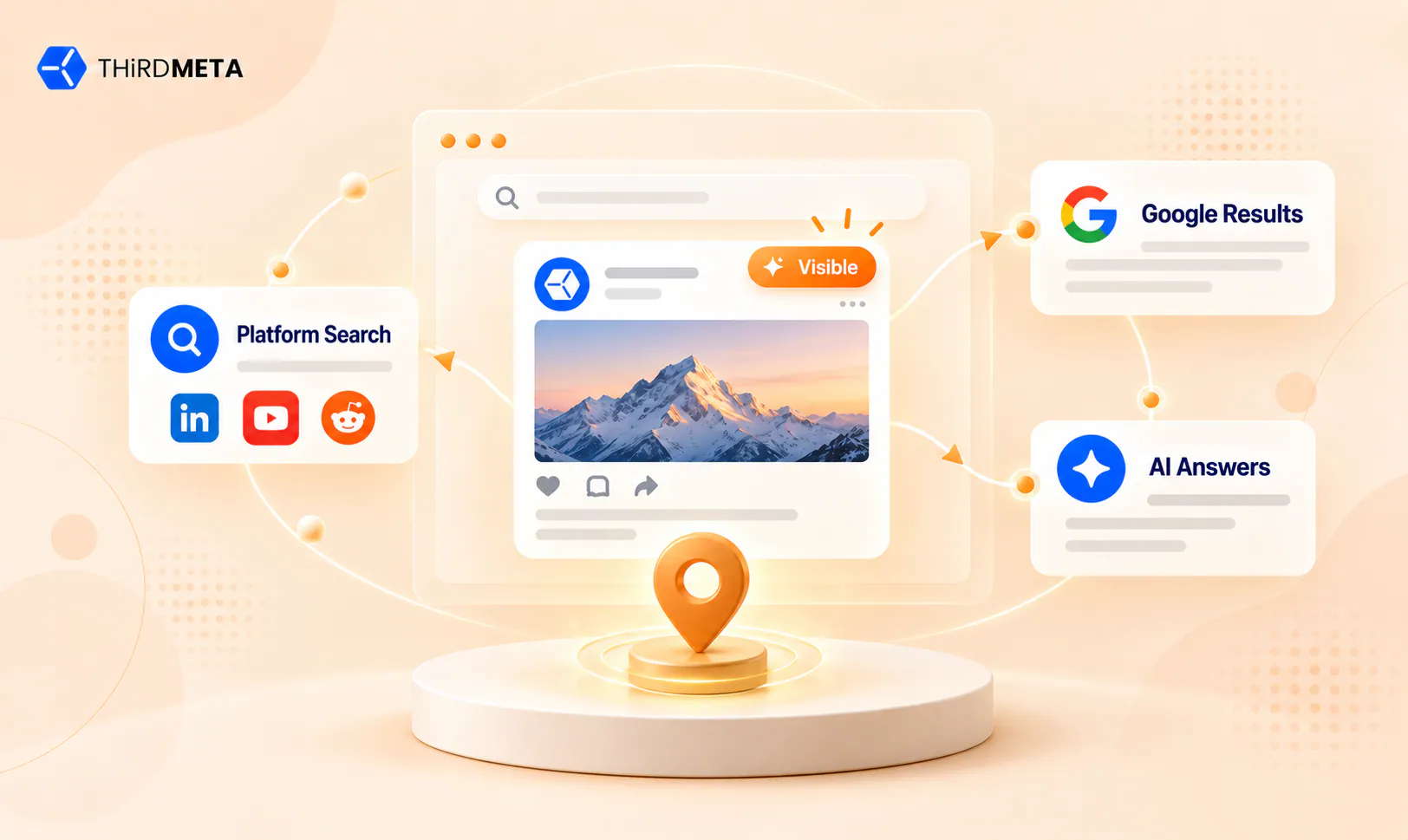
Quick Answer: Social media SEO is the practice of writing social profiles and posts so they rank in platform search, in Google, and in AI-generated answers. For B2B SaaS, the payoff is being the source ChatGPT, Google AI Mode and Perplexity quote when buyers research your category.
Key points covered in this article:
Why likes and shares do not move Google rankings
Which platforms AI engines cite for B2B questions
A five-step plan built on buyer questions
The 5-Question Citation Audit to track progress
Social media SEO is the work of making your team's social content findable as an answer: in LinkedIn and YouTube search, in Google, and in AI answers. For B2B SaaS companies, that last surface now decides the most.
Marketing Heads describe the same three problems. The founder posts on LinkedIn daily, but nothing from last quarter shows up in search. Prospects tell sales that ChatGPT suggested a competitor, and HubSpot files the deals that did start on social under "direct traffic."
G2's April 2026 survey found that 51% of B2B software buyers now start their research with an AI chatbot more often than with Google. Drawing on our AEO and GEO services work, this guide covers which platforms count, why likes do not move rankings, and an audit you can run this week.
TL;DR
Social media SEO for B2B means becoming the source AI engines quote, not collecting likes.
Google says social shares are not a ranking signal, so measure citations instead of reactions.
LinkedIn, YouTube and Reddit carry more B2B search weight than TikTok or Instagram.
Content and Marketing Heads should first list the five questions buyers ask about their category.
Run those questions through ChatGPT, Google AI Mode and Perplexity, then log which social pages get cited.
Fill the empty answers with long-form posts from named experts before adding to the calendar.
What is social media SEO, and why does it matter more for B2B in 2026?
Social media SEO is the practice of writing profiles, posts and videos so they surface in search, not only in the feed. A feed post lives for a day. A well-titled LinkedIn article or YouTube explainer can answer a buyer's question for years.
For a company selling to a CFO or a VP of Operations, the useful definition is narrow: which social pages answer your buyers' questions, and whose name is on them. That makes it one layer of your B2B social media marketing plan, not a separate channel.
Which surfaces does it cover?
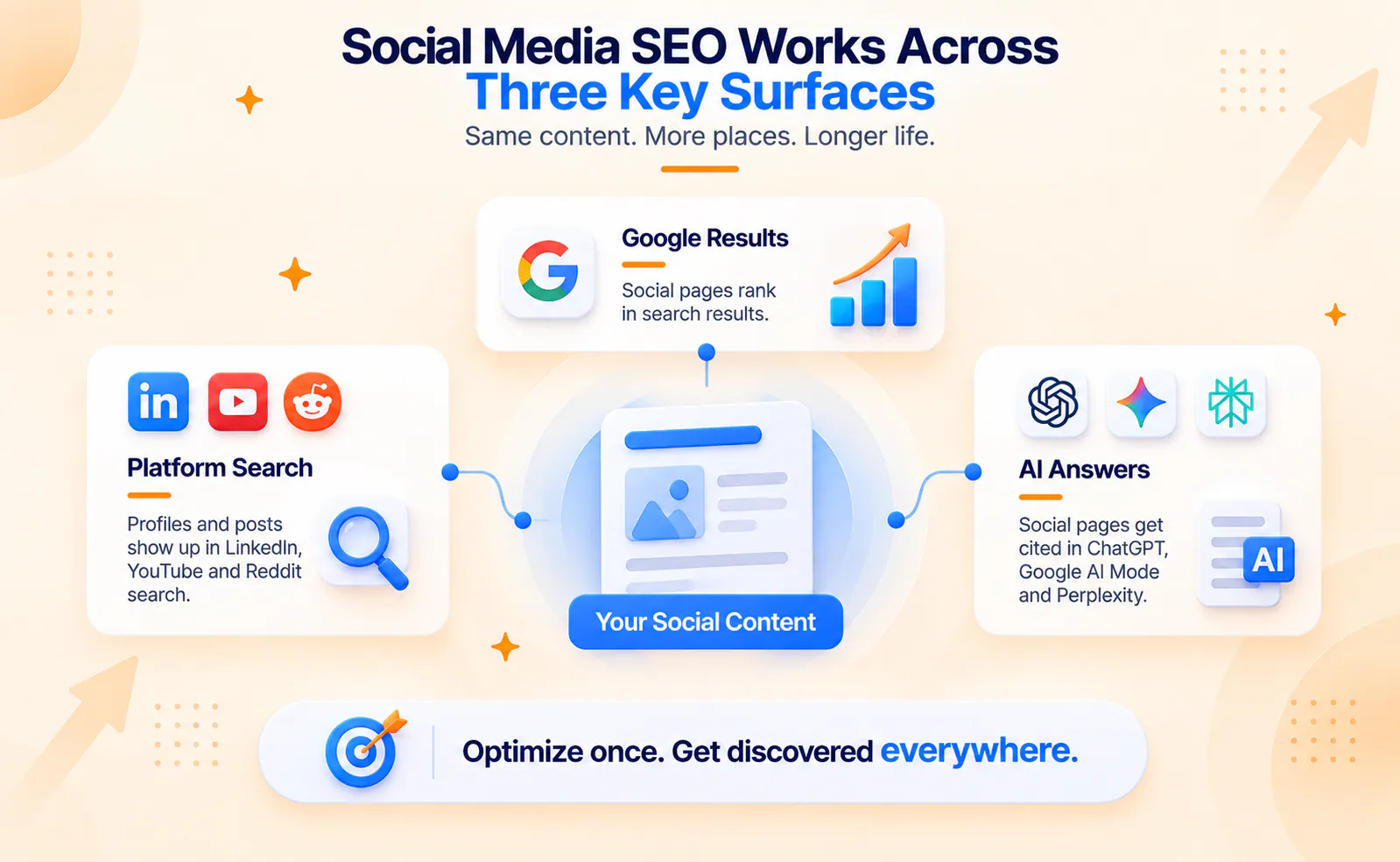
Three surfaces matter, and each rewards a different kind of writing. The third is where B2B research has moved.
Platform search: LinkedIn, YouTube and Reddit search bars, driven by titles and keywords in the text.
Google results: LinkedIn articles, YouTube videos and Reddit threads rank as ordinary results.
AI answers: ChatGPT Search, Google AI Mode and Perplexity cite social pages as sources.
What changed in 2026?
As of 2026, AI engines lean heavily on social pages. Semrush's study of 325,000 prompts found LinkedIn was the second most cited domain across ChatGPT Search, Google AI Mode and Perplexity, appearing in 11% of responses on average. A post that wins a day of reactions and earns no citations has done half the job.
Which social platforms matter most for B2B social media SEO?
LinkedIn, YouTube and Reddit matter most for B2B social media SEO, because AI engines and Google quote them for software questions. TikTok and Instagram search are large, but B2B buyers rarely shortlist vendors there. Your go-to-market model sets the order.
A product-led company needs answers where practitioners compare tools, which favours YouTube and Reddit. A sales-led company needs credibility where a buying committee checks the people, which favours LinkedIn.
Platform | Where it ranks | B2B role | Sales-led | Product-led |
LinkedIn search, Google, AI answers | Credibility of the people behind the vendor | High | Medium | |
YouTube | YouTube, Google video, AI answers | Demos and technical how-to | Medium | High |
Google forum results, AI answers | Peer validation, "alternatives" threads | Medium | High | |
Instagram, TikTok | In-app search | Hiring brand, rarely vendor choice | Low | Low |
What we see across our B2B SaaS work: the company page gets the budget, while AI engines quote the people. A product lead's plain article on one integration gets cited more often than the brand's launch post.
Profile set-up still decides whether a person appears in LinkedIn's own search. Our LinkedIn SEO profile guide covers that layer in detail.
Does social media SEO help your website rank, or is that the wrong goal?
Social media SEO does not raise your website's rankings through likes, shares or followers. Google's Gary Illyes said in August 2025 that social views and shares are not ranking signals, and "for the future is also likely no." The goal that pays is different: the social pages themselves rank and get cited.
The situation: most guides answer the ranking question with indirect benefits, such as branded searches and backlinks. Each is plausible, but none is measurable from a social dashboard, so teams keep posting for reactions.
What works instead: treat each post as a search result competing for one question, not as a prop for a web page. That changes three things:
First lines state the question and the answer, so an AI engine can lift the passage.
Long-form LinkedIn articles and YouTube descriptions replace hot takes for anything you want found.
Success is counted in citations and branded search, not reactions.
"Likes tell you the feed approved of a post; citations tell you a buyer's question was answered by it, and only the second one ever shows up in a pipeline review."
The mechanism matches ranking in chatbots, covered in our guide on how to rank on ChatGPT. Social pages give you a second route into the source list, one that does not depend on your domain's authority.
Your team posts every week, yet ChatGPT still names a competitor when buyers ask about your category. Show me which social pages AI engines cite for my category → |
How do you build a social media SEO strategy your buying committee will find?
A B2B social media SEO strategy starts from buyer questions, not a posting calendar. Pick the questions each committee member asks, assign a person on your team to each, and publish answers that search and AI engines can quote.
Format matters more than frequency. Semrush's data shows articles make up 50–66% of the LinkedIn content AI tools cite, with 500 to 2,000 words the most-cited length.
List the committee's questions. The CFO asks about payback, the IT head about integrations, the end user about workflow. Pull wording from Gong or HubSpot call notes and your B2B SaaS keyword research.
Assign a named voice. Security questions go to your head of engineering, pricing to a founder. Buyers and AI engines both weigh who said it.
Publish the long answer first. Use the question as the title of a LinkedIn article or YouTube video, and answer it in the first two sentences.
Cut it down for the feed. Turn each answer into two or three short posts that link back. The 5:3:2 rule (five curated, three original, two personal) was built for reactions; for search, raise the original share.
Mirror it on your site. Publish an expanded version on your blog and link the two.
Across our B2B SaaS work, the posts that get quoted are rarely the founder's opinion pieces. They are a product lead explaining one specific thing, such as how a NetSuite integration handles duplicate vendor records, in sentences plain enough to lift word for word.
Is your social media SEO working? Run the 5-Question Citation Audit
Your social media SEO is working when AI answers to your category's top questions cite your team. If a stranger asks an AI about your category and hears a competitor's head of product, you have a gap no follower count will show.
The stakes are concrete. G2's survey found 69% of buyers chose a different vendor than initially planned because it was part of a chatbot's recommendation.
The audit takes about thirty minutes. Ask five buying questions in ChatGPT Search, Google AI Mode and Perplexity, and log every social URL cited. Sort each answer into Yours, Earned (customers, analysts), Competitor, or Empty.
The 5-Question Citation Audit: sort every AI answer into one of four boxes, then work them in order.
Worked example (illustrative). An accounts payable automation company selling to mid-market CFOs runs the audit. Four of its answers looked like this:
"Best AP automation for mid-market": three competitor LinkedIn articles. Competitor.
"AP automation ROI for a 50-person finance team": no social source cited. Empty, your fastest win.
"AP automation with NetSuite": your sales engineer's article, cited in two engines. Yours.
"AP automation pricing": a customer's LinkedIn post. Earned.
Fill Empty boxes first, then answer Competitor boxes with a more specific article from a named person. Re-run the audit monthly, and set the count beside branded impressions in Google Search Console, a signal our guide on ranking in AI Overviews also tracks.
Not sure whether AI engines cite your team or your competitors? |
Which social media SEO mistakes cost B2B teams pipeline?
The costliest social media SEO mistakes come from measuring the feed and calling it search. Three show up repeatedly, and each has a direct fix.
Writing for the wrong intent. Our own LinkedIn profile guide sits on page one of Google for "social media for SEO" and earned zero clicks last quarter. Searchers wanted a broad explainer, so match each piece to the exact question.
Running social and SEO as separate teams. Separate plans mean the LinkedIn article and the blog post answer different questions. Treat both as one organic lead generation channel with one question list.
Expecting social to fix a weak site. Social media SEO will not rescue a website Google cannot crawl. Social citations send buyers to whatever you have, so fix thin pages first.
None of these fixes needs a bigger team. They need one shared question list and a monthly audit.
Why Should You Choose ThirdMeta for Social Media SEO?
Most teams come to us with Hootsuite full of scheduled posts and a Search Console report that shows none of them. We connect the two, so your people answer your buyers' questions on the platforms AI engines quote.
Buyer-question maps by committee role, built from sales calls
Ghostwritten LinkedIn articles and YouTube scripts for named experts
Monthly citation audits across ChatGPT, AI Mode and Perplexity
Reporting that sets citations beside branded search and pipeline
We run this inside the same plan as SEO, AEO and content for B2B SaaS, fintech and logistics companies. Social and website work answer one question list.
vs Hootsuite or Buffer: they schedule and count reactions; we check whether posts get cited.
vs Metricool: it reports platform analytics; we tie them to AI citations and pipeline.
vs a ghostwriting freelancer: they write posts; we map each post to a buyer question.
If your buyers are consumers browsing TikTok, a creator-led social agency is the better fit. If they are a buying committee asking ChatGPT about your category, we should talk.
Your experts already know the answers your buyers are asking AI engines for. |
Conclusion
Social media SEO for B2B is not a way to push your website up Google with likes. It is the work of making your team's posts the answers Google, ChatGPT and Perplexity quote when buyers research your category.
A Marketing Head who acts on this stops reporting reactions and starts reporting five questions, three engines, and whose name appears in each answer. Within a quarter, that list shows which experts to put forward and where your SEO, AEO and GEO budget should move next.
Frequently Asked Questions
Posting on LinkedIn does not directly raise your website's Google rankings. Google has said social shares are not ranking signals. LinkedIn articles can still rank and get cited by AI engines. That makes social media SEO a second route to visibility.

Technical Content Strategist