
Your B2B Buyer Has Already Shortlisted You Before the First Sales Call
75% of B2B buyers use social media when making purchasing decisions and that research happens long before a demo is booked or a sales rep sends a first email.
By the time a prospect gets on a discovery call, they have already formed an opinion about your brand based on what they read, watched, and heard from peers. The problem is not that B2B teams are absent from social. It is that most social strategies are built for visibility, not for the buying behavior that actually closes deals.
Three questions worth sitting with:
- Is your content addressing the CFO, the Head of IT, and the VP Operations separately or treating the entire buying committee as one generic “decision-maker”?
- Do you know which posts are pushing prospects toward a sales conversation versus which ones just generate likes?
- Is your brand visible enough on social that decision-makers recognize your name before your sales team ever reaches out?
This guide covers the platforms, content types, targeting approaches, and KPIs that make B2B social media marketing work as a pipeline channel, not a brand awareness exercise.
TL;DR
- B2B social media marketing builds trust over long sales cycles. It is not designed for impulse purchases.
- LinkedIn leads, but buying committees are spread across YouTube, Reddit, and niche communities.
- Forrester’s 2026 data shows the typical B2B purchase involves 13 internal stakeholders plus nine external influencers. One-platform strategies miss most of them.
- The 70/30 rule governs B2B content: 70% educational, 30% promotional. Most B2B teams have this ratio backwards.
- Skip vanity metrics. Track authority signals, engagement quality, and pipeline-influenced opportunities instead.
- Founder-led and employee advocacy content consistently outperforms brand pages in B2B reach and trust.
What B2B Social Media Marketing Actually Means in 2026
Quick Answer: B2B social media marketing is the discipline of using content and community to earn position on a buyer’s shortlist before the first sales conversation begins.
B2B social media marketing refers to the practice of using platforms like LinkedIn, YouTube, X, and Reddit to educate buying committees, build industry authority, and generate qualified pipeline across long, multi-stakeholder sales cycles.
The goal is not immediate purchase. It is to become the recognized, trusted option before a buying committee formally begins evaluating vendors. That positioning happens through consistent content, peer validation, and community presence over weeks and months.
What separates brands that generate inbound through social from brands that just maintain a presence is targeting precision. Every post should speak to a specific person at a specific stage of the buying process this is the core discipline behind any working B2B content strategy, and social is no different.
You’re Targeting One Buyer. Forrester Says 13 More Are in the Room.
This is the assumption that makes most B2B social strategies fail.
22 stakeholders
now shape the average complex B2B purchase decision
Forrester State of Business Buying, 2026
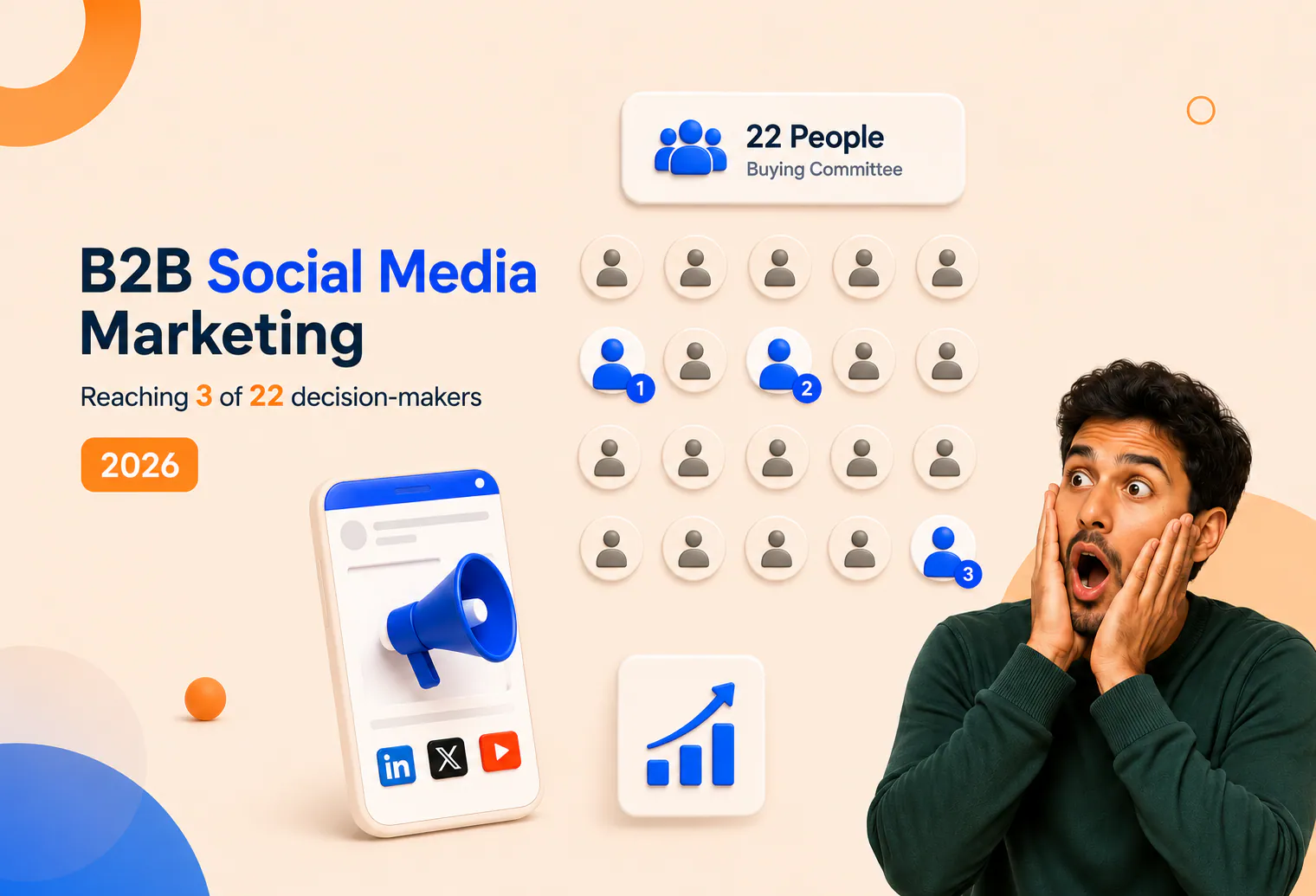
According to Forrester’s State of Business Buying 2026, the typical B2B purchase now involves 13 internal stakeholders and nine external influencers. The full decision network is 22 people. Most B2B social media strategies target one of them usually the title that appears on the demo request form.
“B2B buyers are under immense pressure to justify investments and minimize risk. As buying groups expand and decision cycles grow, B2B marketers must develop dynamic, role-specific insights that capture how buyers evaluate risk, seek information, and define success for their business purchase.”
Barbara Winters, VP and Principal Analyst, Forrester Research
Source: Forrester State of Business Buying, January 2026
The CFO cares about cost-per-outcome. The Head of IT cares about security and integration timelines. The VP Operations cares about deployment speed and daily workflow impact. These are three different people, consuming content on potentially three different platforms, with three different objections to address.
Brands that post generic thought leadership reach no one specifically. Brands that map content to each buying role and distribute it across platforms where each role actually spends time earn position on the shortlist before the first sales conversation begins.
Before planning content, map your buying committee. Then map each person to a platform. Then write to that combination. Everything downstream of this step becomes more effective.
Which Platforms Actually Drive B2B Pipeline in 2026
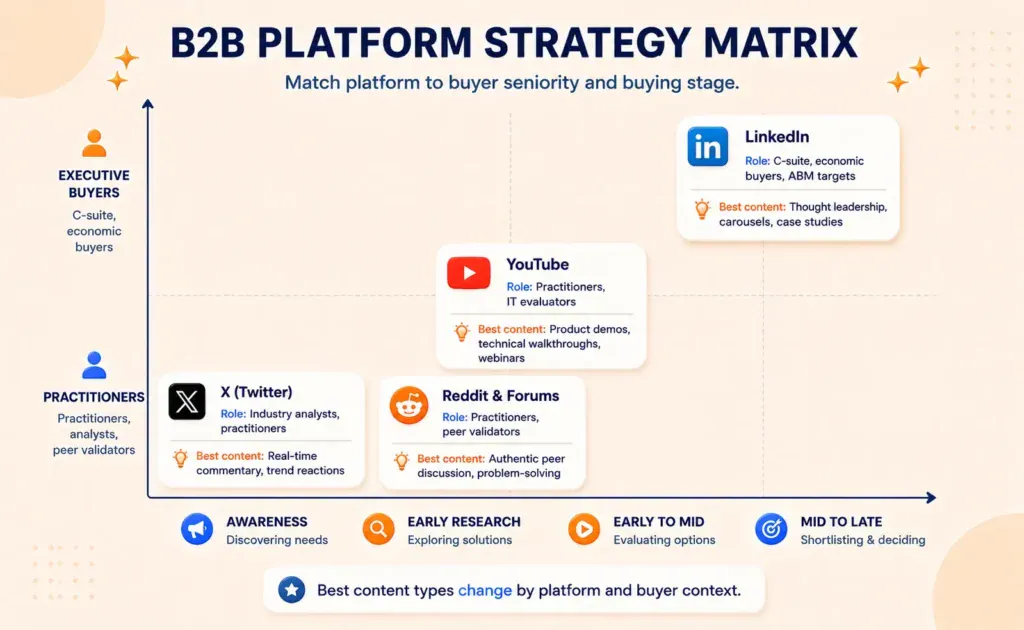
B2B social media marketing works differently across platforms because each platform plays a different role in the buying process. The right channel depends entirely on which buying role you are targeting.
LinkedIn: Where Decisions Get Validated
LinkedIn is the primary B2B platform by a significant margin. Four out of five LinkedIn members drive business decisions at their companies, and exposure to LinkedIn content increases purchase intent by 33%. Every touchpoint matters here the LinkedIn profile, the company page, and the publishing cadence all shape how a buying committee perceives your brand before a sales conversation starts.
YouTube: Where Technical Evaluators Do Their Due Diligence
The practitioner evaluating your product before recommending it upward is on YouTube. Product walkthroughs, integration tutorials, and technical breakdowns address the questions practitioners carry into internal meetings. Skipping YouTube means your brand has no presence at the exact moment the technical champion forms an opinion.
Reddit and Niche Forums: Where Peer Validation Happens
Peer-to-peer validation is a critical late-stage buying signal in B2B. Practitioners ask real questions in Reddit threads and niche forums without vendor interference. A brand with genuine, non-promotional participation builds the kind of trust that paid ads cannot replicate. The difficulty is doing it without triggering the community’s well-calibrated vendor radar.
Platform selection is not about being everywhere. It is about being present where each buying role forms the opinions that shape the final decision.
One question that comes up often: whether LinkedIn or Facebook is worth the budget for B2B. The answer depends on deal size, ICP seniority, and whether you are targeting by job title or by interest graph the two platforms use fundamentally different targeting logic.
B2B Content That Moves Decision-Makers, Not Just Metrics
B2B social media content performs when it directly addresses the information needs of a specific buyer role at a specific buying stage. Four content types consistently do this well.
- Original Research and Data
Proprietary data or aggregated research signals credibility that no amount of generic thought leadership can match. A CFO who reads a benchmarking report you produced will remember your brand when a vendor evaluation begins. One who scrolled past your industry trends post will not.
- Case Studies and Social Proof
87% of B2B buyers rely on content from trusted industry creators to validate their choices, according to Global Web Index research commissioned by LinkedIn in 2024. Anonymized client results and outcome-specific case studies address the objections that stall deals during evaluation.
- Founder-Led and Employee Advocacy Content
People trust people over brand pages. Millennials and Gen Z now account for 71% of B2B buyers, and they consistently engage more with individual voices than with corporate accounts. Executives and subject matter experts sharing real-world perspectives outperform brand posts in reach, trust, and engagement quality.
- Interactive Formats
LinkedIn polls, newsletter content, and Q&A posts generate engagement data that is strategically valuable beyond the engagement number itself. Who responds, what they ask, and what positions they hold are intent signals. Feeding those signals directly into qualified pipeline is where interactive content stops being a vanity play and starts being a revenue input.
The content type that performs best is always the one that answers a real question for a specific buying role. Start there, not with the format.
The 70/30 Rule: What B2B Social Content Actually Looks Like When It Works
The content that builds durable B2B pipeline follows a 70/30 distribution. 70% of posts educate, challenge, or help the audience do their job better. 30% reference the brand, the product, or the offer directly. This ratio is not new. The consistent failure mode is execution under pressure, not ignorance of the principle.
Most B2B teams invert this ratio when pipeline slows. The instinct is to post more promotional content. That instinct produces the opposite result. Promotional content drives unfollows, reduces organic reach, and then reduces the audience for the educational content that actually builds trust.
In our work with B2B SaaS clients, the pattern is consistent: the teams posting three educational pieces to every one brand piece are the ones whose DMs contain inbound pipeline. The teams posting weekly promotions are measuring impressions and calling it brand awareness. The shift is not a creative problem it is a discipline problem. The moment a team commits to the ratio, the inbound quality changes within 60 days.
“Buyers today expect brands to earn the right to make an ask. Educational content is not a nice-to-have. It is the cost of being taken seriously by a modern B2B buying committee.”
A four-post week should break 3-to-1: three educational posts, one brand post. That is the execution standard, not the aspiration.
How to Target a B2B Buying Committee Through Social Media
Effective B2B social programs are organized around buying roles, not content themes.
The process is sequential. Start with your ICP and map the full decision network. For a typical mid-market B2B deal, this includes the economic buyer, the technical evaluator, the internal champion, the compliance reviewer, and the procurement contact. Each person needs different content.
- Map each buying role to the platform they use
Not every platform for every role. Match the content type and distribution channel to where each buying role actually spends professional attention.
- Build a content brief for each role
Write down the three questions each role carries into an evaluation process. Those questions become your content topics. Write about their problem, not your product.
- Use paid social to accelerate ABM reach
78% of businesses using social selling outperform those that don’t, per LinkedIn’s own research. Organic builds authority over time. Paid social on LinkedIn, targeted to specific account lists and buying roles, accelerates the timeline significantly.
- Create feedback loops between social and sales
Sales reps should see who engaged with what content and when. Social engagement is an intent signal. When a Head of Finance at a target account watches a LinkedIn video about cost benchmarks, the sales team should know that before picking up the phone.
The buying committee targeting approach is where B2B social media marketing graduates from a marketing function to a revenue-generating system.
The KPIs That Actually Predict B2B Pipeline
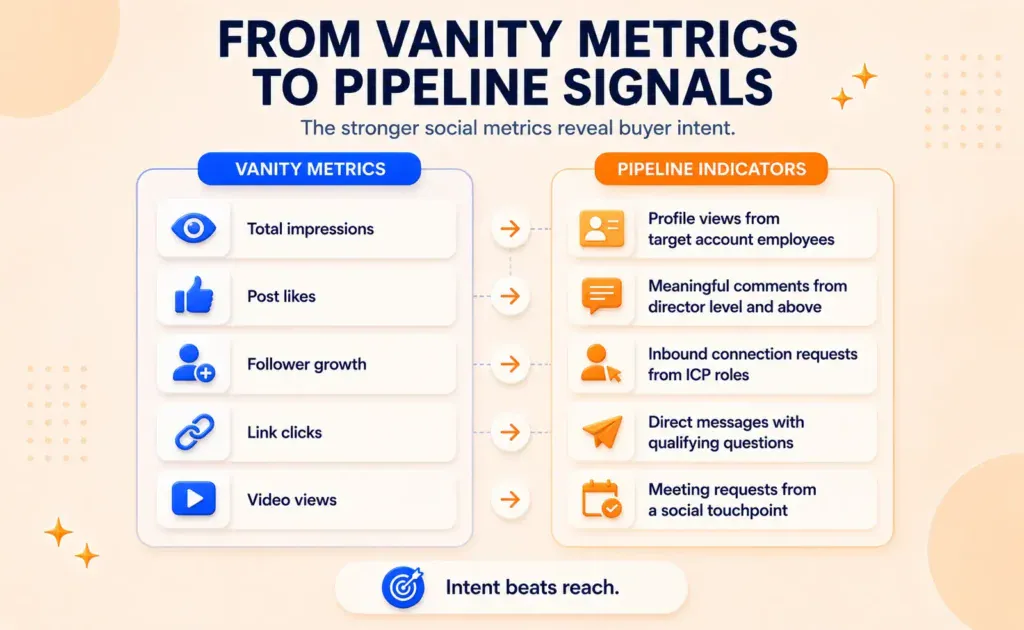
The metrics that matter in B2B social media marketing are not the ones most dashboards show by default.
Authority Signals
Branded search volume is one of the clearest leading indicators that B2B social is working. When prospects encounter your brand on social repeatedly and then search for you directly, they are moving from awareness to consideration. Track this in Google Search Console alongside your posting cadence.
Engagement Quality
One substantive comment from a VP of Finance is worth more than a hundred likes from people outside your ICP. Qualify your engagement, not just the volume. Which job titles are commenting? Which accounts are sharing? Are the right companies appearing in your follower analytics?
Pipeline Attribution
This is the hardest metric to track and the most important one. Use UTM parameters on social-linked CTAs. Track which deals had at least one social touchpoint before a demo was booked. Over time, this data builds a defensible case for social as a pipeline driver rather than a brand-awareness budget line.
How this connects to the broader GTM strategy attribution logic, CRM hygiene, handoff points determines whether social ever shows up in a revenue conversation.
Where Most B2B Social Strategies Break Down Before They Start
B2B social media marketing is not complicated in theory. The gap between teams that make it work and teams that don’t almost never comes down to strategy knowledge. It comes down to three execution failures.
- Inconsistency: B2B social builds through repetition. A buying committee needs multiple touchpoints across multiple formats before a brand becomes a reference point. Teams that post for two weeks and go quiet for a month are invisible by the time a procurement cycle begins.
- Single-channel dependency: Building an entire presence on LinkedIn alone means missing technical evaluators on YouTube, peer validators on Reddit, and practitioners following niche industry forums. Buying committees are distributed. Your presence should reflect that.
- No feedback loop to sales: When social engagement data stays in a marketing dashboard and never reaches the sales team, the pipeline opportunity disappears. The moment a prospect engages with relevant content is a real-time intent signal. Teams that capture and act on it close faster than teams that don’t.
The brands consistently generating inbound through B2B social are not running exceptional campaigns. They are running consistent, audience-specific programs with a direct line to their pipeline targets. Whether that is built by an in-house team or a dedicated growth partner depends on headcount, stage, and how much time leadership can commit to editorial direction.
Build the Social System That Fills Your Pipeline
Most B2B brands already know what good social media strategy looks like. What they are missing is the system to execute it consistently, across every buying role, without pulling their team off the work that drives revenue.
At ThirdMeta, we build B2B social systems that map to buying committees, not just content calendars. We connect social engagement to pipeline attribution, so every decision we make is traceable to revenue, not impressions.
When you are evaluating which B2B marketing agency is the right fit, the questions to ask are about pipeline transparency, attribution methodology, and whether the team has operated inside the verticals you sell into. When you are ready to have that conversation, schedule a strategy call.
Conclusion
B2B social media marketing is not a content production challenge. It is an audience architecture challenge. The goal is to reach the right person, on the right platform, with the right message, before your sales team ever makes contact.
The brands generating consistent inbound from social are not posting more. They are posting to more of the people in the buying room. Start with the committee. Everything else follows from there.
Frequently Asked Questions
B2B social media marketing targets professional decision-makers and operates across long sales cycles that involve multiple stakeholders. B2C targets individual consumers with content designed to drive quick purchasing decisions. The platforms, content types, and success metrics are fundamentally different between the two.

Isha Chaudhari is a content strategist specialising in B2B technology and enterprise software. She writes on AI, finance automation, and the operational challenges facing modern business teams. Her work focuses on making complex technology decisions accessible to the people who have to act on them.