
| Quick Answer: An account-based marketing strategy is a B2B go-to-market approach that treats individual high-value target companies as their own markets, aligning sales and marketing teams to build personalised campaigns for specific decision-makers rather than generating broad lead volume. Key points covered in this article: • Why ABM programmes stall at the content layer, not the technology layer • The 5-step framework for building an ABM strategy that generates qualified pipeline • How ABM execution has shifted in 2026 due to AI content saturation • How to measure ABM success without defaulting to vanity metrics |
B2B SaaS marketing teams that invest in intent data platforms for account-based marketing but leave the content layer generic are spending on targeting precision they then discard. ABM has become the dominant pipeline model for companies with complex, high-ACV sales cycles: 87% of B2B marketers report that ABM delivers higher ROI than any other marketing tactic.
The gap between companies that see that ROI and companies that do not comes down to one variable: what gets served to target accounts once the targeting infrastructure is in place.
This article covers the full account-based marketing strategy framework for B2B SaaS teams. It includes ICP definition, buying committee mapping, content execution, and the failure mode most implementation guides skip entirely. It is built for marketing leaders whose pipeline needs to come from 50 specific companies, not 5,000 anonymous site visitors.
TL;DR
- ABM starts with a target account list agreed on by sales and marketing. Campaign planning comes after, not before.
- Most ABM programmes fail at the content layer: intent data identifies who to reach, but generic content gives target accounts no reason to respond.
- Tier 1 ABM requires content specific to each account’s industry, tech stack, and buying committee role.
- In 2026, original research and practitioner-level specificity are the minimum threshold for ABM content that moves senior B2B buyers.
- Measure ABM success through account engagement scores and Tier 1 pipeline coverage, not MQL volume or site traffic.
- ABM is not right for every B2B SaaS company. It pays off when ACV and sales cycle length justify the per-account content investment.
What Is Account-Based Marketing Strategy and Why Are B2B SaaS Teams Replacing Traditional Lead Gen With It?
Account-based marketing strategy is a go-to-market model where sales and marketing agree on which companies to target before any campaign begins, then build every content asset, ad, and outreach sequence around that fixed list. Unlike inbound marketing, which generates high lead volume and then filters, ABM starts with the filter. The result is higher deal sizes, shorter sales cycles, and a marketing budget concentrated on accounts that already fit the ICP.
The structural tension in traditional B2B lead generation is well-documented: marketing is measured on MQL volume, while sales ignores most of those leads to pursue the 30 to 50 accounts in their quota. ABM resolves this by making the target account list the shared foundation of both functions. Sales stops waiting for leads worth calling, and marketing stops producing content for audiences that will never convert.
ABM operates across three tiers based on deal value and resource intensity. Understanding which tier to apply at which account is the first real decision in any account-based marketing strategy.
Strategic ABM (One-to-One): Fully personalised campaigns for a small list of ultra-high-value accounts. Custom research, dedicated landing pages, and account-specific outreach sequences. Most effective for deals above $100K ACV.
ABM Lite (One-to-Few): Campaigns targeting clusters of 15 to 50 accounts with shared firmographic characteristics. Personalised at the segment level, not the individual account level.
Programmatic ABM (One-to-Many): Technology-driven targeting across hundreds of accounts using intent data and automated personalisation. Effective when deal size is lower and the target account list is broad.
For B2B SaaS companies at the Series A to Series C stage, the most common starting point is ABM Lite. It provides enough personalisation to differentiate from generic outreach without requiring the full content investment that Strategic ABM demands per account. Most teams scale to Strategic ABM for their top 10 to 20 accounts once the programme is running and the content operation is in place.
What shifts as you move up the tiers is not the goal but the depth of content investment required per account. What makes account-based marketing strategy work is not the model itself. It is whether the content built for each tier is specific enough to be worth opening.
Why Your ABM Program Is Stalling (It Is Not Your Intent Data Platform)
The problem most ABM guides do not address
The standard ABM narrative runs like this: buy intent data, define the ICP, build a target account list, activate ads and sequences, and watch pipeline grow.
This is the technology-first version of ABM, and it produces most of the programme failures B2B SaaS marketing teams experience in the first 90 days. Intent data identifies which companies are researching your category. It does not tell those companies why your solution fits their specific environment.
The actual failure point is the content layer
Most B2B SaaS companies running an account-based marketing strategy serve target accounts the same case studies, generic product pages, and broad thought leadership content they use for every other prospect in the funnel. The targeting is account-specific. The content is not. A Head of IT at a 300-person manufacturing company receiving a blog post titled “Five Benefits of Operations Software” experiences the same thing as every other contact in the database.
| “Most B2B companies are running two completely different plays simultaneously. Marketing is generating thousands of MQLs while sales ignores 90% of them to focus on the 50 accounts they actually care about. ABM is simply the acknowledgment that sales was right all along.” |
87% of B2B marketers with ABM programmes report higher ROI than any other marketing tactic. Yet most ABM programmes fail to produce qualified pipeline in the first 90 days.
What this means before you upgrade the platform
The intent data subscription, the SDR sequences, the LinkedIn ad budget: all of it depends on content specific enough to move a senior buyer who receives 40 vendor messages per week.
Before purchasing 6sense or Demandbase, the more pressing question is whether the content operation behind the technology produces anything worth reading when the right person finally shows up. For B2B SaaS teams deciding whether to build this content function internally or with an agency, this breakdown of in-house vs. agency marketing covers the real tradeoffs.
Because apparently, subscribing to intent data and then sending the same whitepaper to every flagged account is the industry’s preferred route to a flat pipeline dashboard.
| If your intent data is pointing at the right accounts and your pipeline is still flat, the issue is almost certainly the content brief. ThirdMeta diagnoses and fixes this in a 30-minute call. |
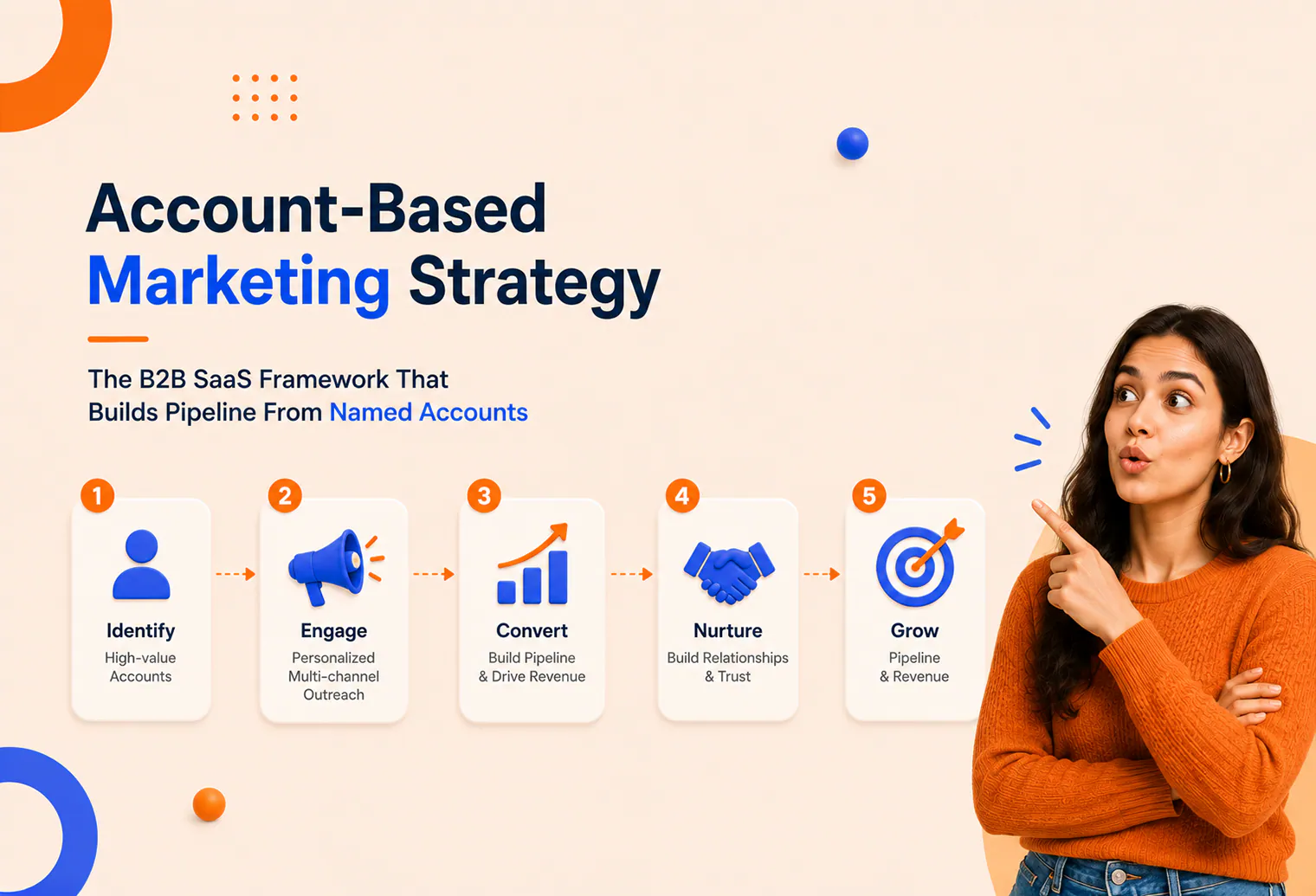
How to Build an Account-Based Marketing Strategy: The 5-Step Framework
Building an account-based marketing strategy starts with account selection, not campaign design. The most common implementation mistake is beginning with channel planning before the account list is agreed on by both sales and marketing. The steps below reflect what B2B SaaS companies with $30K to $150K ACV products consistently follow when ABM generates pipeline within the first 60 days.
In our work with B2B SaaS companies building ABM programmes from scratch, the teams that generate pipeline fastest spend more time on steps 1 and 2 than most teams spend on the entire programme. What generates qualified conversations early is almost always account selection quality and content brief specificity, not channel choice.
Step 1: Define the ICP at the Firmographic and Technographic Level
Your ICP is not “mid-market SaaS companies.” It is “Series B SaaS companies between $15M and $50M ARR, selling to operations or IT buyers, with 50 to 200 employees, currently using a point solution the VP Operations wants to replace.” The more specific the ICP, the more account selection becomes a filter rather than a judgment call.
Step 2: Build and Tier the Target Account List
Start with your ten best-fit existing customers. Identify the firmographic and technographic attributes they share, then find 50 to 200 companies that match.
Tier them: Tier 1 receives Strategic ABM (full account personalisation), Tier 2 receives ABM Lite (segment personalisation), Tier 3 receives programmatic outreach. The list must be signed off by sales before any campaign begins.
Step 3: Map the Buying Committee, Not Just the Decision-Maker
According to Gartner, the average B2B purchase involves 6 to 10 stakeholders, each conducting independent research and bringing back conflicting information to the group. An account-based marketing strategy that targets only the contract-signer misses the IT Head who flags implementation risk, the CFO who challenges TCO, and the end-user team whose adoption determines renewal.
The content implications are significant. A technical buyer needs deployment architecture, integration compatibility, and security documentation. A business buyer needs ROI modelling, case studies from comparable companies, and a deployment timeline that does not disrupt current operations. Procurement needs contract terms and vendor viability evidence. Mapping one piece of content to all three roles fails with all three.
Step 4: Create Account-Tier-Specific Content
This is the step that separates ABM from demand generation with better targeting. Tier 1 accounts need content referencing their specific industry, their known tech stack, and their growth stage. A personalised landing page for a fintech of similar size outperforms a generic case study every time. For a detailed breakdown of how to build content that supports account-level progression, see ThirdMeta’s B2B content marketing strategy guide.
Step 5: Sequence Outreach Channels Around Buying Committee Stages
LinkedIn builds familiarity with senior decision-makers before SDR outreach begins. Intent data signals indicate when accounts enter active research mode. Email works for direct pipeline conversations once the account recognises the brand.
Paid advertising across LinkedIn supports all three stages. The channel mix shifts as the account moves through buying committee stages, not based on what the marketing team prefers to run.
The output of these five steps is a target account list, a buying committee map, a content brief by account tier, and a channel sequence. Campaign launch comes after this foundation exists, not before. For teams building this alongside a wider go-to-market motion, ThirdMeta’s SaaS GTM strategy guide covers how ABM fits into the full growth model.
| Ready to build the content layer behind your ABM programme? Start with a 30-minute scoping call with ThirdMeta. |
What Has Changed in Account-Based Marketing Strategy in 2026?
In 2026, the most significant shift in account-based marketing strategy execution is the collapse of generic personalisation as a conversion driver. AI-generated content has saturated every B2B category, and senior buyers (VPs, CTOs, and Heads of Operations) receive outreach that is technically personalised at the surface level but identical in substance. Inserting the company name and industry vertical into a template is not ABM. It is mass email with extra steps.
Three shifts define effective account-based marketing strategy execution in 2026. Each one points in the same direction: the content operation behind the ABM programme now determines outcomes more than the technology stack.
1. Original Research Has Become the Minimum Bar for Tier 1 Outreach
Tier 1 account outreach that contains data or insight the recipient cannot find elsewhere generates responses that templated content does not. This means primary research, client-specific benchmarks, or analysis of the account’s own publicly available signals. “Relevant to your industry” no longer passes as personalisation. “Specific to your situation” is the new standard.
2. AI Overview Visibility Is Now an ABM Channel
Senior buyers research vendors using AI tools before any human contact begins. B2B SaaS companies that appear in Google AI Overviews and ChatGPT responses for their category queries generate top-of-funnel brand awareness with target accounts without paid spend. For ABM teams, this means content strategy and account targeting now operate as one function. For a breakdown of how to appear in AI Overviews for B2B SaaS queries, see ThirdMeta’s guide to ranking on AI Overview.
3. Buying Committee Research Has Moved to Private Channels
LinkedIn dark social, Slack communities, and private forums are where buying committees share vendor recommendations before formal evaluation begins. ABM programmes focused exclusively on paid channels and direct outreach miss 60 to 70 percent of the buying decision that happens before any form is submitted. Thought leadership distributed through community channels now functions as a direct ABM tactic, not a brand exercise.
These three shifts point to the same conclusion: building an account-based marketing strategy in 2026 requires a content operation capable of producing original, account-tier specific, AI-citation-ready material. A quarterly blog calendar running on generic SEO briefs does not qualify.
Which ABM Tactics Actually Generate Pipeline for B2B SaaS?
Account-based marketing tactics generate pipeline when sequenced around buying committee stages, not deployed simultaneously at programme launch. The most common tactical failure is activating all channels at once and treating awareness, consideration, and decision-stage outreach as a single campaign. The table below maps what generates qualified pipeline for B2B SaaS companies with $25K or higher ACV.
The key distinction across every tactic below: each one is a distribution mechanism. The content it distributes determines whether the tactic converts or wastes budget.
| Tactic | Best Use Case | Buying Committee Stage |
| LinkedIn Thought Leadership | Building brand familiarity with VP and C-level buyers before SDR contact | Awareness |
| Intent Data Monitoring | Identifying when target accounts enter active research mode | Awareness to Consideration |
| Account-Specific Landing Pages | Converting inbound visits from named target accounts | Consideration |
| Personalised Sales + Content Sequences | Multi-touch outreach combining relevant content with a direct ask | Consideration to Decision |
| Personalised Video Outreach | Breaking through to senior Tier 1 buyers who do not respond to email | Decision |
| Executive Roundtables (Virtual) | Building buying committee trust in a pre-sale format | Decision |
| LinkedIn Paid (Matched Audiences) | Reinforcing brand presence during active vendor evaluation | Consideration to Decision |
The tactics in the top half of this table are consistently underfunded relative to the bottom half. Most ABM programmes overspend on LinkedIn ads and underspend on the content assets those ads link to. For B2B SaaS teams deciding which paid social channels deserve ABM budget, this comparison of LinkedIn vs. Facebook for B2B covers where mid-market buyers actually engage.
Sequencing matters as much as channel selection. Running LinkedIn thought leadership to a Tier 1 account for four weeks before the first SDR touch produces a materially different response than cold outreach with no prior brand contact. The sequence is not optional: it is the mechanism that converts a cold account into a warm conversation. For a Tier 1 account, the typical warming period before a direct pipeline conversation is 6 to 8 weeks.
An intent signal from a Tier 1 account is only valuable if the follow-up content is specific enough to open a real conversation. An account-specific landing page that leads with a generic value proposition converts at the same rate as a standard page. The ABM tactic gets the attention. The content either earns the conversation or ends it.
How Do You Measure Account-Based Marketing Strategy Without Defaulting to Vanity Metrics?
Account-based marketing strategy measurement fails when teams apply demand generation metrics to an ABM programme. MQL volume, website sessions, and email open rates are activity metrics. They do not show whether the right decision-makers inside target accounts are progressing toward a sales conversation.
What Is an Account Engagement Score and How Do You Track It?
An account engagement score measures how many individuals within a target account are interacting with your brand across channels over a defined period. A single VP reading one blog post is low engagement. Three members of the buying committee across two departments engaging with content over four weeks is a pipeline signal.
Most ABM platforms calculate this automatically. It can also be tracked manually across LinkedIn analytics, site data, and email for teams not yet on a dedicated platform.
What Pipeline Coverage Should You Target From Your ABM List?
Pipeline coverage by tier measures what percentage of your Tier 1 and Tier 2 account list has an active sales conversation open. Most B2B SaaS ABM programmes target 30 to 40 percent of the Tier 1 list in active pipeline at any given time.
Pipeline coverage significantly below this threshold points to one of two problems: account selection (accounts not genuinely in-market) or content quality (accounts brand-aware but not engaging enough to enter a conversation).
How Do You Compare ABM Deal Velocity to Non-ABM Pipeline?
According to McKinsey, companies that deliver genuinely personalised content and outreach report significantly higher conversion rates and shorter sales cycles than those relying on generic campaigns. If deals originating from target accounts are not closing faster than non-ABM pipeline, the account selection or the content execution needs revision, not the channel mix.
ABM is not the right model for every B2B SaaS company. If your ACV is below $10K and your sales cycle runs under 30 days, inbound and product-led growth generate better returns at lower cost. ABM’s economics work when deal size and sales cycle length justify the content and coordination investment required per account. For B2B SaaS teams building a full marketing strategy, ThirdMeta’s marketing strategy guide for B2B startups covers where ABM fits in the broader growth model.
Why ThirdMeta?
B2B SaaS companies running ABM programmes without a content engine behind them are targeting the right accounts with the wrong material. The platform investment, the SDR sequences, the LinkedIn ad budget: all of it depends on content specific enough to move a VP of Engineering who receives 40 vendor messages per week. ThirdMeta builds the content layer that makes account-based marketing strategy generate pipeline.
ThirdMeta’s ABM content work includes:
- Account-tier content briefs: Content mapped to Tier 1 and Tier 2 account characteristics, not generic buyer personas.
- AI Overview and GEO-optimised content: Built to appear in AI-generated search results when target accounts research your category.
- Original research and data assets: The personalisation layer that separates your outreach from every other vendor targeting the same 50 accounts.
- Buying committee content mapping: Separate assets for the VP, the IT Head, and the Procurement Lead. Not one message repurposed for three roles.
ThirdMeta works exclusively with B2B SaaS companies. Content goes from brief to published in 7 to 10 business days, built to rank in search, appear in AI Overviews, and convert when a target account buyer reads it.
- vs. Single Grain or WebFX: ThirdMeta writes exclusively for B2B SaaS ICPs, not retail, DTC, or generalist B2B verticals where ABM content depth is rarely required.
- vs. Siege Media or Animalz: ThirdMeta’s content is built to generate qualified pipeline for long-cycle B2B sales, not to hit monthly traffic targets with informational volume content.
- vs. building in-house: ThirdMeta provides SEO, GEO, and ABM content expertise without the 4 to 6-month hiring cycle to staff the equivalent function.
| Book a 30-minute scoping call and see what ThirdMeta builds for B2B SaaS ABM teams. Book your call here. |
Conclusion
Account-based marketing strategy generates pipeline when the targeting precision of the technology stack is matched by the specificity of the content layer. Companies that invest in Demandbase or 6sense without investing in content that a VP of Engineering at a Series B fintech would find worth reading are not running ABM. They are running expensive demand generation with account filters applied.
B2B SaaS companies generating consistent pipeline from ABM in 2026 share one operational reality: their content team and their sales team read from the same account list. That alignment does not happen automatically. It requires a content operation built around account tiers and buying committee stages from the start, not adapted from a demand generation playbook after pipeline fails to appear.
Frequently Asked Questions
Account-based marketing strategy is a B2B approach that targets individual high-value companies as distinct markets. Sales and marketing align around a shared account list and build personalised campaigns for specific decision-makers. ABM works best for B2B SaaS companies with ACV above $15K and sales cycles longer than 45 days.

Isha Chaudhari is a content strategist specialising in B2B technology and enterprise software. She writes on AI, finance automation, and the operational challenges facing modern business teams. Her work focuses on making complex technology decisions accessible to the people who have to act on them.