
| Quick AnswerA B2B growth marketing agency should connect buyer research, demand capture, content, conversion paths, and sales feedback to qualified pipeline. The strongest partners run a visible learning loop, so each page, message, or campaign produces evidence that changes the next commercial decision. |
A B2B growth marketing agency is worth hiring only when it can identify why a buyer hesitates and design a test that removes that hesitation. Deliverables matter, but a calendar of activity does not explain whether search, content, paid acquisition, and conversion work are helping the same buying decision.
The current buyer environment makes generic campaigns riskier: Gartner reported that 61% of B2B buyers prefer a rep-free experience and 73% avoid irrelevant outreach. Forrester reported that 86% of purchases stall and 81% of buyers are dissatisfied with their chosen provider.
That gives a growth partner a tighter job. It must help buyers find useful evidence without pressure, then help sales enter the conversation when context and judgment actually matter.
Ask these before you shortlist an agency:
- Are we getting traffic but not enough qualified conversations?
- Do our campaign reports explain activity but not buyer progression?
- Can the agency show how it will test our biggest commercial assumption?
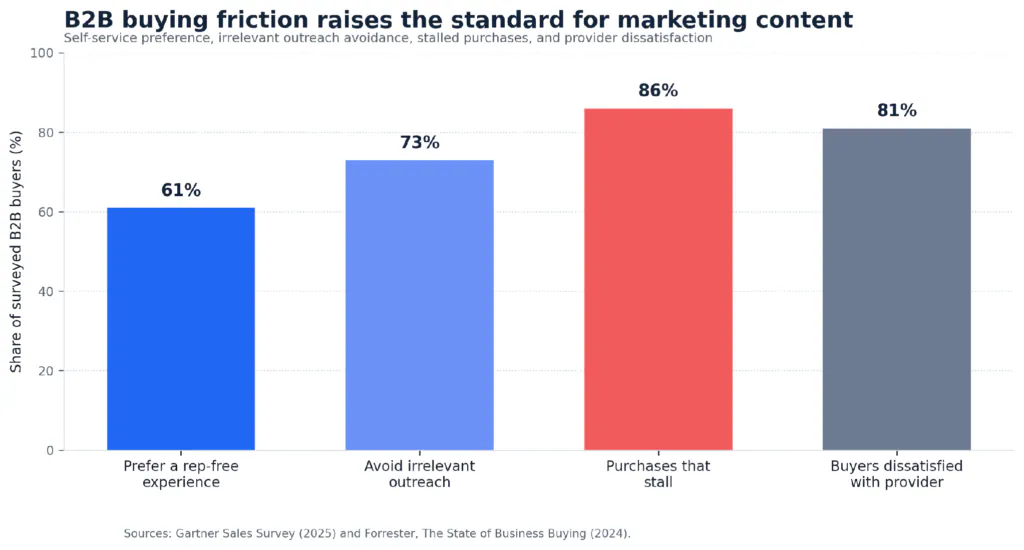
Figure 1. Buyer friction turns self-qualification into a revenue requirement. Sources: Gartner Sales Survey (2025) and Forrester, The State of Business Buying (2024).
| “Instead of offering generic information that buyers can find elsewhere, sellers should offer unique guidance, acting as a sounding board for buyers.”Alice Walmesley, Director Analyst, Gartner | Source: Gartner Sales Survey, 2025 |
TL;DR
- A campaign is only useful when it tests a buyer hypothesis and changes the next decision.
- The right agency fit depends on the growth constraint, not on the longest service menu.
- Search pages, proof, paid messages, sales feedback, and conversion paths should operate as one system.
- Shortlist agencies by how they handle failed tests, not only by their strongest case study.
- Traffic becomes pipeline only when high-intent buyers can self-qualify and see a credible next step.
- An agency review should leave you with a prioritised experiment backlog, not a generic proposal.
What Should a B2B Growth Marketing Agency Actually Own?
A B2B growth marketing agency should connect market signal to commercial action. For a CMO facing high traffic but low demo quality, that means tracing the buyer path from query to proof, conversion, and sales acceptance.
A practical SaaS SEO strategy is therefore not a traffic project in isolation. It should show which high-intent queries need decision pages, which pages need stronger proof, and where a buyer needs a low-friction route to a serious conversation.
| Growth area | Campaign delivery | Experiment-led growth |
|---|---|---|
| Search | Publishes around a keyword list. | Maps buyer questions to commercial pages and next actions. |
| Content | Fills a monthly calendar. | Builds proof, comparisons, and objection coverage around buyer decisions. |
| Paid media | Optimises lead cost. | Tests account fit, message clarity, landing-page relevance, and sales feedback. |
| Conversion | Changes forms and buttons. | Finds where an evaluator loses confidence or cannot self-qualify. |
| Reporting | Tracks impressions and form fills. | Explains what buyer behaviour changed and what the team should test next. |
The connection is where most growth programs fail. B2B SaaS content marketing works when the article, page, or asset answers a buyer question that the product page and sales call cannot answer alone.
Why Campaign Calendars Rarely Create Compounding Pipeline
Campaign calendars generate output, but output does not automatically create learning. A Head of Growth needs a hypothesis behind each article, paid message, or landing-page change.
More channels do not fix a weak pipeline when intent, positioning, proof, and conversion path do not agree on who the buyer is.
1. Name the buyer situation
Define the role, trigger, and commercial fear in plain language. “Need more leads” is not a situation; “enterprise buyers read comparison pages but never book a technical review” is.
2. State the testable hypothesis
Define the change that should reduce friction. The claim might be that a side-by-side alternative page, stronger use-case proof, or a different CTA will help the evaluator progress.
3. Agree on the revenue evidence
Choose evidence that sales can recognise, such as better fit, stronger problem awareness, or a clearer reason for a buyer to continue. Do not let clicks become the only argument that the work is helping.
This is also why AEO and GEO work should be linked to the buying journey rather than run as a separate technical initiative. AI visibility is valuable when it leads a suitable buyer to a page that can resolve the next commercial question.
9 B2B Growth Marketing Agencies to Evaluate
This alphabetical list is a shortlist, not a universal ranking. Each agency should be assessed against your immediate revenue constraint, the buyer motion you need to improve, and the proof you expect before extending an engagement.
| Important Selection RuleThe title is an editorial lens, not a claim that every agency uses the same documented experiment method. Ask every finalist to show how a failed test changes its next recommendation. |
1. Accelerate Agency
Consider when technical SEO and category visibility constrain inbound demand. Ask how technical fixes, commercial pages, authority work, and conversion review will work together.
2. Directive Consulting
Consider when paid acquisition needs tighter accountability to opportunity creation. Ask how paid insight will change the landing page, sales enablement, and next test.
3. Kalungi
Consider when a SaaS company needs marketing leadership alongside execution. Ask how positioning and customer research become an experiment backlog the internal team can sustain.
4. Omniscient Digital
Consider when content must educate an informed SaaS buyer. Ask whether it covers evaluator pages, sales objections, and pre-call proof.
5. Perceptric
Consider when content must carry more of the commercial narrative. Ask how buyer research, comparison intent, and sales questions shape the conversion path.
6. Single Grain
Consider when broader acquisition support is needed. Ask who owns the cross-channel learning loop, because a wide service menu does not create shared accountability by itself.
7. Skale
Consider when organic growth needs sharper commercial measurement. Ask how the team separates pages that attract readers from pages that attract the right buying group.
8. ThirdMeta
Consider when the gap sits between search, AI visibility, content, conversion, and buyer confidence. The work starts with the existing search footprint and sales reality, then finds the main leak blocking buyer movement.
9. TripleDart
Consider when high-intent SEO is central to growth. Ask how keyword research, content, authority work, and conversion review will become one program.
The shortlist should shrink after the first conversation. A credible partner can explain the buyer problem, the evidence needed, the proposed test, and what changes if it fails.
B2B Growth Agency vs In-House Team vs Point Specialist
A B2B growth marketing agency is not always the right operating model. Choose based on whether the constraint is missing capacity, specialist knowledge, clear strategy, or shared channel ownership.
The right option removes the real bottleneck without creating a second reporting layer. An outside partner should challenge assumptions that have become invisible inside the business.
| Operating model | Best fit | Watch for |
|---|---|---|
| In-house team | Clear strategy, stable internal capacity, and easy access to product and sales insight. | Busy execution can continue without a fresh view of the buyer friction. |
| Point specialist | One defined problem, such as technical SEO, paid search, or conversion research. | Learning can stay inside one channel and never change the wider demand program. |
| Growth agency | Connected issues across search, content, acquisition, conversion, and sales feedback. | The work can turn into output production without explicit commercial ownership. |
For example, a conversion rate optimisation review matters most when high-intent visitors reach the site but lack enough clarity or proof to take the next action. Adding more traffic before fixing that loss point may only make the problem more expensive.
Use the Search-to-Pipeline Relevance Scorecard Before You Sign
The most useful agency conversation happens before a proposal is written. This scorecard makes the buyer journey visible, so a founder or CMO can determine whether the problem is visibility, intent alignment, proof, conversion, or attribution.
Use the prompts to assess your current program and every agency finalist. A strong answer is not a polished framework; it is a clear explanation of what the team will inspect, what evidence it will collect, and what decision will follow.
| Question to test | Absent | Partial | Strong |
|---|---|---|---|
| Can we name the high-intent buyer questions? | Keyword list only. | Some use cases covered. | Queries mapped to distinct buyer situations. |
| Does every key page have a next action? | Generic CTA or no route forward. | Some relevant next steps. | Each page has a logical commercial progression. |
| Do pages address sales objections? | Objections live only in calls. | Mentioned in scattered pages. | Proof and comparison pages pre-answer the highest-friction questions. |
| Can reporting guide the next experiment? | Channel metrics only. | Leads are tracked. | Source, fit, behaviour, and progression inform the next decision. |
| Does distribution support the buyer journey? | Publish and wait. | Occasional promotion. | Each asset has a specific audience, channel, and follow-up use. |
A content distribution plan should follow the same logic. Distribution is not simply posting a link; it is the deliberate use of the right message, channel, and asset for a buyer who needs a specific kind of evidence.
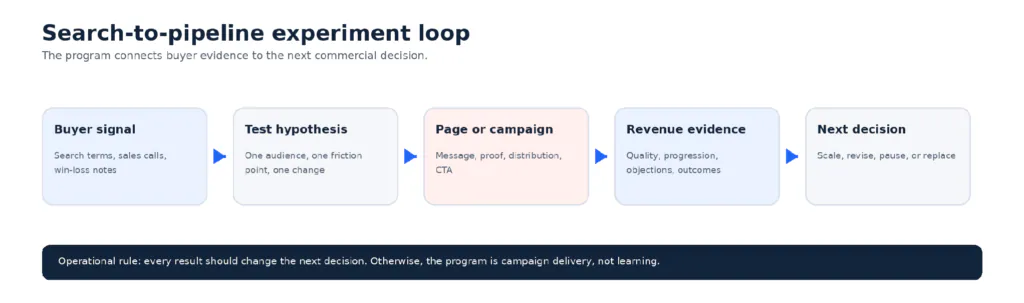
Figure 2. Search-to-pipeline experiment loop. Source: ThirdMeta working framework.
What If Your Agency Creates Activity but No Buyer Movement?
Activity without buyer movement usually means the program is optimising a visible metric that does not represent commercial progress. The warning signs are familiar: more impressions, more content, cheaper leads, or better engagement while sales conversations remain unchanged.
This is where an agency should show its operating maturity. It should trace the result back to the original hypothesis, identify the break in the buyer path, and recommend whether the team should revise, pause, or replace the work.
| What the report says | What may be happening | The next question |
|---|---|---|
| Traffic is growing | Broad content is attracting readers with no active buying context. | Which queries and pages introduce the right buyer to a commercial next step? |
| Lead volume is rising | Form fills are increasing while fit or intent is falling. | What does sales say about problem awareness and account relevance? |
| Content output is high | Evaluators still cannot find proof, comparison, or implementation detail. | Which objection is forcing buyers back into research? |
| Paid lead cost is improving | The ad promise and landing-page message are no longer aligned. | Does the landing page answer the exact question that earned the click? |
When content is visible but not changing sales confidence, start with a content optimisation review rather than another publishing sprint. The work may need a new decision page, evidence from product or sales, a stronger comparison path, or a different category position.
How ThirdMeta Approaches an Experiment-Led Growth Program
ThirdMeta starts with the buyer journey and search footprint already present, not a generic content calendar. The work connects intent, category positioning, content, AI visibility, conversion, sales objections, distribution, analytics, and CRO to the current pipeline gap.
The team identifies whether the leak is discoverability, intent mismatch, weak proof, page friction, or attribution, then runs the smallest credible test needed to find the next answer.
For a SaaS team that needs a clearer demand system, this could combine B2B SaaS lead generation with organic lead-generation channels and the content or conversion changes required to make that attention useful. The objective is not more marketing activity; it is a better share of relevant buyers who discover, trust, evaluate, and convert.
| Primary CTATalk to ThirdMeta about a growth opportunity review built around your existing search footprint, content gaps, buyer journey, and conversion path. The first conversation should clarify the commercial leak and the next test, not lock you into a generic scope of work. |
Start a growth opportunity review | No commitment and no generic proposal before the problem is defined.
Conclusion
The best B2B growth marketing agency is not the one with the longest service list. It is the one that can name the buyer problem, state the hypothesis, identify the evidence, and change course when a result does not support the original assumption.
For a B2B SaaS team, that means choosing a partner that connects demand creation with buyer confidence and pipeline progression. The next agency conversation should begin with the commercial leak you need to fix, not the campaign you think you need to run.
FAQs
A B2B growth marketing agency connects acquisition, buyer education, conversion paths, and sales feedback. It should test what improves qualified pipeline, rather than simply execute isolated campaigns.
Choose an agency based on the commercial constraint that is limiting growth now. Ask how it identifies buyer friction, runs experiments, and uses sales evidence to decide what changes next.
A SaaS company should hire a growth marketing agency when ownership is fragmented or learning has slowed. It is often useful when traffic grows but demos, sales acceptance, or opportunity quality does not.
A B2B growth agency should review fit, sales acceptance, buyer progression, page behaviour, and opportunity creation. Raw lead volume is incomplete when the target buyer never becomes a serious sales conversation.
SEO can create qualified B2B pipeline when search intent, content depth, proof, and conversion paths align. It cannot independently fix unclear category positioning, weak product evidence, or a broken landing-page experience.
Ask the agency to describe one buyer situation, one hypothesis, one source of evidence, and the next decision if the test fails. A clear response shows more operating discipline than a long list of deliverables.

Founders Office
Drushti Gothi is a Growth Strategy and CRO Lead at ThirdMeta, specialising in conversion-focused digital experiences, B2B growth, and audience engagement. She combines strategic thinking, experiential design, and an understanding of user behaviour to help businesses strengthen their online presence and turn traffic into meaningful results. Through her content, Drushti shares practical insights on SEO, conversion optimisation, digital strategy, and building scalable growth systems.