Quick Answer
Organic lead generation channels for B2B SaaS are unpaid growth channels that attract, educate, and convert buyers without depending on ad spend. The strongest mix includes SEO, BOFU content, LinkedIn thought leadership, AI search visibility, product-led growth, review sites, communities, partnerships, webinars, email nurture, and referrals.
The right mix depends on ACV, sales cycle, ICP maturity, and buyer risk. A SaaS team should not ask, “Which channel is popular?” It should ask, “Which channel removes the buyer’s next objection?”
TL;DR
- SEO and BOFU content work best when pages target demo-ready queries, not only traffic keywords.
- LinkedIn converts when founder POV, category education, and customer proof connect to sales follow-up.
- AI search visibility now matters because buyers ask ChatGPT, Gemini, and Google AI Overview before visiting vendor websites.
- Review sites, Reddit, Slack groups, and communities influence buyers who do not fully trust vendor content.
- ThirdMeta connects every organic channel to ICP, funnel stage, conversion path, and CRM attribution before scaling content.
B2B SaaS teams do not have a traffic problem as much as they have a pipeline trust problem. That is why organic lead generation channels for B2B SaaS must do more than bring visitors to a blog.
Buyers now research across Google, AI chatbots, LinkedIn, Reddit, review sites, newsletters, and peer networks before speaking to sales. Forrester reported that 86% of B2B purchases stall during the buying process, which means the content gap is about helping buyers move forward with confidence.
At ThirdMeta, we treat organic growth as a pipeline system, not a content calendar. That means SEO, content, distribution, social proof, and conversion pages must connect to one buyer journey, especially for SaaS teams building a serious B2B SaaS lead generation system.
What Search Intent Says About This Keyword
The search intent behind “organic lead generation channels for B2B SaaS” is commercial informational. Readers want a channel list, but they also want to know which channels produce qualified demos without paid ads.
The AI Overview screenshots from the USA and India both highlight SEO, content marketing, LinkedIn thought leadership, PLG, niche communities, co-marketing, and review sites. That tells us Google reads this topic as a channel-prioritization query, not a beginner definition query.
| Search pattern | What it covers | What our blog adds |
| Organic channel list | SEO, LinkedIn, webinars, communities | Channel selection by buyer stage |
| Lead generation guide | MQLs, SQLs, funnels, personas | Pipeline attribution and sales readiness |
| Organic vs paid article | Cost comparison and traffic quality | How to reduce paid dependency |
| 90-day organic plan | SEO sprint and tracking | Multi-channel conversion architecture |
This matters because a $3,000 ACV self-serve SaaS should not use the same organic mix as a $40,000 ACV platform selling to CFOs. The channel is not the strategy. The buyer path is the strategy.
Organic Lead Generation Channel Priority Chart
The best organic channel is the one that matches the buyer’s current decision stage. SEO captures active demand, LinkedIn creates trust, communities validate decisions, and review sites reduce perceived risk.
The chart below is a ThirdMeta prioritization model for SaaS teams that want pipeline, not only impressions. It helps decide where to invest first when resources are limited.
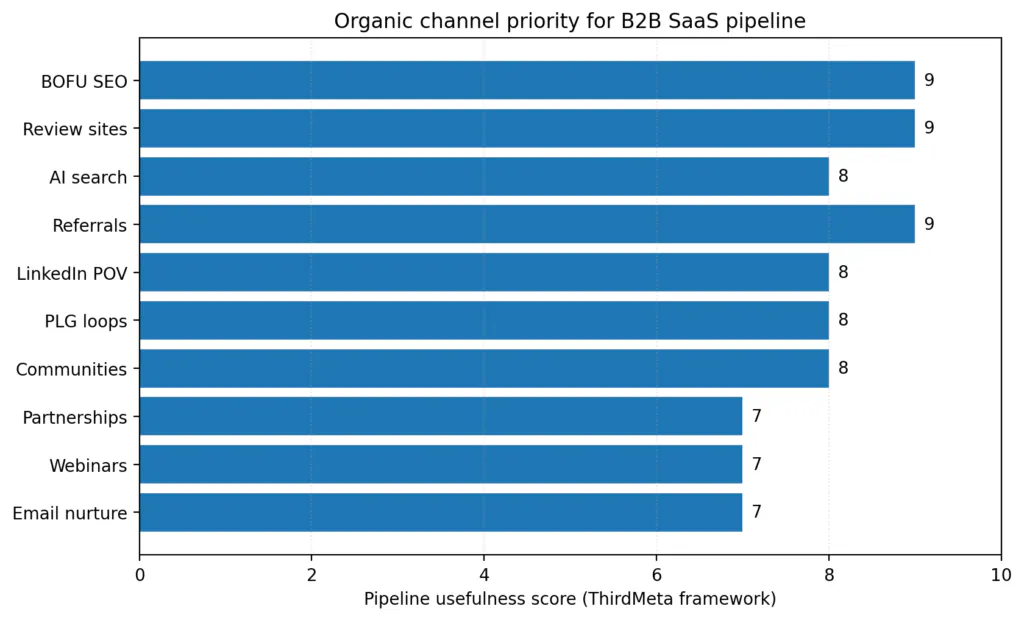
Figure 1: ThirdMeta framework chart for ranking organic channels by pipeline usefulness. Scores are planning weights, not market averages.
1. SEO and BOFU Content: Capture Buyers Already Searching
SEO is one of the strongest organic lead generation channels for B2B SaaS because it captures buyers with active intent. The channel works best when content targets use-case, comparison, pricing, integration, and problem-aware queries.
The mistake is treating SEO as a publishing volume game. Ahrefs reports that 96.55% of all pages get zero organic search traffic from Google, so most content assets never create demand or pipeline.
For SaaS companies, strong SEO pages answer questions that happen before a demo request. These include “best software for,” “alternative to,” “how to solve,” “pricing,” “integration with,” “template,” and “ROI calculator” queries.
At ThirdMeta, we build SEO around demo-intent clusters first. That is why our SaaS SEO strategy guide focuses on qualified pipeline rather than ranking reports alone.
| BOFU page type | Buyer intent | Conversion asset |
| Alternative page | Frustrated with current tool | Migration checklist |
| Use-case page | Needs a workflow fix | Demo-ready workflow map |
| Integration page | Needs stack compatibility | Integration matrix |
| Comparison page | Shortlisting vendors | Evaluation scorecard |
| Pricing guide | Needs budget approval | ROI breakdown |
2. LinkedIn Thought Leadership: Turn Founder POV Into Demand
LinkedIn thought leadership works when it gives buyers a reason to trust the people behind the product. It fails when every post sounds like a company announcement dressed as advice.
The 2025 Edelman and LinkedIn B2B Thought Leadership Impact Report draws insights from nearly 2,000 global professionals and frames thought leadership as a trust, alignment, and access driver. For SaaS teams, that means LinkedIn should test positioning and surface objections, not only create reach.
| “Your brand is what other people say about you when you are not in the room.” Jeff Bezos |
A ThirdMeta-style LinkedIn system usually has four layers: founder POV posts, customer proof posts, team expertise posts, and distribution posts that send readers to deeper assets. This connects naturally with LinkedIn SEO profile optimization, because buyer discovery now happens inside LinkedIn search, Google snippets, and AI summaries.
3. AI Search Visibility: Become the Source Before the Click
AI search visibility is now an organic lead generation channel for B2B SaaS because buyers ask AI tools before visiting vendor pages. This channel includes Google AI Overview, ChatGPT, Gemini, Perplexity, and AI-generated vendor shortlists.
G2’s 2026 research reported that 51% of B2B software buyers now begin research with an AI chatbot more often than with Google. The same release states that review site citations are the top signal that makes buyers trust AI chatbot recommendations.
This changes organic strategy. Ranking on Google still matters, but AI citation requires structured answers, strong entity coverage, review proof, comparison clarity, and consistent messaging across the web.
ThirdMeta’s AI SEO guide and guide on how to rank on AI Overview support this shift. The goal is not only to rank, but to become the answer buyers see before they click.
| AI visibility requirement | Why it matters |
| Clear category definition | Helps AI understand what the brand does |
| Comparison pages | Supports vendor shortlist queries |
| Review-site presence | Adds third-party trust signals |
| FAQ sections | Creates extractable answers |
| Consistent LinkedIn messaging | Reduces positioning confusion |
4. Product-Led Growth Loops: Let Usage Qualify Buyers
Product-led growth becomes an organic lead channel when the product creates its own conversion signals. Free tools, freemium plans, templates, calculators, sandboxes, and interactive demos help buyers experience value before sales.
PLG works best when usage behavior tells sales which accounts deserve attention. A product-qualified lead is stronger than a passive ebook download because the buyer has already shown workflow intent.
| User action | Lead signal | Sales next step |
| Uses calculator twice | Budget interest | Send ROI breakdown |
| Invites teammate | Buying group forming | Offer team demo |
| Connects integration | Stack fit exists | Send integration proof |
| Hits usage limit | Value is visible | Offer upgrade path |
| Exports report | Internal sharing | Send stakeholder deck |
The ThirdMeta approach is to connect PLG assets with SEO and nurture. A calculator should connect to use-case content, email follow-up, and CRM scoring.
5. Review Sites and Social Proof: Reduce Buyer Risk
Review sites are organic lead generation channels for B2B SaaS because buyers use them to validate claims. They become more important when pricing is high, switching cost is high, or the buyer has been disappointed before.
G2’s 2024 Buyer Behavior Report found that 31% of buyers consult review sites more often than other sources, and 81% consider a vendor’s security breach history during evaluation. This makes social proof and risk proof part of conversion, not reputation alone.
| Asset | What to improve | Conversion impact |
| Category listing | Clear positioning | Better shortlist fit |
| Review prompts | Specific use-case proof | Higher buyer confidence |
| Comparison mentions | Alternative clarity | Better BOFU conversion |
| Security responses | Risk assurance | Better enterprise fit |
This is where ThirdMeta’s work goes beyond publishing. We map review themes back to landing page copy, FAQs, comparison pages, and sales enablement so the buyer sees the same proof everywhere.
6. Communities and Reddit: Join Conversations Buyers Already Trust
Communities work because buyers trust peer context more than vendor claims. For B2B SaaS, this includes Reddit, Slack groups, Discord servers, LinkedIn groups, founder communities, and operator communities.
Reddit and SurveyMonkey’s Hidden B2B Journey Report found that 63% of buyers would ask an industry peer or community discussion site for cost comparison guidance, while 28% would ask the vendor. The same report found that 77% of buyers using Reddit seek social proof.
Most SaaS brands fail here by acting like marketers too early. Communities punish pitch-first behavior quickly, which is fair because nobody joined a Slack group to receive a disguised sales sequence.
| Community step | What to do |
| Find 10 active spaces | Track where your ICP asks real buying questions |
| Capture objections | Document tool comparisons, pricing concerns, and workflow pain |
| Answer before linking | Build trust before sharing assets |
| Turn questions into content | Use repeated questions for FAQs and H2s |
Channel Fit Graph by Buyer Stage
Every organic channel has a different job in the funnel. A channel that creates awareness is not always the channel that closes risk.
The graph below shows how ThirdMeta scores each channel against TOFU, MOFU, and BOFU buyer states. It prevents teams from expecting one channel to do every job.
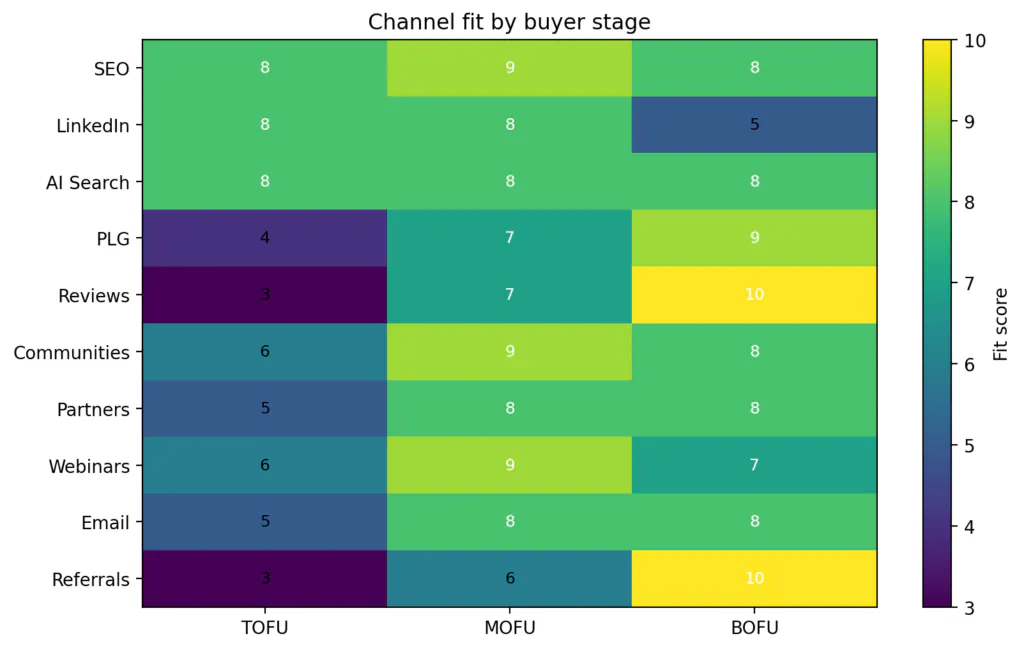
Figure 2: ThirdMeta framework heatmap for channel fit across buyer stages. Scores are planning weights, not market averages.
7. Partnerships, Webinars, Email, and Referrals: Convert Trust Into Pipeline
Partnerships work when two non-competing SaaS companies serve the same buyer and solve connected problems. They fail when both sides only want a logo swap and a low-attendance webinar.
Strong co-marketing assets include joint webinars, integration guides, benchmark reports, newsletter swaps, marketplace pages, and customer workflow playbooks. ThirdMeta evaluates partnerships through ICP overlap, offer fit, and distribution path before creating the asset.
Webinars are useful when the buyer needs education before sales. A strong webinar teaches evaluation criteria, implementation risks, ROI logic, or integration concerns rather than opening with a product walkthrough.
Email nurture keeps organic demand warm after the first visit. Litmus reported that 35% of companies receive $10 to $36 for every $1 spent on email marketing, and its transcript lists software and technology ROI at 36:1.
This is why content distribution strategy and B2B content marketing strategy matter after publishing. Content only becomes pipeline when there is a next step after the first touch.
| Channel | Best use | Conversion asset |
| Partnerships | Borrow trust from adjacent audiences | Joint use-case guide |
| Webinars | Educate complex buying groups | Scorecard or checklist |
| Email nurture | Keep organic demand warm | Segmented sequence |
| Referrals | Turn customer trust into introductions | Referral email template |
What Most B2B SaaS Teams Get Wrong
Most B2B SaaS teams do not fail because they chose the wrong channel. They fail because they run channels without a buyer-stage strategy.
A blog brings traffic. LinkedIn builds familiarity. Reviews build trust. Communities reveal objections. Email keeps the buyer warm. None of these works properly when they operate in silos.
| “The best marketing does not feel like marketing.” Tom Fishburne |
| Broken organic system | Revenue-led organic system |
| Content calendar first | ICP and buyer stage first |
| Traffic as main KPI | Demo quality and pipeline as KPI |
| Generic blog topics | Use-case and comparison clusters |
| Founder posts without follow-up | LinkedIn connected to sales motion |
| Review sites ignored | Review proof mapped to BOFU pages |
| No attribution | GA4, GSC, and CRM tracking from day one |
If your team is getting traffic but not enough qualified demos, start with the channel-to-pipeline gap before adding more content. A B2B SaaS keyword research process helps identify which topics deserve investment and which only look good in a traffic report.
How ThirdMeta Builds Organic Lead Generation Channels for B2B SaaS
ThirdMeta builds organic lead generation channels for B2B SaaS by starting with pipeline logic. The goal is not to publish across every channel, but to identify which channels match the buyer’s trust gaps and decision stage.
A typical ThirdMeta system starts with ICP analysis, search intent mapping, competitor gap review, conversion-page planning, content clustering, distribution paths, and CRM tracking. The work becomes practical because every page and channel has a defined job.
| Layer | What we build | Why it converts |
| ICP clarity | Buyer role, pain, trigger, objections | Better targeting |
| Search strategy | BOFU and MOFU keyword clusters | Better lead quality |
| Content system | Guides, comparisons, use cases, FAQs | Better education |
| CRO layer | CTAs, forms, proof blocks, internal links | Better conversion |
| Distribution | LinkedIn, partners, communities, email | Better reach |
| Trust proof | Reviews, customer stories, proof assets | Better sales readiness |
| Attribution | GA4, GSC, CRM source tracking | Better budget decisions |
This is not the right fit for SaaS teams that only want blog volume. It is the right fit for teams that want organic growth connected to demos, sales conversations, and pipeline.
If your current organic system brings readers but not enough qualified conversations, a ThirdMeta diagnostic can show which channel is leaking trust, intent, or conversion. The first call is a working audit, not a generic sales pitch.
Conclusion
Organic lead generation channels for B2B SaaS work best when they are connected to how buyers actually make decisions. SEO captures demand, LinkedIn builds trust, AI search shapes discovery, communities reveal objections, reviews reduce risk, and email keeps the buyer engaged.
The strongest SaaS teams do not chase every organic channel at once. They build a focused system where each channel moves the buyer one step closer to a confident demo request.
FAQs
The best organic lead generation channels for B2B SaaS are SEO, LinkedIn, AI search visibility, review sites, communities, partnerships, webinars, email nurture, referrals, and PLG loops. The right mix depends on ACV, ICP, sales cycle, and product complexity.
Organic lead generation for B2B SaaS usually takes longer than paid campaigns because trust compounds over time. BOFU pages, review sites, and LinkedIn can create earlier signals when tied to clear conversion paths.
SEO is still worth it for B2B SaaS lead generation when it targets buyer-intent keywords. Use-case pages, comparison content, pricing guides, and integration pages usually convert better than broad awareness blogs.
ThirdMeta improves organic lead generation by connecting SEO, content, CRO, distribution, and attribution. The focus is qualified demos and pipeline, not only organic traffic growth.

Founders Office
Drushti Gothi is a Growth Strategy and CRO Lead at ThirdMeta, specialising in conversion-focused digital experiences, B2B growth, and audience engagement. She combines strategic thinking, experiential design, and an understanding of user behaviour to help businesses strengthen their online presence and turn traffic into meaningful results. Through her content, Drushti shares practical insights on SEO, conversion optimisation, digital strategy, and building scalable growth systems.