


Quick Answer: A cybersecurity marketing agency is a specialized growth partner that builds demand gen, ABM, and thought-leadership content around the CISO buying committee and the analyst relationships that shape it.
“The cybersecurity buyer isn’t hard to reach. They’re hard to convince five times over.”
A cybersecurity marketing agency exists because a single funnel was never built to convince a security engineer, a CISO, legal, and a CFO at the same time. Generic B2B campaigns get one buyer to say yes and assume the rest will follow. In security, the rest of the committee is where deals actually die. This is the exact gap a cybersecurity marketing agency is supposed to close.
TL;DR
- CISOs rarely buy alone; five or six stakeholders hold veto power
- Analyst validation from Gartner or Forrester shapes the shortlist early
- Fear-based messaging is already a solved problem, not a differentiator
- Evaluation criteria differ sharply from a standard agency vetting checklist
- Technical and analyst content need different writers than demand gen
What Is a Cybersecurity Marketing Agency?
A cybersecurity marketing agency is a growth partner built for security vendors selling into CISOs, security engineers, and compliance teams.
It runs demand gen, ABM, and content with analyst relationships, Gartner and Forrester among them, built in from the start, not bolted on after launch. That distinction is the whole premise behind our growth-as-a-system model.
Why Generic ABM Playbooks Get Breached by the Buying Committee
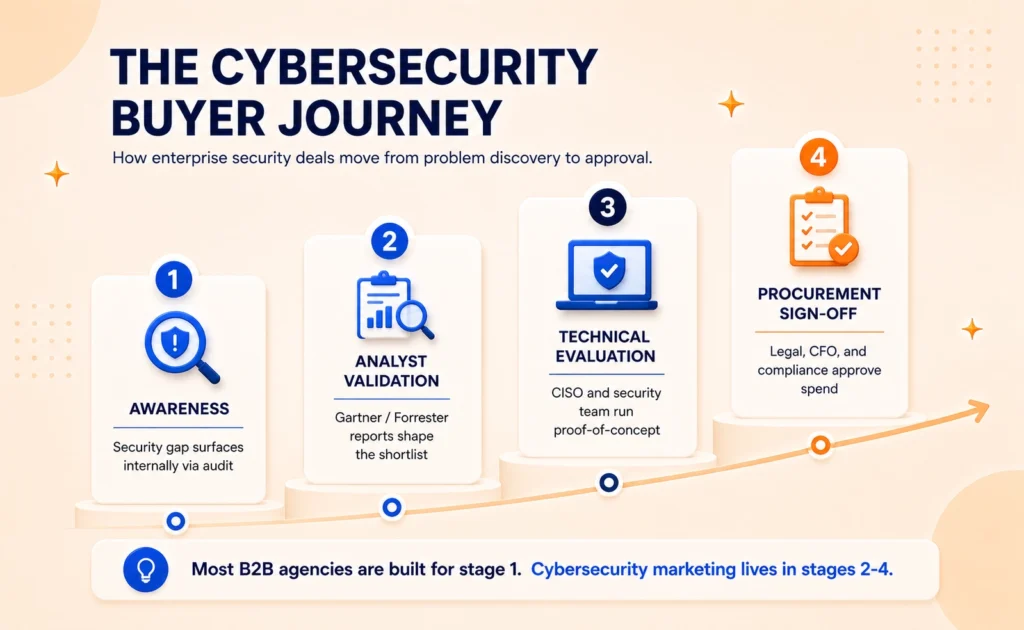
Generic ABM playbooks fail for cybersecurity because they’re sequenced for one buyer, not five. By the time a campaign reaches the CFO, the messaging that convinced the security engineer has already changed twice.
- A campaign wins over the security team, then stalls at legal
- Analyst reports get ignored until procurement asks for them
- Fear-based hooks get filtered out before the CISO even opens the email
- None of this shows up in a standard single-buyer ABM sequence
“A CISO doesn’t buy a pitch. A CISO buys the fact that five other people already stopped objecting.”
Teams that try to absorb this with a purely in-house marketing setup often discover the analyst-relations workload alone justifies outside help. The agencies that get this right write for the whole committee from week one, not just the loudest buyer in the room.
The stakes are real: Gartner forecasts that worldwide spending on information security will reach $213 billion in 2025, up from $193 billion in 2024. That budget is being fought over by teams still writing single-buyer campaigns.
Still getting firewalled out of the CISO’s shortlist? See how we get past that gate.
What to Look for in a Cybersecurity Marketing Agency
Evaluate a cybersecurity marketing agency on committee-wide messaging and analyst fluency, not portfolio size. Four checks catch most of the risk early.
- Ask how they write for the whole buying committee, not just the CISO. Security engineers, legal, and the CFO all need a different version of the same proof.
- Check for analyst-relations experience. Campaigns that ignore Gartner and Forrester validation lose the shortlist before the first call.
- Confirm technical and demand-gen content are staffed separately. Whitepapers and account-based marketing need different writers entirely.
- Ask about AI-visibility strategy. A growing share of buyer research now starts inside an AI answer engine before a single Google search happens.
Cybersecurity Marketing Agencies on Our Radar
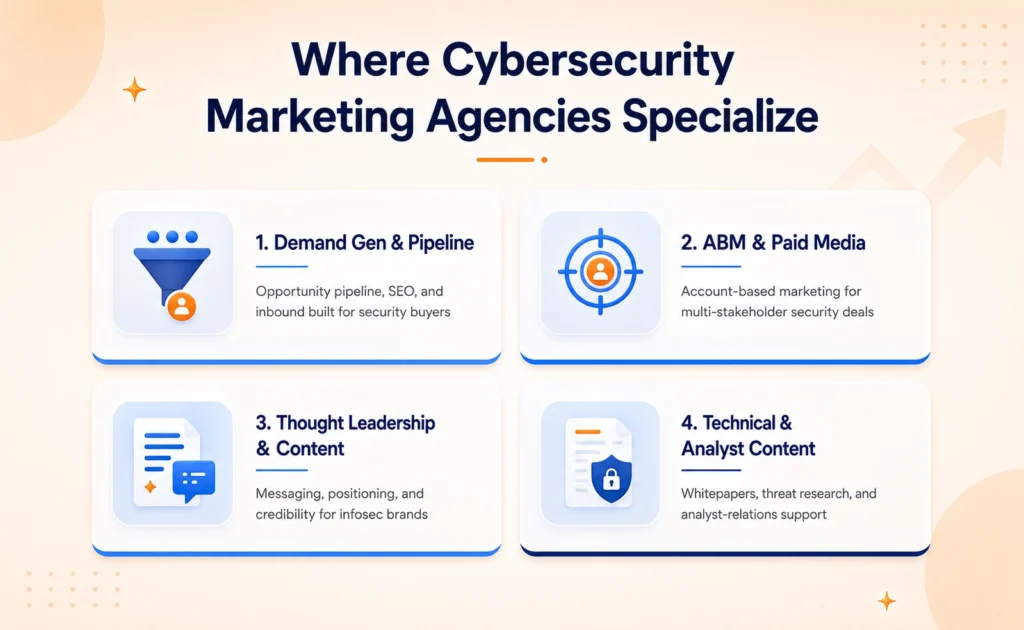
A handful of agencies specialize specifically in cybersecurity, each built for a different stage of the buying committee. Listed alphabetically:
- Beacon Digital – ABM, paid media, and inbound marketing built for complex, multi-stakeholder security deals.
- Bluetext – Brand and creative agency specializing in web experiences and messaging for high-stakes security vendors.
- Bora – Content-first agency focused on thought leadership, messaging, and positioning for infosec companies.
- CyberTheory – Analyst-driven agency with a CISO advisory board and intent data behind every campaign.
- Denave – Global B2B demand-generation and sales-ecosystem partner built to convert enterprise security pipeline.
- Ironpaper – Demand-generation agency focused on opportunity pipeline and technical content for security providers.
- ThirdMeta – Growth-as-a-system agency running SEO, ABM, and GEO/AEO as one program built around the buying committee, not just the CISO.
Compare how each one writes for the committee, not just the case studies on their homepage. A pipeline-selection framework built for evaluating agencies makes that comparison easier to run.
Why Work With ThirdMeta on Cybersecurity Marketing?
If your last campaign won over the security team and still stalled at legal, that’s exactly the gap ThirdMeta’s cybersecurity practice is built around. We run SEO, ABM, and GEO/AEO as one coordinated program instead of separate vendors.
- Committee-wide messaging – Built for the CISO, the security engineer, legal, and the CFO, not just the loudest buyer.
- Analyst-aware content – Positioned to work alongside, not against, Gartner and Forrester validation.
- AI-visibility built in – Content structured so answer engines surface it during early-stage research.
Across recent engagements, clients using this model have cut CAC by as much as 38 percent. See how a committee-wide campaign gets built from the first brief.
This isn’t the right fit for an early-stage security startup still finding its first design partner, a founder-led, high-touch sales motion usually teaches more per dollar before a full agency program makes sense.
Conclusion
A cybersecurity marketing agency earns its category by writing for the whole buying committee, not the CISO alone. Security engineers, legal, and the CFO all sign off in the same short window, and a campaign built for one buyer usually collapses right there.
Choosing the right partner means asking how they handle analyst relations and multi-stakeholder messaging before a single deliverable gets discussed. Heading into 2026, that same committee increasingly forms its shortlist inside an AI answer engine before a single call gets booked.
FAQs
It runs demand gen, ABM, and content built for security buyers, coordinating analyst relations and technical credibility instead of treating them as an afterthought
Cybersecurity deals involve five or six stakeholders instead of one or two. Analyst reports from Gartner and Forrester often shape the shortlist before a vendor is contacted.
Campaigns usually win over one stakeholder, like a security engineer, then fail to address legal or the CFO. The message needs to work for the whole committee from the outset.
A documented process for analyst relations, technical content staffed separately from demand gen, and a clear answer on AI-engine visibility, since a vague, spreadsheet-style ICP leads to generic campaigns.