
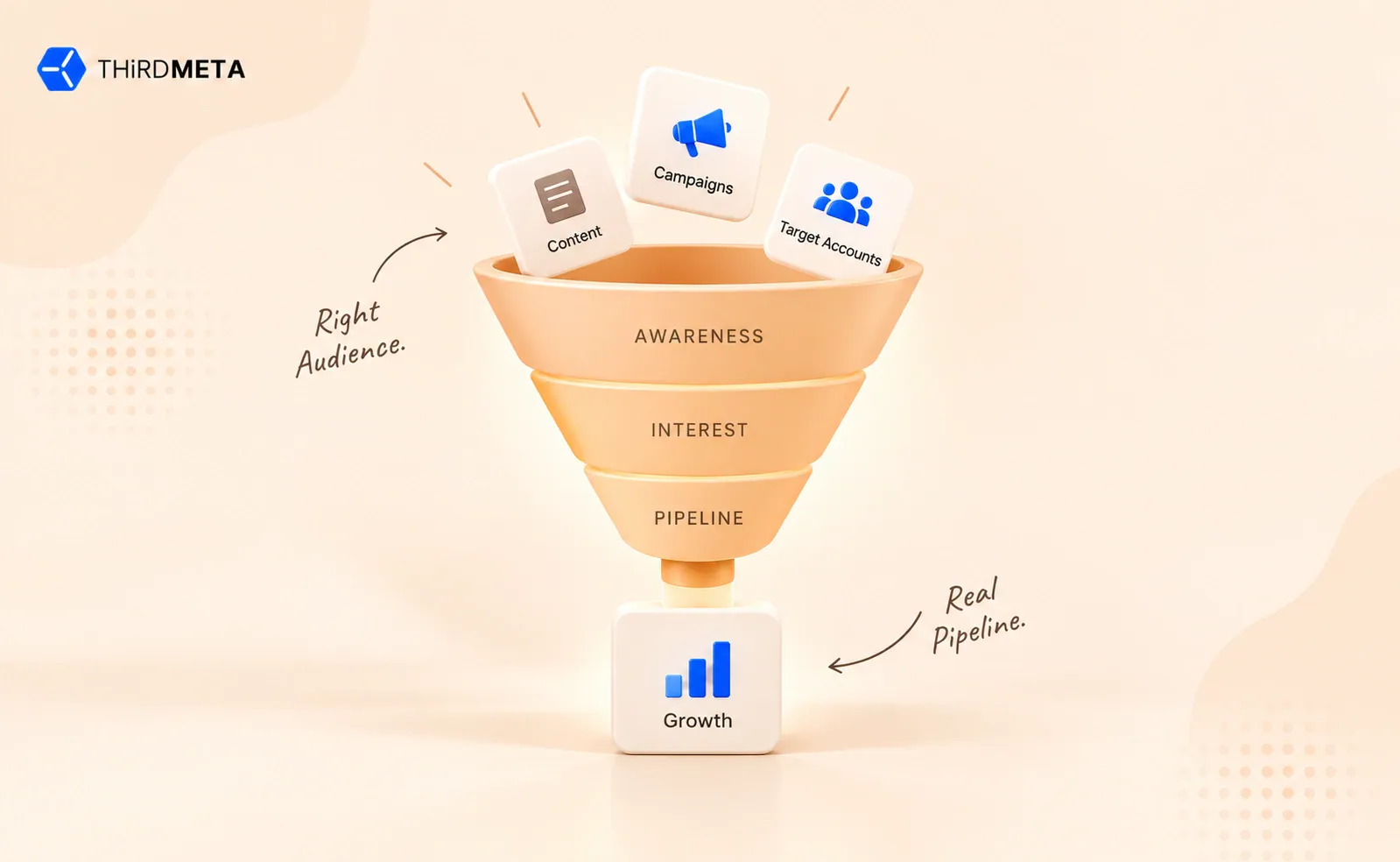
Quick Answer: A demand generation agency builds the campaigns, content, and account targeting that create pipeline for a B2B company, but the right playbook depends heavily on whether the GTM motion is product-led or sales-led, something most agencies price and pitch identically.
Key points covered in this article:
A demand generation agency's right playbook differs for PLG and sales-led SaaS
The Signal Audit checks three places demand already exists before buying more
Retainers run for months at real budget, so pricing structure matters
Ask for pipeline stage proof, not channel volume, before signing anyone
A demand generation agency builds the campaigns, content, and account targeting that create and capture pipeline for a B2B company, rather than running isolated lead capture tactics. The label gets applied to almost any B2B marketing retainer today, from brand campaigns to pure paid lead capture.
TL;DR
A demand generation agency's right playbook should differ sharply for product-led and sales-led B2B SaaS companies
The Signal Audit checks three specific places demand already exists before buying broad awareness-building work
Demand generation retainers run for months at a real budget, so pricing structure matters as much as the pitch
Marketing or Growth Heads should ask for pipeline stage proof, not channel volume, before signing
A generic demand generation pitch that fits every company usually fits none of them well
For a Marketing or Growth Head at a B2B SaaS company, the pitch usually sounds identical no matter who is selling it: build awareness, nurture intent, convert pipeline. What almost no agency asks first is whether the company is product-led or sales-led, because the honest answer changes what demand generation should mean for that business.
Forrester's C-Suite Alignment Survey, 2025 found only 37% of B2B leaders describe their organization as genuinely product-led, more than three times the B2C rate. This piece covers what a demand generation agency should actually cost and deliver, a five-minute audit to run before signing anyone, and how to spot a generic pitch versus one built for your specific go-to-market motion.
What Does a Demand Generation Agency Actually Do?
A demand generation agency runs the campaigns, content, and account targeting that build pipeline across the full buying process, not just the bottom-funnel forms lead generation focuses on. Lead generation captures contact information from people already looking. Demand generation is supposed to create and shape interest before that search even starts.
In practice, that usually means paid campaigns on LinkedIn and Google, account-based targeting for named accounts, and content built to earn attention before a prospect is sales-ready. Most agencies bundle these under one retainer and report on the same channel metrics: impressions, clicks, form fills.
None of that is wrong. It just describes the mechanics, not whether they are the right mechanics for a specific company's GTM motion, which is where most demand generation pitches stop being useful.
Why the Same Demand Generation Playbook Doesn't Fit Every B2B SaaS Company
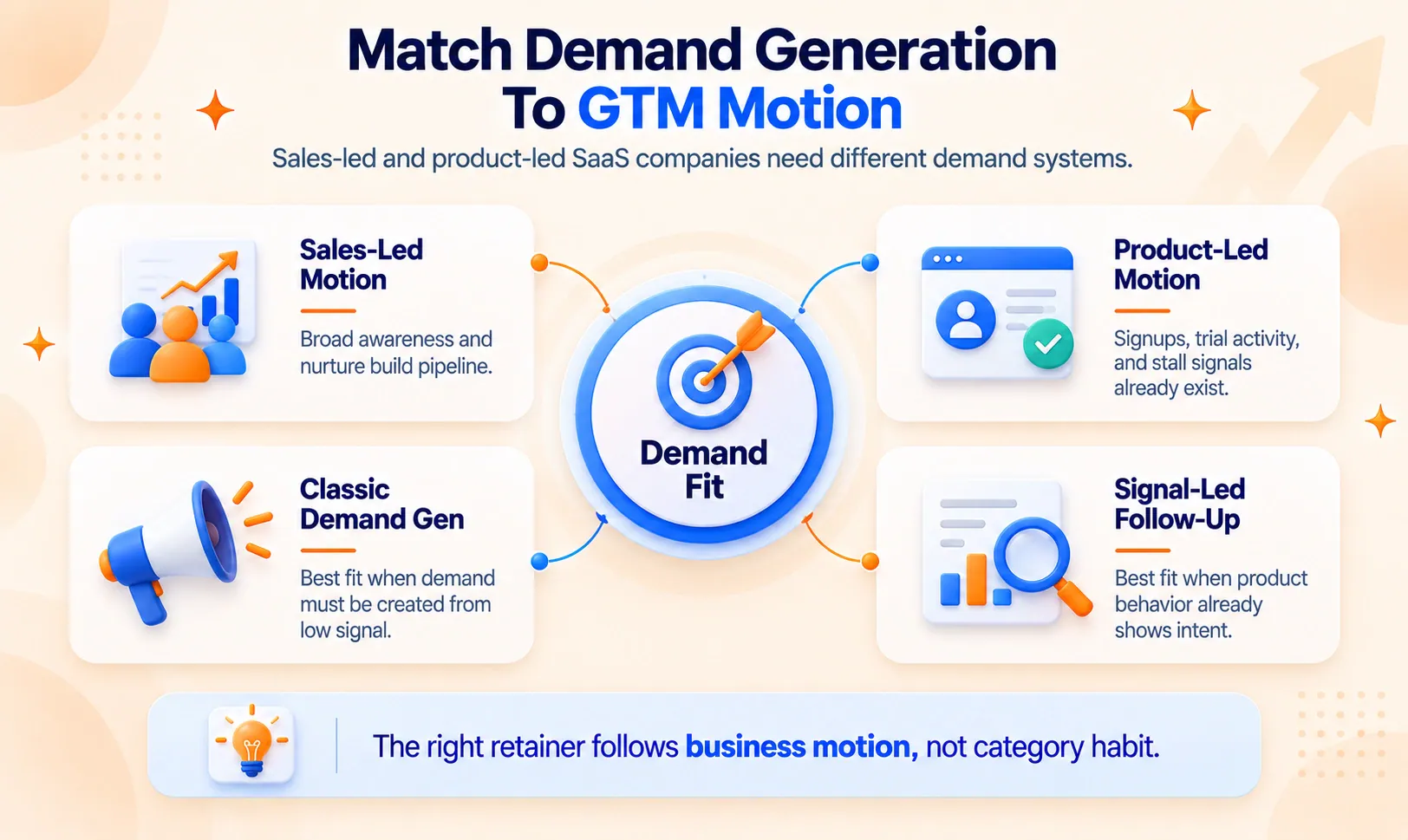
Nearly every demand generation agency, including the biggest names in the category, pitches a version of the same playbook: build broad awareness, nurture it, convert it into pipeline. That playbook fits a sales-led company with no existing signal to work from. It is often the wrong first purchase for a product-led one.
A product-led SaaS company already generates a kind of demand a sales-led company does not: people who signed up, tried the product, and quietly stalled. Selling that company a broad brand-and-awareness retainer skips past demand it already created and paid for once.
Across our B2B SaaS work, the companies most frustrated with a demand generation retainer six months in are almost always product-led businesses sold a sales-led playbook, not the other way around.
"Buying broad demand generation before checking your own product signups is paying twice for demand your company already created for free."
This mismatch has gotten more expensive to justify in 2026, not less. Gartner predicts more than 40% of CMOs who push for larger brand budgets will lose influence with the C-suite, with only 22% of CMOs prioritizing brand work against 54% prioritizing performance marketing. A broad, brand-first retainer is a harder budget line to defend than ever, especially when it is solving the wrong company's problem.
You're weighing a demand generation retainer without knowing whether your GTM motion even matches the pitch.
The fix is not skipping demand generation. It is checking what demand already exists, instead of defaulting to the same lead generation tactics dressed up under a new name.
The Signal Audit: Find Out If You Need Demand Generation Yet
The Signal Audit is a three-question check on whether demand already exists inside your own systems before you pay an agency to build more of it. It takes about five minutes and needs three things most companies already have: product analytics, marketing automation, and the CRM. Run it before the first call with any finalist agency.
Check these three signals in order:
Product or trial signal. Pull signups or trial starts from the last 90 days and check how many got a follow-up sequence. A high number with no follow-up means unused demand, not missing demand.
Content signal. Check content downloads, webinar attendees, or demo requests sitting in the CRM with no lead score or outreach attached. That is demand your team already paid to generate once.
Expansion signal. Look at existing customers whose usage has grown without any expansion outreach. That is pipeline sitting inside accounts you already have.
Two or more signals with real, unused volume means the priority is activation, not broad demand generation. All three empty or already fully worked means a demand generation agency is solving the right problem. It is also the fastest way to see whether a finalist even asks the question, since comparing an in-house team against an agency starts with knowing what you already have.
What a Demand Generation Agency Should Cost and Deliver for a B2B SaaS Company
A demand generation agency for a B2B SaaS company typically runs as a monthly retainer rather than a project fee, priced by scope and channel mix rather than company size alone. Full-service programs covering paid, ABM, content, and analytics sit well into five figures a month. A narrower scope, like ABM for a single target list, costs meaningfully less.
Cost alone tells you little. What the retainer is supposed to produce matters more: a defined target account list, campaigns mapped to specific buying-committee roles, and reporting tied to pipeline stage rather than channel volume. An agency that cannot describe its effect on customer acquisition cost in those terms is pricing the retainer, not the outcome.
A shorter engagement, under three or four months, will not show much. Demand generation compounds slowly, and a company that needs quarter-one pipeline results from a brand-building motion is buying the wrong service, regardless of which agency delivers it.
Ask for the specific deliverables tied to the retainer amount before signing, not after the first invoice.
How to Tell If a Demand Generation Agency Will Actually Move Pipeline
Three questions separate agencies that move pipeline from agencies that move impressions. None require access to the agency's internal reporting, only a direct answer on a sales call.
Can they name your buying committee, not just your ICP? A demand generation agency working a B2B SaaS deal should know the roles typically involved beyond the economic buyer, not just a one-line ICP description.
Do they report on pipeline stage or just channel activity? Clicks and form fills are inputs. An agency confident in its process will show which stage its campaigns actually influence.
Will they name a campaign that underperformed? An agency that can only describe wins has not run long enough to have real data, or is not being straight about the ones that did not work.
Across our B2B SaaS work, the clearest signal on a first call is whether the agency asks about your sales cycle before pitching a channel mix. Agencies that lead with channels before asking about the buying process are selling a template. None of these three questions require revealing proprietary methodology, the same diligence that matters in any B2B SaaS marketing agency selection.
Not sure your last three finalist calls actually answered any of these three questions?
How to Compare Demand Generation Agencies for a B2B SaaS Company
Comparing demand generation agencies works better on a short table than a long call, especially once GTM fit and the Signal Audit have narrowed the field. Score finalists on the same dimensions instead of the size of their client logos.
Dimension | Generic fit | Strong B2B SaaS fit |
GTM awareness | Same playbook for every client | Different approach for PLG versus sales-led accounts |
Reporting | Channel activity only | Tied to pipeline stage and CAC |
Buying committee | References a single ICP persona | Names specific roles in the buying group |
Engagement length | Pushes for quick wins in month one | Sets expectations for a 6 to 12 month runway |
Underperformance | Only cites wins | Volunteers a campaign that did not work |
A finalist scoring well on three or more rows understands your business, not just the category. One scoring well only on client logos is selling the agency's brand, not a plan for yours.
Why Should You Choose ThirdMeta?
If your GTM motion does not fit the standard demand generation playbook, that is exactly the gap ThirdMeta's Growth-as-a-System model closes. We build the target account list, content, and paid campaigns around your specific buying committee, not a template.
Demand generation scoped to your GTM motion, not a fixed package
Reporting tied to pipeline stage and CAC, not channel volume
A defined buying-committee map before the first campaign launches
Across our B2B SaaS engagements, including document-AI and ops-software platforms, this starts with the Signal Audit itself: checking what demand already exists before proposing what to build.
Unlike broad agency directories, we show you the audit before the pitch
Unlike brand-first shops, our first deliverable is your buying-committee map, not a campaign concept
The fastest way to see whether this fits is a direct conversation about your GTM motion and what the Signal Audit turns up.
Curious what the Signal Audit would find in your own systems?
Conclusion
A demand generation agency is not one thing with one price and one playbook, whatever the pitch decks suggest. The right approach depends on whether a company is product-led or sales-led, and the Signal Audit in this piece is the fastest way to check which problem actually needs solving.
A Marketing or Growth Head who runs the audit before the first agency call stops buying a category and starts buying a specific plan. For the content side of that plan, see what a B2B SaaS content marketing agency should prioritize first.
Frequently Asked Questions
A demand generation agency builds the campaigns, content, and account targeting that create B2B pipeline. It works earlier in the funnel than lead generation, which only captures contacts already searching. The right agency ties its work to pipeline stage, not just channel volume.

Technical Content Strategist