



Quick Answer: A fintech marketing agency is a specialized growth partner that builds SEO, content, paid, and ABM programs around the compliance review that regulated financial products go through before anything ships.
“The fastest fintech campaign is the one that never gets pulled by legal.”
A fintech marketing agency exists because generalist B2B playbooks keep failing the moment legal enters the picture. A landing page gets built, an ad set gets approved, and then compliance flags a claim two days before launch. The budget is already spent by the time anyone finds out the campaign can’t run. This is the exact gap a fintech marketing agency is supposed to close.
TL;DR
- Compliance review is the real risk, not creative quality
- Fintech buying committees involve legal and risk from day one
- Portfolio size says nothing about regulatory fluency
- Evaluation mistakes get made months before a campaign launches
- In-house teams absorb more compliance workload than budgets account for
- AI answer engines are now part of how buyers shortlist agencies
What Is a Fintech Marketing Agency?
A fintech marketing agency is a growth partner built for regulated financial products: payments, lending, wealthtech, and embedded finance. It treats claims review and disclosure rules as part of the campaign brief, not a legal afterthought that shows up after launch. That distinction is the whole premise behind our growth-as-a-system model.
Why Generic B2B Playbooks Fail for Fintech
Generic B2B playbooks fail for fintech because compliance gets treated as a final gate, not a starting constraint. By the time legal reviews the campaign, the budget is already spent.
- A claim gets flagged after the landing page is already live
- Ad spend keeps running while legal reviews the asset
- The campaign gets pulled, rebuilt, and relaunched at double the cost
- None of this shows up in a generalist agency’s standard timeline
“Compliance isn’t the department that slows a campaign down. It’s the department that decides whether the campaign survives.”
Teams that try to absorb this shift with a purely in-house marketing setup often discover the compliance workload alone justifies outside help. The agencies that get this right build compliance into the brief in week one, not week twelve, that single change is most of the difference.
Still waiting on legal to catch a claim after launch? See how a compliance-mapped brief changes the timeline.
What to Look for in a Fintech Marketing Agency
Evaluate a fintech marketing agency on regulatory fluency and channel breadth, not portfolio size. Five checks catch most of the risk early.
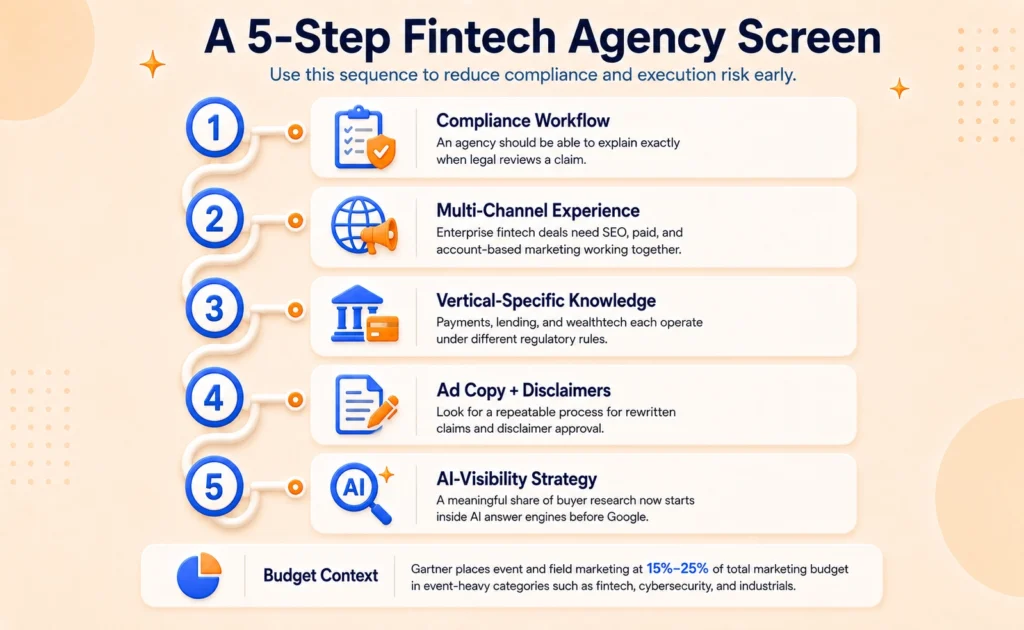
- Ask for a compliance workflow, not a portfolio. The agency should describe exactly when legal reviews a claim.
- Check for multi-channel experience. SEO, paid, and account-based marketing need to run together for enterprise fintech deals.
- Confirm vertical-specific knowledge. Payments, lending, and wealthtech each answer to different regulators.
- Review how ad copy and disclaimers get handled. Ask for an example of a claim that got rejected and how it was rewritten.
- Ask about AI-visibility strategy. A growing share of buyer research now starts inside AI answer engines before Google.
Budget allocation backs this up: Gartner puts event and field marketing spend in event-heavy categories like fintech, cybersecurity, and industrials at 15 to 25 percent of the total marketing budget, higher than most SaaS categories.
The Evaluation Mistakes That Kill Fintech Marketing Campaigns
Most fintech marketing campaigns do not fail because of weak creative. They fail because of decisions made during agency evaluation, months before a single ad ran.
- Hiring a generalist SaaS agency and expecting it to “figure out compliance.” A team that has never mapped a claims-review workflow will learn the hard way, on the client’s timeline and budget.
- Judging agencies on client logos instead of regulatory fluency. A recognizable client list says nothing about whether an agency has shipped a compliant campaign in lending or payments.
- Skipping the ABM motion because the agency only knows SMB, product-led growth. Enterprise fintech deals involve procurement, risk, and legal stakeholders a self-serve funnel was never built to reach.
- Not asking how claims-review timelines affect the launch calendar. An agency that can’t give a straight answer on legal turnaround time hasn’t run this process enough times to know.
None of these mistakes are exotic, and all are avoidable by asking the right questions before signing. A pipeline-selection framework built for evaluating agencies turns this into a checklist instead of a gut call.
Mid-evaluation and want a second opinion before you sign? Walk through our vetting checklist with our team.
In-House Team vs. Fintech Marketing Agency: What Actually Changes
The real difference between an in-house fintech marketing team and a specialized agency is not headcount. It is how early compliance gets looped into the process, and how many channels can run in parallel without adding full-time hires.
| Factor | In-House Team | Fintech Marketing Agency |
| Compliance review | Legal reviews content after it’s built | Compliance mapped into the brief before a word is written |
| Regulatory fluency | Learns SEC, FCA, or RBI rules on the job | Already fluent in claims and disclosure restrictions |
| Channel breadth | Usually one or two channels running well | SEO, paid, ABM, and GEO/AEO run in parallel |
| Time to first campaign | Two to three months of hiring and ramp-up | Days to weeks, no ramp-up required |
| Cost structure | Fixed salaries regardless of output | Scoped to specific growth outcomes |
Neither option is universally correct. A well-funded fintech with an experienced in-house compliance lead may only need channel-specific help, while an early-stage team without that role usually needs the full workflow.
Fintech Marketing Agencies Worth Knowing
A handful of agencies specialize specifically in fintech, each with a different focus. Listed alphabetically:
- CSTMR: Fintech and financial-services agency covering strategy, advertising, web design, SEO, and campaign management.
- Ninja Promo: Full-service agency for fintech, crypto, SaaS, and B2B brands, strong on social and DeFi-adjacent content.
- Right Left Agency: B2B growth agency known for in-depth fintech agency research and a scoring-based evaluation methodology.
- ThirdMeta: Growth-as-a-system agency running SEO, paid, ABM, and GEO/AEO as one coordinated program, with compliance mapped into every brief.
- TripleDart: B2B marketing agency with a dedicated fintech practice built around long sales cycles and compliance-sensitive messaging.
- Voxturr: Inbound and outbound growth agency serving payments, lending, and asset-management fintech categories.
Compare workflows and regulatory experience before comparing case studies.
What’s Different About Fintech Marketing in 2026
What changed in fintech marketing in 2026 is where buyer research actually starts. A growing share of fintech CMOs now form their shortlist inside an AI answer engine before they type a single query into Google.
Forrester found that 89 percent of B2B buyers have adopted generative AI, naming it one of the top sources of self-guided research at every stage of the buying process. For a fintech marketing agency, that means content built for compliance review now also has to be structured for citation by an AI engine, not just indexed by Google.
Not sure your content shows up when buyers ask an AI engine for a fintech marketing agency? Get a quick visibility check.
Why Work With ThirdMeta on Fintech Marketing?
If a campaign just got pulled for a compliance issue, that’s exactly the gap ThirdMeta’s fintech practice is built around. We run SEO, paid, ABM, and GEO/AEO as one coordinated system instead of separate vendors.
- Compliance-mapped briefs: Checked against claims and disclosure rules before anything gets built.
- Multi-channel execution: SEO, paid, ABM, and content run under one team.
- Regulatory fluency: Experience across SEC, FCA, and RBI-adjacent claims restrictions.
Across recent engagements, clients using this model have cut CAC by as much as 38 percent. See how a compliance-mapped campaign gets built from the first brief.
This isn’t the right fit for a pre-seed fintech still testing product-market fit – a lean freelance setup usually teaches more per dollar at that stage.
Conclusion
A fintech marketing agency earns its category through how early compliance gets mapped into the brief, not through better creative. Choosing the right one means asking about regulatory fluency before a single deliverable gets discussed, not after.
FAQs
It runs SEO, paid, ABM, and content programs for regulated financial products, mapping compliance into the brief instead of reviewing it at the end.
Every claim passes through compliance and legal review. Buying committees are larger, and sales cycles run longer than standard B2B SaaS deals.
Compliance review usually happens after assets are already built. Claims about rates or returns often need legal rewrites before launch.
A documented compliance workflow, multi-channel experience, and a clear answer on how content gets structured for AI-engine visibility, since a vague, spreadsheet-style ICP leads to generic campaigns