

Quick Answer: B2B marketing consultant vs. agency is a choice about which job is unfilled: a consultant decides and advises on a fixed scope, and an agency carries out channel work at steady capacity. Neither proves the result unless an internal owner or an independent reviewer grades the work against the pipeline.
Key points covered in this article:
Where consultants and agencies each fit
Why think-versus-do misses the third role
A five-minute audit for any SaaS team
Costs, failure modes, and contract questions
B2B marketing consultant vs agency comes down to which of three jobs is unfilled: Deciding, Doing or Proving. Most guides cover the first two and skip the third.
Heads of marketing at 50 to 500 person SaaS companies usually arrive with specific problems. A founder rewrites every landing page, the HubSpot dashboard shows leads the sales head does not trust, and the Q3 plan has nobody free to ship it. Each problem points to a different missing job.
Budget is rarely the answer. Gartner's 56% of CMOs report their marketing organization cannot fund its 2026 strategy shows why. This article maps where each option fits and links to the in-house vs agency marketing comparison for the team-versus-partner question.
TL;DR
A head of marketing at a B2B SaaS company should name the unfilled job (decide, do or prove) before comparing vendors.
Consultants fit the decide job on a fixed scope, and agencies fit the do job at steady capacity.
Whoever does the work should not grade it, so give the prove job to an internal owner.
Score the three jobs, then match a consultant, an agency or a hybrid to the empty one.
Compare cost by pricing unit (hours, capacity or salary), not headline rate.
Write asset ownership and exit terms into the contract before the first invoice.
What Is the Difference Between a B2B Marketing Consultant and an Agency?
A B2B marketing consultant is an independent adviser who diagnoses a problem and recommends a plan for a defined fee. An agency is a multi-person team that carries out campaigns, content and channel work on a retainer. The practical difference is accountability: a consultant answers for the quality of the advice, and an agency answers for the output delivered.
| B2B marketing consultant | Agency |
What is bought | Judgment and a plan | Production capacity |
Typical scope | Audit, GTM plan, interim lead, fixed term | Monthly retainer for named channels |
Strongest on | ICP, positioning, channel choice, hiring plans | Shipping volume, channel know-how, tooling |
Main risk | The plan stalls after the readout | Channel bias and self-reported metrics |
Needs from the client | Someone to execute | Someone to direct and grade |
Both columns leave one job unassigned, and the next section explains why that matters more than the think-versus-do split. The guide to choosing a B2B SaaS marketing agency covers the agency column in more detail.
Is the B2B Marketing Consultant vs Agency Choice Really About Thinking Versus Doing?
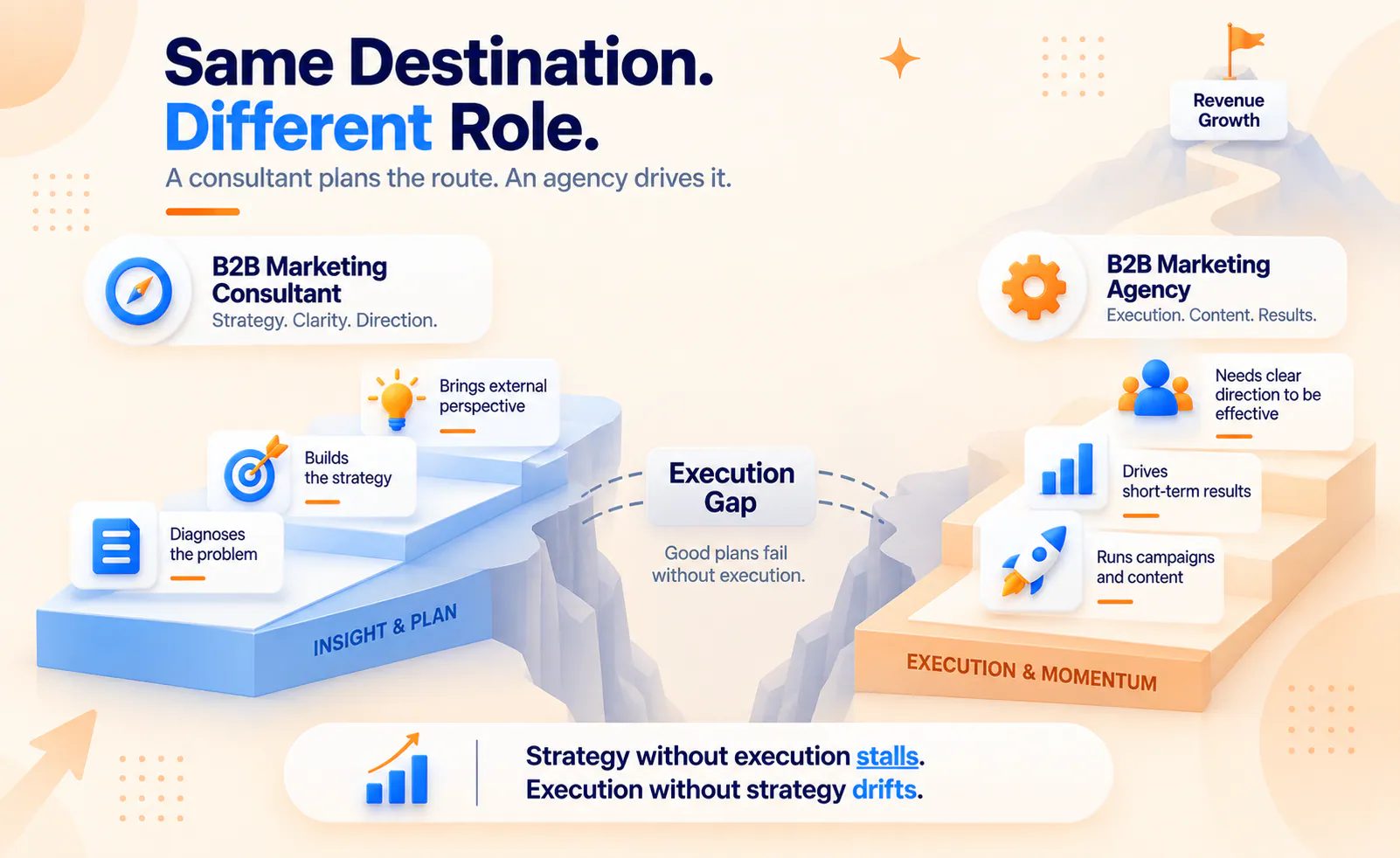
No. Think-versus-do describes what each vendor sells, but it ignores what a B2B SaaS team usually lacks: someone who proves the work moved pipeline. Top-ranking guides repeat the rule that a consultant plans and an agency executes, and Google's AI Overview for the close variant "marketing consultant vs agency" frames the choice the same way.
Take an illustrative case: a consultant delivers a positioning plan, and no experiment launches for six weeks. What we see across our B2B SaaS work is that strategy decks rarely fail on the quality of the ideas. They fail in the weeks after the readout, when nobody owns the first three experiments.
"A consultant plans and an agency executes, but in many B2B SaaS teams nobody is assigned to prove that either one moved pipeline."
The reverse fails too. An SEO retainer hired without a positioning owner tunes pages for keywords it can rank, which may not bring in sales-qualified demos. The fix in both cases is a named owner who accepts the plan and reports sourced pipeline.
Some gaps sit upstream of any vendor. When ICP and positioning are unwritten, start with the GTM Fit Diagnostic in how to choose an ICP-driven GTM strategy provider for SaaS.
How Can a B2B SaaS Team Tell in Five Minutes Whether It Needs a Consultant or an Agency?
The Decide-Do-Prove audit shows a B2B SaaS team in five minutes whether it needs a consultant, an agency or neither. List last quarter's biggest marketing decisions, deliverables and pipeline claims, then record who owned each. The empty job, or the one held by an interested party, identifies the hire.
Every B2B marketing function needs three jobs filled, and the party that does the work must not grade it. The audit takes four steps.
List the decisions. Name last quarter's three biggest marketing decisions (channel mix, ICP change, budget shift) and who made each. "The founder, by instinct" means decide is thin.
List what shipped. Record the campaigns, pages and sequences released, and who produced them. If two people shipped everything, do is capacity-bound.
Trace the pipeline claim. Find who told the CFO which programs created pipeline, and from which report: Salesforce or HubSpot sourced-pipeline fields (sales-led), product-qualified lead counts in GA4 or product analytics (product-led), or a vendor deck. A vendor deck means the party being judged holds prove.
Match the hire. Mark each job as filled internally, filled by a vendor, or empty. Empty decide points to a consultant, empty do points to an agency, and empty or vendor-held prove points to a RevOps lead or an independent audit.
Take a 120-person SaaS company with a head of marketing, two writers and an SEO retainer. Decide and do are filled, but prove sits with the retainer's monthly report. The fix is a RevOps owner reporting sourced pipeline from Salesforce, with the retainer graded against it.
The same report feeds the payback math in the guide to reducing customer acquisition cost without cutting growth. Without it, no vendor can be judged after the first quarter.
Two vendors grading their own work usually means the prove job is empty. |
When Does a B2B Marketing Consultant Beat an Agency, and When Does the Agency Win?
A consultant wins when the problem is a decision, such as ICP, positioning or channel mix. An agency wins when the plan exists and production is the constraint, and both lose when the prove job is empty. Three illustrative setups, not client data, show the pattern.
Series A, 60 people, founder-led marketing: decide and do are both thin.
Result: a consultant first, to write the ICP and channel plan, then an agency or first hire. See marketing strategy for B2B startups.
Series B, 180 people, plan approved: decide is filled, but SEO and paid capacity are short.
Result: an agency retainer for named channels, graded on sourced pipeline.
Growth stage, 400 people, sales disputes marketing's numbers: do is filled, but prove is contested.
Result: an independent audit of attribution rules, and no new agency.
ThirdMeta is an agency, so this section has a stake in the answer. A consultant is the better first hire for a one-off positioning audit, an interim head of marketing, or a budget below a team retainer. ThirdMeta is also the wrong fit for paid-media-first programs, since it does not run large paid-media buying.
What Does a B2B Marketing Consultant Cost Compared with an Agency or an In-House Hire?
Compare by pricing unit, not headline rate. A consultant sells judgment by scope or hours, an agency sells team capacity by retainer, and an in-house hire is salary plus overhead. We found no neutral 2024-or-later rate survey for either vendor type, since published price lists come from firms selling the service.
A consultant's fee buys judgment, not shipped work. Ask for the deliverable list and the date the first experiment launches.
An agency retainer buys capacity whether the plan needs it or not. Ask which named roles staff the account and what the retainer is graded on. For SEO-specific ranges, see SaaS SEO budgets in 2026.
Salary is the only public number in-house. The BLS reports that the median annual wage for marketing managers was $166,790 in May 2025, before recruiting, tools and ramp time.
The costliest option is the one nobody grades. Gartner's 39% of CMOs plan to cut back on agency budgets, starting with unproductive agency relationships and smaller rosters. A vendor with no agreed outcome is the easiest to class as unproductive.
In 2026 budget pressure continues. Gartner now puts marketing budgets at 7.8% of company revenue, with 15.3% of marketing budgets going to AI initiatives on average. Both Gartner surveys skew to companies above $1 billion in revenue, so read the figures as direction for a 200-person SaaS company, not a benchmark.
A retainer graded on its own report is the costliest line in the plan. |
How Do a B2B Marketing Consultant and an Agency Each Fail, and What Are the Early Warning Signs?
Each option fails in a predictable place within the first 60 days. A consultant fails after the readout, an agency fails in its own reporting, and a hybrid fails when two vendors share one plan with no owner.
Consultant failure: the plan nobody ships
The warning sign is a readout with no launch dates. A strong scope ends with owners and dates for the first three experiments.
Agency failure: the channel that grades its own work
The warning sign is a monthly report led by traffic, rankings or impressions. An SEO or paid vendor recommends the channel it sells, and nobody in the room is placed to challenge the mix.
What we see across our B2B SaaS work is that the agencies that stall are rarely the weakest ones. They are the ones nobody on the client side can brief or grade.
A monthly report written by the party being judged tends to find that party doing well. The fix is a pipeline report from the CRM, owned internally.
Hybrid failure: two vendors and no owner
The warning sign is a consultant and an agency who each name the other as the reason a plan slipped. A hybrid works only when one internal owner sets priorities for both.
Each failure is a missing owner, which costs less to fix before signing than after. The guide to how to spot agencies that report outcomes, not dashboards covers the vetting signals.
What Should a Head of Marketing Ask Before Signing with a Consultant or an Agency?
Four questions separate a workable arrangement from a failing one. Each answer belongs in the written agreement, not in a sales call.
Who owns the ad accounts, analytics properties and content after the contract ends?
The client should own Google Ads, Search Console, GA4, the CMS and the CRM from day one. Vendors should hold admin access, not ownership.
What happens if the first 90 days miss the agreed leading indicators?
Leading indicators for a SaaS program include published pages, demo-page visits and sales-accepted leads. Agree a review date and a reset clause up front.
Who attends the weekly pipeline review with sales?
A lead from the vendor should sit in it, alongside the internal owner. Pipeline gets graded there, against Salesforce or HubSpot fields the vendor does not control.
How will the work be graded, and by whom?
Name the metric, the report and the grader before the first invoice. The grader should be internal or independent, never the party holding the do job. The agency, in-house or hybrid decision guide includes a self-audit for this step.
Answers to these four questions turn the Decide-Do-Prove audit into a contract. Match the empty job to a vendor type first, then ask them before signing.
Why Should You Choose ThirdMeta?
EyeRIS, an interactive flat panel brand, reports a 50% lower cost per lead after working with ThirdMeta. Teams comparing a B2B marketing consultant vs agency usually come from a one-off deck or a retainer reported in a monthly PDF. ThirdMeta covers decide, do and prove in one accountable team, and its weekly rhythm already runs Listen, Diagnose, Inputs, Decide, Test, Prove and Scale.
Decide: strategy covering ICP, positioning, KPI tree, channel plan and payback model.
Do: SEO, link building, AEO and GEO, content marketing and CRO, run as one program.
Prove: every program reported against inbound demos, MQLs and pipeline contribution, not traffic.
Account model: the founder stays on the account instead of a layer of junior delivery.
The EyeRIS result is published on the ThirdMeta site, with the client's own quote. Scope is sized to team capacity and budget, on custom INR retainers.
TripleDart: the larger team, by ThirdMeta's own admission. ThirdMeta runs a smaller bench with the founder on the account.
GrowthSpree: the better fit for paid-first programs, since ThirdMeta does not run large paid-media buying.
Standalone consultants: they often stop at the readout, while ThirdMeta carries the plan into the work.
If decide, do and prove sit in three different places, one accountable team is simpler to run. Bring last quarter's reports to a demo call and compare them against the three jobs above.
Three vendors, three reports, and no one grading the whole set is the pattern to fix first. |
Conclusion
The B2B marketing consultant vs agency question is rarely about thinking versus doing. It is about whether decide, do and prove each have an owner, and whether the party that does the work is also the party grading it. A consultant fits the first job, an agency fits the second, and the third belongs inside the company or with an independent reviewer.
A head of marketing who runs the audit this week will know which vendor type to shortlist. The next CFO question about pipeline then has an owner. If the audit shows unworked demand rather than a missing vendor, the demand generation agency guide is the better next read.
Frequently Asked Questions
A B2B marketing consultant advises on decisions and plans for a defined fee. An agency carries out campaigns and content with a team on retainer. The consultant answers for the advice. The agency answers for the output.

Sr. Content Writer
Vamshi Vadali is Third Meta's Content Team Head and the guy who banned fluff from all blog posts. He specializes in SEO, GEO (Generative Engine Optimization), and AEO (Answer Engine Optimization): the trifecta that gets B2B SaaS content ranking in both Google and ChatGPT. Vamshi doesn't write content. He engineers MQL machines. His philosophy? Good writing needs data and clarity, not buzzwords. He writes like a CFO reads: straight to the outcomes. When he's not optimizing for AI Overviews, he's debating whether LLMs prefer Oxford commas.