

Quick Answer: A B2B Ideal Customer Profile (ICP) is a detailed description of the specific company type defined by firmographics, technographics, and buying behavior that generates your highest revenue, lowest churn, and fastest sales cycles. It is not a contact list. It is the operational filter your marketing, sales, and content teams use to decide who gets their attention and what message they receive.
Key points covered in this article:
- Why most B2B ICPs fail before they reach the sales team
- The 5 dimensions of a high-precision ICP beyond basic firmographics
- How to build a B2B ICP using actual customer data, not assumptions
- The difference between an ICP and a buyer persona and why conflating them costs deals
- How your ICP directly determines what content to write and where to distribute it
Every B2B company has an ICP. Most have three or four versions: one buried in a pitch deck, one half-filled in the CRM, and one inside a sales playbook that predates the current product. The result is sales teams chasing deals that never close, and marketing budgets funding content that reaches the wrong audience entirely.
A report found that companies with clearly defined ICPs see 36% higher conversion rates than teams targeting broad audiences. This gap shows up in closed revenue, not just pipeline volume. This blog covers what a high-precision B2B ICP actually contains, where most teams get it wrong structurally, and how to build one that your marketing and sales teams will use past week one.
TL;DR
- A B2B ICP defines the company type most likely to buy, stay, and expand, not the individual buyer
- Most ICPs fail because they are built on assumptions rather than data from top-performing accounts
- A high-precision ICP includes 5 dimensions: firmographics, technographics, behavioral triggers, budget signals, and organizational pain
- ICP and buyer persona are different documents serving different functions; conflating them creates misaligned campaigns
- Your ICP should directly determine which keywords to target, which channels to fund, and which leads to disqualify
- In 2026, B2B deals average 6–10 stakeholders (Gartner), making single-person ICP definitions no longer operational
What a B2B Ideal Customer Profile Actually Defines
A B2B Ideal Customer Profile is a concrete description of the company type that gets the most value from your product, stays the longest, and generates the highest lifetime revenue. It describes a company, not an individual buyer.
Most definitions stop at firmographics: industry, company size, revenue range, geography. That is where most ICPs lose their usefulness. Companies that match those surface criteria will still vary enormously in whether they close, how fast, and whether they stay for a second year.
A functional ICP goes three layers deeper. It captures the technographic context (which tools the company already uses), the behavioral triggers that push them into an active buying mode (a new CFO, a failed audit, a funding event), and the specific operational problem your product addresses better than the workaround they are currently using. Firmographics get you to the right zip code. The other layers get you to the right door.
Why ICP-First Companies Win More Pipeline With Less Spend
Most B2B companies treat ICP as a prospecting filter for the SDR team. The real function is more foundational: ICP is the operating system behind every downstream marketing decision what content gets written, which channels get funded, which leads get disqualified, and which deals get prioritized.
“Don’t count the people you reach; reach the people that count.” David Ogilvy, Ogilvy on Advertising
ICP-targeted B2B campaigns deliver 68% higher ROI than broad targeting, according to LinkedIn’s own campaign performance data.
According to LinkedIn’s campaign data, as analyzed by CXL, ICP-targeted B2B campaigns achieve 68% higher ROI than broad audience approaches. This is not a preference between targeting styles. It is a revenue outcome difference with a number attached.
The market assumption this challenges is that a wider net captures more opportunity. In practice, a wider net pulls unqualified pipeline which extends sales cycles, burns SDR capacity, and inflates CAC without an obvious cause.
A report by Ebsta and Pavilion found that the average B2B sales cycle has expanded to 6.5 months, 25% longer than five years ago. A significant share of that expansion comes from pursuing buyers who were never the right fit. For B2B SaaS companies operating with a growth-first marketing approach, ICP definition is not step five in the process. It is step zero.
The 5 Dimensions of a High-Precision B2B ICP
Most ICP guides stop at firmographics. A high-precision ICP covers five distinct layers. Each layer answers a different question your marketing and sales teams need to act on.
| ICP Dimension | What It Covers | Why It Matters |
| Firmographics | Industry, company size, revenue range, geography | Sets the baseline filter for account lists and ad targeting |
| Technographics | Current tools, tech stack, integrations in use | Identifies switching readiness and integration fit |
| Behavioral Triggers | Funding events, leadership changes, audits, headcount shifts | Signals when the account is actively in the market |
| Budget Signals | Funding stage, budget cycle, recent spend patterns | Determines whether a deal can close at your price point |
| Organizational Pain | The specific operational problem your product solves better than current tools | Grounds your messaging in something the buyer already feels |
Companies that map all five layers reduce time-to-qualification measurably. They also produce sales collateral that speaks to actual buyer scenarios rather than hypothetical pain. The anti-ICP accounts that match surface firmographics but consistently fail to close should be documented with equal precision. Naming who is not a fit saves pipeline from filling with deals that look real but never move.
How to Build a B2B Ideal Customer Profile in 4 Steps
An ICP built on assumptions is a guess with a label on it. Building one from actual customer data takes more time upfront, but the returns are direct: better-fit leads, shorter sales cycles, and content that generates the right conversations.
Step 1: Analyze your top 20% of accounts by revenue and retention
Pull the accounts with the highest ACV, lowest churn, and fastest time-to-close. Look for patterns across firmographics, the role of the buyer who signed off, and the specific problem that triggered the search. These are your best customers, not your most recent ones.
Step 2: Conduct structured interviews with 5–10 of those accounts
Ask what triggered their search, which alternatives they evaluated, and what specific outcome made them choose you. The language your best customers use to describe their problem is the language your content, ads, and sales scripts should use. No survey tool substitutes for this step.
Step 3: Map shared technographic and behavioral patterns
Identify which tools these accounts had before purchase, which events preceded their decision (a leadership change, a board ask, a compliance failure), and which objections came up most consistently. This behavioral trigger layer is what most ICPs leave out entirely, and it is what separates accounts that convert from those that go quiet after the demo.
Step 4: Define the disqualification criteria as precisely as the fit criteria
Your ICP should name who is not a fit as clearly as who is. Accounts that match firmographics but have a 6-month IT review cycle, lack a defined budget owner, or process fewer than 5,000 transactions per month (for a document automation product, for example) are anti-ICP accounts. A well-defined B2B lead generation process filters these out before they consume sales time.
ICP vs. Buyer Persona: One Company, Multiple Decision-Makers
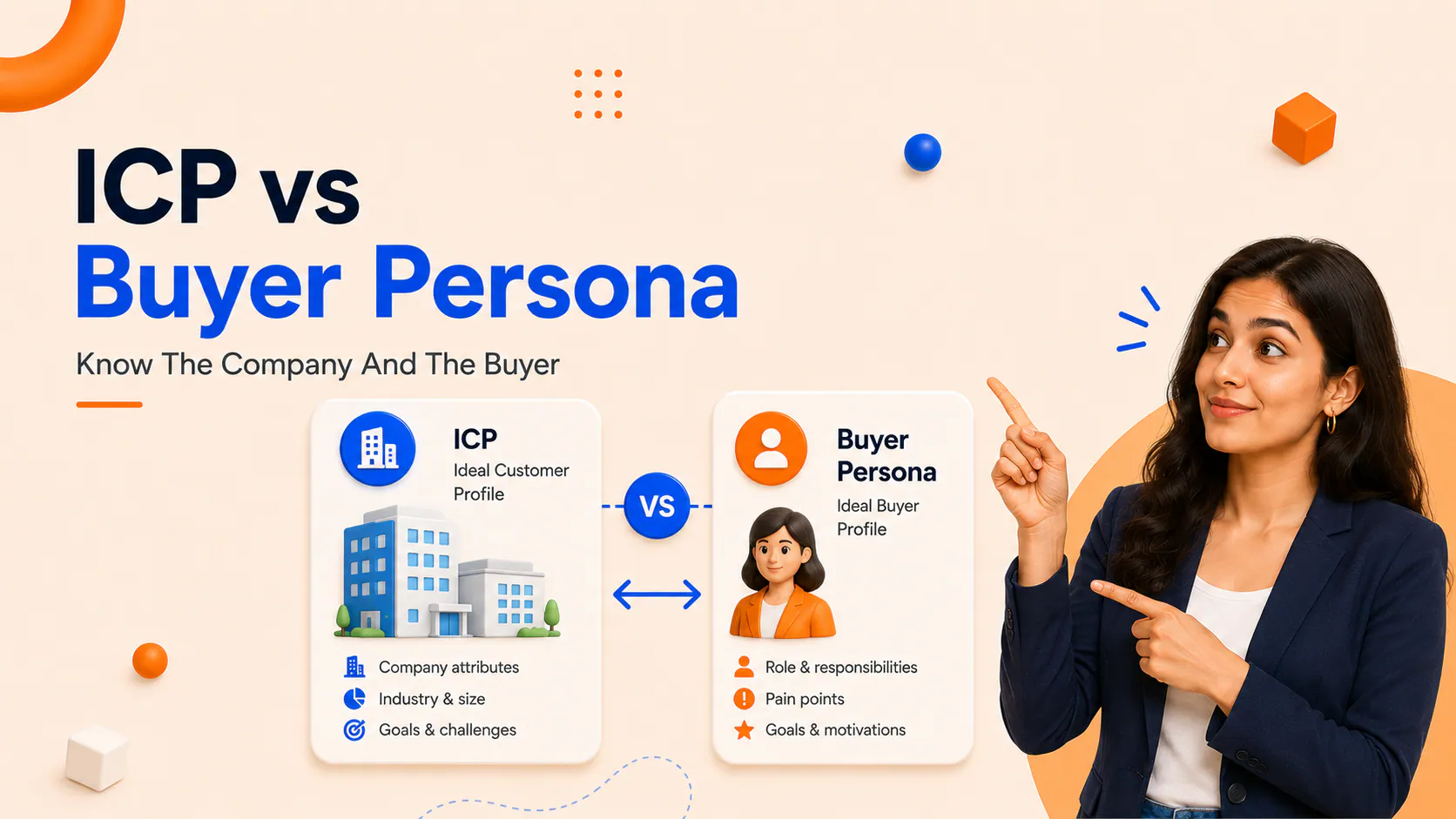
ICP and buyer persona are used interchangeably in most content. They address different layers of the same buying situation, and confusing them creates campaigns that target the right company with the wrong message.
The ICP describes the company: firmographic, technographic, and behavioral profile of accounts most likely to close. The buyer persona describes the individuals within that company who influence or make the purchase decision.
In 2026, research by Gartner found that the average B2B deal involves 6–10 stakeholders, ranging from technical evaluators to financial approvers to the end user who lives with the product daily.
| Document | Describes | Used For |
| ICP | The company type | Account selection, ad targeting, lead scoring |
| Buyer Persona | Individual decision-makers within that company | Content tone, sales sequence, objection handling |
Neither replaces the other. Running account-based marketing campaigns without both defined means targeting the right company with messaging that speaks to the wrong person inside it. That is not an ABM problem. It is an ICP problem.
How Your ICP Determines What Content Gets Written and Where It Runs
This is the connection most content teams miss. ICP is not only a sales input. It is the filter that determines which keywords are worth targeting, which distribution channels your buyers actually use, and which inbound leads your funnel should qualify versus discard.
A B2B SaaS company targeting CFOs at $25M–$500M BFSI firms should not run the same content strategy as one targeting IT Heads at mid-market logistics companies. The channels differ (LinkedIn vs. trade publications), the keywords differ (document compliance vs. field operations visibility), and the content format that converts differs (ROI calculators vs. deployment case studies). When ICP is blurry, B2B content marketing becomes topic-driven rather than buyer-driven and generates traffic from an audience that was never going to convert.
From working with B2B SaaS companies at Series A and B, most arrive with three or four conflicting ICP versions across teams. Sales has one definition. Marketing operates from a different one. The content calendar reflects neither.
The outcome is a blog archive that generates impressions but does not produce inbound conversations. Getting ICP clarity before building a B2B GTM strategy is not a sequencing preference. It is the difference between a content investment that compounds and one that resets its value every quarter.
One honest constraint to name here: ICP work does not fix a product that has not found market fit. It only works when the core offer is already solving a real problem for a defined type of buyer, and the question is which accounts to pursue and in what sequence.
How ThirdMeta Builds ICP Into the Growth System
Most growth agencies start with channel selection. They ask which platforms to run campaigns on, which keywords to rank for, which content cadence to maintain. ThirdMeta’s Growth-as-a-System model starts one layer upstream: ICP clarity is the input that determines every downstream decision.
For the B2B SaaS companies ThirdMeta works with, ICP work defines the keyword map for B2B SaaS SEO, the LinkedIn targeting parameters, the lead scoring criteria, and the content topics that reach buyers at the right stage. The result is a growth system where marketing and sales teams operate from the same definition of the right customer not two versions built by different teams in different quarters.
When your pipeline fills with companies that match your ICP precisely, conversion rates improve, sales cycles shorten, and the content investment starts paying back in revenue rather than vanity metrics.
If your pipeline is full but deals are stalling, or your content drives traffic but not conversations the ICP is usually where the problem lives. Let’s look at it together.
Conclusion
A B2B ideal customer profile that sits in a slide deck is not an ICP. It is a document. The functional version the one that shapes which accounts get targeted, which content gets written, and which leads get disqualified is built from data on your best accounts and updated whenever a significant pattern emerges from won or lost deals.
The companies that treat ICP as a living filter, not a one-time workshop output, are the ones whose marketing budgets generate returns that compound rather than reset every quarter. If your current ICP cannot answer “what specifically disqualifies a lead?” it needs to be rebuilt before you run another campaign.
FAQs
A B2B ideal customer profile (ICP) is a detailed description of the company type that generates your highest revenue, lowest churn, and fastest sales cycles. It covers firmographics, technographics, behavioral triggers, and organizational pain not just industry and company size. The ICP describes a company, not an individual buyer.
An ICP defines the company to target. A buyer persona defines the individual decision-makers within that company. For a typical B2B deal involving 6-10 stakeholders, you need both: the ICP to select which accounts to pursue, and buyer personas to determine which people to engage inside those accounts and in which sequence.
A functional B2B ICP includes five dimensions: firmographics (size, industry, revenue, geography), technographics (current tools and stack), behavioral triggers (events that push a company into buying mode), budget signals (funding stage and spend patterns), and specific organizational pain. It also defines the anti-ICP: account types that match surface criteria but consistently fail to close.
A B2B ICP should be reviewed quarterly and updated when a clear pattern emerges from won or lost deals. Any time three or more deals in a row close in an unexpected segment, or fail to close in an expected one, the ICP criteria need to be re-examined against actual pipeline data not refreshed based on a team brainstorm.