| Quick Answer: Quick SEO wins are targeted optimizations applied to existing content and site structure that produce measurable ranking and traffic improvements within two to six weeks, without requiring new content creation. Covered in this guide: |
- How to identify and fix page 2 rankings before briefing new articles
- Why AI Overview citability now outperforms page 1 rankings as a traffic driver
- How to redistribute existing ranking authority through internal links
- A three-step title tag fix that improves lead-generating CTR without touching your content
- The structural mistakes that cancel every quick win before it compounds
Quick SEO wins are the highest-ROI activity most B2B SaaS teams never execute on their existing content. Most published pages on a B2B SaaS site already rank somewhere between positions 11 and 20, already validated by Google, already matched to a relevant query, and generating almost zero leads.
Most B2B SaaS sites have 15 to 40 pages in that range. These pages have cleared Google’s relevance threshold. They generate negligible traffic because they lack internal authority signals, structural depth, and AIO-structured openings – three things that take hours to fix, not months.
According to Backlinko’s analysis of 4 million search results, pages in positions 11 and below earn less than 1% of available organic clicks, while the top three positions capture more than 68% of all clicks on the same keyword. This guide covers five quick SEO wins built for B2B SaaS teams, sequenced by ROI, starting with a SaaS SEO strategy (thirdmeta.in/blog/saas-seo-strategy-qualified-demos-revenue-growth) that treats existing content as the sprint’s first phase, not its afterthought.
TL;DR
- Pages in positions 11-20 are the fastest traffic opportunity on any B2B SaaS site
- AI Overview citations deliver higher CTR than ranking at position 1 in 2026
- Internal links redistribute existing ranking authority without any link building effort
- Title tag and meta description rewrites fix CTR gaps without touching your content
- Technical debt (broken links, thin pages, missing schema) cancels every other quick win
Fix Your Page 2 Rankings Before You Brief Another New Blog Post
Quick SEO wins start with the 15 pages already ranking on page 2 of your site. For a B2B SaaS team spending 40 hours per month creating new content while 12 existing pages rank in positions 11-20, the content recovery sprint generates pipeline faster than the creation sprint.
The process: open Google Search Console, filter the Performance report for queries where your average position sits between 11.0 and 20.0, and sort by impressions. These are pages where Google has already confirmed your relevance but has not yet rewarded your authority.
For each identified page, three fixes compound the fastest: add 300 to 500 words of substantive content answering a People Also Ask question the current version misses; place the primary keyword inside an H2 subheading if it is not already there; and replace any statistics older than 18 months with current data linked to a live source. Before your next B2B SaaS keyword research session, run this page 2 audit first.
| Position Range | Avg Organic CTR | Recovery Effort |
| Positions 1-3 | 19-39% | High competition, sustained effort |
| Positions 4-10 | 2-8% | Moderate content and authority work |
| Positions 11-20 | Less than 1% | Structural fixes to existing pages |
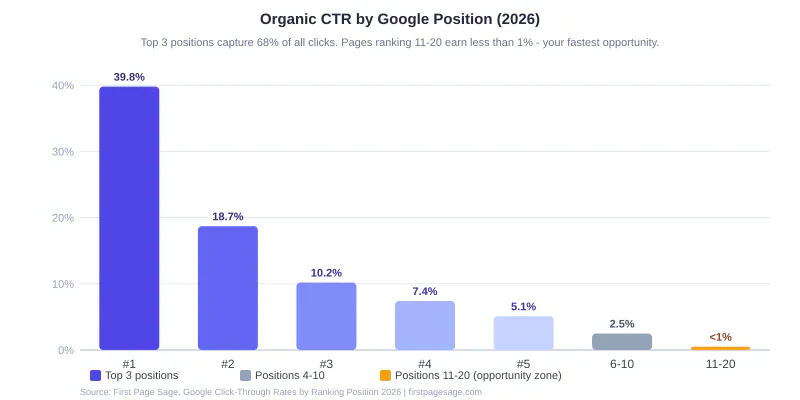
Source: First Page Sage, Google Click-Through Rates by Ranking Position 2026
A page moving from position 14 to position 4 on a 500-search-per-month B2B keyword can represent 30 to 50 additional organic visits per month. For a B2B SaaS site where one demo request comes from every 20 organic visitors, that single page fix adds one to two new pipeline opportunities per month, with no new articles required.
Why Being Cited in a Google AI Overview Beats Ranking at Position 1
Quick SEO wins for B2B SaaS now require AI Overview citability, not just page 1 rankings. For a B2B SaaS marketing team watching their page 1 rankings produce fewer and fewer clicks each quarter, the cause is not a ranking drop, it is AI Overviews appearing above their results.
| “Organic CTR for Google position #1 dropped 32% following AI Overview expansion from 28% down to 19% for the same keywords.”Source: GrowthSRC, Google Organic CTR Study of 200,000 Keywords – growthsrc.com/google-organic-ctr-study/ |
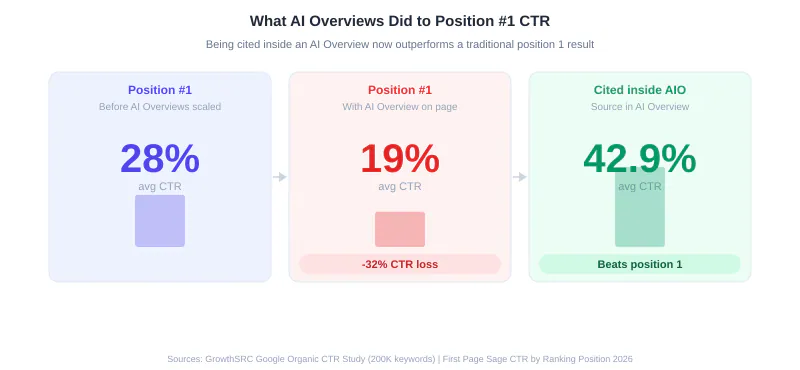
But getting cited inside an AI Overview delivers click-through rates that exceed traditional position 1, according to First Page Sage’s 2026 CTR analysis. The fastest path to real traffic in 2026 is not moving to page 1. It is making your existing pages extractable by AI systems. Understanding how to rank on AI Overview is the difference between a quick win that shows up in impressions and one that shows up in demo requests.
The structural change that makes H2 openings AIO-citable
AI systems extract content written in plain, declarative sentences that directly answer a stated question. For each published page, rewrite every H2 opening with one sentence under 20 words that directly answers the section heading, contains your primary keyword, and makes a specific claim with no hedge words. Follow it with one sentence addressing your specific ICP reader’s exact situation.
Why this edit counts as a quick win
This edit applies to published content only. No new articles, no keyword research phase, no new content briefs required. A focused two-hour sprint across your top 15 published pages immediately improves AIO citability across every section. Paired with the page 2 content revamp above, it creates a compounding effect: ranking improves from added content depth, while citation probability improves from structural rewrites.
| If your team is publishing new articles while existing page 2 pages sit unedited and H2 openings are structured for human readability rather than AI extraction, the organic traffic gap widens every quarter. Talk to ThirdMeta about a structured quick win audit.- thirdmeta.in |
Internal Links: The Ranking Signal Already Inside Your Published Content
Internal links move rankings without requiring a single new backlink or piece of content. PageRank, which Google confirms as an active ranking signal, flows through internal links and redistributes domain authority from high-traffic informational pages to your commercial and conversion pages that need it most.
Most B2B SaaS content teams treat internal links as a user experience feature rather than a ranking mechanism. In our SEO sprint work with B2B SaaS clients, a site with 40 published posts typically surfaces 20 to 30 internal linking opportunities in a two-hour audit, all generating zero PageRank flow to the most commercially important pages.
The three-step process:
First, list your three to five most commercially important pages – typically product pages, use-case pages, and B2B SaaS lead generation landing pages.
Second, run site:yourdomain.com [topic keyword] in Google to surface every existing post covering an adjacent topic.
Third, add one to two contextual internal links per post with anchor text that describes the destination page’s specific topic rather than generic phrases.
Running internal link analysis alongside B2B SaaS link building strategies ensures no domain authority is lost between the posts you earn externally and the pages that convert organic visitors into demo requests.
The 3-Step Title Tag Fix That Improves CTR Without Touching Your Content
CTR fixes are the fastest way to improve lead volume from existing rankings, without changing a word of page content. A page at position 4 with a 2% CTR generates six times fewer clicks than the same page at position 4 with a 12% CTR, the ranking is identical, the lead volume is not.
For a B2B SaaS marketing manager looking at 15 pages averaging below 2% CTR in Google Search Console, the problem is the title tag, not the keyword placement or content quality.
- In Google Search Console, sort the Performance report by impressions and filter for pages with below-average CTR. These are your highest-opportunity pages.
- Rewrite each title tag to front-load the primary keyword, add a specific outcome or audience signal (for example: “For B2B SaaS Teams” or “[2026 Guide]”), and cut to under 60 characters.
- Run the same audit on meta descriptions. Rewrite to state the specific benefit of clicking, not a summary of what the article contains.
For PAA integration: Google your primary keyword, note the exact phrasing of the four most relevant People Also Ask questions, and add a FAQ section using those exact phrasings as headings. Each answer should restate the question in the first sentence, then answer it directly in two sentences. This simultaneously captures featured snippets, improves AI Overview citability, and strengthens the page’s overall keyword coverage for B2B SEO.
What Happens When B2B Teams Execute Quick Wins Without Fixing the Foundation First
Quick SEO wins fail to compound when three structural issues remain unfixed beneath them. For a B2B SaaS team that has invested two months in quick wins, these are the patterns that explain a flatline in organic traffic by week eight.
Broken links stop PageRank flow at the break point
A broken internal or outbound link halts authority distribution at that exact point in the link graph. A site with 15 broken links redistributes zero PageRank through those routes while the internal linking sprint runs in parallel. Use Google Search Console’s Coverage report or a free crawler to identify and fix broken links before beginning the internal linking sprint. For most B2B SaaS sites, this takes under 90 minutes.
Thin pages divide ranking authority across two weaker results
Two pages targeting the same keyword intent divide ranking potential rather than concentrating it. The outcome is both pages stalled at positions 9 and 13 instead of one page at position 3. Consolidate pages covering identical intent into one detailed page and 301-redirect the thinner version. Pairing this with SEO automation for B2B SaaS makes content cannibalization identification repeatable as the site scales.
Missing schema reduces AI Overview extraction regardless of content quality
FAQ schema, How-To schema, and Article schema tell Google’s AI systems exactly what type of content each section contains. Pages without schema are structurally less legible to AI extraction. Adding JSON-LD schema to your top 10 pages takes under an hour with a basic schema generator and directly improves AIO citability.
The B2B SaaS teams where quick wins compound past the 90-day mark treated structural hygiene as the sprint’s first phase, not its afterthought. A B2B content marketing strategy that commissions new articles before fixing these three issues extends the timeline to pipeline impact by months.
Why B2B SaaS Teams Work with ThirdMeta for Their SEO Sprint
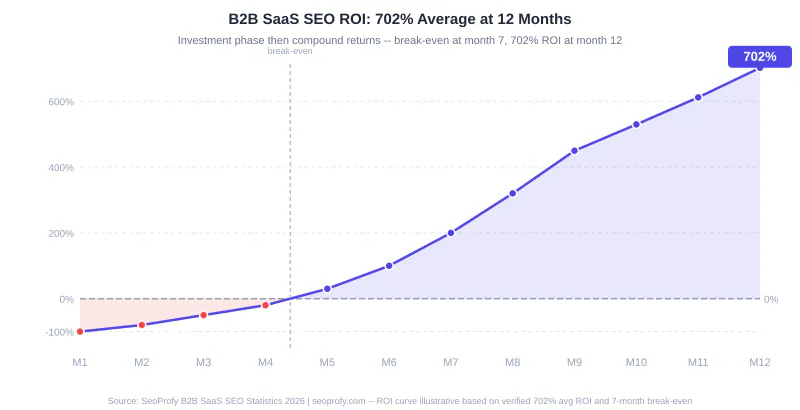
B2B SaaS SEO delivers an average ROI of 702%, according to SeoProfy’s B2B SaaS SEO research, with a break-even at seven months. The return is not in question. The variable is the execution sequence that captures it most teams spend the first three months briefing new content while 15 existing pages sit unrevamped on page 2.
| “71% of B2B researchers begin their buying journey with a generic search before they know which vendor they will contact.”Source: SEO Sherpa |
ThirdMeta runs structured SEO sprints for B2B SaaS companies that prioritise recovery before creation:
- Page 2 content identified, audited, and revamped within the first two weeks
- Internal link maps built and deployed across the full published content inventory
- H2 openings rewritten for AIO extraction across the top 20 published pages
- Title tags rewritten against live Google Search Console CTR data, not assumptions
- Technical issues including broken links, thin pages, and schema gaps resolved before new content is commissioned
Most B2B SaaS clients working with ThirdMeta see measurable GSC movement within 30 days, with the first demo-attributed pipeline from organic appearing within 90 days.
| If your Google Search Console shows more than 10 pages sitting in positions 11-20, that traffic has already been earned. The question is only whether your team captures it before a competitor’s next content update does. Book a 30-minute SEO sprint diagnostic with ThirdMeta.thirdmeta.in The session maps exactly which pages to revamp first and which structural issues are cancelling existing gains. No commitment required. |
Conclusion
Quick SEO wins are not a shortcut around foundational B2B SEO work. They are the correct starting point for any SaaS team with a content inventory, because the fastest path to organic pipeline is capturing what published content has already earned the right to receive. A site with 40 posts and 12 pages in positions 11-20 holds a 90-day traffic recovery opportunity that most teams pass over in favour of new content briefs.
The sequencing determines whether quick wins compound or plateau: structural hygiene first, then internal link redistribution, then title tag and CTR fixes, then page 2 content revamps with AIO-structured openings. Each step feeds the next. The compounding begins in week one.
FAQs
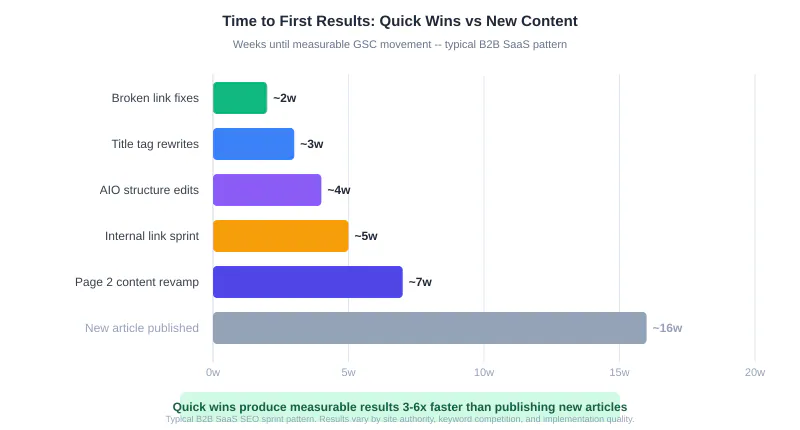
Title tag rewrites and internal link additions are the fastest quick SEO wins. Both apply to existing content and require no new writing. Most B2B SaaS sites see measurable CTR and ranking changes within two to four weeks.
Most quick SEO wins show measurable GSC changes within three to six weeks. Page 2 content revamps produce the fastest ranking movement. Internal link changes take slightly longer as Googlebot recrawls updated pages.
Quick SEO wins work particularly well for B2B SaaS because keyword volumes are smaller and conversion intent is higher. A page jumping to position 4 can add 20 to 40 demo requests per quarter on a single keyword.
Quick SEO wins target existing content for faster results within weeks. A long-term SEO strategy builds domain authority and topical coverage over months. Quick wins generate early pipeline while foundational work runs in parallel.

Isha Chaudhari is a content strategist specialising in B2B technology and enterprise software. She writes on AI, finance automation, and the operational challenges facing modern business teams. Her work focuses on making complex technology decisions accessible to the people who have to act on them.